Making a Difference


CGIAR IMPACT AREAS:
Poverty reduction, livelihoods and jobs
Nutrition, health and food security
This blog post is part of a special monthly series entitled “Making a Difference,” documenting the impact of IFPRI's projects and initiatives. These stories reflect the wide breadth of the Institute's research, communications, and capacity-strengthening activities around the world, in fulfillment of its mission. The blog series has been peer-reviewed by IFPRI's Impact Committee members.


This review of research outcomes was written by Tamsin Zandstra, Research Analyst, Director General's Office, IFPRI; Sam Benin, Senior Research Fellow, Development Strategies and Governance Unit, IFPRI; and Seth Asante, Senior Research Officer, Development Strategies and Governance Unit, IFPRI.
Photo Credits: Petrut Calinescu / Panos Pictures; Shared Interest / Flickr.
About IFPRI The International Food Policy Research Institute (IFPRI), a research center of CGIAR, provides research-based policy solutions to sustainably reduce poverty and end hunger and malnutrition in low- and middle-income countries. IFPRI was established in 1975 to identify and analyze alternative national and international strategies and policies for meeting the food needs of the developing world, with particular emphasis on low-income countries and on the poorer groups in those countries. Partnerships, communications, capacity strengthening, and data and knowledge management are essential components for translating IFPRI’s research to action and impact. The Institute’s regional and country programs play a critical role in responding to demand for food policy research and in delivering holistic support to country-led development. IFPRI collaborates with partners around the world.
Back to top
IFPRI is reaching the lives of millions of people through its contribution to policies and programs that reduce poverty, hunger, and malnutrition. This blog series highlights how IFPRI’s research is contributing to policy decisions and investments made by governments, development organizations, and other partners, and making a difference for food and nutrition security in developing countries around the world.
View More blog posts


As of 2012,
89 Agricultural Mechanization Services Centers
(AMSECs) had been established in 55 districts, and
449 tractors
were distributed.
To transform the country’s agricultural sector to meet the challenges of economic and population growth, in 2007 the Ghanaian government established the Medium-Term Agricultural Investment Plan (METASIP) and the Accelerated Agricultural Modernization Policy. The mechanization program was one of four programs introduced under this framework (others covered fertilizer, block farms, and marketing). Implemented in two phases, it subsidized agricultural machinery and services to farmers through the establishment of Agricultural Mechanization Services Centers (AMSECs). AMSECs are private companies, some owned by individual farmers or associations, that receive farm machinery and equipment—including tractors, ploughs, planters, boom sprayers, pumps, and combine harvesters—at subsidized prices from the government. In turn, they offer tractor hire services to small-scale farmers across the country. A concerted effort was made to use tractors appropriate for local farming conditions.
�On average, each AMSEC is given a machinery package of five tractors and matching implements, based on the expectation that they can service about 500 small-scale farmers with average landholdings of two hectares each in one season. In the first phase (2007-2015), 89 AMSECs (made up of 81 private companies and eight district assemblies) were established, and 449 tractors were distributed to them. In the second phase (2016-2023), an additional 114 AMSECs (79 private companies and 35 district assemblies) were established, and 882 tractors were distributed to them and other individuals. Overall, 626 farmers have benefited, including 26 women (based on recent data obtained from the Agricultural Engineering Services Directorate (AESD) of the Ministry of Food and Agriculture (MOFA), Ghana).�
How farmers in Ghana benefit from the Agricultural Mechanization Services Enterprise Centers Program
Government efforts to make machinery available to farmers
Following the implementation of the programs, the Ghanaian government, via MOFA, asked IFPRI to undertake a series of assessments on the impact of the AMSECs on mechanization, production, and profit, as well as to understand the program’s sustainability and any challenges it faced. IFPRI gathered information through three surveys during the first phase of the program and one during the second phase, and produced several studies based on the results that contributed to reforming implementation in the second phase. �
IFPRI assessments�
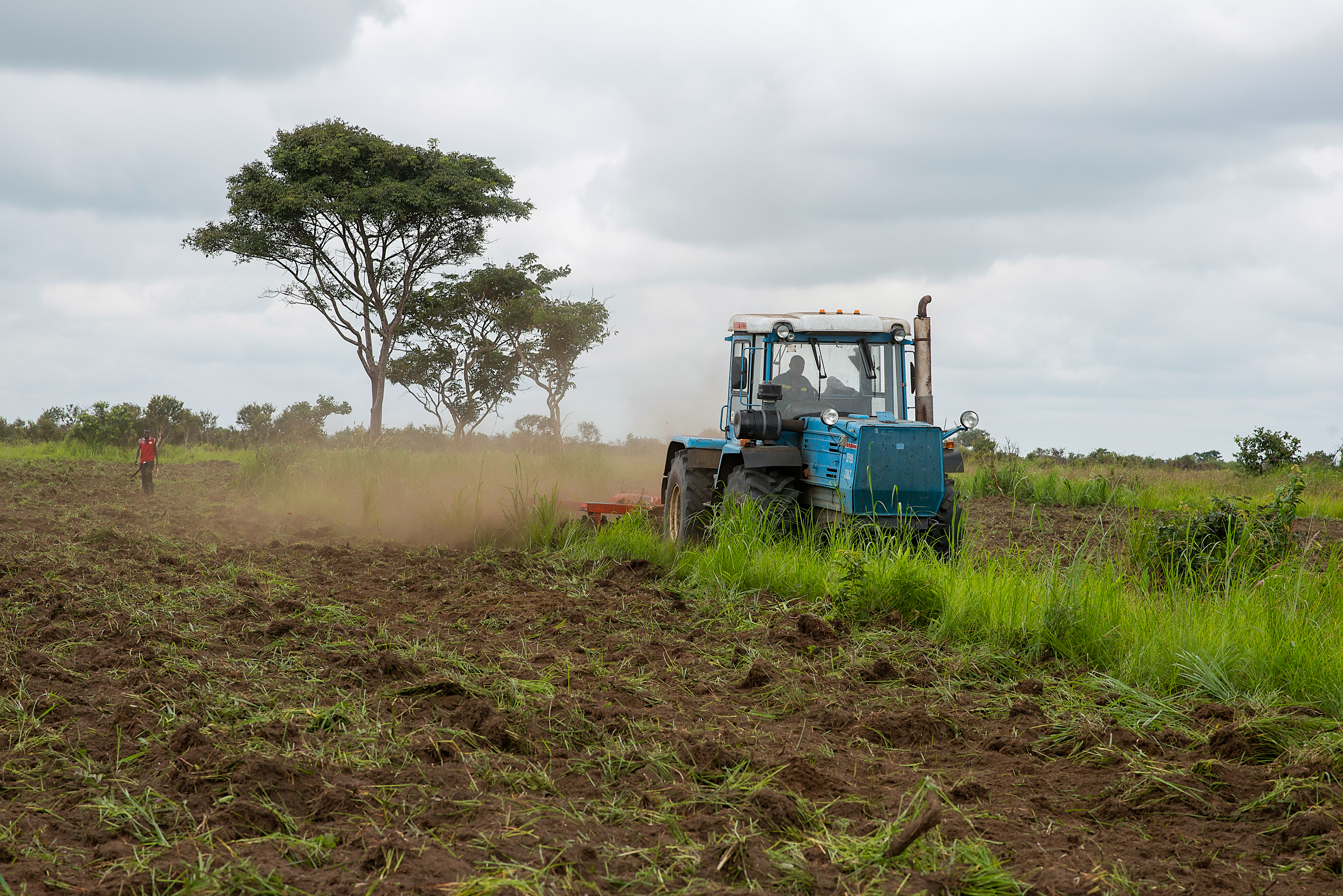
Africa’s agricultural sector, particularly south of the Sahara, has enormous potential to provide jobs and food for a growing population—contributing to food security, economic growth, and poverty reduction. But none of this will happen on its own; realizing this promise requires robust, sustained investment into the sector.
�At the same time, the sector faces growing stresses as demographic shifts put rising pressure on Africa’s farming systems to produce more food with less labor. The continent’s population continues to grow, with larger numbers of people having migrated to cities in recent years, in search of new opportunities, typically in non-farm work.
�Ghana is a case in point for these Africa-wide trends. Between 2000 and 2023, for example, data from the World Development Indicators show that Ghana’s annual population growth rate (2.4%) was twice the global average (1.2%). Ghana’s urbanization rate (1.1%) was also greater than the average for the world (0.9%), with almost half (47.8%) of the increase taking place in two of the country’s ten regions, Greater Accra and Ashanti.
�To tackle this challenge, farmers across Africa have turned to increased mechanization—an approach with many advantages. Higer quality and greater quantities of agricultural machinery can help farmers run operations more efficiently, lightening the drudgery of farm work and allowing more time for some to pursue off-farm income generation.
�Here we focus on Ghana’s mechanization program—and how IFPRI’s work assessing its impacts and progress, and in shaping reforms, has helped farmers reduce drudgery and improve efficiency and yields.�

Survey 1
Survey 2
Survey 3
Survey 4
Survey 1 (2011)
IFPRI—in collaboration with the Ghana Institute of Management and Public Administration and the Department of Agricultural Engineering of the Ho Polytechnic (now Ho Technical University)—conducted agricultural mechanization surveys of 270 farmers, some in areas served by the AMSEC program, others elsewhere. Also surveyed were 48 AMSECs and 88 other providers of mechanization services (or non-AMSECs). The assessment, using treatment effects and matching methods, found that between 2007 and 2011, the intervention had impacts on improving overall availability of mechanization services, reducing drudgery, and increasing yields. Comparing farmers in the areas serviced by an AMSEC vs. those in areas serviced by other providers, 30%–41% more of the first group reported an improvement in the overall availability of mechanization services, 27%–30% more reported reduced drudgery, and 21%–24% more reported increased yields. (The ranges represent the low-high end values associated with different definitions of treatment and matching algorithms for robustness checks.)
Survey 2 (2012)
IFPRI, this time in collaboration with the MOFA AESD, interviewed various stakeholders along agricultural machinery supply chains and service beneficiaries. The aim was to add to the data from Survey 1 to assess the AMSEC program’s sustainability as a business model for promoting private sector-led agricultural mechanization. The assessment revealed a problem: Tractors were being used below the threshold level for a profitable investment. This low-capacity utilization was due to frequent machine breakdowns, exacerbated by a combination of poor maintenance, lack of skilled operators, and weak operator incentives—resulting in low profits for AMSECs and high default rates on the loan repayments to the government of Ghana. These issues were corroborated in a project report on the AMSECs’ capabilities by the Japan International Cooperation Agency (JICA). The report recommended several solutions, including:
Promoting more diverse sizes of machinery, including low-cost and smaller tractors.
Providing a more diverse set of tractor attachments (such as planters, boom sprayers, harvesters, shellers and threshers) to meet the various needs of smallholder farmers and expand utilization rates of the tractors.
Offering training and support for machine operation, maintenance, and repairs.
Making AMSECs eligible for government reform mechanization subsidies allowing them to buy and start with a small number of machines and extending those subsidies to a wider array of machines.
Promoting more diverse sizes of machinery, including low-cost and smaller tractors.
Survey 3 (2013)
IFPRI collaborated with the Savannah Agricultural Research Institute on a national survey to assess overall agricultural machinery ownership, patterns of demand for agricultural mechanization, and challenges farmers face. The survey found that 22% of farmers (7% of small-scale farmers) owned at least one tractor. Less than 1% owned any other kind of machinery such as power tillers, planters, and water pumps. Of the tractors owned, 13% were financed and obtained via the government subsidy or the AMSEC program, and a small fraction from a combination of savings, loans, and remittances. The demand for mechanization was high. On the supply side, several challenges existed. For instance, 45% of tractor owners said they could not meet the rental demand for various reasons, including full use at time of request (50%), broken-down tractor or equipment (22%), potential renter being too far away (19%), or other (9%). Thus, it is easy to see the gap that the AMSEC program can fill, especially given the main constraints to mechanization cited, including lack of access to credit (36% of farmers who did not own a tractor), high cost of machinery/attachment (17%), and high cost of credit (15%).
Survey 4 (2018)
With the reforms or Phase II of the AMSEC program underway, IFPRI, now working with the International Maize and Wheat Improvement Center (CIMMYT), undertook a qualitative survey in January and February to assess how the reforms were affecting private sector operators and farmers. The survey involved 40 farmers and 33 tractor owners (18 beneficiaries of the revised program—10 AMSECs and eight non-AMSECs—and 15 non-beneficiaries). At the time of the survey there were an estimated 10,000 tractors operating in Ghana, most imported through the private sector second-hand and owned/operated by individual farmers. This indicates that government-subsidized AMSECs do not seem to be crowding out private sector investment—but overall, questions remain on whether public funding and efforts can be better utilized elsewhere, especially given beneficiaries’ low loan repayment rates. As with the previous surveys, this one identified low-capacity utilization and high frequency of breakdowns of tractors and equipment, as well as low profitability of the investments. The 2018 survey produced several additional recommendations, including reforming the policy to target the whole service market and value chain instead of a select group of service providers; promoting the use of harrowing or second plowing so that mechanization can be more helpful for land productivity improvement; and promoting research and development on reducing the impediments for complementary investments such as irrigation in areas where access to water is challenging.
Impact of Ghana’s Agricultural Mechanization Services Enterprise Centers Program
Impact of Ghana’s Agricultural Mechanization Services Enterprise Centers Program
More recently, between 2016 and 2023, �an additional
114 AMSECs
were established, and
882 more tractors
were distributed.
Between 2007 and 2011, a comparison of farmers in AMSEC-serviced areas with farmers in areas serviced by other mechanization service providers showed that
30%–41% more �of the farmers
in the AMSEC-serviced areas experienced an improvement in overall availability of mechanization services,
27%–30% more
experienced reduced drudgery, and
21%–24% more
reported increased yields.
Low-capacity utilization of the tractors due to a lack of diversity of mechanized operations beyond plowing, shelling, and carting produce and inputs have kept the profits of the service providers low, which may undermine the sustainability of the program.
Applying findings to reform the program
�The government (through MOFA and AESD), used the findings and recommendations from the assessments to reform the program during its second phase. For example, the government diversified machinery imports to include compact tractors that can perform various tasks, and low-cost and smaller tractors and other machinery for small farm operations. These included:
300 Cabrio 50 horsepower compact tractors
1200 power tillers (walking tractors)
300 VARI mini systems
1000 backpack rice reapers
�The government also made a range of tractor attachments available and allowed the AMSECs (which were also diversified in this phase to include private companies, district assemblies, and individuals) to buy and start their businesses with a few machines and government assistance. For example, the government partnered with several organizations, including the JICA, the German Development Agency (GIZ), the Women in the Driving Seat Project, AGRA, and the JAK Foundation, that provided mechanization training programs for tractor operators.
Continuing impacts
�IFPRI’s work on AMSECs in Ghana has had and continues to have significant impacts. Findings about the AMSEC program have shaped the country’s policy and programmatic decisions and thus have the potential to inform how other African governments and their development partners can work together to improve public sector support for agricultural mechanization to help farmers.
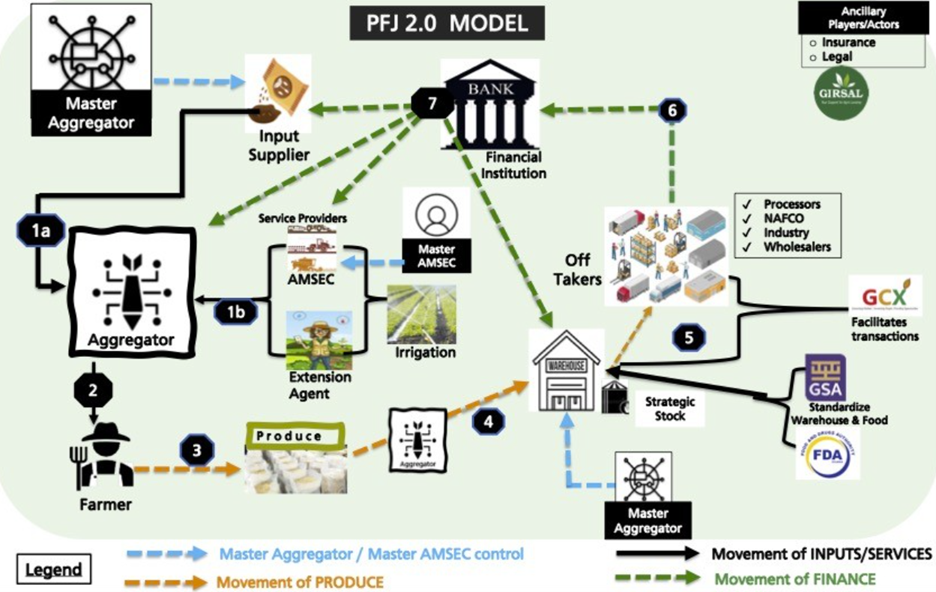
�In recent years, several governments have acquired tractors and other machines through concessional loans from countries including Brazil, China, and India, and provided support to private-sector-run service centers. The experience of implementing AMSECs in Ghana has been useful in guiding other actors navigating through market failures, and even government failures, as they strive to improve the livelihoods of smallholder farmers. The Ghana program’s reforms continue: The AMSEC is now integrated into the new Presidential Initiative on Planting for Food Jobs which aims to boost self-sufficiency, modernize agriculture, stimulate growth for food security and job creation, and promote farming as a noble and profitable business. This is a complex process, in need of ongoing analysis: Eventually, sustaining the gains from reducing drudgery and saving labor in land preparation will depend on how the labor saved is used in successive farming operations and the extent to which those operations are also mechanized.
Continuing impacts
�IFPRI’s work on AMSECs in Ghana has had and continues to have significant impacts. Findings about the AMSEC program have shaped the country’s policy and programmatic decisions and thus have the potential to inform how other African governments and their development partners can work together to improve public sector support for agricultural mechanization to help farmers.
�In recent years, several governments have acquired tractors and other machines through concessional loans from countries including Brazil, China, and India, and provided support to private-sector-run service centers. The experience of implementing AMSECs in Ghana has been useful in guiding other actors navigating through market failures, and even government failures, as they strive to improve the livelihoods of smallholder farmers. The Ghana program’s reforms continue: The AMSEC is now integrated into the new Presidential Initiative on Planting for Food Jobs which aims to boost self-sufficiency, modernize agriculture, stimulate growth for food security and job creation, and promote farming as a noble and profitable business. This is a complex process, in need of ongoing analysis: Eventually, sustaining the gains from reducing drudgery and saving labor in land preparation will depend on how the labor saved is used in successive farming operations and the extent to which those operations are also mechanized.
Changing weather patterns and labor scarcity during peak seasons can cause many challenges when it comes to food security. Mechanization has the enormous potential to help Ghanaian farmers tackle these challenges by increasing their production and productivity. This is why the government is so committed to mechanization programmes such as the AMSECs. The findings from the research conducted by IFPRI and several of our other partners have been instrumental in shaping our policies and programs in this area. For example, in the second phase of the AMSEC program, the government, based on IFPRI’s recommendations, decided to diversify the machinery and equipment being imported. This included introducing compact tractors and equipment which can perform multiple tasks on the farm other than ploughing, as well as low-cost and walking tractors and other machinery better designed for operations on small farms.
– Ing. Patrick O. Aboagye
Deputy Director, Agricultural Engineering Services Directorate of the Ministry of Food and Agriculture, Ghana

Source: Ministry of Food and Agriculture, Government of Ghana