
Making a Difference


Shaping strategies for Rwanda’s agricultural transformation
This blog post is part of a special monthly series entitled “Making a Difference,” documenting the impact of IFPRI's projects and initiatives. These stories reflect the wide breadth of the Institute's research, communications, and capacity-strengthening activities around the world, in fulfillment of its mission. The blog series has been peer-reviewed by IFPRI's Impact Committee members.
Impact at a Glance
The first three phases of Rwanda’s Strategic Plan for Agriculture Transformation (PSTA 1-3) helped the agricultural sector double in value between 2000 and 2016.
CGIAR Impact Areas

Poverty reduction, livelihoods, and jobs
Successes from evidence-informed investments for agriculture-led development.
Rwanda’s Strategic Plans for Agriculture Transformation (PSTAs)
Agricultural transformation—the shift from subsistence-oriented farming to more productive commercial agriculture and agrifood systems—is widely recognized as the primary engine for broader economic development. A successful transformation requires a strategy that balances desired social, economic, and environmental goals within given political, financial, and time constraints. A sound strategy enables stakeholders and sectors to take coordinated action, track progress, and adjust as needed to maximize shared benefits among competing objectives.
�That is why Rwanda made its first Strategic Plan for Agriculture Transformation (PSTA, for Plan stratégique pour la transformation agricole) covering the period from 2005-2008—the first of a series of successful PSTAs supported by IFPRI research that continue today. Since 2007, IFPRI has collaborated with Rwandan government ministries to assess the progress and effectiveness of its agricultural investments, providing key evidence for continued public support of agriculture-led development.�
International Model for Policy Analysis of Agricultural Commodities and Trade
IMPACT
Level: Global
Question: What?
IMPACT is a system of economic, water, and crop models that are linked to climate models and used to explore long-term challenges associated with sustainably, reducing hunger, and poverty. Under various scenarios of changes in climate, population, income, technology, and other factors, IMPACT projects (1) outputs such as agricultural production and demand (for over 50 commodities and 150 countries), trade patterns, and commodity prices and (2) how these outputs will affect various outcomes related to nutrition, land and water use, and greenhouse gas emissions.
Rural Investment and Policy Analysis
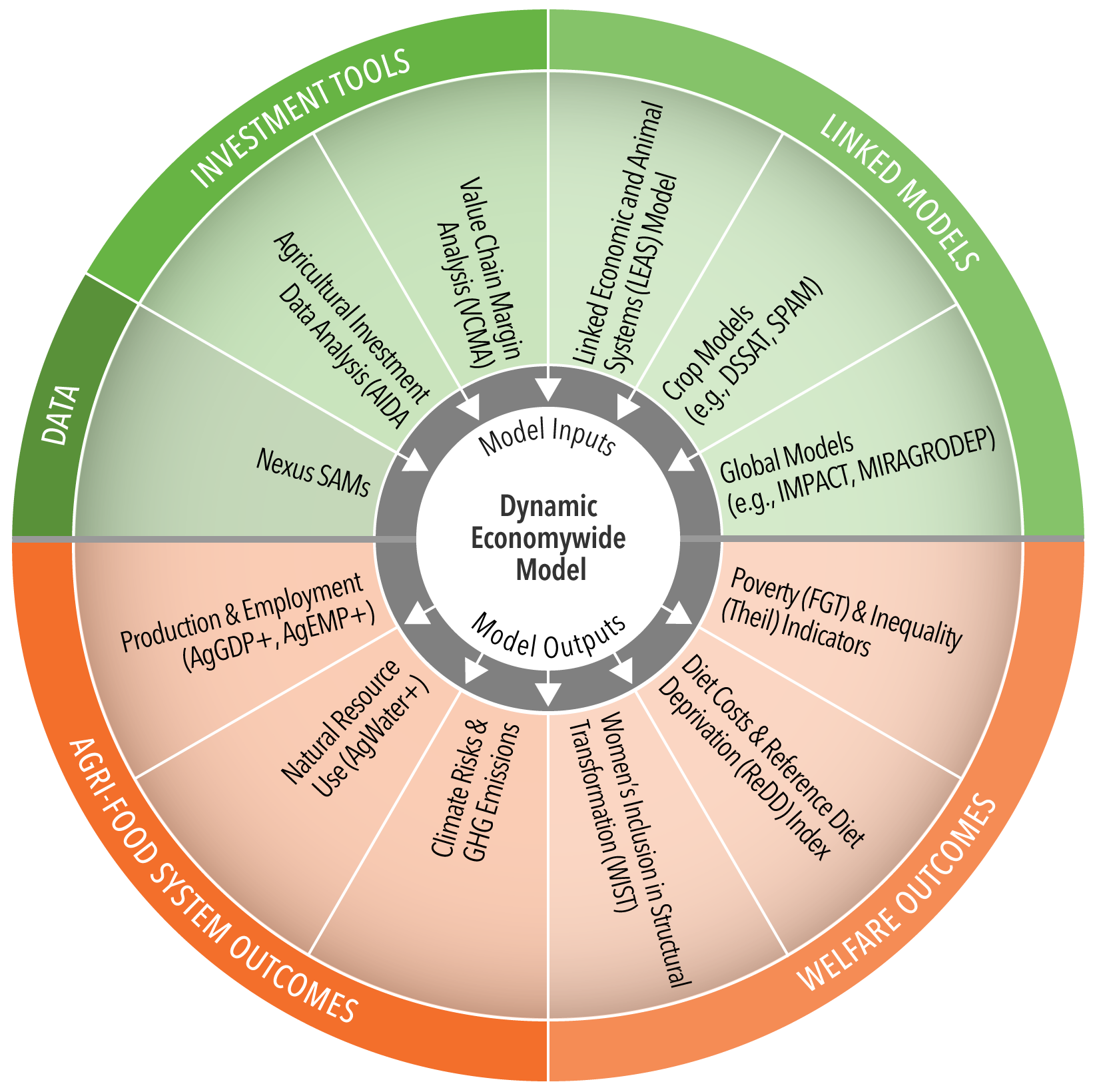
RIAPA serves as a laboratory for simulating the outcomes of country-level policy and investment decisions (e.g., agrifood system growth, employment, household welfare, diet quality). RIAPA helps policymakers understand the trade-offs associated with these decisions and prioritize across policy and investment options given multiple development objectives and resource constraints. To date, RIAPA models are available for around 30 countries, mostly in Africa and Asia.
RIAPA
Level: National�Question: How?
Spatial Production Allocation Model
SPAM uses “coarse” data—from countries, provinces, etc.—to estimate crop production patterns at a finer scale. The result is a global gridscape of over 45 crops which can be downloaded as a dataset. SPAM datasets are available for 2000, 2005, 2010, 2017, and 2020. SPAM provides the “where” for both IMPACT’s “what” and RIAPA’s “how.” To fully understand the trends analyzed by IMPACT, researchers must identify where they take place. To best target policies and investments, policymakers must have a spatial understanding of production.
SPAM
Level: Subnational�Question: Where?
VIEW MORE BLOG POSTS



IFPRI is reaching the lives of millions of people through its contribution to policies and programs that reduce poverty, hunger, and malnutrition. This blog series highlights how IFPRI’s research is contributing to policy decisions and investments made by governments, development organizations, and other partners, and making a difference for food and nutrition security in developing countries around the world.
About IFPRI The International Food Policy Research Institute (IFPRI), a research center of CGIAR, provides research-based policy solutions to sustainably reduce poverty and end hunger and malnutrition in low- and middle-income countries. IFPRI was established in 1975 to identify and analyze alternative national and international strategies and policies for meeting the food needs of the developing world, with particular emphasis on low-income countries and on the poorer groups in those countries. Partnerships, communications, capacity strengthening, and data and knowledge management are essential components for translating IFPRI’s research to action and impact. The Institute’s regional and country programs play a critical role in responding to demand for food policy research and in delivering holistic support to country-led development. IFPRI collaborates with partners around the world.
This review of research outcomes was written by Maria DiGiovanni, Research Analyst, Director General’s Office, IFPRI; James Warner, Program Leader, Rwanda Strategy Support Program, IFPRI; and Serge Mugabo, Senior Research Associate, Rwanda Strategy Support Program, IFPRI.






BACK TO TOP



IFPRI’s mid-term assessment of PSTA 4 found that every dollar of public expenditure spent on agriculture resulted in a $2.05 gain in national GDP.

Guided by IFPRI’s research, Rwanda has depicted how USD $5.1 billion in investments could support agriculture-led development for 2025-2029 in PSTA 5.

Rwanda is a leading country in achieving the continent-wide Comprehensive Africa Agriculture Development Programme (CAADP) Malabo commitments by 2025.

A vision for agricultural transformation
It started with Vision 2020, a long-term plan for Rwanda’s economic and social development developed in a nationwide consultative process. Launched in 2000, Vision 2020 imagined a united, democratic, and inclusive Rwanda—a call motivated by ongoing recovery from the 1994 Rwandan genocide.
�This vision rested on six pillars, including building a “Productive and Market-Oriented Agriculture.” The first PSTA served as an operational guide for implementing the Vision 2020 plan in the agricultural sector. Given that 88.6% of the Rwandan population was then employed in agriculture, the PSTA focused on increasing agricultural productivity. That would have a broad impact on livelihoods and catalyze a structural economic transformation— moving Rwanda toward the goal of becoming a competitive middle-income country.
�Under PSTA 1, the government increased the level of public investment in agriculture from 8.3 billion Rwandan Frances (RWF) in 2002 to 14.7 billion RWF in 2006 ($17.5 million to $26.6 million). The PSTA distributed that investment across four principal programs centered around key priority areas: Sustainable productivity, innovation, inclusive markets, and strengthened institutions.�
Public investment in agriculture (PSTA 1)
8.3
billion Rwandan Frances (RWF)
in 2002
14.7
billion Rwandan Frances (RWF)
in 2006
Filling evidence gaps
Rwanda also joined the African Union’s Comprehensive Africa Agriculture Development Programme (CAADP) in 2007. CAADP was created in 2003 as a continent-wide strategy to help countries boost economic growth. Each CAADP member country is expected to create a National Agricultural Investment Plan (NAIP) to implement shared targets such as an annual agricultural growth rate of 6%. Rwanda integrated the CAADP targets into the PSTA to fulfill this requirement, harmonizing its national goals with broader pan-African development.
�To carry out these plans, Rwandan ministries needed access to sound policy research that could generate evidence to ensure investments efficiently and effectively targeted their priorities. In particular, models can forecast the impact of alternative policies and investment scenarios, making sure that activities with long-term benefits, like R&D, are not neglected in the weighing of costs and benefits. This is where IFPRI came in.
�In 2007, the Rwandan government asked IFPRI to conduct a modeling study to guide its agriculture investment decisions. The study found that the CAADP goal of annual 6% growth in agricultural GDP could be feasible if Rwanda strengthened public investment in agriculture. In 2012, a second IFPRI study calculated the investment required to meet the Vision 2020 goal of halving poverty by 2020. Again, the results pointed to the importance of accelerated agricultural spending. With IFPRI’s input, the second (2009-2012) and third (2013-2017) PSTAs each increased public spending on agriculture.�These investments yielded many of the anticipated returns. Between 2000 and 2016, Rwanda’s GDP grew by an average of 7.9% per year (NISR 2016). Per capita GDP more than doubled from $333 in 2000 to $760 in 2016 (World Bank) while the poverty rate fell from 59% to 38% during the same period (NISR 2018a). �
Much of that socioeconomic progress stemmed from advancements in the agricultural sector, which accounted for one-third of Rwanda’s GDP (NISR 2016). From 2000-2016, the agricultural sector more than doubled in value, with annual growth averaging 5% (NISR 2016). Although primary agriculture represented the majority of agricultural GDP, the value of off-farm activities such as agrifood processing and food service also expanded (Diao et al. 2023). The evidence indicated that, in line with structural transformation, households began to move from farming to other parts of the agrifood system, as well as to non-agricultural sectors with higher labor productivity (Diao et al. 2023).�
Making adjustments
Thus by the time PSTA 4 launched for 2018-2024, Rwanda had made substantial achievements—but still faced challenges. The national prevalence of food insecurity stood at about 19%, while stunting (low height for age) due to chronic malnutrition affected 35% of children (NISR 2018b). By the start of 2020—the concluding year for Vision 2020 goals—Rwanda had fallen short in efforts to reduce the poverty rate by half and to reach its per capita GDP goal of $1,240 (2011 PPP). Then came the COVID-19 pandemic, which led GDP growth to fall below zero (-3%) for the first time since 1994 (World Bank).
�Just before global lockdowns began in spring 2020, IFPRI co-organized a national policy dialogue on PSTA 4 with the Ministry of Agriculture and Animal Resources (MINAGRI) and the Economic Policy Network of Rwanda (EPRN). The Rwandan policy research community expressed the need for more in-depth analysis of public programs to generate evidence on how continuing agricultural investment was facilitating structural transformation. IFPRI was enlisted to conduct a mid-term assessment of PSTA 4 to determine how the plan was contributing to development outcomes and if interventions could be more cost-effective in its second half.
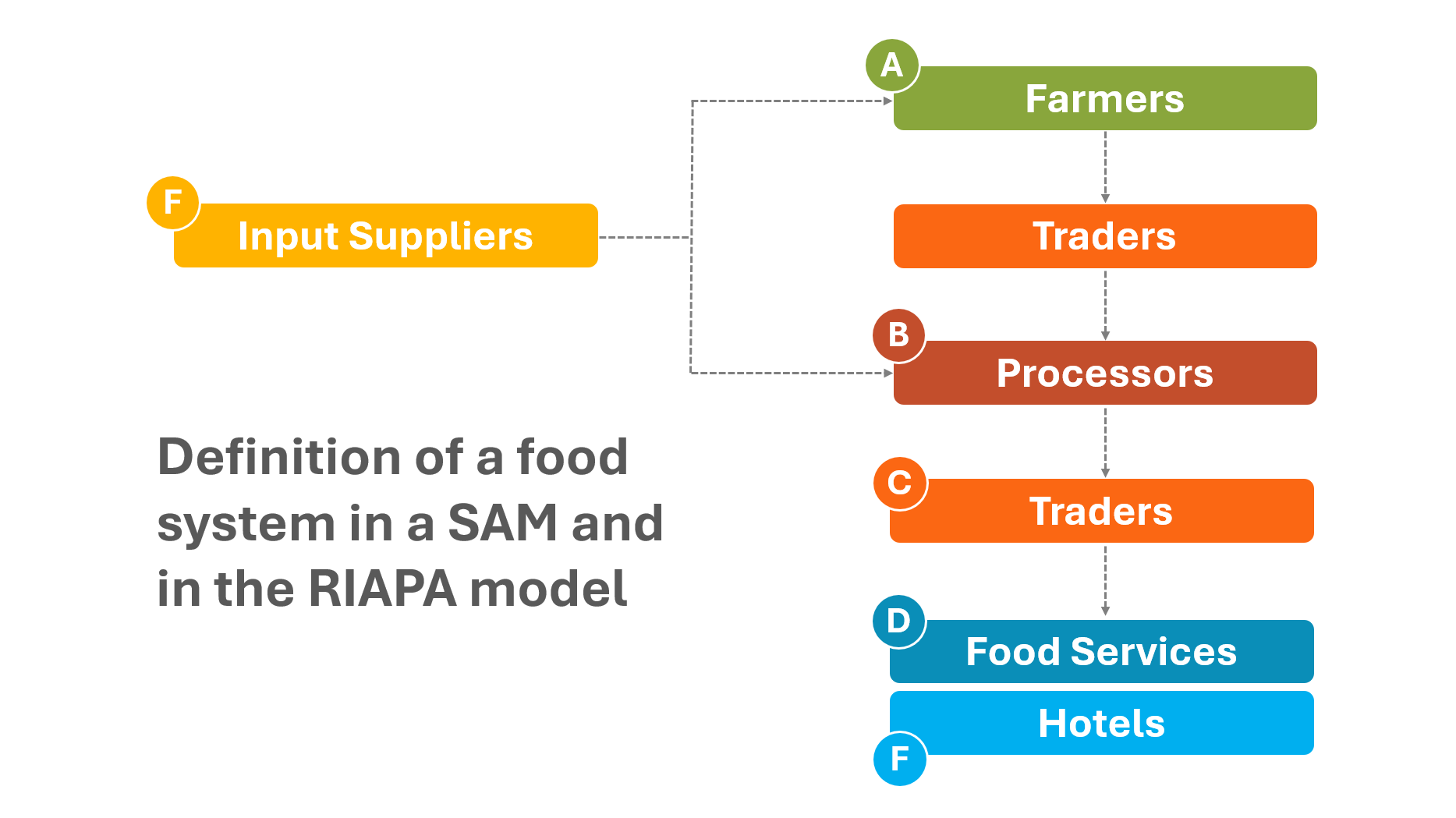
�This assessment used IFPRI’s Rural Investment and Policy Analysis (RIAPA) data and modeling system, a computable general equilibrium model that performs country-level, economywide analysis (see the Making a Difference blog on this and IFPRI's other top models). For each country, the model is calibrated using a country-specific Social Accounting Matrix (SAM), an economywide database. A SAM is constructed from national statistical data to create a disaggregated and comprehensive snapshot of the structure of the economy for a particular year, which helps predict the effect of policy changes and external shocks on socioeconomic systems.�
RIAPA can also link to add-on modules depending on the parameters of the study. For the Rwanda study, IFPRI added the Agricultural Investment Data Analysis (AIDA) module, an investment tool that measures the impacts of alternative public agricultural investment scenarios on multiple development outcomes: Economic growth, job creation, poverty reduction, and diet quality improvement. IFPRI worked with national research institutions—MINAGRI, the Ministry of Finance and Economic Planning (MINECOFIN), and the National Institute of Statistics Rwanda (NISR)—to develop this integrated modeling framework tailored to the Rwandan context.
�Using the Rwanda-specific RIAPA model, SAM database, and AIDA module, IFPRI’s mid-term assessment of PSTA 4 (2018-2021) found that the plan was generally well-structured and cost-effective.�
The current allocation of public expenditures may have generated a $2.05 gain in GDP for every dollar spent.
The accumulated reduction in poverty from total PSTA agricultural investment may have been as high as 1.1 million people (7.7% of the population in 2024) over a period of 10-15 years.
The average rate of yearly GDP growth was 0.6% higher (4.2%) than the average growth rate would have been in the absence of PSTA 4 spending (3.6%).
A modest reallocation of PSTA 4 expenditures could generate an additional $79 million in GDP and reduce poverty by another 103,000 people from 2022 to 2024.
These results demonstrated the importance of continued public investment in agriculture and justified an increase in MINAGRI’s budget, which had been stagnant since PSTA 4 began in 2018. The results were well received by MINAGRI and used to advocate for additional government and donor financial support.
Informing the future
Throughout 2024, MINAGRI consulted with IFPRI and other stakeholders to help develop PSTA 5 (2025-2029). In this iteration of the strategy, Rwanda proposed a more ambitious spending plan and goals, including accelerating agricultural growth to as much as 8% per year. IFPRI conducted another analysis using the RIAPA-AIDA framework and an updated SAM to evaluate which spending trajectories could achieve the targets by 2029.
�In the study, IFPRI modeled several spending scenarios considered during the design of PSTA 5. A baseline PSTA 5 budget was compared with high and modest spending increases. For all key indicators studied—agricultural GDP, poverty, and undernourishment—either the moderate or high spending scenario improved outcomes. However, only the high-spending scenario achieved the targeted agricultural GDP growth rate of 8% and generated the most substantial reductions in poverty and undernourishment.
�In December 2024, MINAGRI launched PSTA 5. As before, PSTA 5 builds on past successes while looking forward to future challenges. The strategy is founded on an agrifood systems approach that strengthens the interconnections between agriculture and other sectors including health, environment, trade, and infrastructure. PSTA 5 also aligns with Africa-wide CAADP goals and Vision 2050, Rwanda’s update to Vision 2020. The $5.11 billion budget is allocated from a combination of public and private investments, underscoring the government’s role in creating an enabling environment for private sector-led innovation and investment in the agricultural sector. In light of recent and increasing global shocks—from climate change-driven extreme weather to the COVID-19 pandemic to food price volatility—PSTA 5 also places improved resilience at the forefront of the strategy.
�
The PSTA 5 official release in March 2025 shows how IFPRI’s research contributed substantially to the development of the plan.
PSTA 5 has an entire section dedicated to IFPRI’s economywide analysis comparing alternative scenarios for public agricultural investment.
PSTA 5 references six IFPRI research products, most studies conducted by the IFPRI Rwanda Office in direct support of Rwanda’s research needs.
The PSTA 5 results framework, a set of indicators to monitor progress, includes IFPRI’s Women’s Empowerment in Agriculture Index (WEAI). �
This extensive use of IFPRI research demonstrates both the Institute’s ongoing commitment to evidence-based policymaking and the Rwandan government’s receptiveness to integrate its research into policy development and decision-making. This comes in part due to the strong relationships built by the IFPRI Rwanda Office in Kigali, which opened in 2019. Now, IFPRI is supporting direct inputs into PSTA 5 programming, such as improving efficiencies of fertilizer subsidies and assessing the role of agricultural infrastructure in commercialization.�
Looking ahead
Through a succession of evidence-based agricultural investment strategies over the past 25 years, Rwanda has demonstrated its commitment to agriculture-led growth and development—and that is leading to country-wide success. In the third CAADP Biennial Review (2021), Rwanda emerged as the only country on track to meet CAADP Malabo commitments by 2025. As of today, Rwanda remains a leading example for African agricultural transformation.
�The work is not done yet. The African Union’s Kampala Declaration set forth updated CAADP commitments for 2026-2035, outlining new objectives for member countries, including Rwanda, to adopt in the decade ahead. Agriculture is still the primary livelihood for 60% of Rwandan households. Agrifood systems transformation remains central to achieving the integrated and inclusive Rwanda imagined at the turn of the millennium. As PSTA 5 is carried out, the optimistic outcomes modeled by IFPRI are feasible—but they depend on a continued commitment to efficient public investment in agriculture and bolstered resilience to shocks, which policy research can help guide. �
Source: Aragie et al. 2023
14.7
billion Rwandan Frances (RWF)
in 2006
8.3
billion Rwandan Frances (RWF)
in 2002
IFPRI is reaching the lives of millions of people through its contribution to policies and programs that reduce poverty, hunger, and malnutrition. This blog series highlights how IFPRI’s research is contributing to policy decisions and investments made by governments, development organizations, and other partners, and making a difference for food and nutrition security in developing countries around the world.
About IFPRI The International Food Policy Research Institute (IFPRI), a research center of CGIAR, provides research-based policy solutions to sustainably reduce poverty and end hunger and malnutrition in low- and middle-income countries. IFPRI was established in 1975 to identify and analyze alternative national and international strategies and policies for meeting the food needs of the developing world, with particular emphasis on low-income countries and on the poorer groups in those countries. Partnerships, communications, capacity strengthening, and data and knowledge management are essential components for translating IFPRI’s research to action and impact. The Institute’s regional and country programs play a critical role in responding to demand for food policy research and in delivering holistic support to country-led development. IFPRI collaborates with partners around the world.


