Making a Difference


Transform Nutrition
West Africa builds knowledge for decision-makers

Impact at a Glance
110+
knowledge products were designed for decision-makers and made freely available.
100+
West African nutrition professionals participated in 4 courses to strengthen their capacity and leadership skills.
400+
West African decision-makers were reached directly through events, webinars, and short courses, gaining knowledge they could directly apply to decision-making.
CGIAR Impact Areas


This blog post is part of a special monthly series entitled “Making a Difference,” documenting the impact of IFPRI's projects and initiatives. These stories reflect the wide breadth of the Institute's research, communications, and capacity-strengthening activities around the world, in fulfillment of its mission. The blog series has been peer-reviewed by IFPRI's Impact Committee members.
West Africa faces significant problems with various forms of malnutrition, especially among women and children. In the mid-2010s, these challenges intensified. In 2017, the region had the highest rate of under-5 wasting (low weight for age) in Africa—8.5% compared with the continent’s mean of 7.4%. Rates of stunting (low height for age) were also extremely high at 31.4%. In 2017, 52% of women aged 15-46 suffered from anemia.
These staggering numbers led to a push from governments and international organizations for solutions.
UNDER-5 WASTING
8.5%
Continental Mean - 7.4%
OF WOMEN (15-46 yrs)
suffered from ANEMIA
52%
UNDER-5 STUNTING
31.4%

In response, IFPRI, with funding from the Gates Foundation, established Transform Nutrition West Africa (TNWA)—a bilingual (French and English) regional knowledge platform to facilitate effective policy and action on maternal, infant, and young child nutrition in West Africa with a focus on four countries: Burkina Faso, Ghana, Nigeria and Senegal. TNWA ran from 2017-2021.
Under the program, in 2017 IFPRI began assessing and analyzing nutrition-relevant data, programs, and policies to build knowledge on the best way forward to address malnutrition problems. This information was then used—in a wide variety of ways, from workshops to publications—to strengthen the enabling environment and inform nutrition-relevant decision-making. Efforts were anchored in the context of West Africa and the four focal countries.
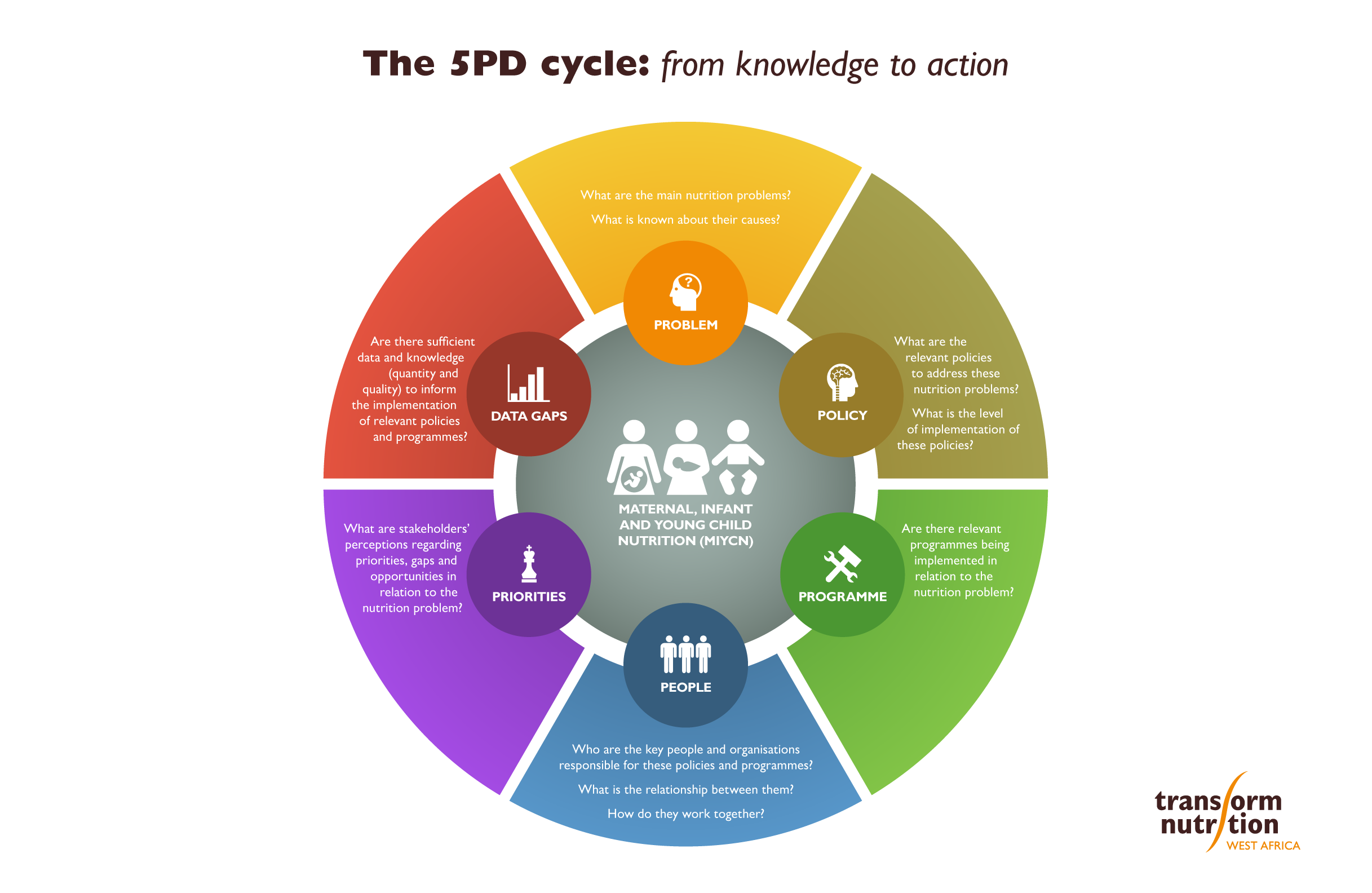
To analyze nutrition challenges, TNWA researchers took a novel holistic 5PD approach that is made up of six interacting domains (problem, policy, program, people, priorities, and data and knowledge gaps). Their efforts were guided by a combination of supply- and demand-driven research, secondary data analysis, evidence synthesis approaches, qualitative analysis, and policy and program reviews. Efforts also considered the priorities of stakeholders (including private foundations, research organizations, governments, and affected populations). Research methods and leadership-building strategies were tailored to respond to these priorities and ensure that objectives were being met.
IFPRI researchers under TNWA carried out research and analysis to inform policy and program decisions. Examples:
Research on World Health Assembly (WHA) targets to guide further primary research. This included an assessment of the existing landscape of peer-reviewed evidence on WHA targets, which allowed for the identification of gaps in evidence for each target to guide decision-makers.
Stories of Change studies in Burkina Faso, Ghana, and Nigeria to increase the understanding of how multisectoral approaches can be successful in addressing specific nutrition problems. TNWA’s study in Ghana examined the differences between approaches to child stunting and anemia reduction and outstanding challenges. The study helped drive increased attention to stunting at the highest level of decision-making by the Ghana Health Service. The government also launched several new interventions, which engaged communities in preventing and controlling child malnutrition—including a micronutrient powder distribution program in northern Ghana that helped reduce anemia and a national iron and folate supplementation program for school-age girls in 2017.
A review of existing nutrition-relevant policies across all West African countries. This information was summarized in country-specific evidence notes and consolidated into a regional report, as well as a guidance note with recommendations for future nutrition policy development. The database was shared with the West African Health Organization’s (WAHO) Nutrition Observatory. Coherence across policy and programs in Burkina Faso and Nigeria was also investigated.
An assessment of the availability of actionable nutrition data for West African countries (for both key nutrition outcomes and coverage indicators), and of countries’ means to use this data to monitor and track progress. Results were summarized in two types of data profiles for each country—on nutrition outcomes and nutrition interventions.


IMPACT
The project’s impact can be seen in the many people reached through training, events, engagement, and partnership efforts as well as its many publications.
Publications
117 knowledge open-access products were designed for decision-makers. These included blog posts, evidence notes, country briefs, country data profiles, policy notes, and peer-reviewed papers. In addition, 10 newsletters providing research digests of recent nutrition-relevant evidence were distributed in both French and English to 615 subscribers. One example of where these products have been influential was the 2019 ECOWAS Forum in Liberia, where IFPRI presented the TNWA adolescent nutrition policy analysis.
An opportunity to appreciate nutrition programming at a subregional level, and to learn/adopt/borrow best practices.”
“
Richmond Aryeetey
Associate Professor, University of Ghana

Three key regional events were organized to engage with stakeholders around key priorities for nutrition policy and programming.
Events

There were 4,877 unique website users, 2,363 X (Twitter) followers, and 63 presentations posted to Slideshare with 928 views. Four hundred West African decision-makers were reached directly through events, webinars, and short courses where they discussed how to use knowledge to inform decision-making.
People Reached
112 West African nutrition professionals participated in four short courses (two given in French and English) to strengthen their capacity and leadership skills. The first focused on the skills needed to lead changes in nutrition and the second on evidence and nutrition-related knowledge for nutrition policy and programming. The courses helped to improve participants’ understanding of TNWA knowledge in decision-making and how to tailor their approaches to local contexts.
Training
There were 19 engagements between TNWA and a range of public and private partners established at the country and regional levels, including seven strategic institutional partnerships and 12 long-term engagements. A regional nutrition network was established through a mix of long-term engagements, short courses, events, outputs, and leadership opportunities for young professionals. TNWA also helped national-level nutrition professionals play important convening roles and build strong links with regional-level key players. One example is the Together for Nutrition: West Africa Data Forum. TNWA brought together stakeholders, resulting in a WAHO-endorsed Call to Action to strengthen the data value chain for nutrition in West Africa and establish a nutrition data ecosystem with strong leadership, consensus on data priorities, and the capacity to gather and analyze data for decision-making.
Engagement and partnerships
“
TNWA has offered us great opportunities to enhance complementarity and synergy and to build strong partnership for scaling up effective interventions.”
Anne-Sophie Le Dain
UNICEF WCARO
Engagement
Over time, the original partnership between the Gates Foundation and IFPRI expanded, adding several more organizations committed to addressing the challenges around maternal, infant, and young child nutrition in West Africa. Memoranda of understanding (MOUs) were signed with UNICEF, Alive & Thrive, and WAHO. A joint action plan was created with Action Against Hunger. Two collaborative partnerships were also established with DataDENT and Countdown to 2030.
“
The partnership between Alive & Thrive, UNICEF, TNWA, and WAHO has had an important impact on nutrition programming in West Africa. These impacts have three main aspects: Capacity building of countries on nutrition data analysis and its interpretation for programs and policies, advocating and mobilizing action around adolescent nutrition, and building momentum and accelerating knowledge of nutrition programs and policies, particularly for breastfeeding. Furthermore, the partnership was successful in using each partner’s unique strengths and in expending resources efficiently to improve health and nutrition outcomes in the region. Going forward, this progress can be maintained through informed dialogue of the evidence base in West Africa and continuous reflection on how to use knowledge generation and partnerships in supporting countries to accelerate improvements in nutrition programs and services.”
Manisha Tharaney
Alive & Thrive
Long-term Impact
While the TNWA project concluded in 2021, its indirect impacts (though difficult to quantify) continue to be felt through its trainings, the skills it cultivated, the use of its tools, and its implemented policy recommendations. TNWA’s benefits continue to be discussed across West Africa’s nutrition community.
�TNWA supported the commitment of governments with evidence for decision-making and created an enabling environment for improving maternal, infant, and young child nutrition. The program strengthened intersectional partnerships and networks and the use of knowledge to accelerate policy and program actions to improve nutrition in the region. These efforts continue to impact how people work today. TNWA left a mark for taking a demand and supply-driven approach toward data and knowledge.
�Looking ahead, TNWA’s work is now a key resource for stakeholders seeking continued progress in moving the maternal, infant and young child nutrition agenda forward in West Africa. This project has also built a foundation that groups beyond West Africa can use to cultivate more effective collaboration on crucial nutrition issues. Knowledge and synthesis reports are readily available to governments and policymakers in all low-and middle-income countries around the world. An available resource bank comprises procedures to follow, the necessary templates, and the relevant resources for producing rapid, high-quality evidence reviews in low- and middle-income country settings. A 5PD Cycle toolkit allows stakeholders to identify and address persistent nutrition problems in diverse national and local contexts. These tools, which played such an important role in synthesizing regional knowledge in West Africa, can be an important international resource for policymakers tackling difficult nutrition and health challenges.�





IFPRI is reaching the lives of millions of people through its contribution to policies and programs that reduce poverty, hunger, and malnutrition. This blog series highlights how IFPRI’s research is contributing to policy decisions and investments made by governments, development organizations, and other partners, and making a difference for food and nutrition security in developing countries around the world.
VIEW MORE BLOG POSTS


About IFPRI The International Food Policy Research Institute (IFPRI), a research center of CGIAR, provides research-based policy solutions to sustainably reduce poverty and end hunger and malnutrition in low- and middle-income countries. IFPRI was established in 1975 to identify and analyze alternative national and international strategies and policies for meeting the food needs of the developing world, with particular emphasis on low-income countries and on the poorer groups in those countries. Partnerships, communications, capacity strengthening, and data and knowledge management are essential components for translating IFPRI’s research to action and impact. The Institute’s regional and country programs play a critical role in responding to demand for food policy research and in delivering holistic support to country-led development. IFPRI collaborates with partners around the world.
This review of research outcomes was written by Tamsin Zandstra, Research Analyst, Director General’s Office, IFPRI; Roos Verstraeten, Scientific Project Officer, European Commission - Joint Research Centre, Italy; formerly Research Coordinator with IFPRI’s West and Central Africa Office in Dakar, Senegal; Ampa Dogui Diatta, Senior Research Analyst, Nutrition, Diets and Health Unit, IFPRI; Loty Diop, Senior Research Analyst, Nutrition, Diets and Health Unit, IFPRI; Mariama Touré, Senior Research Analyst, Nutrition, Diets and Health Unit, IFPRI.
BACK TO TOP
110+
knowledge products were designed for decision-makers and made freely available.
100+
West African nutrition professionals participated in 4 courses to strengthen their capacity and leadership skills.