The shift to digital mobility in the automotive world is being compounded by the rapid introduction of software-defined hardware platforms (SDHP) to accelerate the market introduction of battery-electric vehicles (BEV). Connectivity is an intrinsic part of these SDHP and is key to implementing and keeping updated advanced driver-assistance systems (ADAS) and other safety functions on both BEV and internal-combustion-engine (ICE) vehicles.
The accelerating pace of change in automotive has resulted in shifting priorities and changes in both industry time horizons and expectations. The drive to BEV has made connectivity a focus of attention as software and new vehicle platforms are rushed to market. These same platforms are essential to delivering the increased capabilities of ADAS that enhance safety for both ICE and BEV platforms.
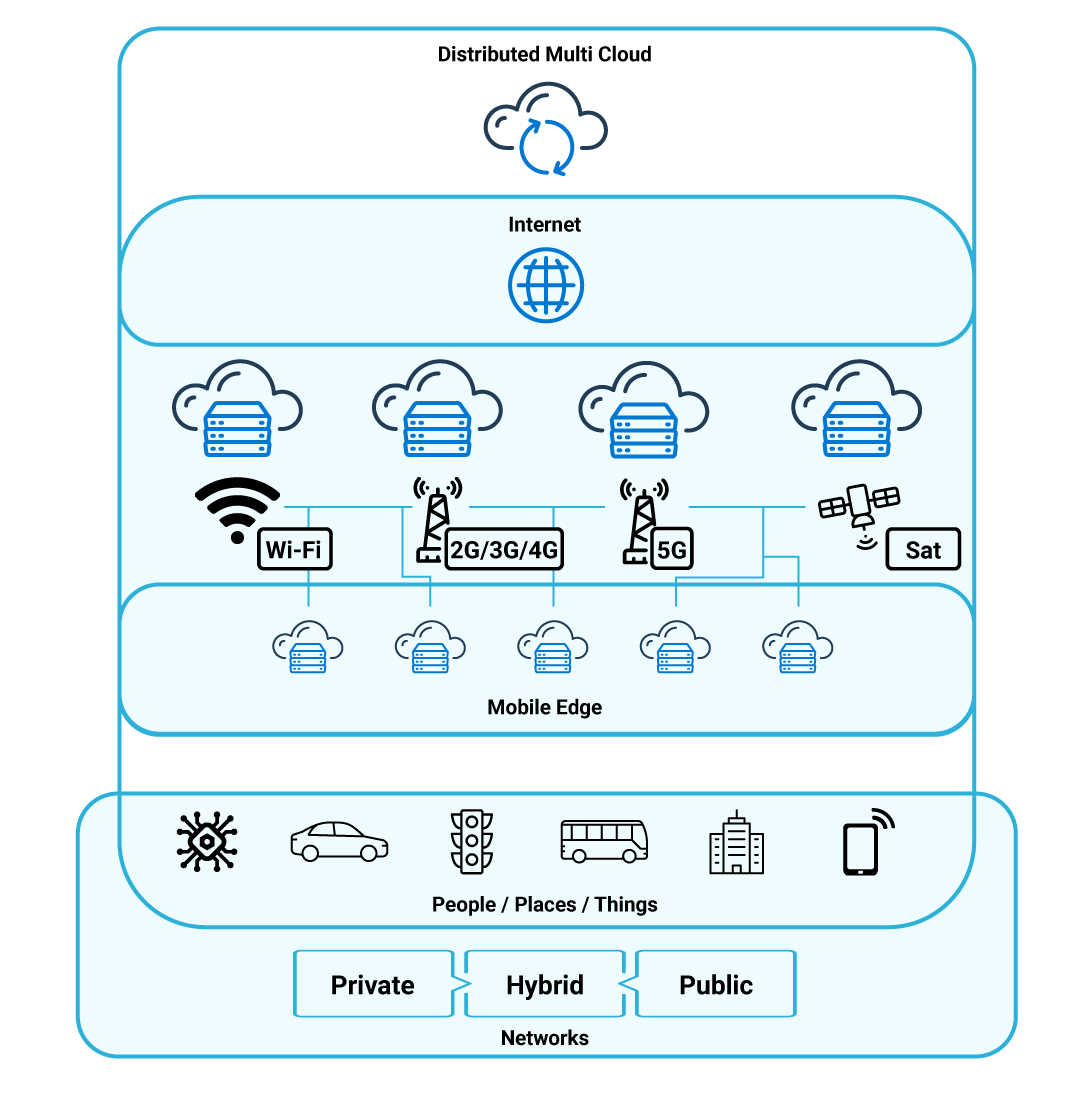
4G has already started to enable an ecosystem comprising autotech providers of solutions and services. 5G cloud native architecture fully enables the cloud-to-car continuum that supports microservices and open integration, bringing scalability and interoperability. This provides better access to the vehicle for more interactive use of the data to optimize performance, enhance security and tailor service to drivers and passengers.
Connectivity within the vehicle is being upgraded to allow faster transfer of vast amounts of data across a network of control units and increasingly high-performance computer systems. The richness of data means access, acquisition, storage and management of the data will be a critical capability and will have a direct impact on quality, performance and feature functionality. Additionally, it will impact the operating cost of the vehicle and the value delivered over the lifetime of the vehicle, as well as new automaker revenue streams.
Game Changing Automotive Priorities Driving New Connectivity Requirements
A Wards Intelligence White Paper Produced for Dell Technologies

sponsored by
Executive Summary

Background and Context

Learn More

Q: When will connectivity be considered a mission-critical safety system?
Globally, there are approximately 300 million connected cars on the road which represents around 19% of all vehicles. In 2023, Wards Intelligence forecasts that around 57 million new connected cars will be shipped which represents 67% of all vehicle sales.
In Europe and other parts of the world, connectivity is now vital to their ability to remain compliant with UNECE’s WP.29 R155 & R156 regulations and the ISO/SAE 21434 standard. These regulations and standards are designed to give manufacturers the flexibility to deliver and maintain software and firmware updates throughout a vehicle’s lifecycle by being compliant with innovative cybersecurity approaches to ensure the safety and security for their customers. It is also the means to connect with customers to deliver enhanced features and immersive experiences over the lifetime of the vehicle. This underpins a new emerging business model where profit no longer is only achieved at the point of sale but also from lifetime revenue streams.
At first sight, these results could reinforce the paradigm of technology-bullish CSPs and conservative automotive industry. The deeper insight is that, because automotive have always and must continue to put safety first, there is concern about the reliability of connectivity to be a mission critical system. The recent sunsetting of 2G and 3G technologies highlights a non-alignment of timelines which has implications in terms of safety. While safety systems were not tied to connectivity in the U.S, the e-Call system in Europe is, and the decisions to sunset network technology with no alternative is an ongoing problem.
Automotive manufacturers know there are benefits of 5G but even as they plan for its introduction into vehicles, they want to know the safety systems and their future business models for vehicles, which have a life of 15 plus years, are not to be put in jeopardy by a rapid shift to 6G in 2030. The telecoms’ model of continuous generations of technology development needs to be cognizant of the automotive industry’s need for guaranteed connectivity and potentially redundant connectivity in a new era of mission critical connectivity.
Connectivity as a Mission-critical Safety System
CSP Understanding of Connectivity and Edge Needs of Automotive Applications
In this survey question we highlighted the diversity of application areas within this broader automotive connectivity universe and probed to see how well they were being understood by the CSPs.
Around 80% of respondents indicate that the wireless carriers have a partial to full understanding of their needs for electric and connected vehicles as well as autonomous vehicles.
Specifically, the percentage of people that think CSPs have full knowledge of CVs and BEVs is the same at 31%. Interestingly, 33% believe CSPs have a full understanding of AV needs while 21% think CSPs have no understanding.
This disparity of perspective is reflected in other application areas as well. Autotech is closely aligned to automotive but is more skeptical of CSP knowledge of needs, with a higher percentage believing CSPs have no knowledge in 4 of the 7 application areas.
There is a requirement for the industry to look at connectivity beyond just the vehicle and with a broader holistic perspective. This reflects recent conversations with automotive senior supply chain and purchasing people who are recognizing that connectivity is fundamental to the company’s operations and are adopting a more strategic procurement and management approach.
It would be a mistake to think of the automotive market as one-dimensional in terms of a connected vehicle served by 4G that shifts over time to an autonomous vehicle requiring 5G. It has already been identified that the automotive industry is going through a metamorphic change in terms of the nature of the product, as well as how vehicles are designed, produced, sold, maintained and used.
Equally, the mobile networks are going through a significant change and not just in terms of cellular technology generation shifts. As terrestrial 4G networks are being upgraded to 5G, the next generation of core networks will also integrate nonterrestrial satellite technology to enable coverage of the 90% of the world not yet covered by cellular. This offers the automotive industry the ability to have ubiquitous coverage and redundant coverage for mission critical systems going forward.
Most initial deployments of 5G have been non-standalone (NSA) which means the new 5G radio access networks were added to existing 4G Evolved Packet Core (EPC). The migration to 5G standalone (SA) is where the 5G new radio uses a new dedicated 5G core network rather than a 4G EPC. This combination enables additional capabilities including ultra-reliable low latency communication (URLLC) and network slicing, which enhance multi-access edge computing (MEC).
5G network slicing is a software-driven network architecture method that allows the creation of multiple virtualized and independent networks to be created on top of a common physical infrastructure. These independent, logical network slices with specific attributes can benefit multiple use cases, such as supporting a high-density factory application, while another might require low latency streaming of highdefinition video and augmented reality (AR).
Top applications where the consumer was considered likely to pay were AV infotainment (40%) and infotainment services (34%). This is in line with current streaming service preferences. Network slicing could offer the possibility of dedicated high-speed and quality-assured delivery which could prove a potentially very attractive offering.
Interestingly, 29% thought consumers would pay for OTA feature upgrades, 42% thought OEMs would pay and 18% thought it would be a combination of both OEMs and consumers.
The Impact of 5G Network Slicing
Who Pays for C-V2X
The great conundrum of the automotive industry in the 21st century is trying to solve the “chicken and egg” dilemma of V2X, specifically who starts first, who pays for what and what is the value add. This challenge has plagued the deployment of V2X and in the U.S. has resulted in the auto industry losing valuable spectrum resources.
The initial technology was DSRC, or in Europe ETSI ITS G5, but in 2017 C-V2X technology was standardized by ETSI 3GPP; it leverages the upper software layers of these initial technologies but utilizes a more efficient cellular-based technology for the radio transmission. The original C-V2X standard was based on 4G LTE, but with the latest 5G standard, 3GPP Release 16, C-V2X will benefit from additional functionalities enabled by ultra-low latency and increased bandwidth which have obvious benefits for automotive applications.
This question was an interesting one. Nearly half the respondents indicated that the OEMs and both levels of government (federal & state/country) should pay for the C-V2X infrastructure. This is intriguing because, given it's taken 20-plus years to get to a point of non-deployment and the only two parties involved in this were the auto industry and government, this indicates the status quo still hasn't been resolved.
Looking at the breakout responses from the auto industry, 53% believe federal and state governments should be paying, while 45 % see it as an OEM responsibility. Only 26% see CSPs and a further 8% see cloud providers paying. 58% of the telecoms agree that federal and state governments should be paying, but the interesting aspect was 50% believe CSPs should be paying. 55% of autotech respondents say the OEMs should pay and 36% believe the CSPs should pay.
Connectivity is increasingly an essential aspect of the automotive industry value proposition rather than just a bought-in service. However, if all the players in the ecosystem do not up their game in terms of understanding in detail the technical capability available, matched to the changing needs of the industry by application area, then the translation of 5G technology capability into benefits will be slow to transpire and will limit its adoption across the industry.
Assessment
The big change in the automotive industry is the transformational shift from ICE to BEVs that has accelerated the adoption of SDV platforms. There's a realization that SDV platforms accelerate work on ADAS and, without this, the industry is unlikely to get to an AV future. The compute inside these SDVs, married with enhanced connectivity, enable the networking of these mobility platforms. By orchestrating SDV capabilities at the edge, it allows delivery of a stream of advanced services.
Additionally, there's a broader aspect in terms of enlightenment about how connectivity can enable more efficient operations along the supply chain through to the dealers. Automotive OEMs are increasingly struggling with how to manage vehicles over their lifetime, which hasn't been part of the business thought process in the past century.
The vehicle itself is not as important as the opportunity behind that vehicle to participate in the overall ecosystem of services, whether it's for e-commerce monetization, being part of a smart grid or supporting transportation and mobility systems as part of a smart city / digital city environment.
Despite years of engagement, the survey points to a relationship between CSPs and OEMs that remains transactional. The survey indicates that the deep knowledge of the current and future applications required to co-create solutions is still limited. This presents an opportunity for CSPs, or other participants in the cloud-to-car-continuum ecosystem, to emerge as strong partners and influencers.
Conclusion
Explore Dell Technologies
Learn more about Dell Technologies solutions
Automotive Hub
Automotive Hub
Register for the Webinar
Register for the Webinar
Download Resources

Download the Full Survey Results
Download the Full Survey Results

Download White Paper
Download White Paper

Download Infographic
Download Infographic
This data is based off of a 2022 Wards Intelligence survey of 163 participants, sponsored by Dell Technologies.

© 2023 Informa USA, Inc., All Rights Reserved | Privacy Policy | Terms of Service
The call to action in this paper is for participants in the autotech ecosystem to wake up to this major shift in the industry and revisit their assumptions. There is a prevailing assumption that the only use case for 5G is autonomous vehicles (AV) and since this need is moving to 2030 and beyond there is no 5G urgency. This assumption is misplaced. The reality is that the digital transformation that is burning through the industry has made software-defined vehicles (SDV) the use case that desperately needs 4G now but will very quickly demand upgraded 5G capability.


The full survey results are available on Wards Intelligence site, but in this white paper we have focused on four topics that could be pivotal in determining the future role and engagement of CSPs with the automotive industry. These are the shift in mindset that considers connectivity as a mission critical system, the degree to which CSPs understand the connectivity and edge needs of automotive applications, the impact of 5G network slicing, and who pays for cellular V2X (C-V2X).
Why is it important to understand these four topics?

163 Industry Respondents
In August we deployed a survey to understand the following areas: the role of connectivity and technology deployments; the influences of technology and service providers; the evolving connectivity business model; cybersecurity risk; 5G applications; C-V2X regional challenges; mobile edge compute in automotive.
This was a detailed survey and required significant knowledge to understand and answer the questions. As can be seen by demographics, we gathered significant responses from both the automotive industry and auto tech companies but less from telecom. Nonetheless the survey provides good insight into on the direction and needs of the industry.
Connectivity Survey
The first focus area is connectivity itself. For many years connectivity has been considered a “nice-to-have” for communication, entertainment and, most recently, location and traffic updates. The introduction of eCall regulations in Europe moved connectivity into the realm of required technology for most manufacturers. The trailblazing introduction of electric SDVs and over-the-air updates by Tesla has moved the needle for the industry and made the existing players recognize that connectivity is at the heart of the vehicle’s technical integrity and ultimately their survival as a modern mobility business. The first question tests this mindset shift.
The second focus area looks at the degree to which the industry and telecoms understand connectivity and edge compute requirements for the various types of applications that are at the heart of the industry’s transformation. The car-to-cloud continuum will be built on this capability and if there is no understanding, then the progress will be hampered.
The third focus area concentrates on network slicing, a unique aspect of 5G, and asks which applications are opportunities to monetize the capability and who will pay. If there is no monetization opportunity, the reality of the technology gaining traction is limited.
The fourth focus topic probes V2X, a pet project of the automotive industry that has failed to launch after 20 years of nurturing. The specific focus is the “chicken and egg” quandary of C-V2X in infrastructure and who should pay for this essential ingredient of an intelligent transport system and most concepts of a smart city.
Connectivity
Understanding
Slicing
V2X
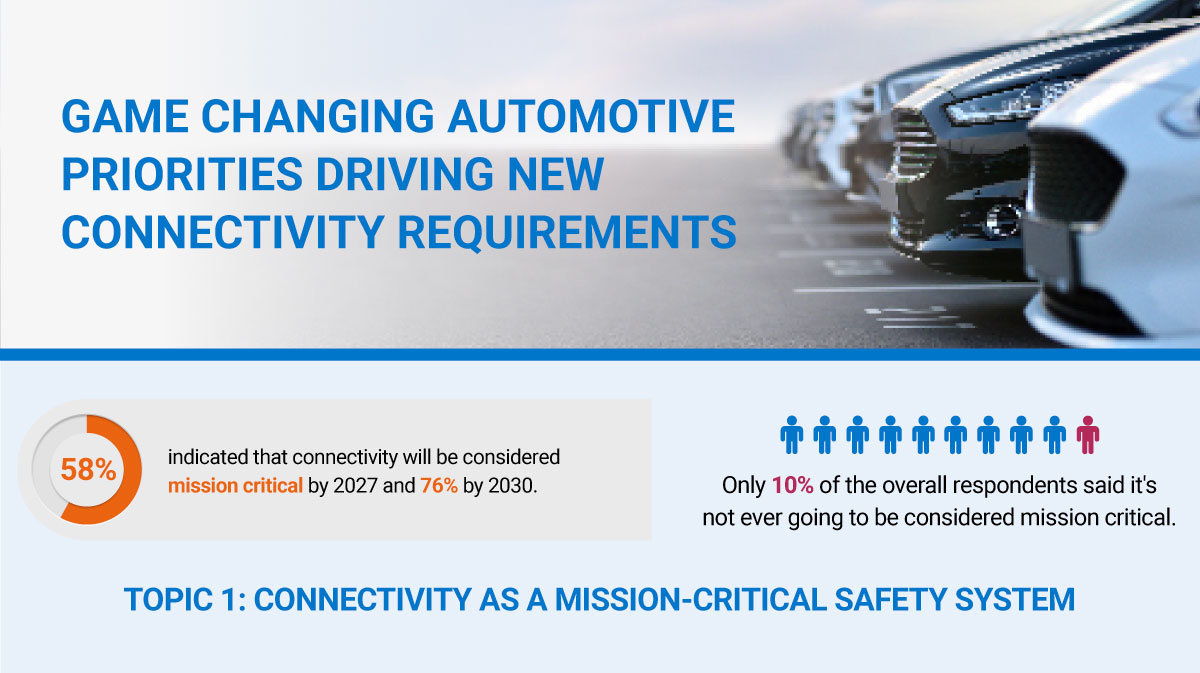
The response we got was that 58% indicated connectivity will be considered mission critical by 2027 and 76% by 2030. Only 10% of the overall respondents said it's not ever going to be considered mission critical.
Looking at the results by auto industry, autotech and telecom, there was a very optimistic response from the telecoms industry with 67% saying connectivity is going to be happening sooner than 2024 and a further 25% by 2027. The automotive industry was more conservative, with only 17% anticipating by 2024 and 32% believing connectivity will happen by 2027. Autotech spans the spectrum with 31% saying it will occur by 2024 and 38% saying it will be by 2027.

Connected Cars at Present 2023 New Vehicle Sales
Connected Cars Others

This global coverage, combined with hybrid private networks, can facilitate worldwide integrated smart manufacturing and supply networks. These smart capabilities are increasingly necessary to cope with diverse supply chains, semiconductor and component shortages, and geopolitical localization pressure. At the same time, they are essential to address the increased complexity and cost of producing both BEV and ICE vehicles.
These Industry 4.0 smart factories enable IT-OT convergence which support end-to-end digital continuity from design to production to vehicle operation. The car-to-cloud continuum eventually will support the creation of a digital twin of every vehicle produced and facilitate tracking of every vehicle from design to start of production (SOP) to end-of-life (EOL).
Q: Do Communication Service Providers understand the connectivity and edge needs of the Automotive OEMs for the following applications?

Connectivity Underpins Autotech & The Future of Automotive
Regarding the other areas (ADAS, dealer programs, global supply chains and factories) the degree to which CSPs are not understanding, or only partially understanding, is significantly increased. Looking at the details, there are some interesting mismatches:100% of the telecom respondents believe CSPs fully or partially understand the needs of both AVs and CVs; 67% believe they fully understand the needs of AVs; whereas only 50% fully understand CVs. This compares to automotive where 21% believe they have no understanding of AVs and 32% believe they have full knowledge.
Regarding factories, 50% of telecoms think they fully understand automotive needs whereas only 18% of automotive think they fully understand and 27% think they have no knowledge.
CSP Understanding of AVs, CVs, and Factories

Working closely with automotive clients to develop deep vertical expertise, CSPs can then customize their 5G SA networks to take advantage of these capabilities and even offer Network-as-a-Service (NaaS). The NaaS model allows CSPs to configure 5G network slices to serve different use cases. For the automotive market, NaaS offers the advantages of faster deployment of new software upgrades, flexible payment for different models and the ability to scale and adjust in hours as the business grows and changes.
It is anticipated that many automotive use cases, such as safety-related features, remote control functions such as remote door opening/closing, and assisted and automated driving features, will require reliable mobile network connectivity. At Mobile World Congress (MWC) 2022 the CAMARA initiative was announced by GSMA. The initiative consists of network operators, technology vendors, cloud providers, OS vendors and application developers, and aims to standardize network Application Programming Interfaces (API) globally. Quality on Demand was the first network API standardized in the CAMARA initiative.
This not just a theoretical set of use cases and propositions. In February 2022, Deutsche Telekom, in cooperation with the BMW Group and Valeo, announced the API were successfully tested for the Automated Valet Parking (AVP) use case and the results were presented. This was followed up on Nov. 28, 2022, when Deutsche Telekom, BMW Group and Valeo worked with Ericsson and Qualcomm Technologies to deliver the world’s first demonstration of an automated driving application supported by 5G Standalone (SA) network slicing, with controlled network features for Quality of Service (QoS) via a Network API that exposed network capabilities.
In the survey we tested whether network slicing, which is touted as a great benefit for 5G SA, will add value and whether consumers are willing to pay for it – or is it just going to be a B2B play?
Q: Do you believe that network slicing will add enough value to the following applications that it can be monetized by charging the consumer, or will additional cost have to be absorbed by the OEM?
What we found was that remote teleoperation / driving was seen by 33% of respondents as the top area for joint payment by OEM and customer. This reinforces the development work BMW has been showcasing with DT. It also shows the diversity of thought as 29% said it should be the consumer who pays while another 29% thought the OEM should pay.
Top applications where the OEM pays were OTA updates (57%) and AV safety applications (56%). This makes sense in terms of ongoing safety, maintenance and warranty on a vehicle.




V2X implementation is finally beginning to occur across the world. China leads the way with the government deciding to roll out C-V2X and support testing on infrastructure pilot projects. In Europe, the regulatory situation is not clear as to which V2X technology will be deployed or if in fact both will be used. From 2025, the Euro NCAP requires V2X to be present in a vehicle for a 5-star rating so we can expect most manufacturers to include one technology or the other. In the U.S. it seems as if C-V2X has become the winner, not least because the FCC-designated spectrum for the technology removed half the previously allocated spectrum.
In this complex situation, as vehicles begin to deploy with one or both communications technologies, the challenge is still to accelerate the deployment of compatible roadside infrastructure to deliver cooperative and collaborative services not only for vehicles but also other vulnerable road users.
So, we posed the question: Who will pay for this necessary roll-out of infrastructure? The premise is that CSPs and cloud providers pushing forward with 5G deployments and cloud to the edge networks presents an opportunity. Through private / public partnerships they could help fund smart city plans and plans for collaborative intelligent transport systems (C-ITS).
Q: C-V2X is a key technology to address safety for ADAS and autonomous vehicles but who should pay for the compute infrastructure on highways and in cities?


In terms of whether connectivity has become mission critical, it is known that safety can be enhanced by linking SDV capability with ADAS. When added to the network effect of C-V2X, this could enable cars to become an active swarm via a network-supported mesh network effect. This in turn permits vulnerable road users and pedestrians to be forewarned of danger through alerts on their smartphones and wearables. From the results, this is still a long way off. The question is: can C-V2X take root and will the investment in infrastructure be made?


5G connectivity, combined with cloud and edge compute and the increasing use of artificial intelligence and machine learning, means the potential applications and use cases in automotive expand significantly. However, the use of network slicing and edge compute to deliver safety and business critical systems is only moderately understood by the industry. This could crucially impact the trajectory of technology adoption and therefore the creation of new business opportunities.

Download White Paper
Download Related Blog Post
Download Related Blog Post

Download the Full Survey Results
Download the Full Survey Results
Download White Paper
Download White Paper
Download White Paper
Learn more about Dell Technologies solutions