Menu Economics: Navigating Food Inflation
Webinar Key Takeaways
02
Key Takeaways
Meet the Speakers
Inflation Will Continue to Impact Food Costs Into 2023
Lowering Cost Should Not Mean Sacrificing Quality
Focus on Operations and Marketing to Make a Difference
View Key Takeaways
Watch the Webinar
Additional Resources
Get Back to Basics
Inflation is Driving Significant Changes to Food Sector Operations
01
03
04
05
Andrew K. Smith, Managing Director, Savory Restaurant Fund
Maryam Chaney, Vice President of Food & Beverage, Savory Management
Moderated by Sam Oches, Editor-in-Chief, Nation's Restaurant News
Featuring:
Sponsored by:
Scott Uehlein, VP Culinary Excellence and Innovation, MOD Pizza
Mike Turner, Sr. VP of Culinary & Supply Chain, Walk-On’s
Nate Weir, VP of Culinary, Modern Restaurant Concepts
Revay Wilson, Sr. Director, Foodservice Marketing, Ventura Foods
Tom Bailey, Senior Consumer Foods Analyst, Rabobank
Since the summer of 2022, food prices have experienced a cataclysmic increase. Per Andrew K. Smith, this has created budgeting challenges for 2023 due to inflation. He believes overall prices are unlikely to return to pre-pandemic levels, though food costs in some categories are softening.
Key Takeaway
Share this page
1
Previous | Next
“We have 52 company restaurants, making us the largest operator of the restaurant brand. So, we are right there next to the franchisee. We know exactly what it takes to run them and what it takes to build them and what the challenges are, be they labor or food or whatever.”
- Scott Deviney, CEO, Chicken Salad Chick
Rising food costs are forcing a rethinking of pricing and processes
“We're looking at our margins and saying, ‘We have to understand the new reality.’ . . . Nobody knows the future. All we can do is say, ‘We think this is what's going to happen in ’23 and we're going to build a plan around it.’”
- Andrew K. Smith, Managing Director, Savory Restaurant Fund
In a webinar poll, attendees shared how they plan to deal with rising food costs:
Recent supply chain and commodity issues have compounded today’s inflation challenges. One way to deal with rising food costs is through scenario planning, detailing every cost and behaviors that might impact ROI. A result of scenario planning may be working to decrease employee turnover, which keeps costs from rising for training, waste, and loss. While events like avian flu or the war in Ukraine cannot be planned for, getting educated on what is going on in the world can help inform planning.
Vice President of Food & Beverage, Savory Management
Maryam Chaney
Maryam Chaney on Current and Future Availability
Watch
Over the last 18 months, Rabobank, the world’s largest food and agriculture bank, has focused on food price inflation. Analysts have observed cost increases at double-digit levels for more than a year. Currently, the U.S. is transitioning from acute to structural inflation. Although inflation appears to be easing, the CPI (consumer price inflation) is still 14.4%, which is higher than in November 2020; PPI (producer price index) remains higher for some food categories and will likely remain high for 6 to 12 more months.
Structural factors that impact costs include climate change, which encompasses increased adverse weather events, and green inflation as energy transitions to more sustainable sources. Bifurcation between the U.S. and its allies, and China and Russia and their allies, has created a more fractious global trade flow, an increase in working capital costs, a shift to a just-in-case model, and continued high labor and energy costs for restaurants, while higher interest rates dampen demand. Over the next few years, the supply chain will be a key strategic pillar for the food industry, from farmers to restaurants. Supply integrity and optimizing costs are crucial to success for restaurants and suppliers. Investments in technology and other methods to streamline operations will be useful.
Rabobank predicts inflation pressures easing in the second half of 2023
2
“While the headlines might make people feel a little bit better, people's wallets are still being pinched.”
- Tom Bailey, Senior Consumer Foods Analyst, Rabobank
Inflation does not affect consumers only in terms of food. It also impacts non-discretionary spending, such as shelter, medical costs, and utilities, all of which have risen significantly. Because of this, consumers are shifting to more value-focused products such as private labels, shopping at discounters, and decreasing pantry stocking. Coupled with the increase in prices is the challenge presented by declining real wages in most sectors. However, the only sector where real wages have grown has been leisure and hospitality. To attract labor, restaurant and leisure industry businesses have had to raise wages.
“Retailers and food service providers are going to outperform other segments to the extent that they can keep prices lower . . . Cost cutting is essential in this environment. Only invest in areas that help you be more efficient [and] have a plan around supply security.”
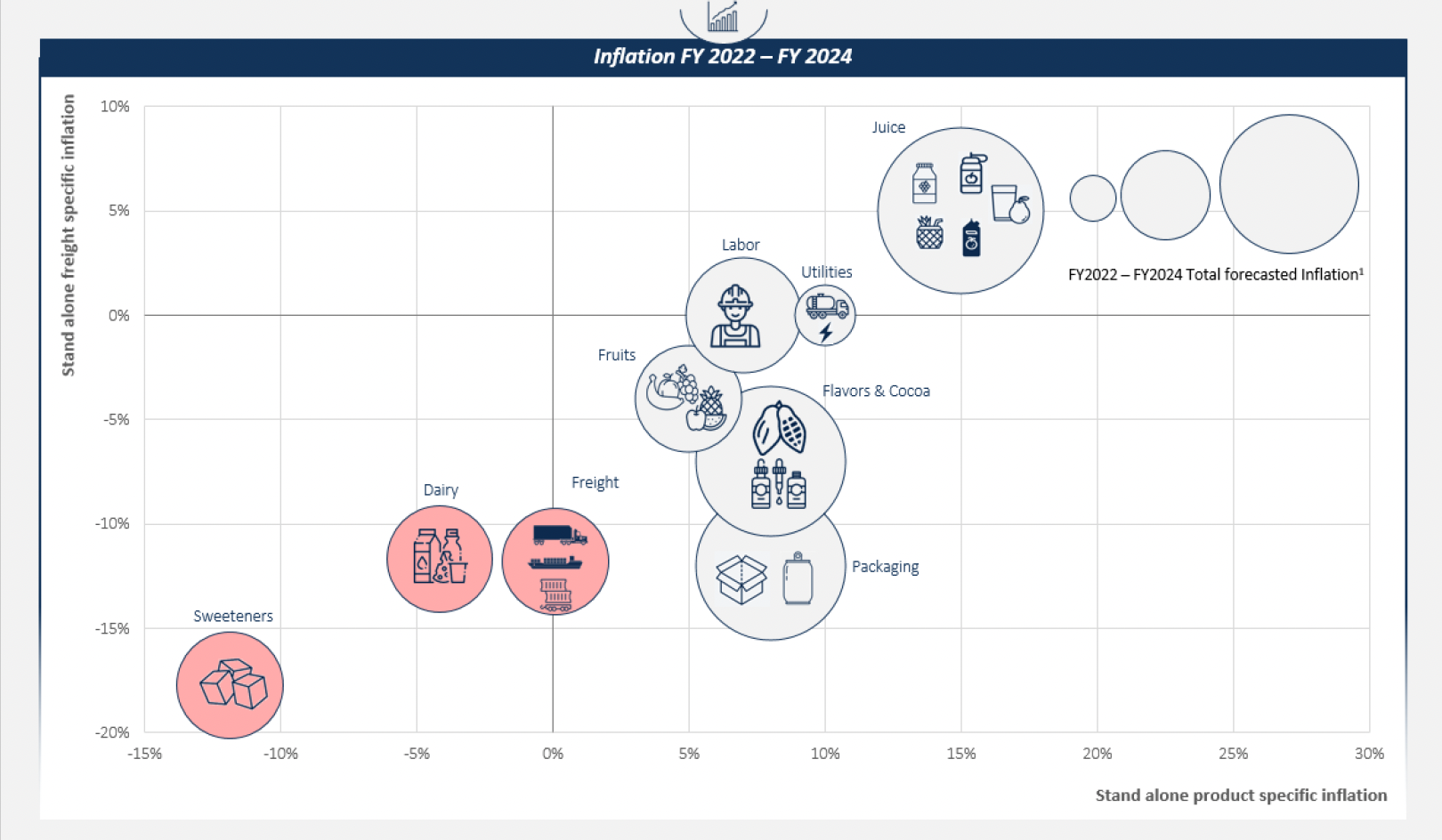
Rabobank estimates inflation of 56% in the food supply chain between 2021 and 2024, the majority of which has already occurred. Rabobank believes 2023 is when the tide will start to turn on inflation and food costs.
Senior Consumer Foods Analyst, Rabobank
Tom Bailey
Tom Bailey on Supply Chain Changes
From an operator perspective, Scott Uehlein recommends leveraging your existing distribution system to find alternative ingredients and testing menu changes—even removing menu items. From the vendor side, Revay Wilson recommends identifying substitutes for high-cost ingredients and leaning on manufacturers to provide samples, ideas, and tips for menu revamping, while supporting menu transitions. Manufacturers are providing increased support in recent years, as labor shortages have had a major impact on distributors.
3
When making menu adjustments, leverage testing and manufacturer assistance
“It’s a fairly reasonable way to get new guests in your restaurant, partly because third-party delivery is bringing them there.”
“Really lean on your manufacturers, because we're likely already doing this work and eager to share it.”
- Revay Wilson, Sr. Director, Foodservice Marketing, Ventura Foods
Especially in a customer-customizable environment such as MOD Pizza, a decision to substitute or remove ingredients is based on robust testing. Testing reveals whether there is low-hanging fruit—high-cost items that can be eliminated or substituted. Testing can prove whether changes offer greater value while maintaining high quality. Listening to customer feedback is critical.
“For us, it's . . . ’Test, test, test.’ . . . And when you make the decision to take something off the deck . . . monitor social media, monitor consumer complaints, and engage with your customers one-to-one.”
- Scott Uehlein, VP Culinary Excellence and Innovation, MOD Pizza
VP Culinary Excellence and Innovation, MOD Pizza
Scott Uehlein
Scott Uehlein on Ingredient Adaptation
Sr. Director, Foodservice Marketing, Ventura Foods
Revay Wilson
Revay Wilson on Testing Ingredient Changes
With a large and diverse menu predominantly made from scratch, Walk-On’s is a high food-cost-to-alcohol-sales business, which gives this operator a unique ability to pivot.
4
Operational changes can offset the effects of rising food costs
“We were never really an LTO-driven company until the last year . . . We think that's a way we can get some incremental additional sales and take pressure off the food cost line as we move into 2023.”
- Mike Turner, Sr. VP of Culinary & Supply Chain, Walk-On’s
“If it's not driving people of some sort to come into your restaurant . . . the costs ultimately don't matter.”
- Nate Weir, VP of Culinary, Modern Restaurant Concepts
Walk-On’s has been creative with manipulating its menu mix through a strong marketing strategy, and addressed the commodity turndown through smart buying and great vendor relationships. Mike Turner recommends “buy smart and be smart,” making sure you can get ingredients and pay for what you should be paying for, but hold buyers accountable for 30- to 45-day terms. Focusing on smart buying and designing of menu items helps you stay within your theoretical food cost threshold. In addition to menu changes, operators are using other ways to bring in more customers and drive revenue. This includes using LTOs, which bring people in and provide an opportunity to test a new recipe. Just as with ingredient substitution and new recipe development, manufacturers often support LTOs. In response to recent inflation challenges, Walk-On’s is reviewing its menu with an eye toward possibly shrinking it and/or shifting prices, as well as pushing some LTOs.
Looking forward, Walk-On’s has three menus in play. This shows the brand’s evolution from a founder-driven menu development approach to a data-driven, 320-day development cycle from ideation to creation to implementation. Evolving the restaurant concept uses the same “Test, test, test” approach as when developing new menu items or substituting ingredients. Considering indirect costs, such as labor, and identifying value-add activities or product solutions to eliminate or reduce those costs can ultimately help profitability. For example, as labor costs increase, some restaurants that make items from scratch might shift some focus to pre-made or frozen ingredients. Technology can also play a role in addressing labor costs, such as using automatic labeling for prepped items rather than marking them by hand. To understand the full cost breakdown of an item, it is key to determine all input costs. However, it’s also important to balance the interplay between good cost, good value, and appeal to consumers to forecast how an item is going to sell.
Sr. VP of Culinary & Supply Chain, Walk-On’s
Mike Turner
Mike Turner on Menu Adaptation
Nate Weir of Modern Restaurant Concepts recommends going back to the basics at the store level, focusing on the blocking and tackling to account for waste and ensure staff understand their role.
5
As part of that work, it is important to have conversations with teams at the store level, to understand what employees are struggling with, what might be taking too much time, and/or what is going to waste due to processes that need to be reevaluated.
Accounting for waste and observing and addressing employee pain points can have a big impact
“Spend a little time on the line and watch what's going on . . . executing line checks, tracking your waste, understanding where your products go, and looking at the delta between your actual and theoretical food costs. These kinds of basic things are hypercritical, and things you can absolutely control in a more macro environment where pressures are hitting our restaurants that we have less control over.”
“We've talked a lot about the voice of the guests here. But sometimes the voice of your team members can be even more important and instructive.”
VP of Culinary, Modern Restaurant Concepts
Nate Weir
Nate Weir on Value-driven Opportunities
Andrew K. Smith
Managing Director, Savory Restaurant Fund
Speakers
Sam Oches - Moderator
Editor-in-Chief, Nation's Restaurant News
Watch the WEbinar
Watch Webinar
You’ve got a cool brand and lineup of crave-worthy dishes customers love, but if you want to scale that success, you need to get ruthless about what’s on your menu. In the fourth session of the Live Learning Series, learn how to assess the value each dish brings to your menu and how to weed out the ones that are dragging you down. Find out how to build a menu that cuts costs, streamlines operations and boosts the overall profitability of your growing business.
WEbinar
SunGlow Cost Savings
Infographic
Previous
Resources
Cut butter costs, keep the benefits. Save 30% or moreby converting your butter toSunGlow European Style Butter Blend
Download Infographic