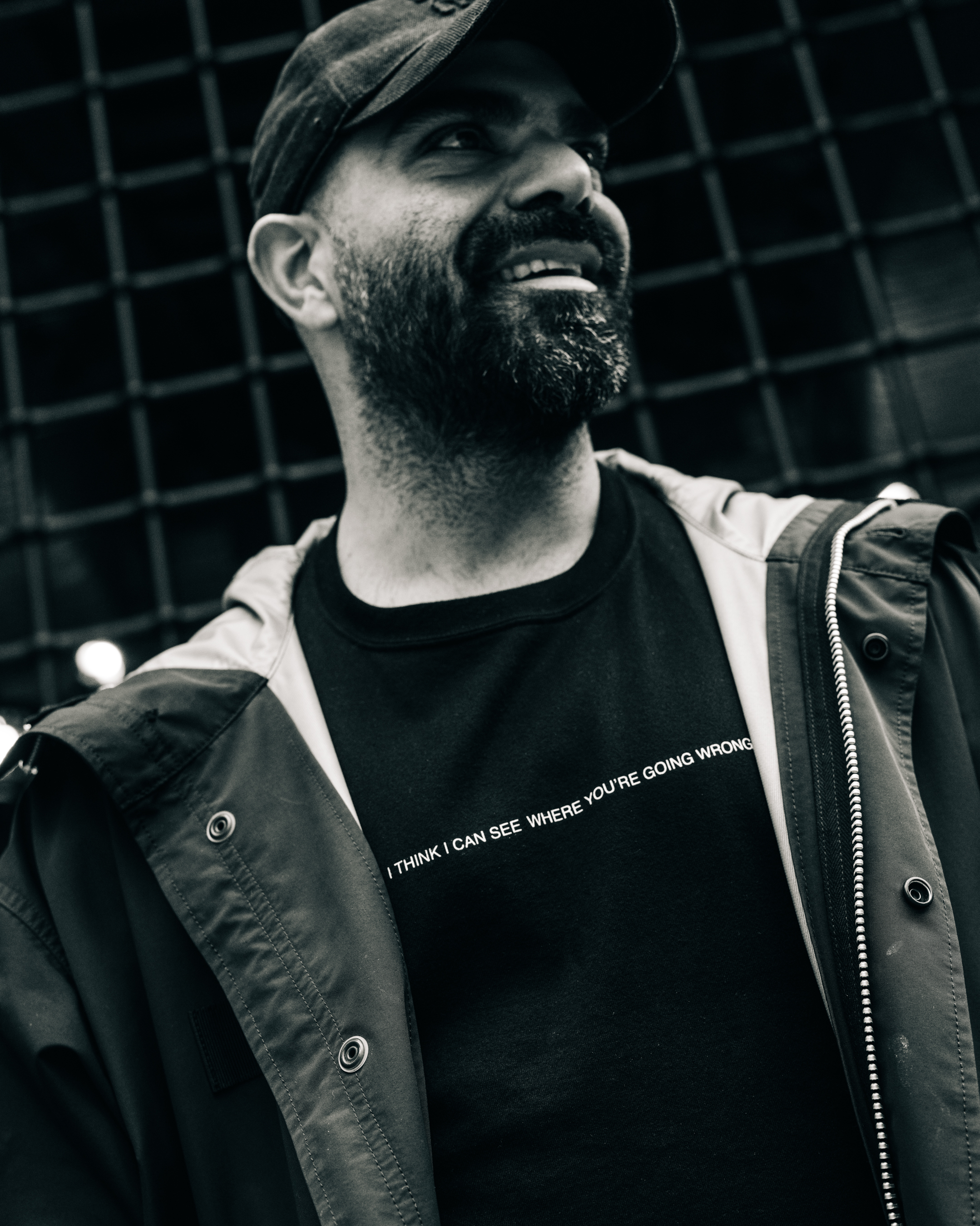
Jeramiah Irwin, @jerairwin
The Jersey City–based designer attended Afropunk for the first time last year, and the festival’s accepting ethos made him come back again this year. “I love festivals in general, but this one to me is so different. Everyone is so friendly. There’s no judgment,” he says. “It’s really true what they say—the no sexism, no homophobia here.” And given the opportunity to fully express himself, Jeremiah chose a denim corset and ripped jeans that were inspired by the pop-country music he’s been listening to. Says Irwin, “I was going to wear a cowboy hat, but I’m saving that for later.”
related content
MUMI HAIATI
Agency Founder
Having spent 10 years abroad, Haiati worked as a freelance creative consultant in London, Barcelona, New York, and Paris. Throughout these experiences, he collaborated with a wide range of brands and artists. In 2011, he relocated to Berlin, where he founded his namesake brand and one-man show, which would later evolve into Reference Studios in 2017.
Contributor: Adam Katz Sinding
Published March 2025
What would you consider to be the most impactful moments in the development of Reference Studios, and how have these moments or achievements shaped the direction of the agency?
The launch of course. And the first edition of our cultural Reference Festival in 2019, which came as a complete novelty in the industry and beyond, and set the tone for the future of the agency as a whole. In late 2022 we would fundamentally help to conceive the all-new RIMOWA Design Prize, whose 3rd edition is planned for 2025. In February 2024 we launched Intervention, a runway format within Berlin Fashion Week that is committed to supporting Berlin design talent.
Having scaled your agency for well over a decade how do you ensure that your brand meets industry demand while staying true to its roots?
Our brand authenticity consists both in the zeitgeist as well as in a set of core values and craftsmanship. As long as we maintain these, we also meet ever-changing industry demands.
Q&A
How has the evolving intersection between technology and the creative industry influenced your approach to innovation and the work you do?
The intersection between technology and our industry has allowed us to launch our very own brand of fragrance with the Dutch tech start-up and AI perfumer Every Human. Reference Times is a collaborative olfactory platform that premiered at Dover Street Parfums Market this past fall, with an AI-powered machine residency program.
What has your career journey taught you about yourself?
Taste cannot be challenged. And that I have a reliable eye for potential.
If you could get one message out to the industry, what would it be?
Back to the drawing board.
Q&A
Connect with MUMI on Instagram
EXPLORE OUR PROJECT community
SPOTLIGHT: LILIA LITKOVSKA
Lilia Litkovska sits down with Adam Katz Sinding to explore the concept of continuous learning, the influence she sees tech having on design, and more.
LOGO HERE
Having previously founded menswear brand L’HOMME ROUGE, John is a Woolmark Prize winner, and was named the future face of global menswear by Interview Magazine. After a health scare 10 years ago, he took up running to relieve anxiety and cope with stress. He has since founded the holistic running brand UNNA, which means "treat yourself" in Swedish. He now serves as the creative director.
Contributor: Adam Katz Sinding
Founder & Creative Director
JOHN-RUBEN HOLTBACK
What changes have you seen influencing fashion culture?
I used to discover brands and designers by going to stores, feeling the fabrics, and trying on products. Twenty years ago, buying denim meant going downtown and touching it, you know? We had to invest time to really experience it. Now, you can just go on social media, do a quick browse of a brand, and get an idea. However, this doesn't tell you much about the actual product, its quality, or the depth of detail.
We've shifted a lot from focusing on product quality, to product presentation and branding. I see an opportunity in finding new ways to showcase products and be an influential source. Today, brands are more defined by their vibe than by the people wearing them. Customers lean into that vibe, so try to own it.
Do you think brick-and-mortar can have a resurgence in this environment?
Yeah, I miss the personal relationships you could build with the well-respected and passionate sales staff; these people educated me. It's just so hard to get that online. I'm not the type to post questions on Reddit; I prefer face-to-face interactions. Therefore, I believe physical retail has a role to play in the future, focusing more on the local community and bringing like-minded people together.
Staple wardrobe item?
I've been wearing my silver necklace from my friend Jonatan's brand, Kultur 5, a lot. I love it, and soon I think I need to get the bracelet too.
Do you think accessories are important, or is it just that piece that you’re drawn to?
Nowadays, I’m quite inspired by styling in general. Since entering the sports space, I’ve enjoyed merging and contrasting sports and technical clothing with wider tailored silhouettes, wool knits, jewelry, and similar items. Running with a necklace that has zero function and might even slow you down is a playful nod to all the performance-focused people out there—I don’t care.
join the social community
Connect with JOHN-RUBEN on Instagram
related content
SPOTLIGHT: NICOLAS BAROSI
Multidisciplinary Creative Nicolas-Barosi explores his desire to grow his brand and the nuanced connection between sociology and fashion as he sits down with Adam Katz Sinding.
Read Now
Pursuing an editorial path in fashion must have been quite exciting. What sparked that journey for you?
Essentially, it started because I wanted a cashmere sweater, and my mom said, “I am happy to buy you a sweater, but it’s not going to be cashmere. If that’s what you want, I suggest you get a job and buy it yourself.” So, I went to the nicest clothing store in town, Joseph P. Roth and Sons, and asked them if they needed any help after school or on weekends, and they said, “YES.” I have been working ever since. I was 16 when I started working.
So, the question is…how many cashmere sweaters do you own now?
I recently counted 47…I feel like there could be more…somewhere.
Looking back at your 35 year career can you pinoint any individuals or experinces that you feel helped to shape your journey?
I honestly think that Peter Rizzo, who was my boss at Barneys New York (1987–89), taught me everything I know today. He taught me how to look at brands, the way a collection is designed, how to choose fabric, and how to refine my taste and point of view. He really was a master.
Were you a buyer at this time? How did you take his advice and make it your own?
Yes. I was first an assistant buyer, then got promoted to buyer. In stores, buyers are called merchants. I really believe it was the best training I could ever have. It’s analytical, it’s creative, and it’s how I developed taste and a point of view. I just listened and soaked up everything, or as much as I could. It’s as if I knew this would last only a couple of years, so I truly made the most of it.
FW25/26 MENS CONTEMPORARY & YOUNG MENS BUYER'S GUIDE
Discover key men's contemporary and young men's trends, products, and brands to shop at PROJECT Las Vegas in our exclusive Buyer's Guide.
FASHION & TECHNOLOGY IN 2025Discover where fashion is headed, why technology matters for every professional, and how solutions and strategy are steering the industry into 2025.