373
40
325
30
: Quantum
How Business Leaders Can Navigate Opportunity and Risk – and Come Out Ahead
............................................
CONTINUE
Contents
Introduction Quantum Computing 101: The Era of Exponential Possibilities. Forecasting the Quantum Impact The Double-Edged Sword of Quantum Security. - The Looming Encryption Crisis. - Post-Quantum Cryptography (PQC): The Solution Starts Now.. - Opportunities in Securing a Quantum Future. What Business Leaders Must Do Now. When Will Quantum Deliver? A Use Case Timeline Today – already in use. - Quantum Random Number Generation (QRNG) - Quantum Annealing for optimisation problems. At 50 Logical Qubits. - Small Molecule Simulation (Drug Discovery) At 100 Logical Qubits. -New Materials Design. - Financial Portfolio Optimisation. At 100-200 Logical Qubits. - Logistics Routing (e.g., Smart Traffic Management) - Quantum AI / Machine Learning. At 4000 Logical Qubits. - Cryptography (Q-day) Glossary.
07
06
05
04
03
02
............................................................................................................................................
Quantum Computing 101: The Era of Exponential Possibilities
Quantum computing represents a fundamental shift in how information is processed. While classical computers use bits - restricted to values of 0 or 1 - quantum computers use qubits, which can exist in multiple states at once through a property called superposition. This is further enhanced by entanglement, where qubits become interdependent, and interference, which amplifies correct outcomes while suppressing incorrect ones. These principles enable quantum computers to explore vast numbers of possible solutions simultaneously, not by brute force, but by leveraging quantum mechanics to perform fundamentally different computations. Consider the contrast: • Classical computers evaluate solutions sequentially. • Quantum computers explore many possibilities in parallel. If scaled successfully, this new approach could transform fields such as drug discovery, energy optimisation, financial modelling, and logistics – solving problems too complex for even the most powerful classical systems today.
Quantum-based technology isn’t just the future - it’s already transforming industries, challenging cybersecurity norms, and redefining the boundaries of what technology can achieve. With advancements accelerating faster than many experts predicted, quantum computing could drive breakthroughs in ways that complement or even surpass those brought by artificial intelligence, particularly in scientific and cryptographic domains. For business leaders, it’s not a matter of if but when they will need to position themselves for the opportunities and risks quantum computing will bring. This article draws on the foundational principles of quantum mechanics - superposition, entanglement, and interference - to explain how quantum computing is reshaping industries. It examines why its potential could exceed that of previous computing paradigms and, most importantly, what organisations must do to adapt and prepare.
JULY 25
Rob O’Connor EMEA CISO and Cybersecurity CTO
270
The Double-Edged Sword of Quantum Security
Opportunities in Securing a Quantum Future Despite its security challenges, quantum computing also paves the way for breakthroughs in secure communication. Technologies like Quantum Key Distribution (QKD) harness quantum mechanics to deliver near-perfect encryption: Any attempt to intercept a QKD-secured message disturbs the quantum state, alerting both sender and receiver to a breach. Governments and enterprises are already testing QKD in high-stakes environments, establishing a new gold standard for unbreakable communication.
Forecasting the Quantum Impact
The quantum computing market is projected to reach £145 billion globally by 2040, according to industry forecasts. Sectors such as finance and energy are leading the way, with 28% and 16% of early adopters respectively already exploring quantum applications. Some estimates suggest thousands of quantum systems - ranging from research platforms to commercial-grade prototypes could be in operation by the end of the decade. For business leaders, these figures are more than projections. They are early signals that quantum is moving from lab to market – and organisations that fail to engage early risk falling behind competitors who are already exploring its potential.
While the promise of quantum computing is vast, it also presents one of the most serious cybersecurity threats in decades. Today’s encryption methods depend on the computational difficulty of reversing certain mathematical problems - tasks that would take classical computers years, centuries, or more to crack. Quantum computers, however, have the potential to solve these problems far more efficiently, rendering widely-used algorithms like RSA and ECC vulnerable. This isn’t just a future risk - the threat is emerging now. Adversaries are already stockpiling encrypted data, betting that future quantum systems will one day be able to decrypt it.
While the promise of quantum computing is vast, it also presents one of the most serious cybersecurity threats in decades. Today’s encryption methods depend on the computational difficulty of reversing certain mathematical problems - tasks that would take classical computers years, centuries, or more to crack. Quantum computers, however, have the potential to solve these problems far more efficiently, rendering widely-used algorithms like RSA and ECC vulnerable. This isn’t just a future risk - the threat is emerging now. Adversaries are already stockpiling encrypted data, betting that future quantum systems will one day be able to decrypt it. The Looming Encryption Crisis Algorithms like Shor’s have shown that quantum computers could one day break widely used cryptographic schemes such as RSA and ECC in a fraction of the time classical computers would require. RSA-2048, which today would take millions of years to brute-force, could potentially be broken in hours or days once a large enough fault-tolerant quantum system becomes available. The implications are serious: · Data once thought secure - including financial records, government communications, and medical histories may be exposed as quantum capabilities mature. · This isn’t a distant theoretical concern. Nation-states and threat actors are already believed to be stockpiling encrypted data in the hope of decrypting it in the future - a tactic known as “harvest now, decrypt later.” Post-Quantum Cryptography (PQC): The Solution Starts Now In response, cryptographers are developing post-quantum algorithms that rely on mathematical problems believed to be resistant to quantum attacks - such as those based on lattices, code-based systems, and multivariate polynomials. But moving to PQC is a complex, multi-year journey. Organisations must start now by identifying where cryptography is used, classifying data that must remain secure long-term, and preparing for a phased transition to quantum-safe encryption. Standards bodies like NIST are leading the way, but businesses cannot afford to wait. Opportunities in Securing a Quantum Future Despite its security challenges, quantum computing also paves the way for breakthroughs in secure communication. Technologies like Quantum Key Distribution (QKD) harness quantum mechanics to deliver near-perfect encryption: Any attempt to intercept a QKD-secured message disturbs the quantum state, alerting both sender and receiver to a breach. Governments and enterprises are already testing QKD in high-stakes environments, establishing a new gold standard for unbreakable communication.
Post-Quantum Cryptography (PQC): The Solution Starts Now In response, cryptographers are developing post-quantum algorithms that rely on mathematical problems believed to be resistant to quantum attacks - such as those based on lattices, code-based systems, and multivariate polynomials. But moving to PQC is a complex, multi-year journey. Organisations must start now by identifying where cryptography is used, classifying data that must remain secure long-term, and preparing for a phased transition to quantum-safe encryption. Standards bodies like NIST are leading the way, but businesses cannot afford to wait.
The Looming Encryption Crisis Algorithms like Shor’s have shown that quantum computers could one day break widely used cryptographic schemes such as RSA and ECC in a fraction of the time classical computers would require. RSA-2048, which today would take millions of years to brute-force, could potentially be broken in hours or days once a large enough fault-tolerant quantum system becomes available. The implications are serious: • Data once thought secure - including financial records, government communications, and medical histories may be exposed as quantum capabilities mature. • This isn’t a distant theoretical concern. Nation-states and threat actors are already believed to be stockpiling encrypted data in the hope of decrypting it in the future - a tactic known as “harvest now, decrypt later.”
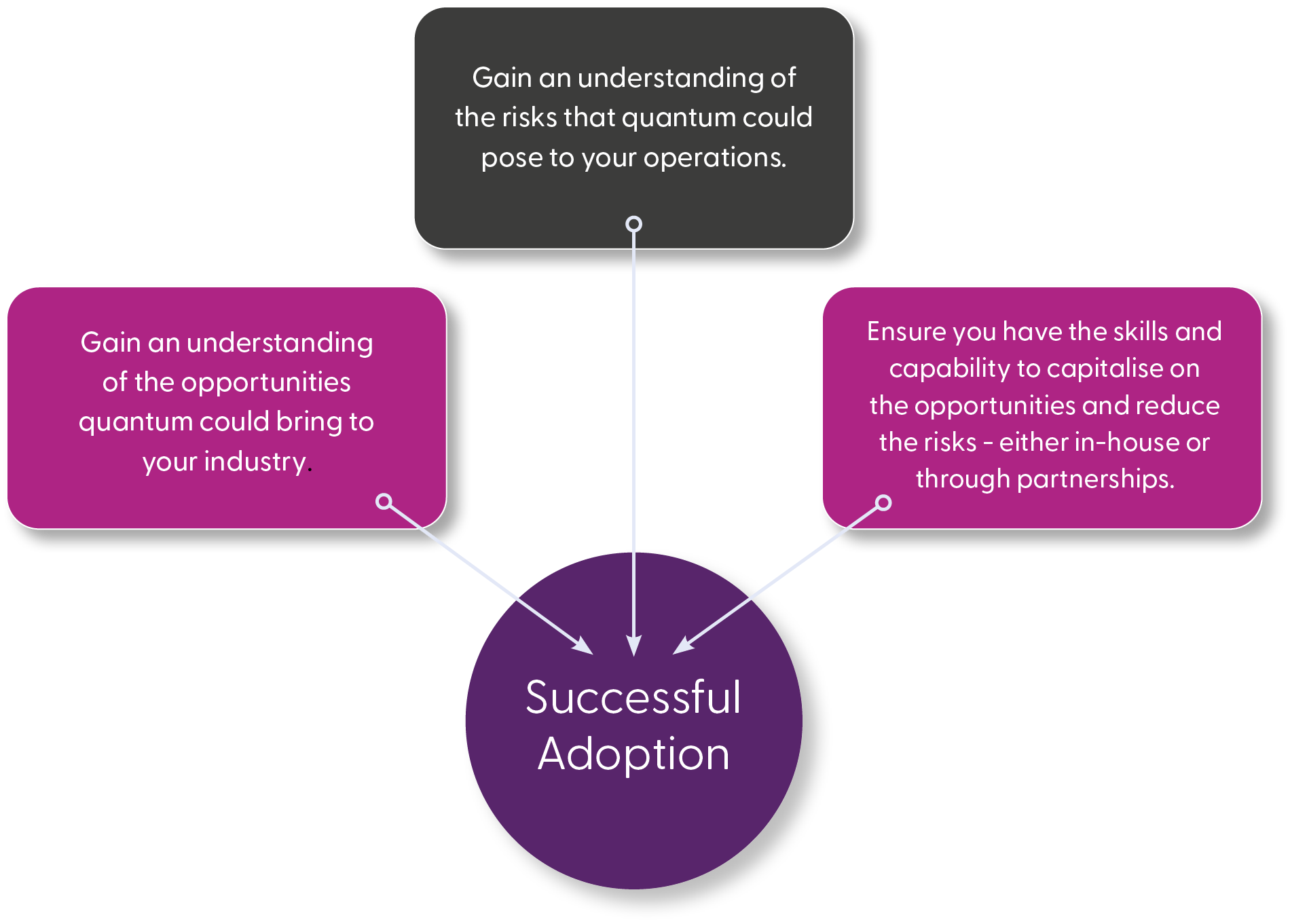
1. Educate Your Leadership Ensure your board and senior leadership team understand quantum’s trajectory. Read industry briefings, attend quantum-focused events, and invite specialists to shape early-stage strategy discussions. 2. Audit Your Critical Systems and Data Classify your data based on how long it needs to remain secure. Identify where encryption is critical and begin planning for post-quantum migration. 3. Upskill Your Organisation Quantum-literate talent is in short supply. Partner with universities, research labs, and training providers to build internal understanding of quantum principles and their business relevance. 4. Engage with Technology Leaders Work with quantum vendors and cloud platforms to explore proof-of-value pilots. Cloud-based access to quantum hardware and simulators allows experimentation without major investment. 5. Develop a Post-Quantum Roadmap Begin building a long-term quantum strategy - one that aligns your risk posture, innovation goals, and investment priorities with the likely pace of development in your industry.
Quantum computing presents both a strategic opportunity and a looming risk. It’s no longer a question of if quantum will impact your sector, but when – and those who engage early will be better positioned to respond. Preparing your organisation doesn’t require a wholesale transformation today. A well-structured executive briefing or targeted expert engagement may be enough to start identifying areas of relevance and risk.
What Business Leaders Must Do Now
The path to successful quantum adoption starts here:
The UK’s NCSC recommends that organisations begin planning now for a post-quantum world - even if Q-Day is a decade away. Their migration guidance suggests 2031 as a readiness target for public and private sectors.
Because randomness underpins encryption, simulation, and secure key exchange, QRNG is one of the few quantum technologies with practical, proven value today, even before scalable quantum computing arrives. QRNG is already integrated into certain hardware security modules (HSMs) and VPN systems, delivering enhanced entropy for critical security operations.
• Already in commercial use for encryption key generation, secure communications, and cryptographic hardware modules. • Offered as standalone hardware or cloud-accessible services – providers include ID Quantique, Quside, and Toshiba. • Certifications and standards are emerging, including support from NIST and ETSI, helping drive adoption in finance, government, and telecoms.
Among the most mature and commercially available quantum technologies today is quantum random number generation. Unlike classical random number generators – which rely on algorithms and can, in principle, be predicted – QRNGs use the inherent unpredictability of quantum processes (such as photon emission or quantum state collapse) to produce truly random numbers.
Today – already in use Quantum Random Number Generation (QRNG)
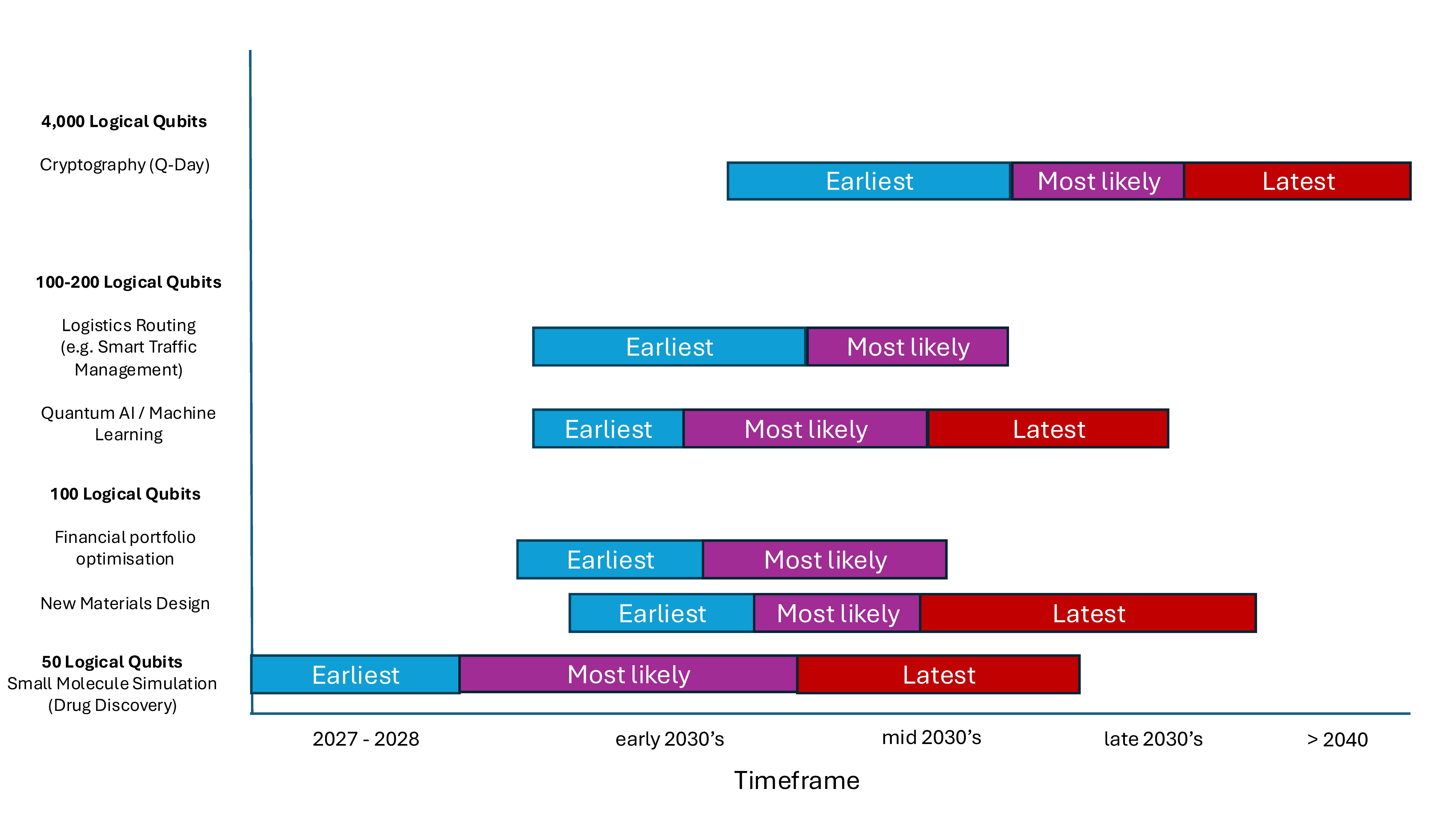
One of the biggest questions surrounding quantum computing is: when will it matter? The answer varies by use case - and depends heavily on breakthroughs in materials, hardware, and error correction. While no one can offer precise timelines, combining vendor roadmaps with known qubit thresholds offers a credible view of how quantum applications may unfold. Below is a breakdown of key use cases, grouped by the number of logical qubits required and accompanied by best, likely, and worst-case projections. This framework helps business leaders plan for early opportunities – and anticipate when to expect real disruption.
When Will Quantum Deliver? A Use Case Timeline
Quantum Annealing for optimisation problems While fault-tolerant quantum computing remains years away, early exploratory applications of quantum computing are already emerging. One of the most immediate commercial deployments involves quantum annealing, a specialised approach best suited to solving certain optimisation problems. Companies such as D-Wave have built machines with thousands of qubits. Though these systems are not universal or error-corrected, they are being used in limited production-like environments to explore real-world problems such as resource routing, scheduling and allocation, and job-shop optimisation. While these applications have shown promise, they have not yet demonstrated a consistent or scalable quantum advantage over classical approaches. Access is available via the cloud.
...........................................................................................................................................................................................................
BCG predicts that by “around 2030, pharmaceutical companies will be using quantum to solve problems in binding molecules with 100 or fewer atoms” bcg.com
Click here for more articles like this.
2027 - 2028 Early 2030’s Mid 2030’s Late 2030’s > 2040
2027 2028 2029 2030 2031 2032 2033 2034 2035 2036 2037 2038 2039 2040 2041
Most Likely
Earliest
Latest
4,000 Logical Qubits Cryptography (Q-Day)
100-200 Logical Qubits Logistics Routing (e.g. Smart Traffic Management) Quantum AI / Machine Learning
100 Logical Qubits Financial portfolio optimisation New Materials Design
50 Logical Qubits Small Molecule Simulation (Drug Discovery)
............................................................................................................................................................................................................................................................................................................................................................................................................................................................................................................................
TIMEFRAME
... Earliest (~2030): If quantum development accelerates rapidly, a breakthrough could occur with a fault-tolerant machine of ~1 million physical qubits, which could implement the thousands of logical qubits required. .. Most Likely (~2035+): Most expert roadmaps estimate that Q-Day – when RSA-2048 encryption can be practically broken - is unlikely before the mid-2030s. . Latest (>2040): If progress on fault-tolerance and scalable qubit systems slows, RSA may remain secure for decades.
Cryptography (Q-day) Decrypting RSA-2048 using Shor’s algorithm is the flagship challenge for quantum computing – and one of the most resource-intensive.
At 400 Logical Qubits
... Earliest (~2030): On specific, narrow tasks – such as classifying small datasets or accelerating optimisation within ML models – quantum circuits may outperform classical baselines in terms of speed or resource efficiency. .. Most Likely (~2030–2035): Quantum-enhanced versions of common models (e.g., kernel classifiers, recommendation systems) could demonstrate limited advantage. . Latest: General-purpose quantum AI that meaningfully outperforms classical deep learning is likely many years away, and may depend on breakthroughs in both algorithms and hardware.
Quantum AI / Machine Learning Quantum machine learning remains highly experimental, but early milestones may appear within the next decade.
Even with powerful quantum hardware, performance gains may be limited if algorithms do not scale well. Classical optimisation methods remain highly competitive and have decades of refinement behind them.
... Earliest (~2030): A small demonstration may show quantum processors suggesting marginally better solutions for traffic light timing. .. Most Likely (2030–2035): Broader adoption across logistics and supply chain management will depend not only on quantum hardware but also on advances in quantum algorithms, particularly heuristics like QAOA.
Logistics Routing (e.g., Smart Traffic Management) Optimising city-scale systems, such as traffic light coordination, is a commonly explored quantum use case.
At 100-200 Logical Qubits
... Earliest (2028–2030): Certain constrained problems could benefit from quantum optimisers steering classical models toward better solutions. .. Most Likely (2030–2035): Financial firms like JPMorgan and Goldman Sachs are actively researching this space and expect value from quantum approaches as systems with ~100 logical qubits become cloud-accessible.
Financial Portfolio Optimisation Financial institutions may begin testing quantum algorithms for portfolio optimisation, risk analysis, and strategy development using hybrid quantum-classical methods.
... Earliest (2030–2031): With 100 logical qubits and effective error mitigation, quantum systems could calculate material properties that classical computers cannot handle efficiently – for example, simulating a surface reaction involving complex electron interactions with high precision .. Most Likely (2031–2033): Hybrid quantum-classical methods may enable more accurate approximations of material behaviour, helping researchers screen candidate materials or refine classical models more efficiently. . Latest (mid-to-late 2030s): If progress in logical qubit scaling or algorithm maturity slows, quantum advantage in materials science could remain out of reach – especially given the strength of classical simulation tools in this domain.
New Materials Design By the early 2030s, quantum-enhanced simulations may begin to support materials discovery by modelling reaction mechanisms and predicting properties such as conductivity, reactivity, or phase changes. These capabilities are highly relevant for developing new catalysts, advanced battery materials, and high temperature superconductors.
At 100 Logical Qubits
Insight Proprietary & Confidential. Do Not Copy or Distribute. © 2024 Insight. All Rights Reserved.
... EARLIEST (2027–2028): With effective error mitigation (but not full fault tolerance), quantum computers may approximate the ground state energy of a small molecule in a way that classical methods cannot efficiently match or verify. .. MOST LIKELY (2028–2032): Progress in noise reduction and hybrid methods could enable early demonstrations of quantum-enhanced chemistry simulations. . LATEST (mid-2030s): Delays in scaling logical qubits or achieving low error rates may push this milestone further out.
Small Molecule Simulation (Drug Discovery) By the late 2020s to early 2030s, it may become feasible to simulate small molecules (around 50 electrons) more efficiently than classical supercomputers. This could be an important milestone in drug discovery.
At 50 Logical Qubits
Qubit The quantum version of a bit. Unlike classical bits (0 or 1), qubits can be both 0 and 1 at once, enabling new kinds of computation. Superposition A qubit's ability to exist in multiple states simultaneously - the basis for quantum parallelism. Entanglement When two qubits become linked so that changing one instantly affects the other, regardless of distance. Interference A quantum effect used to increase the probability of correct results and suppress incorrect ones in computations. Logical qubit A stable, error-corrected qubit formed from many physical qubits. Needed for practical, large-scale quantum computing. Fault-tolerant quantum computing A level of reliability where errors from quantum noise can be continuously detected and corrected. Quantum annealing A technique for solving optimisation problems using quantum fluctuations - useful but limited to specific use cases. Quantum advantage The moment when a quantum computer outperforms the best classical computer at a specific task. Quantum AI / Quantum machine learning A developing field using quantum systems to enhance or accelerate machine learning models. RSA-2048 A standard encryption algorithm using 2048-bit keys. Secure today, but vulnerable to future quantum attacks via Shor’s algorithm. Shor’s algorithm A quantum algorithm that can factor large numbers exponentially faster than classical methods, threatening RSA encryption. Post-Quantum Cryptography (PQC) Cryptographic systems designed to remain secure even when quantum computers become capable of breaking today’s encryption. Quantum Key Distribution (QKD) A secure method of sharing encryption keys using quantum mechanics. Interception attempts can be detected in real time. "Harvest now, decrypt later" A strategy where encrypted data is stolen today with the aim of decrypting it in the future using quantum capabilities. Quantum Random Number Generation (QRNG) Uses quantum phenomena to generate truly unpredictable numbers for use in cryptography. Hardware Security Module (HSM) A dedicated hardware device that protects and manages digital keys and cryptographic functions. Entropy (cryptographic) A measure of randomness in a system – critical for generating secure encryption keys. Lattice-based cryptography A leading class of quantum-resistant encryption techniques based on complex geometric problems in multi-dimensional space. Considered a strong candidate for standardisation. Multivariate polynomial cryptography An approach to encryption that uses complex systems of equations with multiple variables. It's hard for both classical and quantum computers to solve. Q-Day The hypothetical future point when a quantum computer is powerful enough to break current public-key encryption standards. Proof of Value (PoV) A small-scale pilot project designed to test whether a technology delivers meaningful benefit before full investment. Hybrid quantum-classical A model that combines quantum and classical computing techniques to tackle problems more efficiently. Use case viability The practical point at which a theoretical capability becomes feasible and useful in real-world business or operations.
Glossary OF terms
Download as PDF
Quantum
01