IPSOS DATA DROPS:
Boycotts in America
March 2025
Key Takeaways:
Americans are split on whether the U.S. today is a place where you can arrive with little and “make it” through hard work. Half of Republicans are highly confident that a legal immigrant with little money or formal education could succeed through hard work and determination, versus 24% of Democrats.
Americans think the U.S. is underperforming on providing opportunity

2
When Americans are asked to rank the American values that are most important to them, economic opportunity lands near the top. What's more, 71% say it is important for the U.S. to provide economic opportunity.
However, Americans today have some questions about how well the country is doing at living up to this promise: Just 19% say the U.S. is doing extremely or very well at providing opportunity for Americans to live prosperous and happy lives (though another 32% think the U.S. is doing “somewhat well” on this front).
What’s next:
Americans continue to largely agree that self-reliance and hard work are central to being American — but many are unsure whether our economy and legal system gives everyone a fair shot at success. It’s critical that leaders and policymakers monitor this attitude and its implications for their own policies and communications.
Or visit the Ipsos Consumer Tracker archive and the Ipsos Top Topics page.�
Your three-minute briefing on what business leaders need to know about today.
IPSOS DATA DROPS:
Boycotts in America
March 2025
IPSOS DATA DROPs
Sports betting is booming.
Here’s how Americans feel about it.
January 2026




Check out our other DATA DROPS for more compelling data & insights

Source: Ipsos America 250 Poll, fielded Feb. 25 – Mar. 4, 2026, among 4,692 U.S. adults aged 18-65
DOWNLOAD THE
PPT CHARTS
Want this compelling data in a deck to go?
TO LEARN MORE, CONTACT:�
Most adults say it is important for the U.S. to provide opportunity for Americans, but just 19% think the U.S. is doing extremely or very well at this.
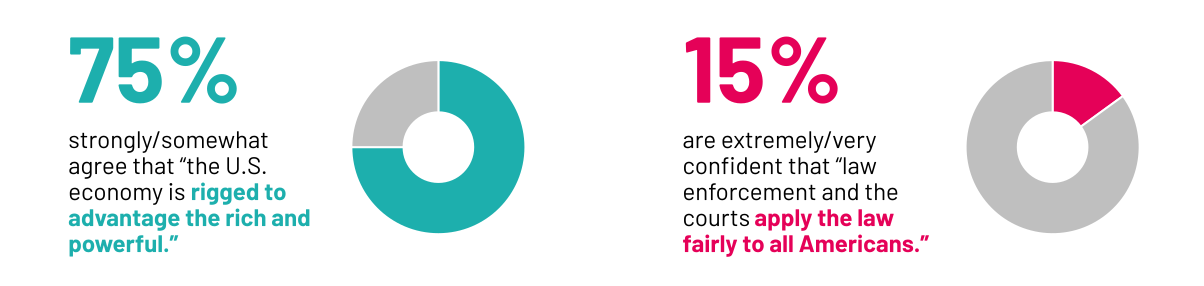
75% of American adults feel the economy is rigged to favor the rich and powerful, and only 15% are highly confident that the legal system applies the law fairly to all Americans, regardless of wealth or status.


Source: Ipsos America 250 Poll, fielded Feb. 25 – Mar. 4, 2026, among 4,692 U.S. adults aged 18-65
A majority of Americans (75%) agree with the view that the U.S. economy is rigged to advantage the rich and powerful. Many also have questions about the fairness of the U.S. legal system, with just 15% saying they are extremely or very confident that law enforcement and the courts apply the law fairly, regardless of economic circumstances and personal characteristics.
It adds up to a sense among many Americans that the playing field is tilted against those starting at the bottom.
Doubts in the fairness of the American system run deep

3
Americans are split on whether a legal immigrant could “make it” in the U.S. today through hard work alone: 36% are very confident, 36% are somewhat confident, and 26% are not confident.
Older Americans are slightly more optimistic than younger generations, but the biggest gap is partisan: 56% of Republicans are highly confident, compared with just 24% of Democrats.
Does hard work guarantee success in the U.S.? Americans are uncertain

1
The belief that you can start at the bottom and make it in the U.S. is a barometer of broader economic health. Brands and institutions need to understand not only how that perception varies and what it means for their audiences, but how belief in the American dream is evolving by cohort and generation. �

Source: Ipsos America 250 Poll, fielded Feb. 25 – Mar. 4, 2026, among 4,692 U.S. adults aged 18+
Despite these questions about opportunity and fairness, most Americans continue to feel that getting ahead through one's own efforts is an important part of the American identity — behind only voting in elections; believing in freedom, justice and equality; and treating people of all backgrounds equally.
The importance of getting ahead – through one’s own efforts

4
Source: Ipsos America 250 Poll, fielded Feb. 25 – Mar. 4, 2026, among 4,692 U.S. adults aged 18-65
Alec Tyson �SVP, Ipsos Public Affairs�alec.tyson@ipsos.com
Bernard Mendez�Senior Data Journalist�bernard.mendez@ipsos.com