Kicking Off 2026
TRENDING
SUPPLY CHAIN
Let's Go
Market Overview: A Year Defined by Mild Recovery and Major Uncertainty
Transportation Market: A Turning Point or Temporary Lift?
LTL Market: Another Year of Contraction with Big Strategic Shifts
Parcel Market: Volume Up, Revenue Lagging, and Surcharges Rising
Industrial Real Estate: Market Stabilizing After Two Intense Years
Labor Market: Logistics Hiring Stalls Out
Innovation & Automation: Adoption Accelerates as Costs Rise
Final Takeaway: The Big Picture for 2026
Warehousing & Inventory: Leaner 2026 Expected as Firms Pull Back
TABLE OF CONTENTS
About Kenco
I.
II.
III.
IV.
V.
VI.
VII.
VIII.
IX.
I. Market Overview
Real GDP climbed 3.3% in 2025 Q2, offering a brief boost before slowing again in Q3 as manufacturers faced falling exports and record levels of unsold inventory. Firms across sectors struggled to pass rising input costs along to customers, putting continued pressure on margins.
A Year Defined by Mild Recovery & Major Uncertainty
Additional touches Incorrect Carrier Selection Bad Data Inaccurate Accruals Higher Freight Spend No access to E-BOL
The risks if no action is taken:
Tariff-driven uncertainty loomed large throughout the year, and business confidence fell to one of its lowest levels in three years. While output and new work improved both manufacturing and services, backlogs continued to shrink, another sign of cooling demand.
In 2026, geopolitical tensions and fragmentation will have the largest impact on supply chains. These will eventually make their way down to the consumer who is already having difficulty in a stubborn inflationary environment. Companies must diversify suppliers and move from global optimization to regional resilience where possible. Strengthen real-time visibility and analytics, while investing in AI will help shippers be predictive and agile, which will enable maintaining service and cost expectations. Creating geopolitical readiness in your company’s risk frameworks is critical. Along with traditional supply chain risks, elevate geopolitical stress testing to include trade policy shifts and currency volatility. Also, invest in automation to drive productivity and reduce labor risk. Savings can drive new product innovation and marketing to drive growth in 2026.
We asked Dave Hauptman, Chief Commercial Officer at Kenco Group:
What macroeconomic or geopolitical factor do you believe will have the biggest impact on supply chains in early 2026, and how should companies prepare?
— Dave Hauptman, Chief Commercial Officer, Kenco
Economic Update
After shrinking for first time since Covid, GDP bounces back in Q2.
Actual GDP Annualized Rates and Projections
Projections by Wall Street Journal Econimists
Source: WSJ, September 25, 2025
BEA Actual
WSJ Projections Average
4% 2% 0% -2%
Q1 2023
Q2 2023
Q3 2023
Q1 2024
Q2 2024
Q3 2024
Q1 2025
Q2 2025
Q3 2025
Q1 2026
Q2 2026
Real GDP grew 3.3% in Q2
Q3= 0.9%
Q4= 1.1%
Q2= 1.9%
Q1= 1.6%
2026 Guidance for Shippers
Kenco Insights for 2026
CLICK TAB TO VIEW MORE
| TABLE OF CONTENTS
End-of-Year Supply Chain Trending Report 2025 | 3
A year of growth on paper, but in reality, it’s hesitation.
What this means for shippers in 2026
As global trade dynamics continue to fragment, companies will need to prioritize regional resilience over global optimization. Diversifying suppliers, strengthening real-time visibility and analytics, elevating geopolitical risk within planning frameworks, and investing in automation will be critical to maintaining service levels and managing cost uncertainties.
II. Transportation Market
A Turning Point or Temporary Lift?
End-of-Year Supply Chain Trending Report 2025 | 4
Carrier Cost Inflation
Operating costs have surged +25% since 2022, driven by fuel, insurance, maintenance, and labor expenses. Carriers passing costs through to contract rates.
Capacity Tightening
Carrier count down 4%, Class 8 truck orders declining 22% year-over-year. Supply constraints creating upward rate pressure across modes.
Tariff Volatility
Import volumes approximately 5-6% lower year-over-year due to trade policy uncertainty. Shippers adjusting sourcing strategies and inventory positions.
LTL Pricing Discipline
General Rate increases holding firm despite softer demand. Carriers maintaining pricing discipline through capacity management and service differentiation.
Truckload rates showed rare, positive movement mid 2025, with spot rates rising ~9.1% YoY and contract rates turning positive for the first time since 2022. Even so, capacity remained long across most regions, and shippers held the advantage in pricing negotiations.
Carrier costs—particularly fuel, insurance, and labor—continued to rise, creating sustained upward pressure late into Q4. Freight volumes fell sharply, including a 9.3% YoY drop in August, reflecting softer demand and ongoing inventory resets. As 2026 begins, tightening pockets of capacity and moderate rate increases hint at early-stage rebalancing, though the industry has not fully transitioned out of its multi-year trough. 2025 ended with the first real signs of recovery—but with structural softness still in play.
We asked Sean Witmer, Director of Carrier Development at Kenco:
What is your outlook on truckload and contract rate behavior for the first half of 2026, and what guidance would you give shippers preparing budgets now?
Shippers should continue focusing on growing long-term carrier relationships. Look for pricing to see small increases in the beginning of 2026 with a bit more upward momentum towards the end of 2026 as more capacity leaves the market due to costs and regulation. Budget accordingly while looking for consolidation and mode shift opportunities.
— Sean Witmer, Director, Carrier Development, Kenco
Transportation pricing is likely to tighten gradually throughout the year. Shippers that prioritize strong carrier partnerships, conservative budgeting, and proactive network optimization will be better positioned as capacity rebalances.
III. LTL Market
Another Year of Contraction with Big Strategic Shifts
End-of-Year Supply Chain Trending Report 2025 | 5
Peerless Research: More than 50% of shippers faced 5–14% YOY rate increases for 2024–2025.
2024 Annual LTL Study
Less than 5%
By how much do you expect the rates to increase from 2024 to 2025*?
Stay the Same 34%
Increase 61%
Decrease 5%
How are you expecting your LTL contract to change from 2024 to 2025?
5% to 9%
10% to 14%
15% or more
Don't know/Unsure
38%
45%
11%
3%
*Among those that expect rates to increase
March 2024
We asked Connor Radsteen, Senior Manager of Carrier Development at Kenco:
How should shippers rethink their LTL strategy moving into 2026 as carriers continue to emphasize pricing discipline and network efficiency?
Shippers should take action now to accurately capture shipment characteristics at the time of shipping. Capturing correct pallet dimensions, weight, and product class is critical in today’s industry. As the industry continues to have density drive price shippers who can navigate this and remove cost from carriers will see the biggest rewards. The LTL industry is moving toward greater automation and density-based pricing. Shippers should look at their freight in a critical way for how to take advantage of carrier offerings. Key points shippers should be looking at in 2026 and beyond is E-BOL, pool distribution, consolidation, and strategic bidding. 2026 is about being proactive. Master freight data, diversify strategically, and build partnerships with carriers who are investing in the right networks and technology in for you lanes.
— Connor Radsteen, Senior Manager of Carrier Development, Kenco
LTL success will increasingly depend on data accuracy, automation, and proactive freight optimization. Shippers that improve freight visibility and align with carriers investing in modern networks will gain a meaningful cost and service advantage.
Parcel demand remained strong, with U.S. volume growing to 22.37B shipments, up 3.4% YoY. But revenue lagged behind volume growth for the second consecutive year, rising only 2.7%.
IV. Parcel Market
Volume Up, Revenue Lagging, and Surcharges Rising
Carriers responded with network changes and new cost structures: UPS and USPS formed a new final-mile partnership. FedEx renewed its Amazon relationship and continued its air/ground consolidation efforts. USPS, UPS, and FedEx adjusted peak surcharges and minimum charges throughout the year. The result: a more fragmented, more expensive parcel landscape heading into 2026. Parcel ended the year more complex—and more expensive—than ever.
End-of-Year Supply Chain Trending Report 2025 | 6
We asked Aaron Parsons, Director of Parcel Solutions and Carrier Development at Kenco:
What is the most important parcel trend shippers should anticipate in 2026, particularly around pricing and carrier diversification?
Parcel cost control will require active management, carrier diversification, and packaging optimization. Shippers that reassess shipping profiles and proactively address accessorial exposure will be better equipped to manage rising parcel costs.
The most important trend will be carriers continuing to pull accessorial levers to increase revenue with little benefit to shippers. Expect ongoing in-year changes to fuel surcharges and other accessorials such as additional handling or delivery area fees. Carrier diversity allows shippers to combat these in-year changes and mitigate these revenue grabs. Without action, actual parcel costs can run 2–4% higher than published GRIs. Shippers need to analyze shipping profiles, carrier mix, and packaging strategies to mitigate these increases. In some cases, shipping two smaller parcels may be more cost-effective than one large shipment subject to dimensional weight and handling charges.
— Aaron Parsons, Director of Parcel Solutions & Carrier Development, Kenco
V. Warehousing & Inventory
Leaner 2026 Expected as Firms Pull Back
Warehousing metrics reflected a sharp deceleration mid-Q4, with utilization dipping –8.8 in October before stabilizing.
The Logistics Managers’ Index pointed to: Upstream supply chain partners expecting slight inventory growth Downstream partners expecting contraction through 2026 Record unsold stock earlier in the year forced many companies to realign inventory strategies toward faster turns and tighter forecasting.
Inventory strategy is shifting from excess to efficiency as shippers prepare for a high-cost 2026
End-of-Year Supply Chain Trending Report 2025 | 7
We asked Jason Minghini, Senior Vice President of Supply Chain Solutions at Kenco:
What shift in inventory strategy do you believe will define 2026, and how should shippers rethink their warehouse footprint?
As customers carry less inventory and turn it faster, node design will shift from storage-heavy models to flow-optimized networks. Customers will hold less inventory in 2026 and expect shippers to absorb variability through smarter labor models, automation, and technology—not excess stock.
— Jason Minghini, Senior Vice President, Supply Chain Solutions, Kenco
Inventory strategies will increasingly prioritize throughput, flexibility, and speed. Warehouses designed for flow and supported by automation and adaptive labor models will outperform traditional storage-centric networks.
VI. Industrial Real Estate
Market Stabilizing After Two Intense Years
Construction slowdown and steady demand point to a more balanced real estate market in 2026.
After two years of rapid supply growth, the industrial real estate market showed early signs of balance:
7.4%
60M SF
19% YoY
+2% YoY
Vacancy stabilized
Net absorption reached 60M SF, the highest since early 2023
Construction declined 19% YoY, with the pipeline at its lowest point since 2018
Rent growth slowed but remained positive at +2% YoY
End-of-Year Supply Chain Trending Report 2025 | 8
We asked Kristin Leffew, Vice President of Real Estate at Kenco:
What is your outlook on industrial real estate availability and pricing in 2026, and how should companies approach facility planning?
Vacancy is expected to trend downward, with rates growing at a stable market pace of 2–4%. While the market will remain favorable from an occupier perspective early in the year, conditions are expected to tighten toward Q4.
— Kristin Leffew, Vice President of Real Estate, Kenco
Early 2026 may present favorable opportunities for occupiers, but tightening conditions later in the year could reduce flexibility. Companies should plan strategically to secure space and favorable lease terms before demand pressure increases.
VII. Labor Market
Logistics Hiring Stalls Out
Logistics employment plateaued throughout 2025, with only +4,000 jobs added in August, consistent with the sector’s stagnation since 2022. Wage growth also softened as companies managed cost pressures.
In Canada, labor conditions worsened: unemployment hit 7.1%, and business investment in machinery and equipment fell by 33% annualized amid tariff uncertainty. Labor constraints may shift from shortage to skill specialization in 2026.
End-of-Year Supply Chain Trending Report 2025 | 9
We asked Rebecca Wilson, Senior Vice President of Human Resources at Kenco:
How do you see labor availability and required skill sets evolving in 2026, and what should companies prioritize in their workforce strategies?
In 2026, demand for talent with advanced capabilities in automation, data analytics, AI deployment, and digital platform management will increase significantly. Competition for external talent with these specialized skills will intensify, requiring organizations to focus heavily on workforce planning and invest in upskilling and reskilling existing team members.
— Rebecca Wilson, Senior Vice President of Human Resources, Kenco
Labor strategies will shift toward skill specialization rather than workforce size. Companies that invest in workforce development and internal capability-building will be best positioned to support increasingly automated operations.
Key themes emerged:
VIII. Innovation & Automation
Adoption Accelerates as Costs Rise
End-of-Year Supply Chain Trending Report 2025 | 10
Economic pressure, labor constraints, and rising operating costs fueled strong adoption of warehouse and supply chain technologies in 2025.
We asked Kristi Montgomery, Vice President of Strategic Transformation at Kenco:
Which emerging technology or automation capability do you believe will deliver the greatest ROI for supply chains in 2026?
Flexible automation is on the rise and with the labor market struggling, the ROI for robotics and autonomous MHE, while still difficult for some customers, can be tied to future resiliency in a declining labor force. However, I would position the digitization of the supply chain as the top emerging trend to generate faster ROI. Digital automation, advanced analytics, and the digitization of supply chain process as well as the AI-enabled optimization and orchestration of the data across the entire end-to-end supply chain in order to provide real-time visibility, predictive decision support, and eliminate both manual redundant work and opportunities for error and inaccuracies in most cases will drive faster ROI and quicker wins as we move into the near term future.
— Kristi Montgomery, Vice President of Strategic Transformation, Kenco
Technology investments will increasingly focus on flexible, interoperable systems that enable accuracy, speed, and resilience. Automation and AI-enabled tools will transition from pilots to scaled deployments.
4 of 4
RPA, mobile applications, and visibility platforms (such as Stratos) accelerated data-driven decision-making. Automation moved from experimental to essential as companies sought efficiencies during an uncertain year.
Digitization & Control Towers
3 of 4
Investments surged in AI-powered quality and safety tools: Protex AI for real-time safety monitoring Kargo Towers for automated pallet verification and label capture
AI-Enabled Vision Systems
2 of 4
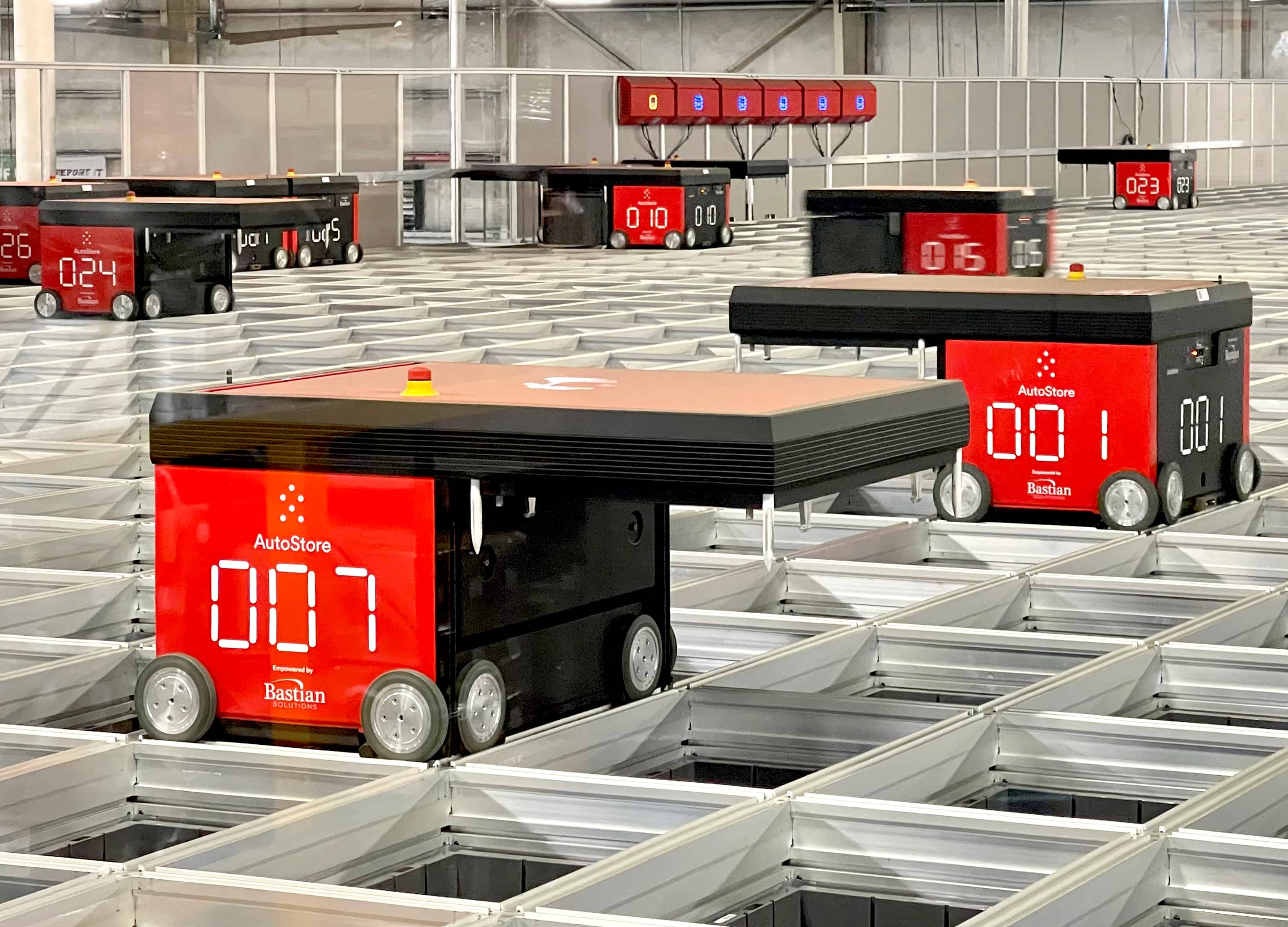
Kenco’s AutoStore in Louisville and expansion of robotic picking pilots illustrate the growing shift toward automated throughput.
Autonomous Operations
1 of 4
Multi-use robotics and scalable automation platforms gained traction across profiles and industries.
Flexible Automation & Robotics
XI. Final Takeaway
The Big Picture for 2026
The supply chain industry entered 2026 on the cusp of a long-awaited correction.
While economic momentum remains fragile, companies that invest in agility—through automation, smarter procurement, diversified sourcing, and stronger digital infrastructure—will be positioned to navigate volatility and emerge stronger.
End-of-Year Supply Chain Trending Report 2025 | 11
In one takeaway, what is your biggest prediction for how supply chains will fundamentally change in 2026?
In early 2026, the biggest supply-chain disruptor won’t be a single shock, but the cumulative impact of deepening geopolitical and trade fragmentation. As supply networks regionalize and costs rise, inflation pressure will increasingly be felt by the consumer — forcing companies to balance resilience with affordability. The winners will be those that use flexible sourcing, diversified logistics networks, invest in automation, and real-time analytics to absorb disruption without simply passing costs downstream.
The most resilient supply chains will balance cost discipline with flexibility, using diversified sourcing, adaptive logistics networks, automation, and real-time analytics to absorb disruption without simply passing costs downstream.
Resilience
Intelligent Operations
Flexibility
The winners of 2026 will be defined by:
© 2026 Kenco | 2001 Riverside Drive, Chattanooga, TN | KencoGroup.com
Kenco is a top-ranked, third-party logistics service provider. For over 75 years, Kenco’s clients have been the central focus of everything we do. Our expert team delivers agile, best-in-class logistics solutions, including Distribution, eCommerce Fulfillment, Transportation Management, Material Handling Equipment Services, Engineering, and data-driven Supply Chain Solutions—all designed for operational excellence. Visit Kenco at KencoGroup.com
Contact Us
End-of-Year Supply Chain Trending Report 2025 | 12