Related Insights
How AI in Recruiting is Reshaping Hiring

CEO & Board Survey 2025: Risky Business
Top 5 Leadership Trends of 2025
READ THE
FULL MAGAZINE
VIEW THE
PODCAST



At the same time, down in Washington, D.C., some of the firm’s top executives are holding a strategy meeting related to pending regulatory changes. And guess what? The CEO is here, too, via Zoom, listening intently while occasionally sipping from a bottle of water. Then, over in London, where it’s 2 PM, the same CEO is looking relaxed and casual, wearing jeans and a quarter-zip fleece while answering questions via video from participants in a leadership-development program.
More than a few CEOs have wished they could be in more than one place at a time. Now they can be, as the leaders of two publicly traded companies proved earlier this year when they used AI avatars as stand-ins during earnings calls. At the time, some people viewed the avatars as a stunt to grab headlines; others saw them more as a declaration of an AI-first strategy. Whatever they felt, everyone was talking about it. “It signaled a level of trust and comfort with AI that I haven’t seen from leaders with other technologies,” says Tamilla Triantoro, a professor of business analytics and information systems at Quinnipiac University.
AI: The initials alone evoke a myriad of reactions across the globe, with a universal one being that something “big” is looming. But in most corporate hallways, a lot of the talk about AI frames it as a destination, a place firms will eventually reach in a few years. Many firms say they are “preparing” for AI, with studies showing that leaders expect its impact to show up in their business in two to five years. But experts who know this technology have a simple phrase for that: Don’t believe it. AI isn’t something on the horizon, they say. It’s here, now, everywhere. Some of its uses are well-known: You’ve probably been texted or called by a chatbot about an exciting job opportunity that matches your profile. And you can’t book a hotel or flight anymore without encountering an AI agent. Internally, managers and employers are increasingly using ChatGPT and other models not just to automate tasks, but to help make decisions and provide advice.
But this just scratches the surface. For the better part of this year, supply-chain leaders have been using AI to run tariff-response strategies to game out scenarios and plans of action. Financial, tech, and other companies have deployed teams of “AI employees” to staff entire business lines or functions. The speed of AI advancement may be matched only by the sophistication of its applications, says Korn Ferry’s head of AI strategy and transformation Bryan Ackermann. “An AI application goes from being a game-changing breakthrough to a commodity to obsolete in a cycle we’ve never seen before,” he says.
Too many leaders are
putting off deciding how
to handle this once-in-a-
generation technology.
The problem
Firms that capitalize
best on AI will likely
bury competitors.
why it matters
Move quickly to set
AI strategies and to
partner workforces
with the technology.
The solution
The Mind Meld

How AI in Recruiting
is Reshaping Hiring
CEO & Board Survey 2025: Risky Business
Lessons from Other Turbulent Times
Top 5 Leadership Trends of 2025

VIEW THE
PODCAST
READ THE
FULL MAGAZINE
As AI bursts onto the
scene, firms are grappling with how to bring in the missing link: humans.
By Peter Lauria / Illustrations by Tim Ames


I
t’s 9 AM in New York, and the CEO and directors are filing into the conference room to begin their board meeting. Dressed in a navy blue power suit, the CEO takes his seat at the head of the large mahogany table and calls the meeting to order.



layoffs or hiring freezes that the technology will cause. The best solution, say experts, is to focus not just on the technology, but on humans. Indeed, a recent Korn Ferry survey of 250 CEOs and board directors globally found that 82 percent of leaders say they believe AI will replace less than 20 percent of the workforce in the next two to three years. The challenge for leaders is to figure out how the rest of the workers will merge their brainpower with machine intelligence. “When thinking about the ROI of AI,” says Triantoro, “one of the key questions to ask is, ‘How will your people react to it?’”
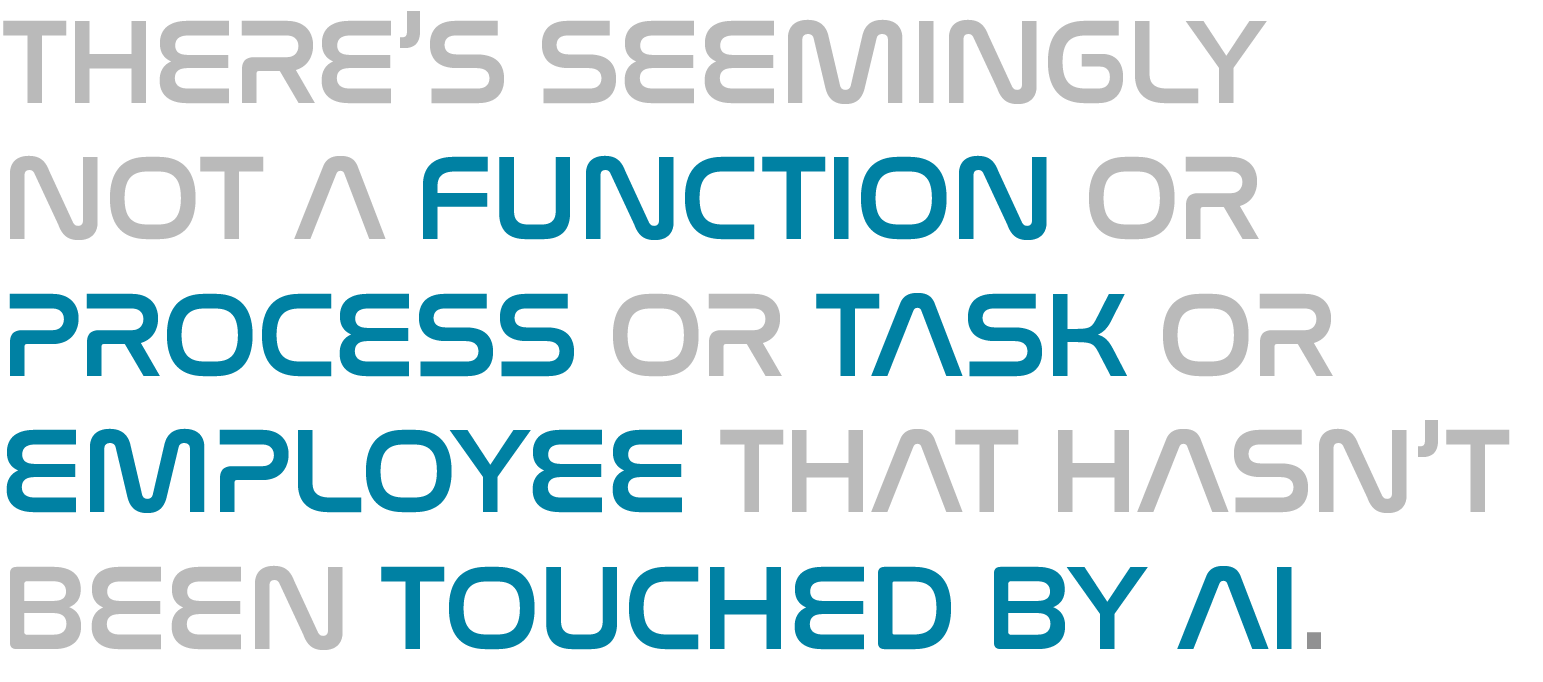
Change comes slowly, as they say, and then all at once. That seems to be the case with AI. Seemingly no function, process, task, or employee hasn’t been touched by the technology. It’s multiple things at once: tool, platform, colleague, business model. Each new use presents both practical benefits and existential risk. Moreover, the transformative changes AI has brought to the business landscape in three years are nothing compared to the changes to come. Here, we look at how firms and leaders are incorporating AI—and humans—into the workplace, from leadership development to operations to how they approach clients and customers.
CUSTOMER & CLIENT SERVICES
4: CUSTOMER & CLIENT SERVICES
3: OPERATIONS >
3: OPERATIONS >
2: LEADERSHIP >
2: LEADERSHIP >
1: WORKPLACE >
1: WORKPLACE >
NEXT: WORKPLACE >
4: CUSTOMER & CLIENT SERVICES >
4: CUSTOMER & CLIENT SERVICES >
3: OPERATIONS
2: LEADERSHIP >
2: LEADERSHIP >
1: WORKPLACE >
1: WORKPLACE >
NEXT: CUSTOMER & CLIENT SERVICES >
Historically speaking, leaders aren’t known for being early adopters. Workers of a certain age can remember a time when executives printed out emails and fumbled with BlackBerrys. If a tech advance reached the top of the house, it did so haltingly and after much resistance.
It’s not like that anymore. AI has already made it into corner offices everywhere, from large multinational organizations to small independent firms. Part of that is because clients both expect and demand it. “Clients are very keen to know how we are using AI in our services,” Rubino says. Underscoring the conundrum AI poses, he says clients want to see that the technology is saving them money on billable hours, while at the same time they “are keenly aware if we are only using AI.”
LEADERSHIP
4: CUSTOMER & CLIENT SERVICES >
4: CUSTOMER & CLIENT SERVICES >
3: OPERATIONS >
3: OPERATIONS >
2: LEADERSHIP
1: WORKPLACE >
1: WORKPLACE >
NEXT: OPERATIONS >
It took 15 years before email became mainstream in corporate offices. The internet and social media got there a bit quicker, taking only a decade to become commonplace. It took generative AI less than three years.
AI already runs through the workplace—from the front lines to the back office, and everywhere in between. ChatGPT is now in three-quarters of offices globally. Last year, the percentage of employees who reported regularly using ChatGPT for work tasks swelled to almost 30 percent, from 8 percent in 2023. And things are just getting started. By now, even the most diehard Luddite is familiar with the text-based prompt interface of platforms like ChatGPT and their ability to return market data, create client presentations, and write business proposals in nanoseconds. Upgraded versions have additional capabilities that can perform financial modeling, write code, and even recommend and prioritize action plans. Russ Rubino, a principal with strategic marketing and communications firm CorpBridge Advisors (he has worked on IPOs for Spotify, Blue Buffalo, and Snapchat), has come to view ChatGPT as an indispensable brainstorming partner for content creation, competitive analysis, and proposal writing. Recently, for instance, he helped program an entire content series around cloud computing for an information-technology client. He says that ChatGPT got him up to speed on the industry “easily 10 times faster than it would have taken me to do the research on my own.”
To be sure, employees who use AI for work tasks report being 68 percent more productive than they were previously, saving one to three hours daily. But even though he’s a big fan of AI, Rubino echoes a common complaint about the technology’s lack, for want of a better phrase, of a human touch. He notices it when he prepares a campaign around a client’s voice, style, and purpose. “ChatGPT is great for the base research,” he says, “but it doesn’t know the brand’s nuances and market reputation like I do.”Despite many such imperfections, AI has raced into the workplace, transcribing notes, assisting in training and development, and updating sales forecasts, among literally thousands of other uses. This, too, has revolutionized how we work. Nowhere is that more evident than with so-called AI agents, which take large language models one step further with their ability to include contextual clues and make decisions autonomously, instead of just returning information, while performing tasks and even filling roles. Already, these agents have been popularized in everything from ad campaigns featuring Hollywood bros Woody Harrelson and Matthew McConaughey to actual signs posted on the streets of San Francisco encouraging firms to stop hiring humans. And the allure is easy to see: AI agents can complete tasks
WORKPLACE
4: CUSTOMER & CLIENT SERVICES >
4: CUSTOMER & CLIENT SERVICES >
3: OPERATIONS >
3: OPERATIONS >
2: LEADERSHIP >
2: LEADERSHIP >
1: WORKPLACE
NEXT: LEADERSHIP >


Encourage boldness
Redeploy and transition ethically
Be agile in recruiting
Korn Ferry found that only 9 percent of leaders in a recent survey had the combination of behaviors and experiences need-ed for the AI era. By contrast, 91 percent exhibited
predominantly “business as usual” mindsets and behaviors. “Leaders keep telling us they believe becoming a digital and AI-enabled company will determine their competitiveness in the years to come,” Bauriedel says. “But the knowledge gap remains substantial.”
Assess AI
readiness
Assess AI
readiness
Encourage boldness
Encourage
boldness
Redeploy and transition ethically
Redeploy and transition ethically
Be agile in recruiting
Be agile in recruiting
Design jobs differently
Design jobs differently


Assess AI
readiness
Assess AI
readiness
Design jobs differently
How to restructure positions for AI is another people-related challenge for orgs, says Korn Ferry’s Bryan Ackermann. What does the role of managers look like in the AI world? How will automation impact job families if certain roles go away? Where firms are on that �journey runs the gamut. Some clients have identified one-third or more jobs across sales, legal, finance, and other functions that will need to change in terms of responsibilities and scope, says Ackermann. Others haven’t even begun the process. “It isn’t just a question of automating a role or not,” he observes. “For leaders, it’s
a question of how does the organization need to change because
of that decision.”
Design jobs differently
AI has made hiring simultaneously easier and more difficult. Automation increases efficiency for both applicants and recruiters, but also—as critics have noted—can miss promising candidates or �demonstrate bias. Predictive-analytics platforms (such as Korn Ferry’s Nimble Recruit) pair experts in human resources and recruiting with advanced AI capabilities to pinpoint specific skills
and assess talent supply. Korn Ferry’s Jerry Collier says identifying AI-ready talent is about more than just tech skills. “It takes a different mindset,” he says.
Be Agile in recruiting
There’s no point in denying that jobs will be lost to AI. Korn Ferry’s Chris Cantarella notes, “Companies are going to lose a lot of trust and loyalty for allowing this to happen.” Experts say smart firms and leaders are rightly looking at ways beyond typical outplacement offerings to help those affected, part of emphasizing a human
touch for displaced employees. “Socially responsible employers
are seriously considering the moral and ethical aspects of AI,”
says Bauriedel, noting that doing so sends an important signal
to remaining and prospective employees.
Redeploy and �transition ethically
More than half of US workers in a recent survey said their company’s AI policies were unclear, and that confusion—combined with fears about the technology’s future impact—may mean many will hide their use of it. That could be a bigger deal than it seems, since it
may hold firms back from uncovering “enterprise-wide innovations,” says Bauriedel. Another study found that employees don’t disclose their AI use to colleagues and managers for fear of negative repercussions. “The risk of losing out on enterprise-wide innovations is much greater than the risk of people making mistakes from trying things out,” Bauriedel says.
Encourage
boldness
While AI-related layoffs remain a major fear among workers, studies and research abound confirming the importance of successfully marrying humans with AI—for business, for culture, and for society. The goal shouldn’t be to replace jobs, says Wolfgang Bauriedel, a senior client partner in the Technology and Digital practice at Korn Ferry. Instead, there should be a continuum from humans to AI tools. “It’s not AI that will replace your job,” says Bauriedel.
“It’s the people who successfully leverage and use AI who will.”
Here are five ways our experts say firms can solve the “people problem” AI poses:

with minimal human direction or intervention while working over long periods of time and handling complex assignments. There are now websites and job boards devoted solely to AI-agent candidates, and some start-ups are staffed exclusively by so-called “synthetic employees.” All of this creates considerable anxiety for human workers.
And along with the added stress, the deployment of AI agents has become a bit of a “Wild West,” says Triantoro: “For the most part, right now AI agents are doing narrow tasks that help individuals.” There’s little order or strategy to how firms are using AI agents, she adds. Some encourage employees to create AI agents on outside platforms; others build their own internally. Most agents are being created in isolation, which further complicates the job of integrating them across the enterprise so they can speak to each other.
And with AI agents come real human consequences as well. For starters, they could erode employees’ critical skills such as decision-making, problem-solving, communication, and more, says Mark Esposito, a professor, founder, and globally recognized leader in the application of AI in business. “Humans don’t feel in the loop,” he says. Allowing employees to develop AI agents without corporate oversight or a governance framework could expose a firm to data and privacy breaches and other kinds of liability. There’s also the optics to think about, says Triantoro. Employees don’t feel particularly valued or trusted as it is, she says, and now firms are replacing them with AI agents. “Lots of employees are saying, ‘Hey, I’m an actual human over here, how much do you value me?’”

In early spring, executives from project44, an AI supply-chain firm, were summoned to the White House to discuss various scenarios around tariffs and their impact on shipping. Trade officials wanted to know what project44’s 8 billion data points worldwide—including weather patterns, ocean tides, shipping routes, port-congestion records, social media, and more—were seeing in real time. More importantly, however, they wanted to know what the data predicted based on where tariffs would be enacted and at what level. Jonathan Scherr, chief strategy and operations officer at project44, says its AI can project the likelihood of certain outcomes by analyzing how firms are changing and rerouting manufacturing, pulling forward or holding back inventory, and other actions. “Our AI helps firms go from a defensive to an offensive posture, which can greatly mitigate losses,” says Scherr.
AI’s impact on supply chains and the other nuts-and-bolts of a company’s operations, unglamorous though it may be, is arguably the most dramatic. On a large scale, firms are fine-tuning predictive-analytics platforms for budget planning, inventory forecasting, talent management, and more. Banks like JPMorganChase have long used these platforms for investment strategies and fraud detection, for example, while big consumer-products companies commonly deploy “digital twins” to predict market demand and devise forecasting strategies. Josh Rabinowitz, a music supervisor and producer who works with major consumer brands and entertainment companies, uses a platform called DISCO to help curate songs for potential use in films, TV, commercials, and other media. “I sometimes have to sift through thousands of songs and isolate specific tracks, and AI helps streamline the curation,” he says.
Predictive AI is far from perfect, however. Pinpointing when the next missile attack, pandemic, or labor strike might occur isn’t an exact science. Or, as Scherr puts it, “Black swan events are still black swan events.” Moreover, the fact that AI can make a call doesn’t necessarily mean it will make a good one. Predictions are only as good as the data they are based on, after all. A sudden change in consumer behavior could easily lead to an inventory miscalculation. Sometimes it isn’t clear how AI has arrived at a decision, which can have serious repercussions if, for instance, a bank denies a loan based on faulty reasoning or biased data. “Leaders think they want to have everything automated, but do they really understand what taking humans out of the equation means?” asks Triantoro, the Quinnipiac professor.



has its drawbacks, from the frustration chatbots elicit in job candidates to the need to restructure roles and careers. Do you retrain an employee, or automate the role? Do you merge roles horizontally or vertically? “Leaders are struggling to figure out how to reorganize their firms for AI,” says Jerry Collier, solution leader of the Assessment and Succession practice in Europe, the Middle East, and Asia for Korn Ferry.
Even among those firms fully engaged with AI, some are struggling to figure
out how to make it work for them. Studies suggest that only half of AI projects survive past the pilot stage, and of those that do, a glaring number don’t ultimately scale to a level of meaningful cost savings or business impact. Perhaps that’s why so many business leaders worry about losing their jobs or long-term career opportunities if they don’t show measurable business gains from AI. “Leaders are just as worried about killing themselves with the wrong applications of AI as they are with anything else,” says Matt Beane, a professor of technology management and researcher at the University of California, Santa Barbara.
OPERATIONS

It’s highlighted in a tiny oval next to the navigation menu on Amazon’s home page: Against a white background, in black letters, is a button for “Rufus”, the retail giant’s AI-powered “shopping assistant.” A lot is riding on Rufus, strategically and financially, not just for Amazon but for customer-facing firms across industries. And after a slow start, the chatbot helped traffic grow 300 percent this year, according to Amazon.
Banks, healthcare providers, travel and hospitality companies, streaming-media services, and even utilities firms all have their own AI-powered chatbots. Nowadays, hotel guests are more likely to be greeted on the phone by a digital agent than an actual person. And they seem to prefer it that way. One user on Reddit praised the digital concierge at a Marriott Renaissance, writing that “it didn’t just suggest a restaurant, it knew my preferences.” Big-box retailers like Lowe’s and independent platforms like KitchenDesign.io allow people who upload photos to use VR and 3D to step into their own kitchen redesigns, all without human assistance. To be sure, while riding in a Waymo in Arizona recently, Jay Sherman, an executive at credit-rating agency Moody’s, was struck by how nonchalant people have already become about driverless cars. “People trust these cars to within a half-inch of their lives,” he noted.
On the organizational side, the more firms deploy AI into customer- and client-facing roles, the harder the job becomes for its human coworkers, technology-management professor Beane notes. Since AI is increasingly capable of resolving routine issues, the ones that remain for people to solve will necessarily be more complicated and more emotional. “The human is going to be lobbed flaming curveballs much more often,” says Beane. “That’s the interesting part about AI:
It isn’t what the technology can do, but how work and jobs for humans will change because of it.”

It took 15 years before email became mainstream in corporate offices. The internet and social media got there a bit quicker, taking only a decade to become commonplace. It took generative AI less than three years.
AI already runs through the workplace—from the front lines to the back office, and everywhere in between. ChatGPT is now in three-quarters of offices globally. Last year, the percentage of employees who reported regularly using ChatGPT for work tasks swelled to almost 30 percent, from 8 percent in 2023. And things are just getting started. By now, even the most diehard Luddite is familiar with the text-based prompt interface of platforms like ChatGPT and their ability to return market data, create client presentations, and write business proposals in nanoseconds. Upgraded versions have additional capabilities that can perform financial modeling, write code, and even recommend and prioritize action plans. Russ Rubino, a principal with strategic marketing and communications firm CorpBridge Advisors (he has worked on IPOs for Spotify, Blue Buffalo, and Snapchat), has come to view ChatGPT as an indispensable brainstorming partner for content creation, competitive analysis, and proposal writing. Recently, for instance, he helped program an entire content series around cloud computing for an information-technology client.
He says that ChatGPT got him up to speed on the industry “easily 10 times faster than it would have taken me to do the research on my own.”
To be sure, employees who use AI for work tasks report being 68 percent more productive than they were previously, saving one to three hours daily. But even though he’s a big fan of AI, Rubino echoes a common complaint about the technology’s lack, for want of a better phrase, of a human touch. He notices it when he prepares a campaign around a client’s voice, style, and purpose. “ChatGPT is great for the base research,” he says, “but it doesn’t know the brand’s nuances and market reputation like I do. ”Despite many such imperfections, AI has raced into the workplace, transcribing notes, assisting in training and development, and updating sales forecasts, among literally thousands of other uses. This, too, has revolutionized how we work. Nowhere is that more evident than with so-called AI agents, which take large language models one step further with their ability to include contextual clues and make decisions autonomously, instead of just returning information, while performing tasks and even filling roles. Already, these agents have been popularized in everything from ad campaigns featuring Hollywood bros Woody Harrelson and Matthew McConaughey to actual signs posted on the streets of San Francisco encouraging firms to stop hiring humans. And the allure is easy to see: AI agents can complete tasks with minimal human direction or intervention while working over long periods of time and handling complex assignments. There are now websites and job boards devoted solely to AI-agent candidates, and some start-ups are staffed exclusively by so-called “synthetic employees.” All of this creates considerable anxiety for human workers.
And along with the added stress, the deployment of AI agents has become a bit of a “Wild West,” says Triantoro: “For the most part, right now AI agents are doing narrow tasks that help individuals.” There’s little order or strategy to how firms are using AI agents, she adds. Some encourage employees to create AI agents on outside platforms; others build their own internally. Most agents are being created in isolation, which further complicates the job of integrating them across the enterprise so they can speak to each other.
And with AI agents come real human consequences as well. For starters, they could erode employees’ critical skills such as decision-making, problem-solving, communication, and more, says Mark Esposito, a professor, founder, and globally recognized leader in the application of AI in business. “Humans don’t feel in the loop,” he says. Allowing employees to develop AI agents without corporate oversight or a governance framework could expose a firm to data and privacy breaches and other kinds of liability. There’s also the optics to think about, says Triantoro. Employees don’t feel particularly valued or trusted as it is, she says, and now firms are replacing them with AI agents. “Lots of employees are saying, ‘Hey, I’m an actual human over here, how much do you value me?’”
30%
Percentage of
workers using
ChatGPT:

KEY STATS:
Making sure humans "feel in
the loop" as companies turn to the technology.
Size of global
AI-agent market:
$7 billion
KEY CONCERN:
NEXT: LEADERSHIP >
Leaders deciding correctly when �to automate roles and when to �retrain employees.
KEY CONCERN:

Percentage
of AI projects adopted following pilot stage:
50%
KEY STATS:
Percentage
of AI pilots
that generate meaningful ROI:
On the management side, AI is showing up in small and medium-sized firms at
a stunning rate. About 40 percent of such firms in North America are actively using AI tools, and by next year an estimated 75 percent globally will have undertaken at least one AI project. Emanuele Criscione, CEO and founder of life-sciences consulting firm LCN Consulting, says he started using AI about a year ago to track projects, aggregate billable hours, and generate client updates, among other tasks. Since his firm’s workers—a mix of employees, contractors, and individual contributors—are handling different aspects of a project at any one time, Criscione says, AI helps them save hours, if not days, of manually going through spreadsheets. “There are very tangible things we use AI for to help free us up for other work for our clients,” he says.
AI shows up in executive leadership in other, subtler ways as well—such as determining who is hogging the meeting. Equaltime.io, whose 2,800 customers include online-education, travel, and government-services firms, is a meeting-summary tool that calculates talking times by gender and participant, analyzes speech and video for sentiment, and provides an overall inclusion score. Its newest features provide action steps for managers and employees on such things as how to handle being interrupted or “mansplained” to, says cofounder Rachel Dowling, who developed the platform after 15 years as a tech executive. “We help move the needle on culture, which helps with recruiting and retention,” she says, adding that one client saw a 65 percent increase in speaking time for women during meetings after only a few months of using the platform.
As firms cut layers and layers of middle management, AI has become a vital
tool for keeping up: Those who remain are deploying AI agents and avatars, as well as managing them as direct reports. AI is also altering talent-management functions like recruiting and performance reviews. Here, too, the technology
21%

Predictive AI can be a great but imperfect tool for operations, so firms should trim staffs conservatively.
KEY CONCERN:

Percentage of firms that have partially integrated
AI into operations:
57%
KEY STAT:
Anywhere from 30% to 50% of consumers report unfavorable experiences with chatbots.
KEY CONCERN:

Percentage of firms
adopting AI-powered chatbots for
customer service:
80%
KEY STAT:
But it’s with chatbots that the need for a mind meld with humans may be greatest. Everyone has no doubt experienced the “spiral of misery” that comes from being misdirected or misunderstood by a chatbot, despite years of efforts to improve the technology. Deepfakes and other scams pose all sorts of risks to firms as well. Rabinowitz, who frequently travels to speak at conferences around the world, recalls how a friend almost booked a hotel room on the wrong island because a travel website said it was only 15 miles from where they needed to be—which it was; just by water, not roads. Failing at basic tasks is a problem even the biggest platforms suffer from. Matt Twomey, a copywriter and filmmaker, says what AI can’t do amazes him as much as what it can. “I asked Claude [Anthropic’s AI] to give me the page and word count for each chapter of this book I’m working on, which was something Word could do in the 90s, and it failed,” he says.

Korn Ferry found that only 9 percent
of leaders in a recent survey had the combination of behaviors and experiences need-ed for the AI era.
By contrast, 91 percent exhibited predominantly “business as usual” mindsets and behaviors. “Leaders
keep telling us they believe becoming
a digital and AI-enabled company will determine their competitiveness in
the years to come,” Bauriedel says.
“But the knowledge gap remains substantial.”
Assess AI readines
How to restructure positions for AI is another people-related challenge for orgs, says Korn Ferry’s Bryan Ackermann. What does the role of managers look like in the AI world? How will automation impact job families if certain roles go away? Where firms are on that journey runs the gamut. Some clients have identified one-third or more jobs across sales, legal, finance, and other functions that will need to change in terms of responsibilities and scope, says Ackermann. Others haven’t even begun the process. “It isn’t just a question of automating a role or not,” he observes. “For leaders, it’s a question of how does the organ-ization need to change because of that decision.”
Design jobs differently
AI has made hiring simultaneously
easier and more difficult. Automation increases efficiency for both app-licants and recruiters, but also—as critics have
noted—can miss promising candidates or demonstrate bias. Predictive-analytics platforms (such as Korn Ferry’s Nimble Recruit) pair experts in human resources and recruiting with advanced AI capa-bilities to pinpoint specific skills and assess talent supply. Korn Ferry’s Jerry Collier says identifying AI-ready talent
is about more than just tech skills. “It takes a different mindset,” he says.
Be agile in recruiting
There’s no point in denying that jobs
will be lost to AI. Korn Ferry’s Chris Cantarella notes, “Companies are going to lose a lot of trust and loyalty for allowing this to happen.” Experts say smart firms and leaders are rightly looking at ways beyond typical outplacement offerings to help those affected, part of emphasizing a human
touch for displaced employees. “Socially responsible employers are seriously considering the moral and ethical aspects of AI,” says Bauriedel, noting that doing so sends an important signal to remaining and prospective employees.
Redeploy and transition ethically
More than half of US workers in a recent survey said their company’s AI policies were unclear, and that confusion—combined with fears about the technology’s future impact—may mean many will hide their use of it. That could be a bigger deal than it seems, since it
may hold firms back from uncovering “enterprise-wide innovations,” says Bauriedel. Another study found that employees don’t disclose their AI use to colleagues and managers for fear of negative repercussions. “The risk of losing out on enterprise-wide innovations is much greater than the risk of people making mistakes from trying things out,” Bauriedel says.
Encourage
boldness
new jobs globally this year
by 2030
$1.81
trillion
AI by the Numbers
The global AI market
is expected to reach
AI is expected to create more than
97 million
of US companies are using ChatGPT
half
Nearly
companies deem
AI to be a top
priority in their
business strategy
4 in 5
Around
How businesses adopt ai
Don't use AI currently,
but are looking into it
7%
A Look at current company usage of Ai
Are experimenting with use case but haven't moved to pilot stage
14%
Have started implementing limited AI use cases
33%
Have promising pilot concepts and are looking to scale
21%

The money firms are spending on AI hasn’t been seen before either. UBS estimates global AI spending will increase 60 percent year-over-year, hitting $360 billion in 2025 and rising to $480 billion in 2026. A not insignificant share of that is going to talent, with tech firms offering nine-figure compensation packages to top researchers. It’s a small price to pay for the promise of more productivity at a lower cost. AI agents, according to Morgan Stanley, could boost the earnings of S&P 500 companies by 28 percent or more next year.
But with business being so steeped in AI, experts worry that something critical is being left out: the human role. Sure, firms talk about humans as “partners” with AI, but at the same time many of them are openly discussing