Why Location Intelligence Is the Missing Layer in Facilities Management
Written by: Paul McBride
...On California Climate Change Disclosure Rules
Written by Leslie Wong and Hussein Sayani
BACK TO HOMEPAGE
Share on Social Media!


Leslie Wong
Senior Associate
lwong@langan.com
Hussein Sayani
Senior Project Manager
hsayani@langan.com


Paul McBride�Senior Project Manager

Building upon Investments
One of the greatest misconceptions surrounding digital transformation is that organizations must replace their existing technology to modernize operations. In reality, the most successful organizations build upon the investments they have already made.��
Enterprise Asset Management systems, IWMS platforms, CMMS solutions, CAD drawings, IoT devices, and enterprise business applications continue to serve important purposes. The opportunity lies in connecting these systems through a common geographic framework that allows information to flow more effectively across departments. Rather than creating another data silo, location intelligence becomes the operational layer that helps existing systems deliver greater value.��
Looking Ahead
Facilities are becoming increasingly connected, intelligent, and data-driven. As organizations continue to invest in digital transformation, the ability to integrate information across systems will become just as important as the systems themselves.
The future of facilities management isn't defined by another application or another database. Instead, it's defined by providing the right information to the right people at the right time.��
Location intelligence helps organizations achieve exactly that by transforming disconnected facility information into connected operational insight.
As organizations modernize their campuses, buildings, and infrastructure, prioritizing the connection of existing systems is key to improving efficiency, facilitating better decision-making, and maximizing the value of every facility.��
How Langan Can Help
For organizations looking to connect their existing enterprise systems without replacing them, Langan's IndoorFusion solution provides a modern approach to integrating facility and operational data through location intelligence.��
IndoorFusion brings together GIS, IWMS, CMMS, enterprise asset management, CAD/BIM, IoT, and other business systems into a single operational view, enabling organizations to visualize assets, spaces, work orders, and building information in context. Rather than creating another data silo, IndoorFusion enhances the value of your existing technology investments by making information easier to access, understand, and act upon.�
Whether you're implementing a new facilities management strategy, modernizing existing operations, or looking to better connect the systems you already own, Langan combines deep expertise in GIS, digital engineering, and enterprise system integration to help organizations improve operational efficiency, enhance decision-making, and build a scalable foundation for the future.

Why Location Intelligence Is the Missing Layer in Facilities Management��
Organizations today have no shortage of facility data. From work orders and asset inventories to space assignments, building plans, occupancy metrics, and maintenance records, information exists across dozens of systems. Yet despite these investments, many facility leaders continue to face the same challenge: this wealth of information remains disconnected.
When maintenance teams, facility managers, planners, executives, and emergency responders rely on separate applications and data sources, decision-making moves slower, collaboration becomes more difficult, and operational improvement opportunities are often missed.
The evolution of facilities management isn't about replacing existing applications and data sources, however—it's about connecting it.
�Moving Beyond Systems of Record��
Many organizations have invested heavily in enterprise systems that perform specific functions exceptionally well. Computerized maintenance management systems (CMMS), integrated workplace management systems (IWMS), building automation systems, CAD drawings, IoT sensors, and enterprise asset management platforms all play important roles in daily operations.��
The challenge isn't the quality of these systems. Rather, it's the lack of context between them.��
Location intelligence fills in the missing context by creating a composite operational picture. Instead of viewing work orders, assets, spaces, and building information independently, organizations can understand how these elements relate to one another spatially and operationally.
When information is connected geographically, teams gain a clearer understanding of where work is happening, what assets are affected, how spaces are utilized, and what operational impacts may occur.��
GIS Has Evolved into an Operational Platform
For many people, GIS is still primarily associated with mapping. While mapping remains a core capability of GIS, modern systems have evolved into something much more powerful.��
Today's GIS platforms integrate data from multiple business systems to create a living digital representation of facilities and campuses. Floor plans become interactive operational environments; assets become intelligent objects connected to maintenance histories, inspections, and documentation; and space information becomes immediately accessible for planning, occupancy analysis, and emergency response.
Rather than replacing existing systems, GIS enhances their value by providing a unified operational view.��
��
�
Turning Buildings into Connected Digital Assets
Every building tells a story, and understanding that story requires more than a view of the floor plan. Picture this: a technician responds to a maintenance request. Instead of receiving static information with a work order number and room identifier, they are guided directly to the asset through indoor mapping. The same platform allows them to review maintenance history before arriving, access associated documentation, identify nearby shutoffs and supporting infrastructure, and complete updates in real time.�
Now expand that experience to facility managers monitoring space utilization, executives reviewing portfolio performance, emergency responders navigating unfamiliar buildings, or planners evaluating future capital investments.��
When facility information is connected through location intelligence, every stakeholder benefits from improved awareness and more informed decision-making.
Supporting the Entire Facility Lifecycle
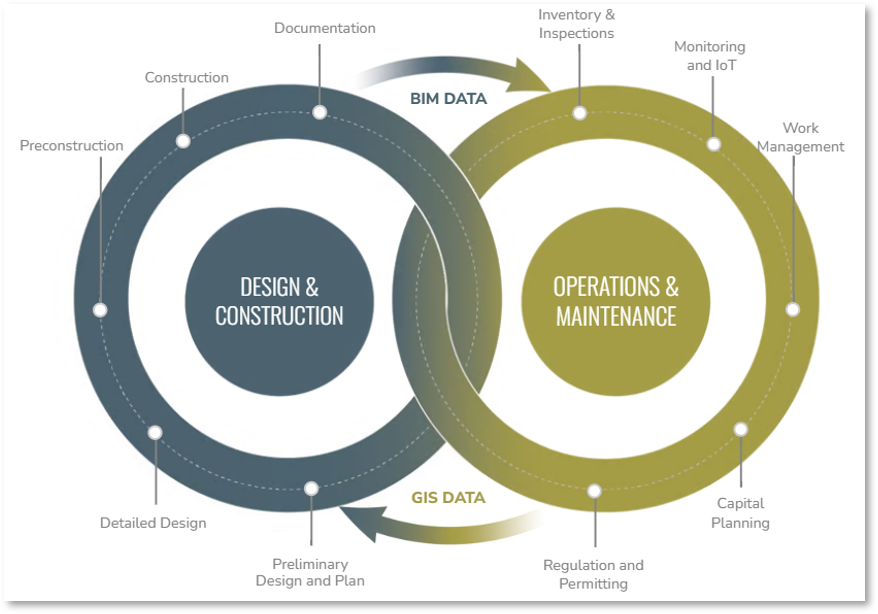
Connected location intelligence extends well beyond daily maintenance activities, supporting organizations throughout the entire lifecycle of their facilities.��
With this support, teams can visualize assets and infrastructure before projects begin; operations staff can prioritize maintenance based on an asset’s condition and location; space planners can evaluate occupancy trends and optimize utilization; and capital planners can make informed investment decisions using comprehensive operational data.��
This holistic approach allows organizations to shift from reactive management to proactive planning.��