STEPS COMMUNITIES
MAY TAKE IN EASING STAY-AT-HOME ORDERS
Lifting stay-at-home orders will vary by state, but several common measurements will likely impact those decisions
SCROLL

DOWN
The new normal for the near future
Practice good hygiene
Sources: Centers for Disease Control and Prevention, Guidelines to Open Up America Again; New York, California, Michigan and Wisconsin state governor's offices
Separate yourself from other people
and animals in your home
As much as possible, stay in a specific room. Use a separate bathroom, if available.
Limit contact with pets & animals: When possible, have another member of your household care for your animals while you are sick. If you must care for your pet, wash your hands before and after you interact with pets and wear a facemask.
Call ahead before visiting your doctor
Call ahead: If you have a medical appointment, call the healthcare provider and tell them that you have or may have COVID-19. This will help the healthcare provider’s office take steps to keep other people from getting infected or exposed.
Wear a facemask if you are sick
If you are sick, you should wear a facemask when you are around other people or pets and before you enter a healthcare provider’s office.
If you care for others, and a sick person isn’t able to use a facemask (for example, because it causes trouble breathing), wear a facemask if you enter a room with a sick person.
Cover your coughs and sneezes
Cover: Cover your mouth and nose with a tissue when you cough or sneeze.
Dispose: Throw used tissues in a lined trash can.
Wash hands: Immediately wash with soap and water for at least 20 seconds or use an alcohol-based hand sanitizer that contains at least 60% alcohol.
Clean your hands often
Wash hands: Wash your hands often with soap and water, especially after blowing your nose, coughing, or sneezing; going to the bathroom; and before eating or preparing food.
Sanitizer: If using hand sanitizer, cover all surfaces of your hands and rub until they feel dry.
Avoid touching: Avoid touching your eyes, nose, and mouth with unwashed hands.
Avoid sharing personal household items
Do not share dishes, glasses, cups, utensils, towels, or bedding. After using these items, they should be washed thoroughly with soap and water.
Clean all “high-touch” surfaces everyday
Clean and disinfect: Practice routine cleaning of high-touch surfaces such as counters, tabletops, doorknobs, fixtures, toilets, phones, keyboards, tablets, and bedside tables. Use a household cleaning spray or wipe. Labels contain instructions for safe and effective use.
Monitor your symptoms
Seek prompt medical attention if your illness is worsening (e.g., difficulty breathing).
Call your doctor: Before seeking care, call your healthcare provider to tell them you have COVID-19.
Put on a facemask before you enter the facility. This will help keep other people in the office or waiting room from getting infected or exposed.
Isolating yourself
Persons who are placed under active monitoring or self-monitoring should follow instructions from the local health department.
Call 911 if you have a medical emergency: If you have a medical emergency and need to call 911, notify the dispatch personnel that you have, or are being evaluated for COVID-19. If possible, put on a facemask before emergency medical services arrive.


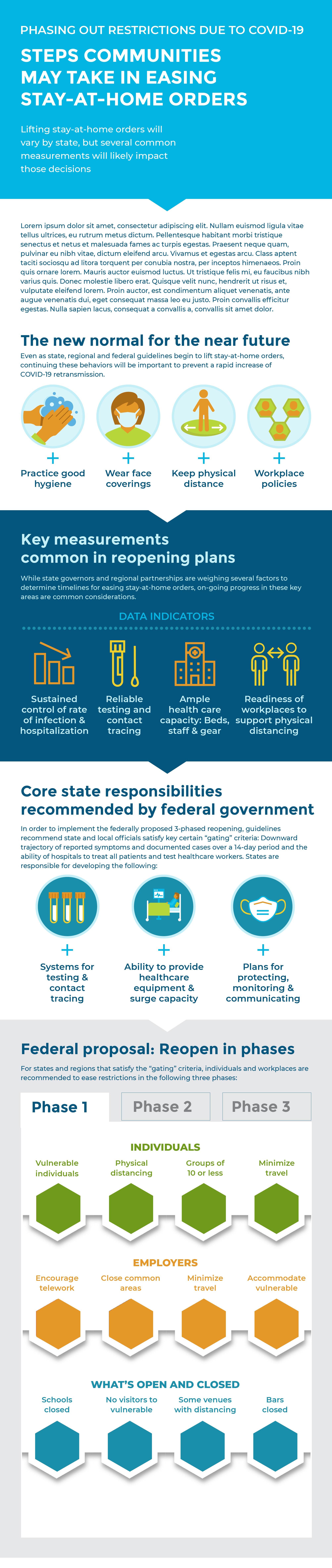
Even as state, regional and federal guidelines recomend lifting stay-at-home orders, continuing these behaviors will be important to prevent an increase of COVID-19 retransmission.

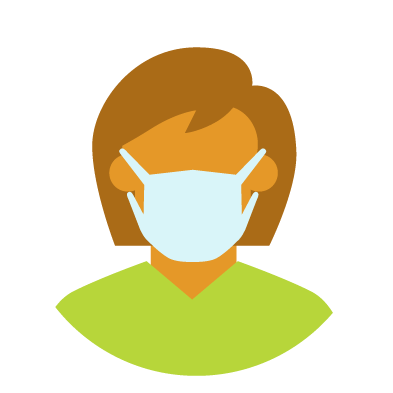
Wear face coverings
Keep physical distance
Workplace policies
While state governors and regional partnerships are weighing several factors to determine timelines for easing stay-at-home orders, on-going progress in these key areas are common considerations.
Key measurements
common in reopening plans
Sustained control of rate of infection & hospitalization
Reliable testing and contact tracing
Ample
health care capacity: Beds, staff & gear
Readiness of workplaces to support physical distancing
DATA INDICATORS
In order to implement the federally proposed 3-phased reopening, guidelines recommend state and local officials satisfy key certain “gating” criteria: Downward trajectory of reported symptoms and documented cases over a 14-day period and the ability of hospitals to treat all patients and test healthcare workers. States are responsible for developing the following:
Core state responsibilities recommended by federal government
Systems for testing & contact tracing
Ability to provide healthcare equipment & surge capacity
Plans for protecting, monitoring & communicating










- Wash your hands with soap and water or use hand sanitizer, especially after touching frequently used items or surfaces.
- Avoid touching your face.
- Sneeze or cough into a tissue, or the inside of your elbow.
- Disinfect frequently used items and surfaces as much as possible.
Practice good hygiene
- Continue to adhere to state, local and CDC guidance with respect to face coverings.
- Use face coverings while in public, and particularly when using mass transit.
Wear face coverings
- The CDC recomends all individuals in public should maximize physical distance from others. Stay at least 6 feet from other people.
- When COVID-19 is spreading in your area, everyone should limit close contact with individuals outside your household. Since people can spread the virus before they know they are sick, it is important to stay away from others when possible, even if you have no symptoms.
- Those who are sick should not go to work or school. Contact and follow advice of medical provider.
Keep physical distance
Federal guidelines recommend employers develop policies and industry best practices, regarding:
- Social distancing and protective equipment
- Temperature checks
- Sanitation
- Use and disinfection of common and high-traffic areas
- Business travel
Monitor workforce for COVID-19 symptoms and develop procedures for contact tracing employees who test positive for COVID-19.
Workplace policies
- Ability to quickly set up safe and efficient screening and testing sites and trace contacts of those testing positive for COVID-19.
- Ensure sentinel surveillance sites are screening for asymptomatic cases and contacts for COVID-19 positive results are traced (sites operate at locations that serve older individuals, lower-income Americans, racial minorities, and Native Americans)
Systems for testing & contact tracing
- Ability to quickly and independently supply sufficient personal protective equipment and critical medical equipment to handle dramatic surge in need
- Ability to surge ICU capacity
Ability to provide healthcare equipment & surge capacity
- Protect the health and safety of workers in critical industries, those living and working in high-risk facilities, and employees and users of mass transit.
- Monitor conditions and immediately take steps to limit and mitigate any rebounds or outbreaks by restarting a phase or returning to an earlier phase, depending on severity.
- Advise citizens regarding protocols for social distancing and face coverings.
Plans for protecting, monitoring & communicating
Elderly or individuals with serious underlying health condition should continue to shelter in place. Household members returning to work or other environments where distancing is not practical could carry the virus back home. Precautions should be taken to isolate from vulnerable residents.






Vulnerable individuals
Physical distancing
Groups of
10 or less
Minimize travel
INDIVIDUALS
All individuals, when in public (e.g., parks, shopping areas), should maximize physical distance from others. Social settings of more than 10 people, where appropriate distancing may not be practical, should be avoided unless precautionary measures are observed.
Avoid socializing in groups of more than 10 people in circumstances that do not readily allow for appropriate physical distancing (e.g., receptions, trade shows)
Minimize non-essential travel and adhere to CDC guidelines regarding isolation following travel.
Continue to encourage telework, whenever possible and feasible with business operations. If possible, return to work in phases.
Close common areas where personnel are likely to congregate and interact, or enforce strict social distancing protocols.
Minimize
non-essential travel and adhere to CDC guidelines regarding isolation following travel.
Strongly
consider special accommodations for personnel who are members of a vulnerable population.

Encourage telework

Close
common areas
Minimize
travel

Accommodate
vulnerable
EMPLOYERS
Schools and organized youth activities (e.g., daycare, camp) that are currently closed should remain closed.
Visits to senior living facilities and hospitals should be prohibited. Those who do interact with residents and patients must adhere to strict protocols regarding hygiene. Elective surgeries can resume on an outpatient basis at facilities that adhere to CMS guidelines.
Large venues (e.g., sit-down dining, movie theaters, sporting venues, places of worship) can operate under strict physical distancing protocols. Gyms can open if they adhere to strict physical distancing and sanitation protocols.
Bars should remain closed.

Schools
closed

Visitors & hospitals

Venues,
with distancing

Bars
closed
WHAT'S OPEN AND CLOSED
For states and regions that satisfy the “gating” criteria, individuals and workplaces are recommended to ease restrictions in the following three phases:
Federal proposal: Reopen in 3 phases
Phase 1
Phase 2
Phase 3
Phase 1
Phase 2
Phase 3
EMPLOYERS
Elderly or individuals with serious underlying health conditions can resume public interactions, but should practice physical distancing, minimizing exposure to social settings where distancing may not be practical, unless precautionary measures are observed.
Low-risk populations should consider minimizing time spent in crowded environments.
Resume unrestricted staffing of worksites.
Vulnerable individuals

Avoid
crowds

Unrestricted
staffing
INDIVIDUALS
Visits to senior care facilities and hospitals can resume. Those who interact with residents and patients must be diligent regarding hygiene.
Large venues (e.g., sit-down dining, movie theaters, sporting venues, places of worship) can operate under limited physical distancing protocols.
Gyms can remain open if they adhere to standard sanitation protocols.
Bars may operate with increased standing room occupancy, where applicable.
Visitors & hospitals
Venues,
with distancing
Bars remain open
WHAT'S OPEN AND CLOSED
Schools and organized youth activities (e.g., daycare, camp) can reopen.
Large venues (e.g., sit-down dining, movie theaters, sporting venues, places of worship) can operate under moderate physical distancing protocols. Gyms can remain open if they adhere to strict physical distancing and sanitation protocols.
Bars may operate with diminished standing-room occupancy, where applicable and appropriate.
Schools
open
Visitors & hospitals
Venues,
with distancing
Bars open, with distancing
WHAT'S OPEN AND CLOSED
Continue to encourage telework, whenever possible and feasible with business operations.
Close common areas where personnel are likely to congregate and interact, or enforce strict social distancing protocols.
Non-essential travel can resume.
Strongly
consider special accommodations for personnel who are members of a vulnerable population.
Encourage telework
Close
common areas
Travel is OK
Accommodate
vulnerable
EMPLOYERS
Elderly or individuals with serious underlying health condition should continue to shelter in place. Household members returning to work or other environments where distancing is not practical could carry the virus back home. Precautions should be taken to isolate from vulnerable residents.
All individuals, when in public (e.g., parks, shopping areas), should maximize physical distance from others.
Social settings of more than 50 people, where appropriate distancing may not be practical, should be avoided unless precautionary measures are observed.
Non-essential travel can resume.
Vulnerable individuals
Physical distancing
Groups of
50 or less
Trvel is OK
INDIVIDUALS
Visits to senior living facilities and hospitals should be prohibited. Those who do interact with residents and patients must adhere to strict protocols regarding hygiene. Elective surgeries can resume on an outpatient and
in-patient basis at facilities that adhere to CMS guidelines.