Allergens in the food industry
Australia has one of the highest rates of food allergies recorded in the world, affecting more than 1.5 million Australians. It also has one of the highest rates of hospital admissions due to anaphylaxis worldwide. Over the past five years, there has been a significant 51% rise in anaphylaxis cases reported in emergency departments of hospitals, with annual cases now exceeding 11,5001.
Undeclared allergens such as nuts present a major hazard in the food industry and are responsible for nearly half of all recalls. Between January 2020 and December 2024, Australia recorded a total of 431 food and beverage recalls, with 210 of those linked to undeclared allergens, representing 49% of all recall notifications.
Chemical contamination
Foreign Matter contamination
Microbiological contamination
Others
Undeclared allergens
Recall cause
Recall cause �2020 to 2024
49%
22%
6%
13%
10%

Allergen related recalls
Total recalls
Food & beverage recalls Australia

Most recalled products
Mixed and/or processed foods are the most recalled products during this timeframe*, primarily because they contain multiple ingredients and undergo significant processing, heightening the risk of cross-contamination.
Additionally, confectionery, bread, bakery items, and dairy products are often recalled due to the presence of undeclared allergens.
* Between January 2020 and December 2024
Allergen-related recalls by product category
Mixed and/or processed foods
Breads and bakery
Dairy products
Fruits, vegetables and herbs
Confectionery
Other
Allergen-related recalls by product category
26%
10%
44%
11%
10%
10%

Undeclared allergens
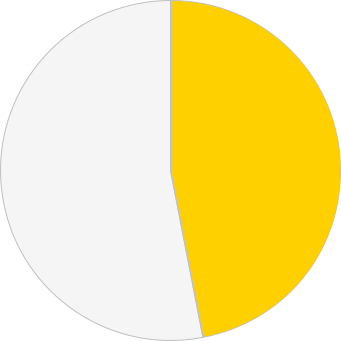
Over the last five years, most recalls were linked to a single undeclared allergen. However, 22% of these recalls involved multiple undeclared allergens. The allergens that were most frequently undeclared included milk, tree nuts, wheat/gluten, and eggs.
Undeclared allergens
Milk
Tree nuts
Wheat
Others
Eggs
30%
13%
30%
12%
15%

Imported vs �local foods
53%
47%
Imported foods
Although imports account for only around 11% of food consumption by value3, they are responsible for nearly 50% of allergen-related recalls. This inconsistency can be traced back to differing allergen regulations among various countries, which include variations in labelling requirements and the particular allergens that need to be disclosed. It’s possible that some foreign manufacturers may not be fully informed about Australia’s specific regulatory standards, and that importers may lack sufficient quality control measures.
Additionally, countries with lower rates of food allergies may not enforce the same strict regulations on food manufacturers. This variation in regulatory standards can result in inconsistencies as to how allergens are managed and disclosed in imported food items.
Undeclared allergens 2023-2024 (imported vs local)
Imported
Local


The Food Standards Code now mandates that food and ingredients must be labelled with specific required names. This update also stipulates that individual tree nuts, molluscs, and specific cereals must be declared separately.
What’s changed?
New allergen labelling requirements for food will take effect in Australia on 25 February 2024. All food products packaged after this date must adhere to the updated regulations. However, items that were packaged and labelled prior to 25 February 2024 and met the previous allergen declaration standards may still be sold until 25 February 20264.
Declarations must be made in the statement of ingredients using bold font and a font size no smaller than that used for other listed ingredients (e.g. maltodextrin (wheat), milk powder), and a separate allergen summary statement in bold font beginning with the word ‘contains' (e.g. contains milk) located in the same field of view and directly next to the statement of ingredients.
More details of these changes can be found in the Food Standards Australia New Zealand report Plain English Allergen Labelling.
* Barley, oats and rye must be declared if they contain wheat
** Sulphites must be declared when added in amounts equal or more than 10 milligrams per kilogram of food.
Regulatory changes
almond
barley
brazil nut
cashew
crustacean
egg
fish
lupin
macadamia
milk
mollusk
oats
peanut
pecan
pine nut
pistachio
rye
sesame
soya bean
sulphite
walnut
wheat
Biodegradable and biobased food packaging
Did you know?
Allergens can migrate from packaging materials into allergen-free foods?

As numerous countries implement bans on specific single-use plastics, there has been a notable increase in the demand for biodegradable and biobased food packaging. These innovative packaging solutions are increasingly made from protein-based materials sourced from milk, eggs, soy, rye, and wheat.
Crisis Management | Australia
PRODUCT RECALL MONITOR
March 2025
Liberty Product Recall Monitor explores different drivers of product recalls across a variety of industries.
In this edition, we focus on allergens and their effects on the Australian food industry.


Contact us
How to access pre-incident credit to prepare for a product recall
Why Liberty?
Biodegradable and biobased food packaging
Regulatory changes
Imported foods
Undeclared allergens
Most recalled products
Allergens in the food industry
Menu


Allergen-related recalls consistently lead the statistics, followed by microbiological contamination issues and foreign matter; notably, in 2024, 64% of food and beverage recalls in Australia were allergen-related2.
Undeclared allergens
Gluten migration
Regulatory requirements
Recent research indicates that food contact materials (FCM) made from wheat or rye, which contain gluten, can transfer gluten into gluten-free foods. A study conducted in Germany analysed gluten migration from six types of FCMs, such as cutlery, wafer cups, plates, and straws. The findings revealed that the level of gluten migration differed - based on material properties, the type of food, and the length of contact time5.
Gluten migration was detected in all wheat-based food contact materials (FCMs) except for cutlery, probably because of the minimal contact areas and brief contact times during pricking and cutting. On the other hand, plates exhibited a troubling level of migration, with gluten concentrations soaring to 203 mg/L.
According to the Food Standards Code in Australia, businesses making ‘gluten-free’ claims must be confident that their products or menu items contain no detectable gluten (i.e. < 5 mg/L). The migration levels observed exceeded the detection threshold, raising concerns. While individuals with wheat allergy and coeliac disease should avoid using these materials, there are currently no regulatory requirements for allergen labelling in FCMs.
Why Liberty?
Every day Liberty protect around a third of all products sold in major Australian supermarkets should they face a product recall. Liberty’s Crisis Management insurance products help to provide financial protection and assistance in the event of a product recall, malicious product tampering event or a product withdrawal.


Experts in crisis management
Liberty has the largest recall team in Australia, comprised of experienced underwriters with more than 20 years experience.
Our bespoke policies are tailored to suit the individual needs of clients, covering:
• Accidental contamination
• Product defect
• Intentional impaired ingredient
• Government recall
• Alleged contamination
• Product extortion
• Malicious product tampering
• Adverse publicity

Exceptional service, risk engineering and local claims handling

We understand the need for a quick turnaround. Liberty has Crisis Management underwriters in all eastern states and can meet with clients when needed the most.
Our local claims handling is managed out of Sydney by our senior claims specialist, James Paul.

James Paul
Senior Claims Specialist

Luis Gonzales
Risk Engineer
We have a dedicated Risk Engineer, Luis Gonzales, who provides technical support to underwriters regarding risk. Luis is available to meet with your client to help ensure we fully understand your client’s business.

Market leading cover and best in class crisis support
Our market leading Contaminated Products Insurance includes Retailers Withdrawal coverage*. This means our policy also covers product withdrawal due to a quality issue with no threat of bodily injury. This fills the significant gap in coverage for many clients who find themselves exposed when their product is subject to a withdrawal from supermarkets due to a quality issue, as opposed to a food safety issue.
* All benefits and covers described in this monitor are subject to the terms of the relevant policy.

You can expect 24/7 support from our dedicated crisis management consultants.We provide access to leading crisis management consultants, market leading food technologists and PR experts to assist you with the prevention, management and recovery from a product recall event.
24/7 support
If you would like to know more about product recalls and withdrawals and the tailored solutions we provide, please get in touch with a member of the Liberty Crisis Management team.

Find out more
How to access pre-incident credit to prepare for a product recall
All Liberty Insured’s have pre-incident funds available as part of their Liberty Product Recall policy. The allocation is 10% of the net base premium which can be used towards any Liberty pre-approved pre-incident training. These pre incident funds can help you prepare for product recall situations.
What is pre-incident training?
Can Liberty consultants also provide assistance during a product recall event?
Who is on Liberty’s panel?
Are consultant’s costs covered by Liberty’s policy as a result of an Insured Event?
Does the self-insured retention apply to Liberty consultants?
Some of the services that our consultants offer include:
• Mock recall exercises
• Recall plan and crisis management plan reviews
• Media training
• Root cause analysis exercises
• Contingency and business continuity planning/project management
• Assistance in the development of risk based supplier management systems and programs
Yes. We know it is often how a client reacts in the critical first days, or even hours, of a crisis that can determine how severe a crisis will become. This is when the experience and expertise of Liberty’s crisis management consultants is most useful. They can provide advice and assistance to help deal with the crisis at hand. In the event of an incident which may give rise to an insured event, and as part of our Liberty’s product recall policies, we have made available crisis management experts for the Insured.
Liberty’s panel of consultants includes Intelligent Risks and HACCP Australia. Representatives from Intelligent Risks and HACCP Australia are based in Sydney and are more than happy to meet with clients pre or post binding.
HACCP Australia


Based in North Sydney, with staff located in Brisbane, Melbourne, Hong Kong & London. They have over twenty years of involvement with the insurance industry in responding to client's pre-incident and response requirements. They have been in the food technology business for many years of "on the factory floor" experience. This extensive experience and knowledge make HACCP Australia one of the most experienced Crisis Management consultants in Australia and a significant addition to the value and expertise our clients can access. Accidental contaminations are historically the most common type of claim under a contaminated Products policy. Being able to provide access to the expertise and experience of HACCP Australia in the event of an incident will help clients better handle these incidents.
Intelligent Risks

Intelligent Risks was established in early 2001 and has grown into a market leading security, risk, due diligence and crisis management advisory firm. Intelligent Risks support large multinational clients, government agencies worldwide and leading Australian firms by delivering outcomes that build on best practice, and which are adapted to each client’s requirements and capabilities. The team is led by Neil Fergus who has many years of experience managing crisis events, including product recalls, extortion and malicious products tampering, for both the corporate and government sectors.
These costs are included under the policy, and continue for 12 months from first discovery of the insured event if indemnity is accepted under the policy. In the event an incident is not indemnified by the policy, Liberty will still pay the costs of the consultants up to the time Liberty first advises indemnity is not available under the policy.
No self-insured retention applies to consultant and advisor costs. A self-insured retention is a specified amount of money that an insured party agrees to pay out-of-pocket before their insurance policy coverage begins for a particular claim.
3
4
Liberty provides personal, SME, and corporate insurance solutions designed to help people and businesses embrace today and pursue tomorrow. Our team draws on decades of local experience and the strength of the Liberty Mutual Group, a Fortune Global 500 insurer with operations in 27 countries.
We believe progress happens when people feel secure. By delivering protection with care, we support customers, brokers, agents, and partners while building confidence for what’s ahead.��Liberty is here for you. Today. Tomorrow. Together.

About Liberty
Last updated June 2026
AP0986
Singapore
Malaysia
Hong Kong
Visit our Asia websites
Connect with Liberty

Learn the difference between Liberty's Contaminated Products insurance and a standard product liability policy with a Recall Expense Extension

View Liberty's examples of costs involved in Retailers Withdrawal insurance
Learn about Liberty's Contaminated Products insurance
Contact us
If you’re looking for more information regarding product recall insurance, please get in touch with our specialist crisis management underwriters.
Liberty is not authorised to provide financial product advice. The information in this document does not take into account your objectives, financial situation or needs. Always consider the applicable policy wording and other relevant documents before deciding to acquire a Liberty financial product. © Liberty Mutual Insurance Company 2026. This information is current as at 1 April 2026. Liberty means Liberty Mutual Insurance Company, Australia Branch (ABN 61 086 083 605) incorporated in Massachusetts, USA (the liability of members is limited) (Liberty Australia); Liberty International Insurance Limited (UBI 03967394) (Liberty Hong Kong); Liberty Pte. Limited (UEN 201538069C) (Liberty Singapore).


Recall cause �2020 to 2024
49%
22%
6%
13%
10%
Recall cause �2020 to 2024
49%
22%
6%
13%
10%
References
1 https://allergyfacts.org.au/get-involved/food-allergy-week/
2 https://www.foodstandards.gov.au/food-recalls/alerts
26%
10%
44%
11%
10%
10%
26%
10%
44%
11%
10%
10%
Allergen-related recalls by product category
Allergen-related recalls by product category
Undeclared allergens
30%
13%
30%
12%
15%
Undeclared allergens
30%
13%
30%
12%
15%
Imported vs �local foods
53%
47%
Imported vs �local foods
53%
47%
References
3 https://www.aph.gov.au/Parliamentary_Business/Committees/House/Agriculture/
FoodsecurityinAustrali/Report/Chapter_3_Food_production_consumption_and_export#:~:text=We%20do%20not%20produce%20everything,of%20food%20consumption%20by%20value.&text=A%20different%20view%20on%20the,security%20on%20a%20global%20scale
References
4 https://www.foodstandards.gov.au/business/labelling/allergen-labelling
References
5 Gluten migration from biodegradable food contact materials poses a risk to celiac disease patients | European Food Research and Technology