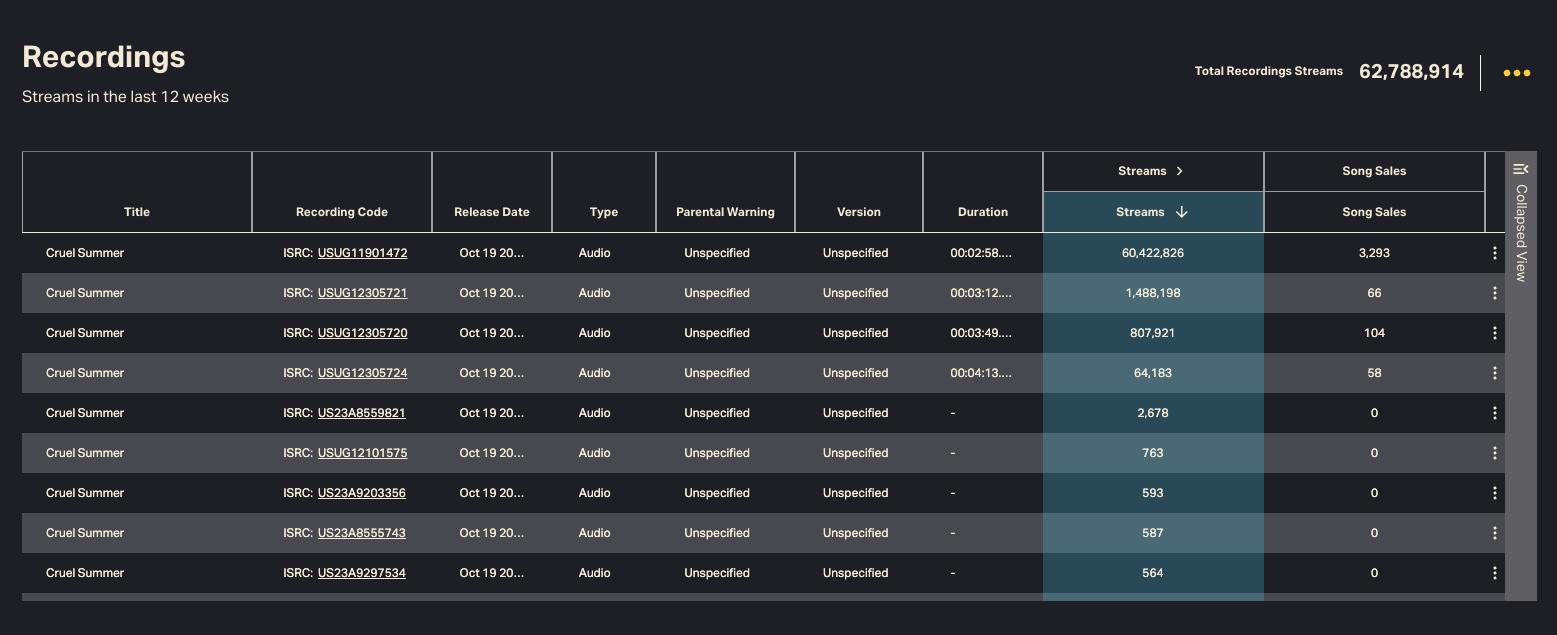
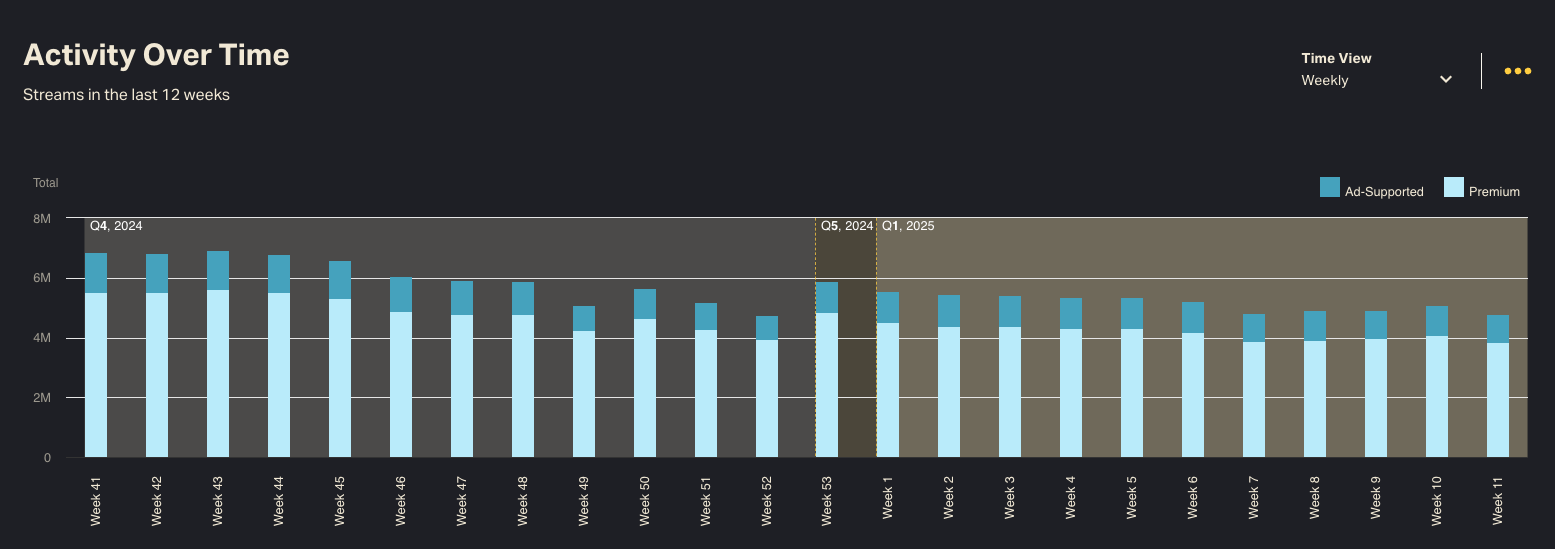
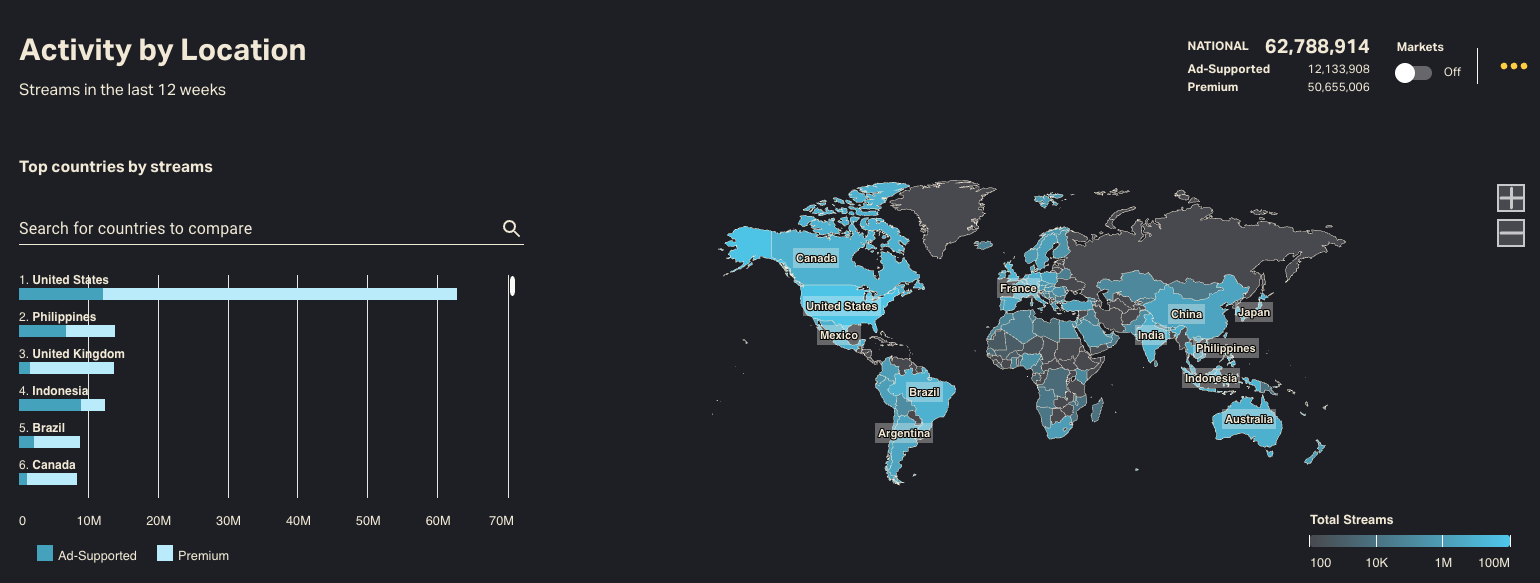
Financial firms have leveraged Luminate data for bespoke analysis, accessing both the user interface and deeper-volume data files to audit streaming activities on behalf of its clients. The goal of this approach is to ensure clients are fully compensated for the use of their music by helping to uncover streaming activities that may have gone unreported or unpaid. Clients range from business managers to artists and other key stakeholders including publishers and labels. �
By providing accurate royalty audits, projections and valuations, firms can maximize the financial returns for their clients, protect their intellectual property rights and enhance the overall value of their music catalogs. To further support these objectives, client firms offer a variety of services including:

Luminate Data Identifies Unclaimed Streaming Activities for Major Financial Firms
In today’s complex music streaming ecosystem, ensuring artists are properly paid is an ongoing challenge for platforms, artists, managers, labels and publishers. Luminate addresses this by providing accurate activity metrics that help identify common gaps to convert that activity into royalty¹ claims, offering a new approach to resolving data issues.
According to The Mechanical Licensing Collective’s (The MLC) March 2024 report, $120M USD — 16.25% of the royalty funds collected in 2022 — remains unmatched or unclaimed (source). With over 100,000 new tracks added to streaming platforms daily, more than $1 in every $6 remains undistributed, highlighting the magnitude of royalty tracking challenges.
STRATEGY
Goal
OVERVIEW
RESULT
The Luminate Connect platform has been instrumental in identifying unreported or mismatched streaming activities and allowing financial firms to convert these into rightful royalty claims. By uncovering discrepancies in streaming numbers, the platform empowers businesses to capture incremental value and improve financial outcomes.

Interested in learning more about our products and solutions to see how we can help you navigate the complexities of royalty management and unlock hidden revenue streams for your clients? Schedule a demo today.
REQUEST DEMO
In a world where music catalogs encompass over 50 million ISRCs with more than 100,000 new ISRCs added daily and distributed to over 100 DSPs across 200 countries, today’s music consumption and royalty payments have become more complex — and more crucial — than ever before. High activity volume, a fractured reporting system and explosive growth have made it difficult to capture all music consumption activity in order for clients to be fully compensated.�
PROBLEM
Unclaimed royalties often end up in holding accounts managed by performing rights organizations (PROs) and other collection societies like The MLC, noted above, where they wait to be claimed by rightful owners.
�
Luminate’s Data Enrichment Services pair musical identifiers with musical �works to:
The Luminate music data platform helps identifyuncovers missing streaming activity that translates into royalties for many clients. Luminate’s Data Enrichment services helps further by gathering metadata for all variations of a song.
Confirm reporting metrics are authentic
Help content owners ensure consumption activity is properly recorded and attributed
Help content owners Verify royalty payments or receipts are accurate
Using Luminate data, business management firms can collaborate with record labels, artists, managers and other entities to ensure clients receive their full share. This involves:
Projecting royalties
Estimating the value of unclaimed royalties
Music catalog valuation
Creating estimates of royalty payments for confirming payouts without acceptable variability �
Identifying ISRCs not paying out correctly
Streamlining metadata from Luminate making it easier to identify and claim royalties which are often difficult to pinpoint due to disorganized or incomplete metadata�
Using U.S./Global consumptions splits to estimate Global royalty payments
Incremental Revenue Identification: A specific client using the platform identified 20% in incremental revenue based on identification of ISRCs that are either unclaimed or not registered properly with CMO nor management organizations, distributors and other licensees
Streamlined Metadata Management: Luminate’s Data Enrichment services enhance metadata collection, making it easier to identify and claim royalties that are often obscured due to incomplete or disorganized data
Global Consumption Analysis: The platform provides valuable data in the U.S. and globally, allowing firms to estimate royalty payments for diverse clients
GLOSSARY
¹A royalty is a payment made to the rights holder of a creative work for its continued use, such as when it's reproduced, performed or licensed. In the music industry (excluding sync licensing), royalties tied to a musical recording typically fall into three main categories:
Mechanical Royalties: These are generated whenever the master recording is reproduced, such as when a song is streamed, sold as a download or pressed onto physical formats like CDs or vinyl. Platforms like Spotify or Apple Music pay these royalties to the rights holder of the master recording.
Performance Royalties: When the master recording is publicly performed (e.g., radio broadcast or streamed or played in public spaces), performance royalties are paid to the rights holder. These are typically collected by performing rights organizations (PROs).
Music Publishing Royalties: These royalties are tied to the song’s composition and benefit songwriters and publishers. They’re earned through reproduction (mechanical royalties), public performance (performance royalties) or synchronization with visual media (sync royalties). This includes radio airplay, live performances and streams. Publishing royalties ensure songwriters get paid for their work across various uses.