This Quarter
Transformation is one of the most overused terms in business—a code word for cost cutting and also a catch-all, meaning everything and nothing. The latest Quarterly Pocket Edition seeks to bring transformational change out of the fog and paint a clearer picture of what it means for today’s leaders. I hope these summaries help you and your organization navigate the journey.
Pocket Edition / 2019 Number 4
Summaries in this edition …
THE TRUTH ABOUT TRANSFORMATION
Why your next transformation should be ‘all in’
ADVANCING ADVANCED TECHNOLOGIES
100 projects at once
The Five Fifty
Trying to launch new tech-powered businesses—while upgrading the tech quotient of your old ones? Better hope you can multitask. To learn how companies can prioritize solutions and get up to speed, read this edition of the Five Fifty, the Quarterly’s timely dose of smart, delivered to your phone.
Last Laugh
What do you think of the Quarterly Pocket Edition? We’d love to hear your feedback.
Full issue available
All of these articles are available in the down-loadable PDF edition.
View “100 projects at once”
Download PDF
Email us
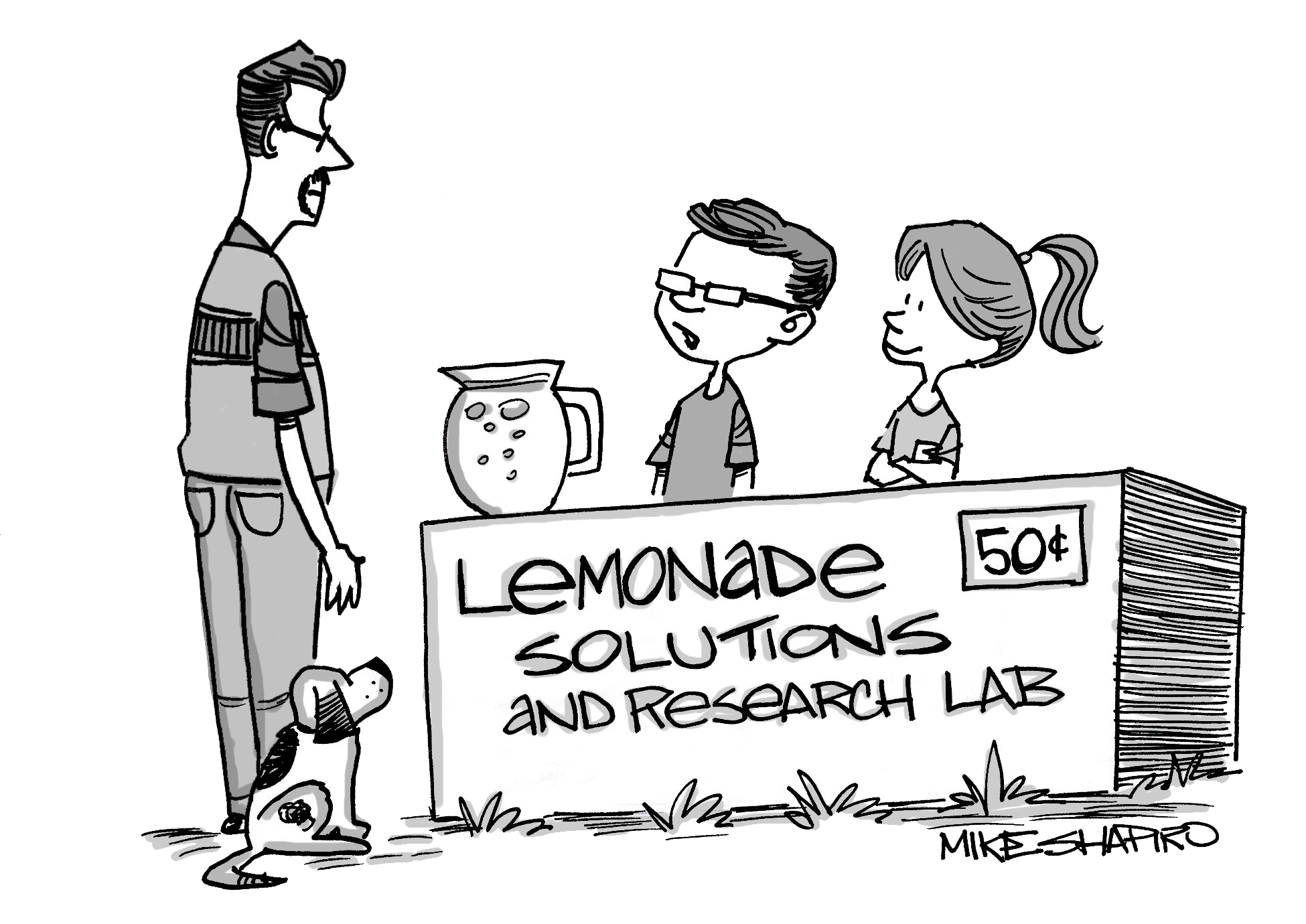
“We expect our new self-disruption initiative will net $4.8 million in new EBIT by summer break.”
CLOSING VIEWS
INNOVATION’S TRANSFORMATIVE ROLE
SHIFTING THE ORGANIZATION
Robert Sternfels
Senior partner, San Francisco office McKinsey & Company
Read previous Pocket Editions
View all Pocket Editions
Read the summary
The innovation commitment
Speak softly, make tough decisions: An interview with Alibaba Group chairman and CEO Daniel Zhang
Digital transformation: Improving the odds of success
The analytics academy: Bridging the gap between human and artificial intelligence
The helix organization
How the British Army’s operations went agile
Automation and economic disparity: A new challenge for CEOs
Reimagining the top line, the bottom line, and everything in between
Transformation
Read the summaries
The numbers behind successful transformations
Answering society’s call: A new leadership imperative
Five ways that ESG creates value
HOW SOCIETY IS RESHAPING BUSINESS
‘Don’t be the villain’: Niall Ferguson looks forward and back at capitalism in crisis
Bias Busters: Getting both sides of the story
Article summary
by Chris Bradley, Marc de Jong, and Wesley Walden
Improve the odds of a successful business transformation by going “all in” to kick-start performance and remake your portfolio.
The problem
Productivity-driven change aimed at ramping up the bottom line is not enough. Tech-enabled disruption these days requires organizations simultaneously to redefine what and who they are, understand where value is shifting, and make decisive moves to seize it.
Why it matters
McKinsey research plotting the economic profit of nearly 1,500 global companies shows that combining performance improvements and portfolio moves during a transformation strongly increases the odds of a successful outcome.
Currently viewing
The drumbeat of digital: How winning teams play
Exhibit
Addressing both a company’s performance and its portfolio offers the highest odds of lasting improvement.
Respondents at top-performing companies
All other respondents
Probability of moving up to the top quintile of the power curve from the middle 3 quintiles over a decade (n = 1,435), %
4
11
7
22
At least 1 performance move
Performance only
All in
Static
Portfolio only
No portfolio moves
No performance moves
At least 1 portfolio move
Sequence moves so that a rapid lift in performance provides the oxygen and confidence for critical portfolio shifts.
•
Go all in if you can by addressing performance and the portfolio. Doing so almost triples the likelihood of reaching the top quintile of companies in economic profit terms from a starting position in one of the middle three quintiles.
Don’t be static. Get moving and make one or more of the five big moves that distinguish truly transformational trans-formations: productivity improvement, differentiation improvement, active resource allocation, programmatic M&A, and capital investment.
Embrace three behaviors that are typical of healthy organizations and that strongly correlate with the creation of deal value:
What to do about it
Build industry context into your plan. In sectors where average economic profit is falling, for example, don’t try to spend your way out of trouble: big capital expenditures may exacerbate a downward trend.
When in the fast lane, step on the gas. Performance improvements are greatly amplified if you’re lucky enough to have an industry tailwind at your back.
Ask yourself tough questions. Are we aiming high enough? Will our company take this seriously? Are we up to the leadership challenge? Where is the value flowing and what can we do about it? Do we put our money where our strategy is? Are we ready to cannibalize ourselves?
Analysis of more than 200 large transformations stretching back over a decade highlights four indicators that showed a statistically significant correlation with strong financial performance. Making progress against them requires careful measurement and management.
The vagueness of “transformation” as a term and a concept frequently leads to uncertainty about what to measure and manage.
Crunching the numbers on transformations suggests good news for companies that go broad, move fast and renew often, prioritize health, and keep stretching their aspirations.
by Kevin Laczkowski, Tao Tan, and Matthias Winter
How lots of small M&A deals add up to big value
Focus on the numbers that show whether and how you are advancing against these priorities:
Committing to organizational health as part of your transformation can be a difference maker.
1
Alpha of total returns to shareholders, based on whether companies fully implemented organizational-health measures
Embrace organizational health. Track your organization’s health with the same rigor you devote to financial performance (exhibit). We’ve been saying this about companies generally for years, but the same goes in transformations: those that implemented a set of health-improvement measures saw nearly double the excess total returns to shareholders of companies that did not.
Move fast, renew often. Snag quick wins, such as better management of working capital or discretionary spending, and use the savings to maintain momentum by funding longer-term ambitions. Renew the number of initiatives after the first year, or even as part of the annual planning process.
Go big and broad. Transform the whole business, not just individual units, and address both top and bottom lines. Mobilize a substantial chunk of employees—top performers involved at least 8 percent and sometimes as much as 20 percent of their workforce. This enables the pursuit of smaller initiatives that often deliver (in aggregate) the biggest wins.
Stretch your aspirations. Set ambitious performance goals and allow them to evolve. Don’t lock in initial estimates that are too low. High expectations can lift results, low ones may hold them down.
In this analysis, alpha measures the performance of an investment against an off-the-shelf sector and geographic stock index. Stock price reflects total returns to shareholders and is (1) adjusted for dividends, (2) adjusted for splits, and (3) weighted on a market-capitalization basis; n = 14 for companies that fully implemented organizational-health measures and 68 for those that did not.
Months
0
140
130
120
110
100
90
3
6
15
18
12
9
Selected index
Health measures not fully implemented
Health measures fully implemented
118
135
Compound growth at MilliporeSigma
Read the full interview
Reduce the odds of placing bad bets through better decision-making processes and closer scrutiny of assumptions.
When choosing opportunities, avoid the false comfort of averages, crude benchmarks, or pie-in-the-sky dreams. Look at (among other things) incremental value delivered, risk, alignment with strategic priorities, portfolio mix, and resource reallocation potential.
Paint a picture of the potential for innovation to transform your company and industry, translated into a strategy and key actions that include qualitative and quantitative metrics.
Cement a commitment to innovation by creating a “green box,” defined as the value that only innovation can produce over a finite planning period and that can be cascaded into objectives for operating units.
There is a strong, positive correlation between innovation performance and financial performance, and the gap between innovation leaders and laggards is only getting wider. Longitudinal surveys suggest that leaders are especially extending their lead in their ability to set bold aspirations and make tough resource-allocation choices.
Too many leaders talk up the importance of innovation yet fail to shift people, money, and management attention to support the best ideas. Portfolios are heavy on “high certainty” efforts but much lighter on potential breakthrough products or new business models.
by Daniel Cohen, Brian Quinn, and Erik Roth
To catalyze breakthrough growth, leaders must set bold aspirations, make tough choices, and mobilize resources at scale.
Mastering five or more innovation essentials appears to be correlated with strong financial results.
Index of economic profit generated by mastery of innovation essentials
Number of innovation essentials mastered
0–2
3–4
5–6
7–8
% mastering essentials
2.4x
1.6x
2
40
20
60
80
% of respondents
Economic- profit index
The chairman and CEO of China’s e-commerce giant describes Alibaba’s approach to innovation and how he balances analytics and instinct to spot hidden opportunities.
The secret ingredient of successful big deals: Organizational health
Generation Z doesn’t believe only in so-called big brands; they prefer unique things and new brands from their own generation. That’s [a big part of] their lifestyle. The other important thing is that they tend to spend more.”
On Chinese consumers:
Highlights from Zhang’s conversation with McKinsey’s Daniel Zipser
“
Technology and data empower our whole business—not only on the sales side and marketplace side but also in the back-end office, in customer service, in every single area. This is how we work. So when people say ‘AI,’ we laugh and say that, to us, it’s ‘Alibaba intelligence,’ because data and technology power everything we do.”
On technology and artificial intelligence:
Even though our business is always evolving, the mission remains unchanged. For example, we are not only helping big brands and retailers—we also help small and medium businesses grow. […] That’s always been our philosophy. […] When small businesses can grow faster and grow healthier, it will benefit the whole society.”
On mission and vision:
I tend to give people opportunities to try their own ideas, but I’m very tough once a decision has been made. Once I make up my mind, I want my teams to go ahead and get concrete results. That’s why people at Alibaba always say it’s very difficult to deal with me in business meetings, because [in that context] I am always trying to get to the substance of the matter and drive people to make progress.”
On his personal leadership style:
As a leader, you have to see something which others cannot, and often that comes down to focusing on customer pain points. […] Pain points mean opportunity. And that’s why, every year, I do a self-evaluation process during Chinese New Year. I ask myself, ‘How many new ideas, how many new businesses did I initiate last year?’”
The vast majority of innovations will result in failure. […] But the key is, can we learn from the failures? For example, five or six years ago, we tried a new thing. It was a digital social-messaging platform called Laiwang. We started the business, invested heavily, sent some of our best people, but it failed. […] That experience served as a critical lesson that informed our thinking when we created DingTalk, a cloud-based, SaaS [software-as-a-service]-based work-collaboration platform. The tool is a direct result of Laiwang’s failure because the team realized that people have too many contacts on their social networks. […] DingTalk’s success is another example of a pain point inspiring a new service.”
On coping with failure:
Jack is a visionary. He thinks about not only today and tomorrow but five and ten years from now, and that is what makes Alibaba different. I learned from him the importance of looking at the big picture. You need to have your feet planted on the ground and move forward solidly, but you also need to be forward looking. We look at opportunities not only for today but, more importantly, opportunities for the next generation and the coming decades.”
On Alibaba founder Jack Ma:
Getting personal about change
New McKinsey research shows that the average digital transformation has a 45 percent chance of delivering less profit than expected, while the likelihood of surpassing profit expectations is just one in ten.
Nearly all incumbents are seeking to digitize aspects of their business and operations, but there’s no playbook of “must-do” practices, and it’s easy to go through the motions without being clear on what your efforts will yield.
Most digital transformations don’t yield the benefits that leaders expect. New research shows that five practices maximize the chance of extraordinary outcomes.
Embrace a set of five transformation practices to significantly lift the odds of exceeding expectations:
Applying five groups of digital-transformation practices maximizes the likelihood of exceeding performance expectations.
by Jacques Bughin, Jonathan Deakin, and Barbara O’Beirne
Embrace agile practices throughout the business and reward employees for generating ideas and taking risks.
Commit time and money. Digital transformations will more likely succeed when they are a top priority for senior leaders and are properly funded.
Invest in talent—especially at the top. All successful companies have a chief digital officer, and the chief analytics officer has become an even more important leadership role.
Lay out clear priorities, focusing on a few clear themes tied directly to measurable business outcomes.
Empower people. Define clear roles, put an “owner” in charge of each transformation initiative, and hold them accountable for meeting goals.
45
44
No practices applied
48
52
5 groups of practices applied
Exceed expectations
Meet expectations
Fall short of expectations
Likelihood of 3 outcomes for digital transformation, %
All in: From recovery to agility at Spark New Zealand
As organizations rebuild their foundations to compete in the era of data and advanced analytics, in-house capability-building programs offer the best way to train workers up to the task.
Today’s ad hoc approaches to talent-building, such as hiring spurts of new workers or relying on online platforms, universities, and executive programs to train existing employees, have a difficult time keeping up with the blazing pace of technological and competitive change associated with artificial intelligence (AI).
Education is a key differentiator: At high- performing organizations, employees at all levels are better educated on data concepts.
by Solly Brown, Darshit Gandhi, Louise Herring, and Ankur Puri
The rise of AI is one of the defining business opportunities facing leaders. Exploiting the potential of AI at scale depends on the organization as a whole—everyone from seasoned but skeptical executives to frontline employees and cross-functional teams.
At all other organizations
At high-performing organizations
Employees who understand data concepts very well or completely, % of respondents
28
25
53
38
62
43
Frontline employees
Managers
Executives
Drive engagement by, for example, positioning training as a privilege for prime roles, celebrating achievement, highlighting lessons learned, and encouraging the sharing of new knowledge (which propels demand from the bottom up).
5.
Blend “book smarts” with “street smarts.” Combining classroom theory with real work helps participants simultaneously learn by doing and advance the company’s agenda.
4.
Go beyond the math. Successful academies emphasize the organizational and cultural changes required to scale AI, not just technical training.
3.
Leave no role behind and involve all levels of seniority. The best academies handle a broad range of learning needs and adopt a phased approach for different cohorts.
2.
Tie training to transformations. Academies are most successful when they align skill building to strategic goals.
1.
Follow the lead of AI pioneers that are using analytics academies to change the speed, depth, and scale of change. An academy can help you deliver a common vision, language, and protocol; create customized content that is linked to your goals, starting point, and industry context; and establish active apprenticeships. To boost the odds of success, you should do the following:
Keep it relevant and put in place structures that will evolve as the landscape changes (for example, building internal faculty, creating an academy leadership team, and securing the support of corporate leaders).
6.
Source: December 2018 McKinsey Global Survey of 575 participants on data and analytics
The Chinese luxury consumer
Complex matrix structures are no longer working in many organizations, and executives are struggling to find a fix for this deep-rooted dysfunction.
Separating people-leadership tasks from day-to-day business leadership can help organizations strike a better balance between centralization and decentralization, reduce complexity, and embrace agility.
Value-creation management: what work gets done
Capabilities management: how work gets done
The helix organization provides a balance between flexibility and stability that is the hallmark of a truly agile approach.
by Aaron De Smet, Sarah Kleinman, and Kirsten Weerda
clear accountability, a strong joint purpose for teams, and the right combination of roles and skills
mature resource and strategic workforce planning, ideally done quarterly, plus flexible financial budgeting
a functioning internal talent market and leaders who understand current and future talent needs across the business
The current malaise is costly, slowing down decision making, hampering resource allocation, blurring roles, and preventing companies from moving quickly to exploit new opportunities.
Look for opportunities to apply a “helix” model that disaggregates people-management tasks typically performed by one manager into two sets of tasks performed by two managers (one overseeing day-to-day work, the other developing an employee’s capabilities).
To make this work, new processes and different mind-sets are required, including:
clear alignment between managers on individual incentives, and a willingness on both their parts to participate in performance reviews
The capabilities manager oversees the employee’s long-term career path, has the power to hire or fire, and drives performance evaluations with input from value-creation managers.
The value-creation manager sets priorities, provides day-to-day oversight, and ensures that the employee meets business objectives.
No more dotted lines: the helix provides two clear, equal, and parallel lines of accountability.
Military commanders have had to change the way they operate in the field. Corporate executives should take note.
Admit it, your investments are stuck in neutral
The trick is to work out what process is good and fundamental to the stable functioning of an organization—and to its consistency—and what process is bureaucratic and superfluous. Don’t throw out the good stuff when you get rid of the bad stuff; organizations that have been fossilized by bad processes sometimes try to get rid of it all.”
Standardization versus agility
Justin Maciejewski, a former brigadier in Iraq, describes how the British Army introduced agile thinking in its operations.
In the old world, leaders wrote down what they wanted people to do in quite a precise way. People were given tasks that fit within an overall operation or mission. A mission today is not a set of tasks, because, in a dynamic situation, people should revert to the purpose rather than the task. Situations change; the enemy’s done something. That’s my purpose—that’s what I’m going to go after—rather than in the old system, where people would literally do their task and wait to be told what to do next.”
Agility, aspirations, and purpose
When a leader shows up in the right way, it’s a source of encouragement; it shows you also have skin in the game on any particular day. When the bullets are flying around, it makes the point that we’re all in this together.”
Leadership, command, and control
I’ve been really shocked by how much fear is used as a motivator in business—in a way that I never saw it used as a motivator in the army. People are very much in a state of fear, not because they’re being shot at, but because there’s an internal fear working in terms of how people are being evaluated and watched all the time.”
Corporate comparisons
We would spend 15 or 20 minutes, perhaps half an hour, a week talking about the army’s values—courage, loyalty, discipline— and what they actually meant. Values can be a hugely powerful thing when they’re shared across an organization, but you’ve got to invest in them. You can’t just put them on a notice board or up in an office and have that be the end of the job.”
Enduring values
For more on how the British Army’s embrace of agility has extended to its headquarters, see the companion interview, Building agility in the British Army’s headquarters.”
For me, a good process is a process that helps someone see how to think, how to find a solution, but it doesn’t tell them what to do. It doesn’t tell them the exact answer. In other words, it’s not a tick box. It’s a framework that lets people bring themselves to the problem in a way that they know they’re not going to miss anything.”
Leaders also need to understand that there is a tension between command and control. A commander may want to do something, but it may be impossible, and that’s where command has to be constrained by control. And there are other times when the commander knows something can be done and has to be done, and sometimes the machine needs to work a little bit harder to make it happen, and that’s where command pushes control.”
I haven’t come across many organizations [in business] where talent selection is really rigorous. Often, it’s based on a good year’s performance, then you leap forward into the next job rather than really understanding what potential looks like versus performance. […] I think business is too quick to bring in talent rather than develop it internally.”
Getting your environmental, social, and governance (ESG) proposition right links to higher value creation. Here’s why.
by Witold Henisz, Tim Koller, and Robin Nuttall
Confronting overconfidence in talent strategy, management, and development
Research shows that a strong ESG proposition correlates with higher equity returns and reduces downside risk. What’s more, ESG-oriented investing has experienced a meteoric rise—up 68 percent since 2014 and tenfold since 2004.
Environmental, social, and governmental concerns are becoming more urgent, yet companies have a poor understanding of how and why to address them.
Explore systematically the five main links to value creation, identifying priorities (which are likely to be industry dependent), understanding their value, and being realistic about what’s possible.
Source: Gunnar Friede et al., “ESG and financial performance: Aggregated evidence from more than 2000 empirical studies,” Journal of Sustainable Finance & Investment, October 2015, Volume 5, Number 4, pp. 210–33; Deutsche Asset & Wealth Management Investment; McKinsey analysis
Results of >2,000 studies on the impact of ESG propositions on equity returns
Paying attention to environmental, social, and governance (ESG) concerns does not compromise returns—rather, the opposite.
Top-line growth (through, say, offering B2B and B2C customers more sustainable products)
Cost reductions (through, say, lower energy consumption or reduced water intake)
Greater strategic freedom and reduced regulatory pressures (through overall strength in ESG)
Higher employee productivity (through, say, better employee motivation and the power of social credibility to attract talent)
Enhanced returns (through allocating capital to more sustainable opportunities and avoiding “stranded” investments that may not pay off in the long term)
Share of positive findings
Share of negative findings
8%
63%
Nine in ten Generation Z consumers believe that companies have a responsibility to address environmental and social issues. Young people think companies that do so are better prospective employers; the vast majority say they would be more loyal to companies with those values.
Demands on leaders are growing as society’s expectations continue to rise.
As public expectations rise, government agencies are doubling down on improving service delivery to delight their customers.
The public sector gets serious about customer experience
Three capabilities are the keys to building purpose through cognitive empathy.
Source: McKinsey and Ashoka survey of Ashoka fellows, n = 109
Not related to building empathy
Related to building empathy
Number of respondents who ranked capability in top 5 for system change
Transparency: Leading-edge businesses increasingly display the origins of their products (including making their ingredients traceable), disclose their environmental impact, and acquire certification of their environmental and social responsibility credentials.
Empathy: Cognitive empathy is a key leadership attribute in this societal context. Interviews with a top-tier group of social entrepreneurs suggest that leaders can summon the necessary energy through experimentation, experiential learning, and exchanges of ideas.
Meaning: Interviews with social entrepreneurs and corporate CEOs showed the power of connecting near-term initiatives with a company’s broader role in society. “The businesses that do best,” suggested on social entrepreneur, “are those where the purpose and the profitability are aligned, where it’s not profit ahead of purpose and it’s not purpose ahead of profit.” That said, “When you have a mission, you sometimes take a chance on a financial model that may not seem perfect,” asserts John Figueroa, former CEO of Genoa Healthcare.
McKinsey research, along with the experience of corporate executives, social entrepreneurs, and recent trends in the fashion and retail industries, show that it pays to boost transparency in the supply chain, create empathy with consumers, and instil meaning for employees.
49
42
68
72
Have the ability to inspire and build trust with others by finding common ground
Feel morally responsible for achieving the vision and lead through example
Create a dynamic network of alliances and partnerships, including some with unlikely stakeholders
Approach problems as a symptom of system failure and an opportunity for system change
Develop a broad vision of the future that extends beyond the problem at hand
Don’t be the villain’: Niall Ferguson looks forward and back at capitalism in crisis
Reputation is extraordinarily important. When it comes to the shifting sands of legislation and regulation, unpopular companies are vulnerable in a way that popular companies are not.
Following a crisis, politicians tend to castigate big business. For example, in the wake of the 2008–09 financial shock, big banks became targets. More recently, data-privacy concerns have raised questions about large technology companies.
The roots of discontent with global capitalism run deep, according to the historian. By looking back, business leaders can get a clearer view of what’s coming.
Business leaders across sectors need to embed technological social responsibility (TSR), a new imperative that emphasizes innovation-led growth and the active management of labor transitions (exhibit).
by Niall Ferguson
Don’t be complacent about the threat. One gaffe, one slip, one lapse can get traction on social media and escalate in dramatic fashion.
Carnegie’s argument was compelling and worth considering. He once wrote that you should spend the first third of your life educating yourself, the second third making money, and the final third giving it all away.
Take a lesson from history. John D. Rockefeller became the villain of the original antitrust movement in a way that Andrew Carnegie, who understood the power of philanthropy, did not.
‘
Companies will make decisions about where to hire, locate operations, invest, and even find their customers on the basis of these regional dynamics and the ways that communities respond to them.
The forces of automation will affect local economies in dramatically different ways. For example, McKinsey research shows that just 25 urban areas and their peripheries in the United States will likely generate 60 percent of job growth in the decade ahead.
The automation age could widen economic disparities between high-growth cities and struggling rural areas, thus affecting where companies hire, invest, and locate.
Can artificial intelligence help society as much as it helps business?
If you are a consumer-facing company, watch and understand the diverging trends between booming markets and more distressed areas to see how customer bases evolve.
Remember that there are trade-offs. Some companies are opting out of the hottest job markets and expanding in lower-cost cities with more affordable housing and an attractive quality of life.
Fill talent gaps by investing in internal capabilities for teaching, training, and evaluating employees, or by partnering with local community colleges and universities.
by André Dua and Susan Lund
Go beyond shareholder value to help struggling areas, to address the problem of poverty, and to bridge the gap between the haves and the have-nots.
A large body of management research suggests that the ability to generate rigorous discussion and debate is a meaningful predictor of decision-making success.
It’s hard for leaders to generate open dialogue about big strategic decisions such as spinning off underperforming assets. Business-unit heads naturally argue for the status quo, while board members and others may be reluctant to speak up.
How can the CEO break employees’ silence and get input critical to making the right strategic moves?
Take a leaf from Warren Buffet and assign two independent groups or individuals (a red team and a blue team) to represent the opposing sides of a decision.
Ask the teams to present their arguments to relevant stakeholders—in a mutually agreed-upon format and time frame—before decision makers voice their opinions.
Don’t underestimate the time and effort required to find team members who are either impartial to, or very passionate about, a particular course of action.
by Aaron De Smet, Tim Koller, and Dan Lovallo
Consider pulling in perspectives from outside the company so as to bring multiple narratives to bear on decisions.