One critical success factor for the implementation of ZEAs is to form a solid, robust, quantitative fact base that assesses the impact of different measures in terms of impact on emissions and cost for different stakeholder groups. A quantitative approach helps ensure a neutral, fact-based perspective and helps remove common misconceptions or overly powerful lobbying groups from the discussion.
Quantifying the model
Establish work principles for all stakeholders up front
Successful zero-emission-area projects of GNMC members had 7 things in common. An incluisive-mulit-stakeholder mindset and operating model is the basis for all of them.
EXPLORE MORE
Evaluate the different approaches
Consultation with GNMC members and data modelling exercises suggests there are three main archetypes:
A
Top-down regulatory push
B
Pick-and-choose incremental improvement
C
Pragmatic, impact-driven cluster approach

The ZEA evaluation should accommodate and consider various factors. Data to inform the impact of ZEA measures should include: real-time traffic volumes and flows from private vehicles, fleets, public transit as well as pedestrian and active mobility volumes; number and location of current EV charging stations, micromobility hubs; and overview of the local small business and retail landscape.
Consider factors for success
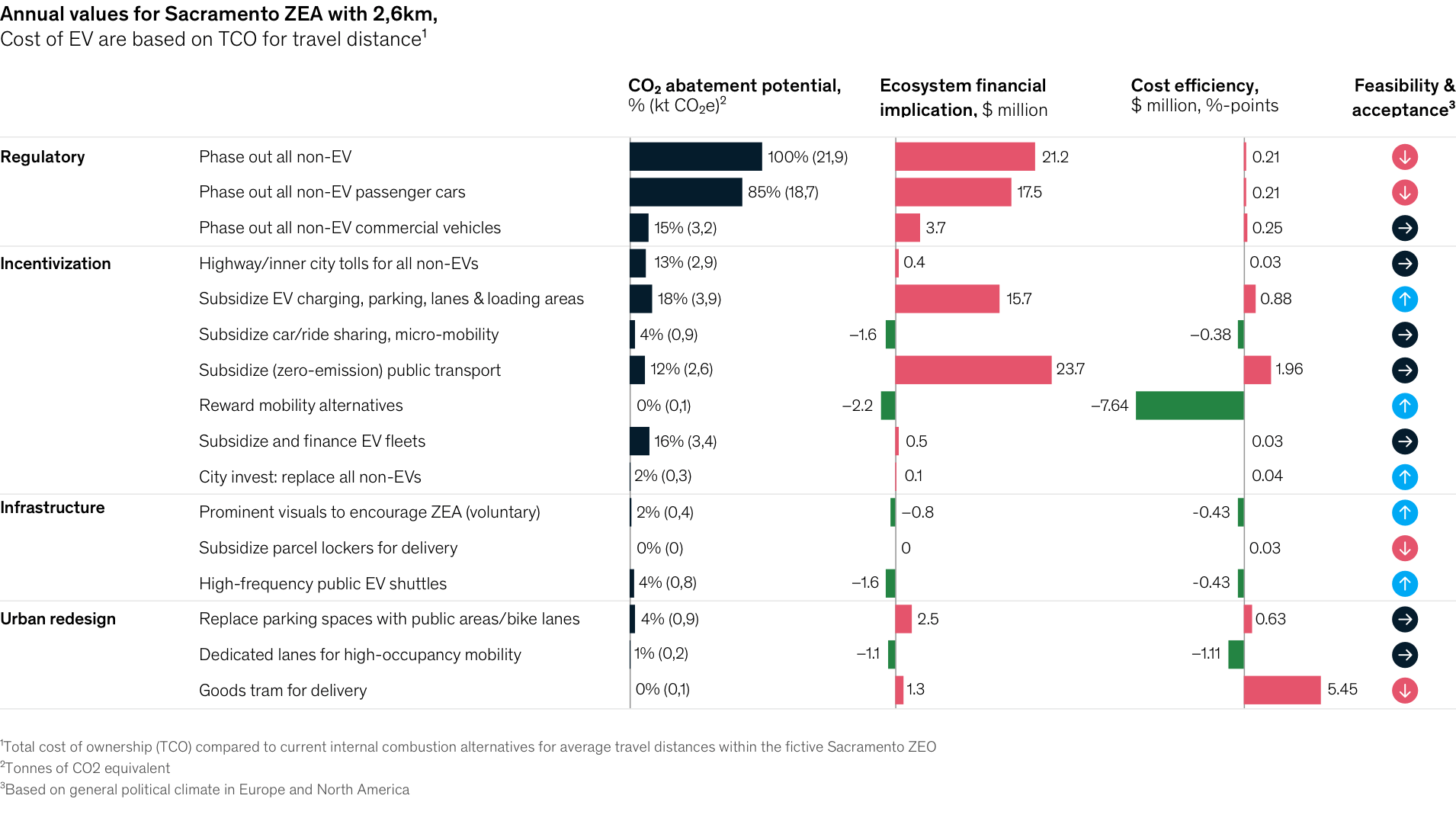
The model can be helpful to evaluate impact of ZEA measures. Click through the interactive for an example of possible effects.
Evaluating the impact of a ZEA
The model quantifies emission reductions across the impact for society, the environment and the economy. When implementing and managing ZEAs, the overall costs, effects and experiences for stakeholders should be taken into account to support reducing carbon emissions, increasing mobility efficiently, freeing up public space, improving equitable access and creating new business opportunities.
Reviewing the system effects of a ZEA


Planning the transition and timing for each measure
The possibility of implementing measures and transitioning to zero emission mobility needs to be mapped out by cities.
1
2
3
4
See how a detailed view can help you understand tradeoffs.

Get started
1

Reward Mobility Alternatives
Creating incentive and reward schemes for switching to low-carbon transportation alternatives are popular methods that can easily win community support.
Next

2
Start
Reward Mobility Alternatives
Benefits
Drawbacks
Start
3
Benefits
Reward mobility alternatives
–2.2
–7.64
Benefits
By including local business in the reward scheme, a reward system can generate an overall financial benefit.
Next
4
Drawbacks
Drawbacks
However, a drawback is the overall low CO₂ abatement effect.
Start over
Bordering freeways
Area
zoning
Large traffic routes
Public transport
Existing infrastructure
Charging stations
Micro-mobility
Enhancements



Proximity to downtown
Larger-scale ZEAs, putting together individual building blocks of ZEAs, implementing learnings from street-level pilots and developing communities into catalysts and advocates for ZEAs.
Amsterdam
Ringroad approach
Target state of comprehensive zero-emission city in which multiple measures are in place.
Oslo
Inner city district
Smaller-scale, street-level pilots for testing individual measures, generating quick-wins and generating community buy-in.
Barcelona
Superblocks model
Oxford
Red zone district


Revenues from tolls for non-EVs can be reinvested to provide subsidies for zero emission public transport, active mobility and other zero emission mobility options.
Impact vs. feasibility
Impact vs. cost
Emissions impact per dollar spent
Political feasibility and ecosystem acceptance
A
Mostly city-/government-led top-down approach via regulatory interventions, leveraging increasing TCO advantage of BEV vs. ICE
B
Incremental improvements with a selection of single interventions focusing on cost-positive, no-regret moves—trying to maximize acceptance by all ecosystem stakeholders as perceived cost and behavioral changes are limited
C
Combination of various measures that have a high probability of implementation and provide significant emission reduction

Impact vs. feasibility
Impact vs. cost
Impact vs. feasibility
Impact vs. cost

Laying the foundation

Laying the foundation

Defining a winning concept
Defining a winning concept

Quantifying the model
Quantifying the model