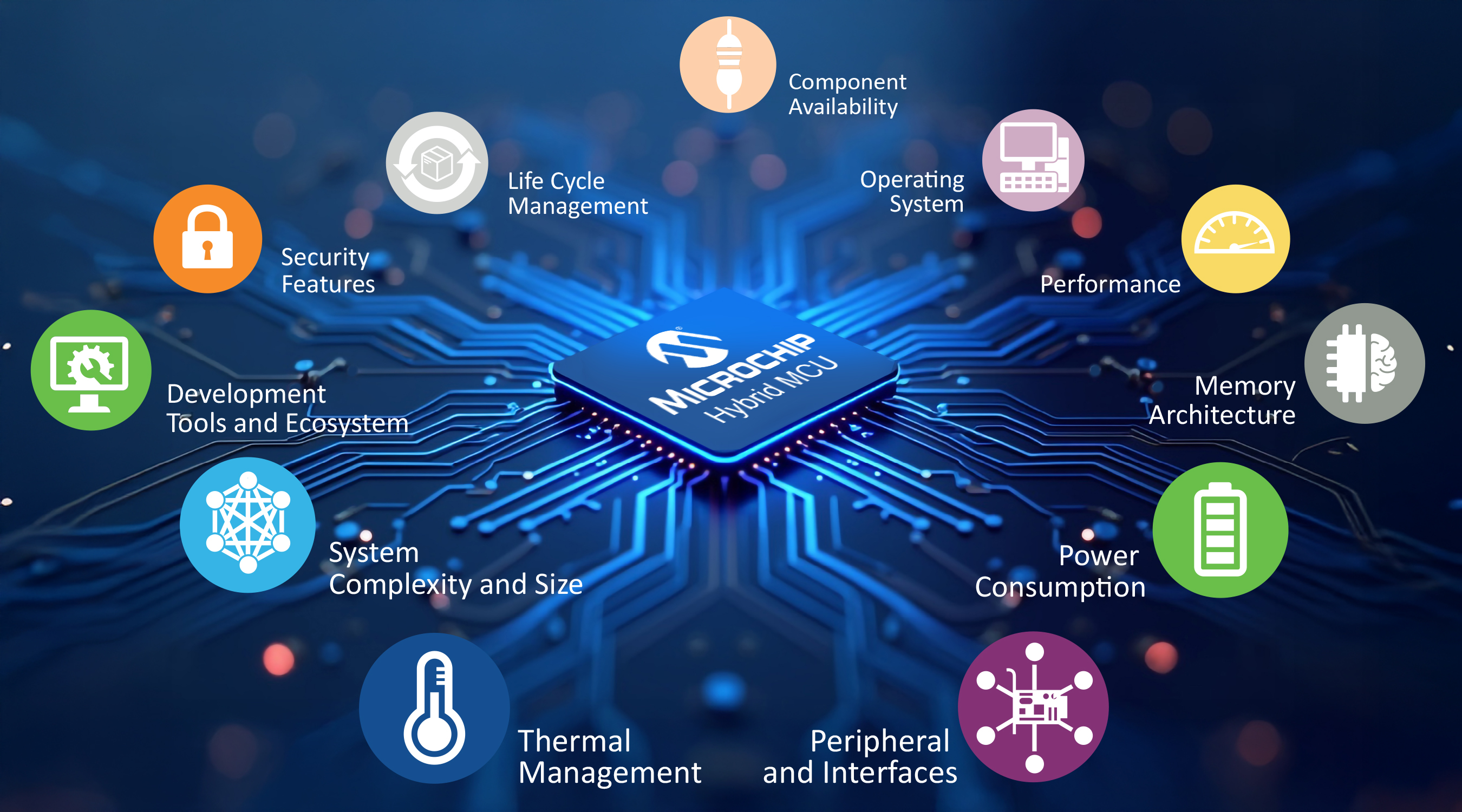


Performance
When designing compute-intensive applications, you might require an increase in performance; a few 100 MHz clocks, for example, are unlikely to be sufficient. Hybrid MCUs provide additional performance capability of up to 800 MHz.
Operating System (OS)
MCUs can run at the bare metal or RTOS level. Hybrid MCUs support bare metal, RTOS and Linux OS development.
Memory Architecture
When selecting a device, memory architecture is an important consideration. Unlike MCUs, which contain embedded memories, hybrid MCUs require you to define which memory you’ll need for:
Boot: NAND Flash, Q/OSPI Flash or eMMC
Code execution/data storage: SDR or DDR
Parameter storage: Serial EEPROM or serial Flash
Power Consumption
Power consumption figures for MPUs are typically specified based on Junction Temperature (Tj) while figures for hybrid MCUs are specified based on Ambient Temperature (Ta).
Backup and idle modes on hybrid MCUs are similar to those you’ll find on MCUs. However, one difference between MCUs and hybrid MCUs is that hybrid MCUs contain ultra-low-power (ULP) mode with DDR save context/self-refresh.�
Peripherals and Interfaces
I/O muxing should be reviewed carefully to ensure a proper migration. MCUs typically offer more mixed analog interfaces than MPUs. On the other hand, hybrid MCUs offer higher-speed interfaces for graphics (LVDS and MIPI® DSI®.) and for cameras (MIPI CSI 2®).
Special care should be given for DDR signals routed on your PCB. Please refer to our application note in the documents section of this page. Alternatively, we provide SiP solutions that integrate the SDR/DDR memory.
Thermal Management
MPUs tend to dissipate significantly higher heat (1W+) due to higher clock speeds and high-speed memory. Therefore, most MPU specifications refer to Tj with some specific thermal management that the application software must manage. Low-power hybrid MCUs do not require any specific thermal management if your application remains within the stated temperature condition.�
System Complexity and Size
MPU-based designs may lead to a larger PCB footprint due to all the external components required compared to an MCU. PCB design might also be more complex because of DDR routing; we recommend conducting a signal integrity analysis. If these constraints are roadblocks for your application, consider our hybrid MCU SiPs.
Our hybrid MCUs come with external Power Management ICs (PMICs). While the power-up sequence can bring some challenges on MCUs (timing versus voltage level versus temperature), the PMICs on hybrid MCUs ensure that they will always boot under the specified conditions. �
Development Tools and Ecosystem
Migrating from MCUs to hybrid MCUs requires careful attention to the architecture differences. Our MPLAB® Harmony embedded software development framework allows you to reuse most of your existing code base. It offers drivers and middleware libraries (USB, TCP/IP stacks, file systems and more) that can be reused when migrating from SAM or PIC32 MCU devices to hybrid MCUs. You’ll be also able to use MPLAB Harmony Configurator (MHC) to adjust the clock settings.
Security Features
Hybrid MCUs come with advanced security features such as secure boot, secure key storage, tamper detection, Physically Unclonable Functions (PUFs), TRNG and hardware encryption such as AES and SHA.
Life Cycle Management
Hybrid MCUs can run Linux® OS, any RTOS or bare metal. One benefit of the Linux® OS is the longer-term distribution maintenance commitment. Therefore, you’ll need to plan for regular Linux kernel upgrades and updates.
Component Availability
These products are backed by our client-driven obsolescence practice of continuing to supply a product for as long as possible and while demand for the product exists.
Thermal
Management
Life Cycle
Management
Operating
System
Performance
Memory
Architecture
Power
Consumption
Peripheral
and Interfaces
Component
Availability
Security
Features
System
Complexity and Size
Development
Tools and Ecosystem
Click or tap the Icons to Learn More
Click or tap the Icons to Learn More