Blueshirts advanced to the Stanley Cup Final in 1928-29 and 1931-32, and in 1932-33, they won their second Stanley Cup.
While the team was having success, Patrick also had the foresight to prepare for when the core group of the original Rangers team would retire. Patrick’s idea, taken from the success that teams in Major League Baseball were having, was to develop young talent with minor league teams that the organization would run. The Rangers would identify these players first – primarily from an amateur tryout school that the team launched in Winnipeg, where they would hold their Training Camp in the mid-1930s through the mid-1940s – and then have them play for these affiliates. This system would come to be known as the “3-R” Chain at first, with the links being the Rangers, the New York Rovers of the Eastern Amateur Hockey League (who played their home games at MSG), and the Philadelphia Ramblers of the Canadian-American Hockey League (which would eventually become the American Hockey League). This system would then become the “4-R Chain” after the Rangers had a junior
asked NHL President Frank Calder if they would be allowed to use Connell. Calder consulted with the Maroons’ Head Coach, Eddie Gerard, about this idea; Gerard refused to give the Rangers permission to do so.
After several minutes of contemplating what to do next, Boucher and Bill Cook asked Patrick if he would be willing to play in goal. Patrick agreed to do so. He was 44 years old at the time, and although he had been a Hall of Fame player, he hadn’t been a goaltender in his career. The Rangers tightened their play defensively to help support Patrick as much as possible. As Boucher described in his autobiography years later, “Taffy Abel and Ching Johnson never played better in their lives.”
Bill Cook scored the first goal of the game 30 seconds into the third period to put the Rangers ahead, but Stewart tied the game late in the period, and the contest went into overtime.
Just over seven minutes into overtime, Boucher scored to win the game, tying the series at one game apiece and putting Patrick’s performance into hockey lore. The Rangers went on to win the Stanley Cup in a winner-take-all Game 5. Led by Patrick, the
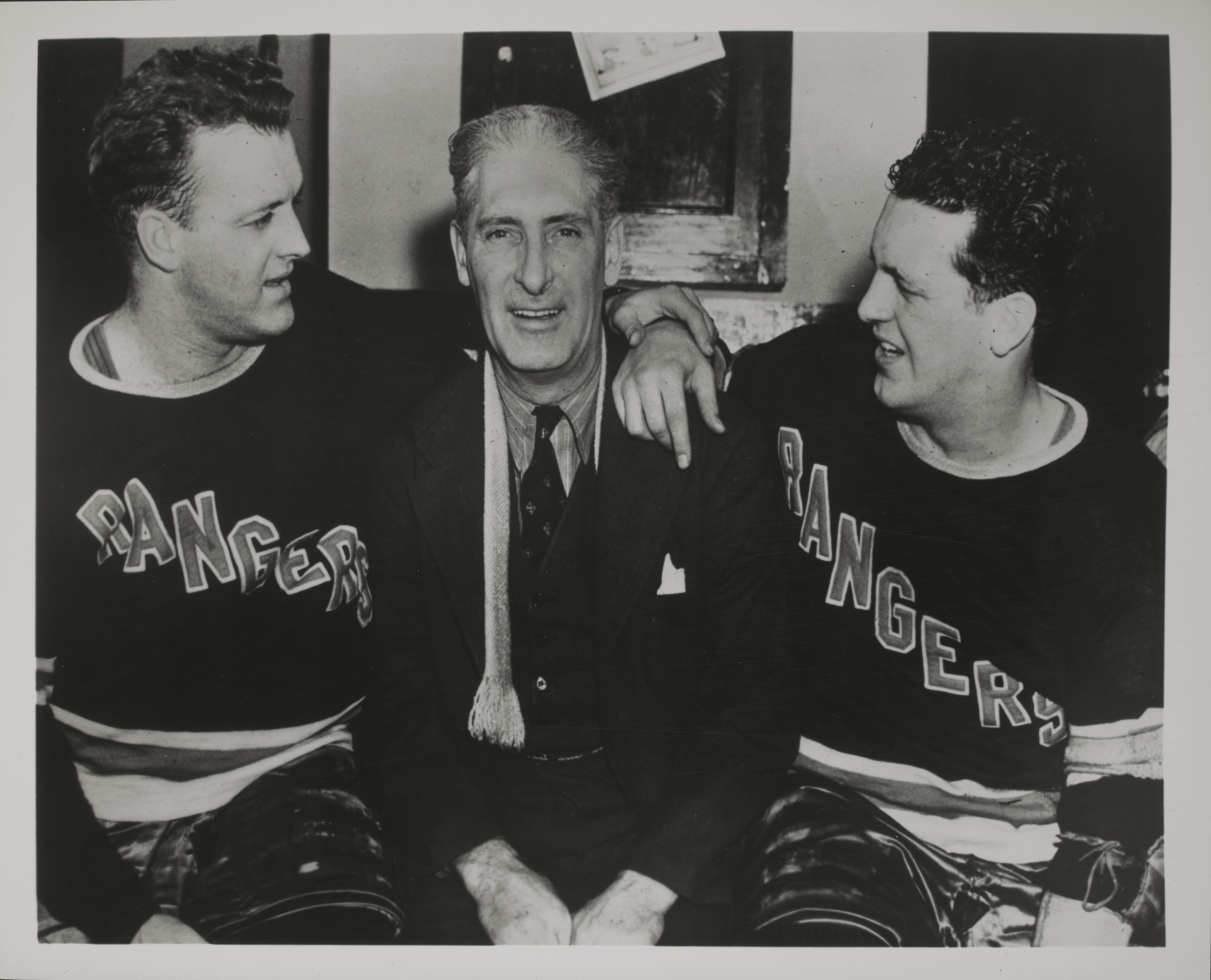
Group photograph of Lester Patrick (center) with sons Lynn Patrick (left) and Muzz Patrick (right).
A legendary figure in the sport of hockey,
Patrick molded the Rangers franchise in its infancy
LESTER PATRICK – THE “SILVER FOX”
Over the first 16 seasons of franchise history, the New York Rangers reached the Stanley Cup Playoffs 15 times, advanced to the Stanley Cup Final six times, and won the Stanley Cup three times. They earned a reputation of being the “Classiest Team in Hockey”, and they had entrenched themselves as New York’s hockey team.
During that time, there was perhaps no more important figure in establishing the Rangers’ identity as a franchise and leading the team to on-ice success than Lester Patrick.
“Lester fit the term patriarch,” hockey historian Stan Fischler said. “He was an innovator. He and his brother, Frank, recreated the game from primitive hockey into the modern game. They put numbers on players’ jerseys and changed rules around to make it more exciting.
“Hockey owes more to Lester Patrick than any single guy.”
Patrick, a native of Drummondville, Quebec, moved to British Columbia during his playing career. For a decade and a half, he became one of the most influential players and coaches of his era in the Pacific Coast Hockey Association (which ultimately merged with the Western Hockey League). In 1924-25, as the general manager and coach of the Victoria Cougars, he helped Victoria defeat the NHL’s Montreal Canadiens to win the Stanley Cup, as Victoria became the last non-NHL team to win the trophy.
When the WHL disbanded following the 1925-26 season, Patrick was unsure of where his next job in hockey would be. Once Rangers president Colonel John S. Hammond was ready to replace general manager Conn Smythe in October of 1926, he knew that Patrick was the person he wanted for the job.
Ultimately, it was the right move for the Rangers and changed the franchise forever.
“Lester Patrick was the most knowledgeable hockey man I ever met,” Frank Boucher – who was the center on the Rangers’ top line in 1926-27 and for many years after that, and who would ultimately succeed Patrick as the team’s head coach and general manager – wrote in his autobiography, When The Rangers Were Young. “You never had to have anything in writing with Lester Patrick,” said Murray Murdoch, one of the original Rangers, and who became the NHL’s first “iron man” with 508
MADISON SQUARE GARDEN NEW YORK, NY
NEW YORK RANGERS VS. MINNESOTA WILD
MONDAY, OCTOBER 20, 2025
THE NEW YORK RANGERS PRESENT THE BIRTH OF THE FRANCHISE


















On this day – October 20 – in 1926, right wing Bill Cook was named the captain of the New York Rangers, becoming the first captain in franchise history.
A few weeks later, on November 16, 1926, Cook would score the first goal in Rangers history, leading the Blueshirts to a 1-0 win in their first game against the Montreal Maroons at Madison Square Garden. By the end of the 1926-27 sea-son, he led the entire NHL with 33 goals and 37 points, becoming the first Blue-shirt to accomplish each feat.
It was just the beginning of several “firsts” that Cook has in Rangers history. And over his 11-year NHL career with the Blueshirts, Cook became one of the most impactful players in the history of the fran-chise.
Cook was born on October 9, 1896, in Brantford, Ontario. While he played in On-tario as a teenager and into his 20s, it was in Saskatoon where Cook became a star in the hockey world. With the Saskatoon Crescents, the right winger led the West-ern Canada Hockey League in both goals and points during the 1923-24 season, and he ranked second in the renamed Western Hockey League in both catego-ries in 1925-26.
The WHL disbanded following the 1925-26 season, and teams in the Nation-al Hockey League began looking west-ward to acquire players to enhance their rosters. One such team was the New York Rangers, who were entering the NHL in 1926-27. The Rangers acquired the con-tracts of Cook, as well as his brother and linemate, Fred “Bun” Cook, from Saska-toon. Before the season began, the Blue-shirts would also acquire center Frank Boucher, who had previously played in the WHL with Vancouver.
Coached by Lester Patrick – a legend-ary hockey figure who rose to prominence in Western Canada and was familiar with the Cook brothers and Boucher – Bill Cook, Bun Cook, and Boucher formed the first great line in Rangers history. As Murray Murdoch, another member of the original Rangers team, once said about Lester Patrick, “The first line did as they liked, the second line did as (they were) told, and the third line was damn lucky to be there.”
The chemistry between the Cook brothers and Boucher was undeniable, and they constantly worked together to create new plays to increase their of-fensive production. As Boucher wrote in his autobiography When The Rangers Were Young, “Lester left Bill, Bun, and me almost completely alone. Often during practices, he would stay at one end of the rink with eight or nine players and let the three of us at the other end flip the puck around and work on our plays. He never interfered with our experiments. I think he gave us this leeway because he had faith in our ability and this, to me, pointed up his greatness as a coach.”
Boucher and Bun Cook were the play-makers of the line, while Bill Cook was the finisher. With his powerful skating stride and hard and accurate shot, No. 5 created havoc for defenses and goaltenders.
In 1927-28 and 1928-29, when offense was limited throughout the league, Bill Cook ranked among the top 10 in the NHL in each season. In addition, he helped the Blueshirts advance to the Stanley Cup Fi-nal in both years and win the Cup in 1927-28.
In 1929-30, the NHL permitted forward passing in the offensive zone, and as a re-sult of the rule change, the Rangers’ captain had some of the
prolific statistical seasons of his NHL career. He tallied 59 points in 44 games that season, finish-ing fourth in the NHL in points. In 1930-31, he was named to the NHL’s First All-Star Team at right wing – becoming the first Ranger to be a First Team NHL All-Star – as he ranked second in the NHL with 30 goals.
Cook just missed out on leading the league in goals in 1931-32, as his 33 goals were one shy of the NHL’s leader, Charlie Conacher of the Toronto Maple Leafs. The Rangers lost to Toronto in the Stanley Cup Final that year, but in 1932-33, Cook and the Rangers got their revenge against the Maple Leafs. The Rangers’ captain led the NHL with 28 goals and 50 points during the regular season, and when the Blueshirts and Maple Leafs met again in the Stanley Cup Final, Cook scored the Cup-clinching goal in overtime of Game 4 of the series.
Cook was a First Team NHL All-Star for three consecutive seasons from 1930-31 through 1932-33 and a Second Team NHL All-Star in 1933-34. By the start of the 1935-36 season, he was 39 years old, and his offensive production began to decline. As the Rangers began to bring in the next wave of players from their minor league teams, Cook and the other mem-bers of the ‘Old Guard’ began to advance into the next stage of their careers.
After the 1936-37 season, Cook be-came player-coach and general manager of the Cleveland Barons in the Interna-tional-American Hockey League (IAHL). In 1952 – while he
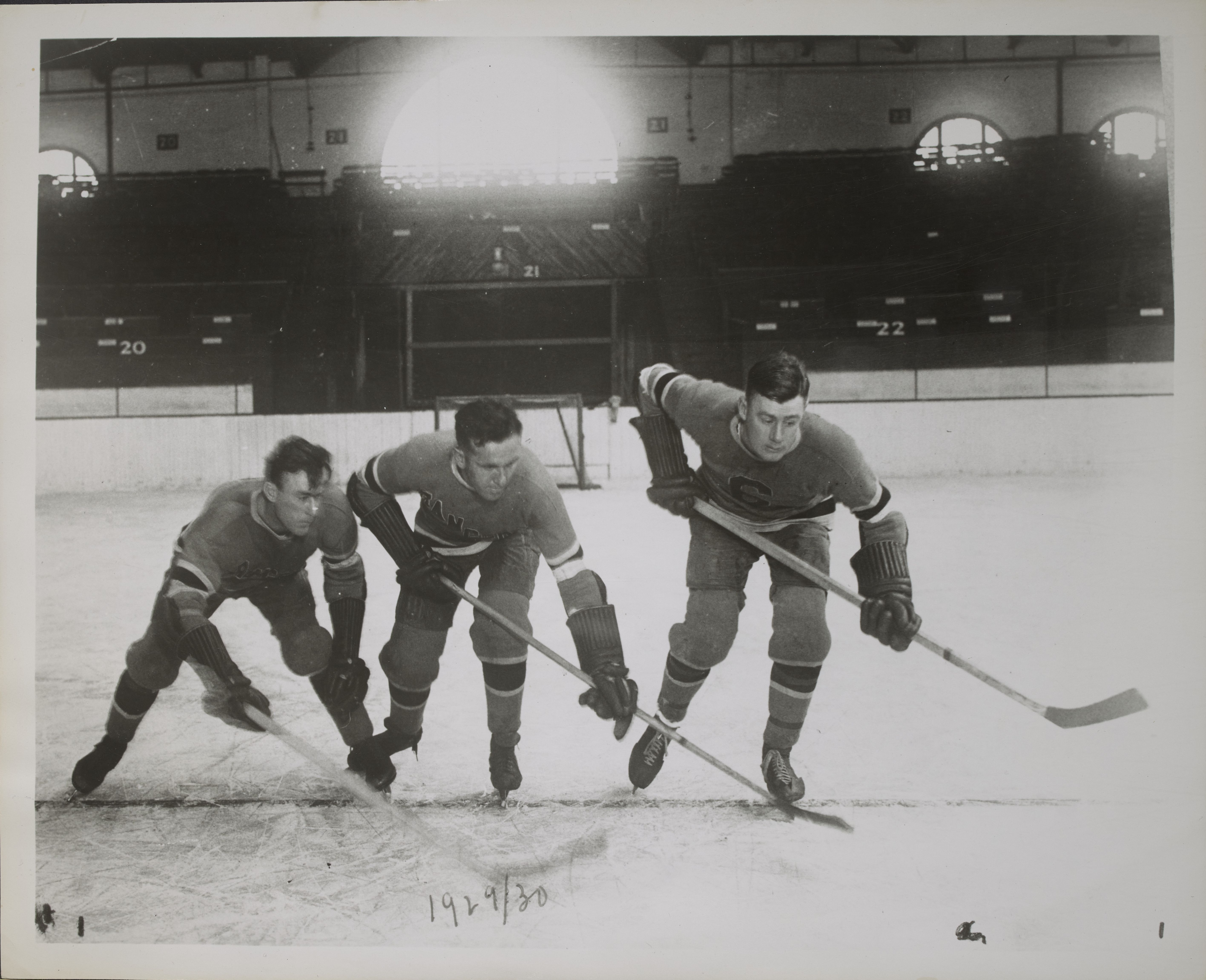
NY Rangers players, The famous New York Ranger line of Bill Cook, Frank Boucher, Fred “Bun” Cook.
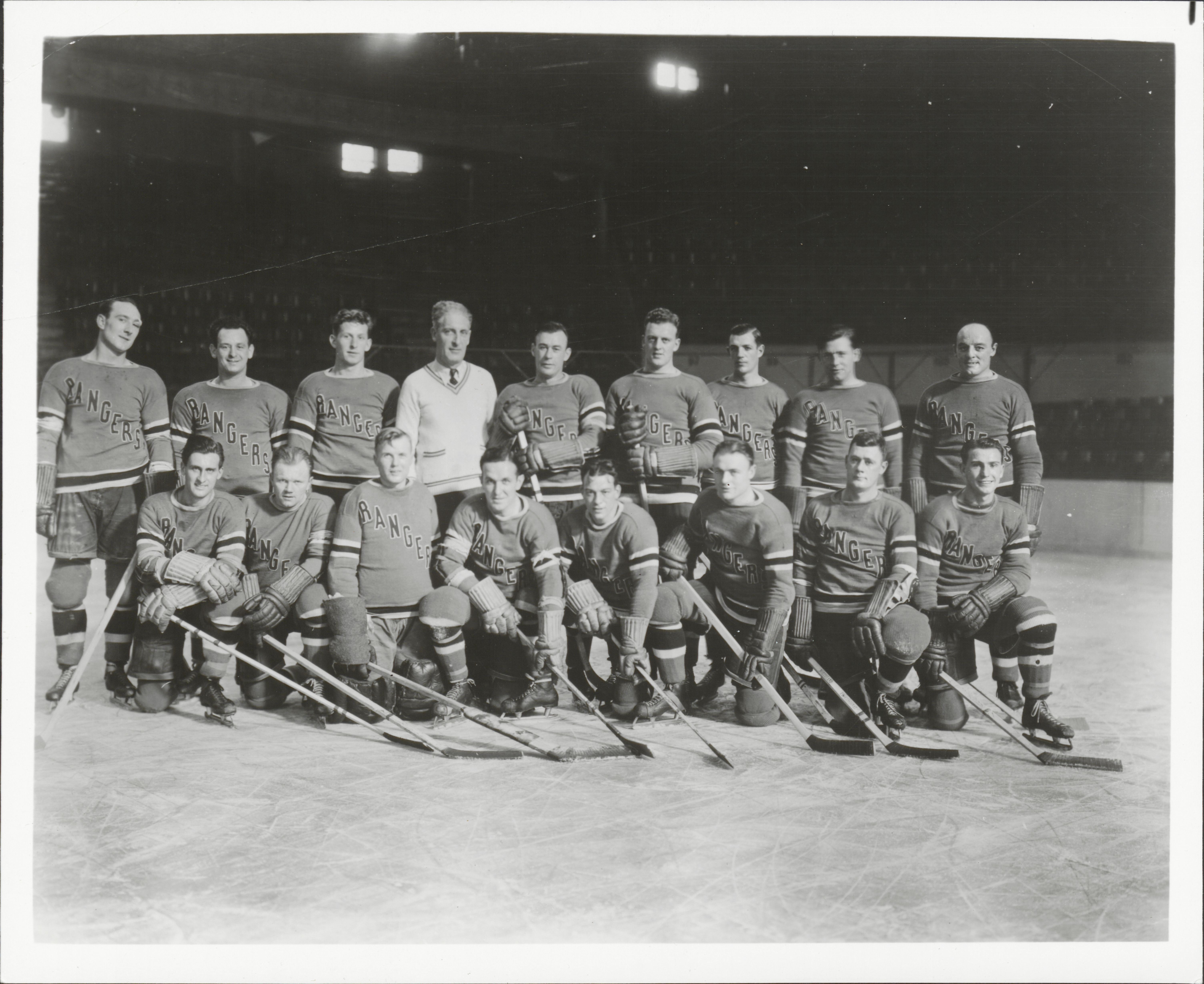
Bill Cook (middle of second row) was captain of the Rangers for 11 seasons, more than any other player in franchise history. He poses here in the team photo for 1934-35, the ninth of his 11 seasons with the Blueshirts.
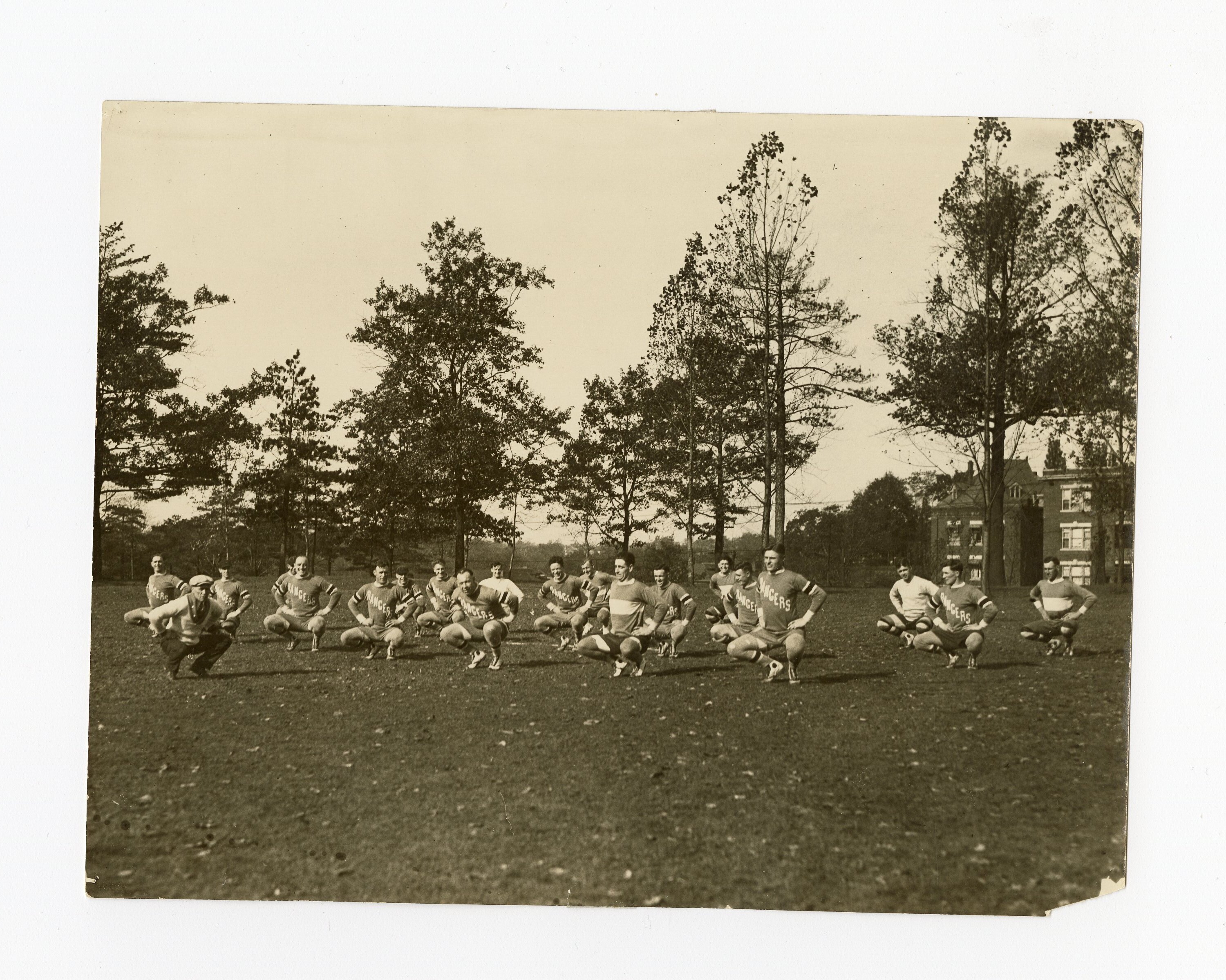
NY Rangers 1st ever training camp held at Ravina Rink in Toronto, ON. Training Camp.
BILL COOK – THE RANGERS’ FIRST CAPTAIN
Hall of Famer accomplished many “firsts” in franchise history
over 11 seasons with the Rangers
consecutive regular season games played over his 11-year career with the Blueshirts. “His word was as good as gold. If he said that if you did a certain thing, or scored a certain number of goals or something like that and there was a bonus for it, you never had to have it in writing.
“Lester was always thinking about the good of the game and just lived hockey.”
As the team’s general manager and head coach, Patrick brought a discipline, focus, and level of class to the Rangers that would shape the franchise. The Blueshirts quickly earned a reputation as the “Classiest Team in Hockey” and Lester, who would help explain hockey to journalists as he would to the players in order to help grow the sport’s popularity in New York, would earn the nickname, “The Silver Fox”.
As Boucher wrote in his autobiography, “During the early years when (Lester) was talking to the New York sportswriters whose grasp of hockey’s finer points was meagre he’d sometimes stretch full-length on his office carpet to illustrate a point about goaltending. In no time at all, they’d be charmed, a most persuasive man when he turned on his smile, and he’d then spend hours talking to them about the game he loved so dearly and knew so well.”
In the Rangers’ inaugural season in 1926-27, Patrick guided the team to the best record in the American Division. The following year, the Rangers won their first Stanley Cup in franchise history, thanks to Patrick’s impact in the front office, behind the bench, and even on the ice.
In Game 2 of the 1928 Stanley Cup Final, Lorne Chabot – who up until that point had played in goal for every second of every regular season and playoff game for the Rangers in 1927-28 – was struck in his left eye with the puck on a shot from the Maroons’ Nels Stewart. Chabot had to be helped from the ice to the locker room, and the game was stopped to give the Rangers time to determine how they would replace him.
In an era where there was not a backup goaltender, the Rangers’ options were limited. Alec Connell, a future Hall of Fame goaltender who had tied for the NHL lead with 15 shutouts as a member of the Ottawa Senators in 1927-28, was in attendance to watch Game 2 of the Stanley Cup Final, and the Rangers

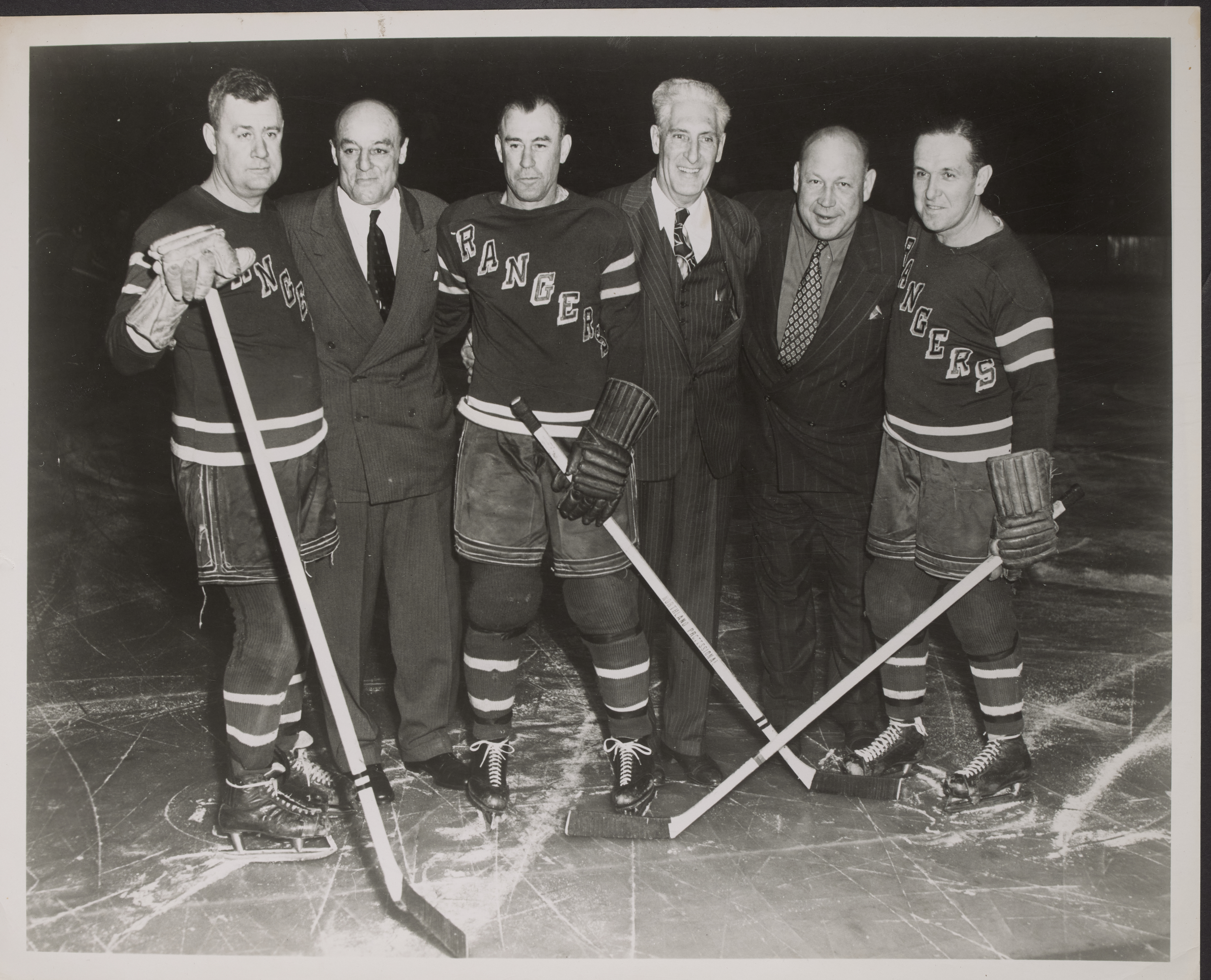




Patrick and the first starting lineup in Rangers history. From left to right, it’s Fred “Bun” Cook, Ivan “Ching” Johnson, Bill Cook, Lester Patrick, Clarence “Taffy” Abel, and Frank Boucher The night we honored Lester Patrick, 1947.
hockey affiliate in Canada as well, which at first was the Edmonton Roamers and then became the Regina Rangers.
The Rangers’ farm system would evolve over time with different affiliates, particularly with affiliations for junior teams in Canada, but the “4-R” chain that Patrick initially created would pay dividends for the franchise in the years that followed.
Prior to the start of the 1939-40 season, Patrick turned over the coaching duties to Boucher and focused solely on his role as general manager. That season, the team was led by players who had been identified and developed through the Rangers’ system. Among them were all three members of the “Bread Line” – Alex Shibicky, Neil Colville, and Mac Colville – and forwards Bryan Hextall, Phil Watson, Dutch Hiller, Kilby MacDonald (who won the Calder Trophy as the NHL’s rookie of the year in 1939-40), Clint Smith, and Alf Pike, as well as defensemen Muzz Patrick (Lester’s youngest son) and Babe Pratt. Behind this group of players, the Rangers won their third Stanley Cup that season.
The same core of the team also helped the Rangers finish the 1941-42 season with the best regular season. The same core of the team also helped the Rangers finish the 1941-42 season with the best regular season record in the NHL. Things were in place for the Blueshirts to have success for years to come, and had it not been for the start of World War II – when several Rangers players left the team to serve their country – their farm system might have led to even more success throughout the decade.
Near the end of the 1945-46 season, Patrick relinquished his post as general manager, ending a distinguished 20-year run in the role. On December 3, 1947, the Rangers held a night to honor Patrick’s legendary accomplishments with the franchise upon his Hockey Hall of Fame induction; he was the first member of the Rangers organization to receive such a recognition.
As the Rangers celebrate their Centennial and recognize those who helped establish the foundation on which the franchise stands today, there is perhaps no figure who helped shape their legacy in their formative years more than Lester Patrick. �
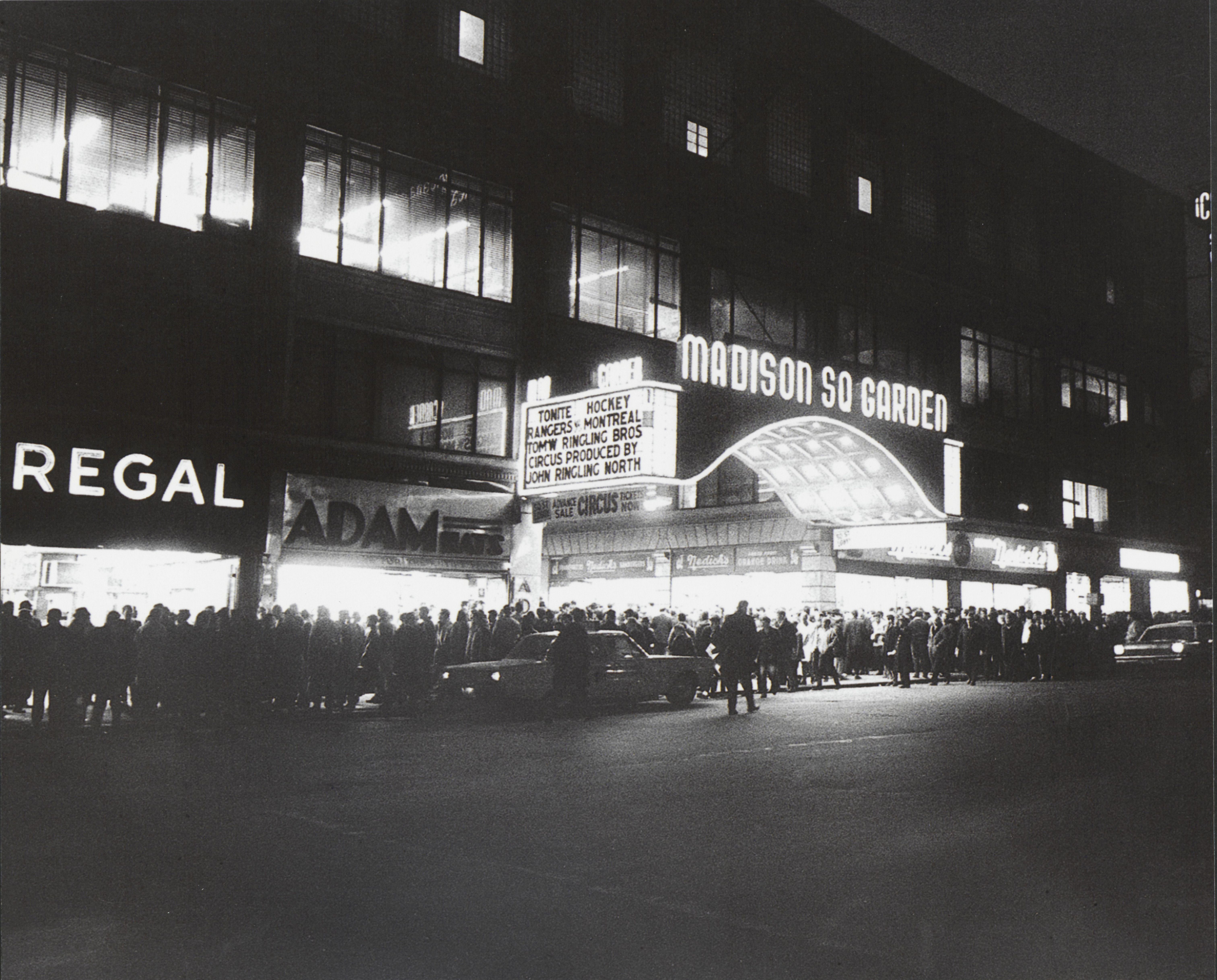
Print photograph of a crowd entering the Madison Square Garden III arena (1925-1968) for a Rangers game.
was in the middle of his stint as the Rangers’ head coach – he was inducted into the Hockey Hall of Fame, becoming the first player who played the majority of his career with the Rangers to receive the honor.
Cook scored 228 goals and tallied 366 points in 475 career games over his 11 seasons with the Rangers. He was the franchise’s all-time leader in goals until 1962, when he was surpassed by Andy Bathgate. He served as captain for more seasons than any other player in franchise history, and the only player who was the Rangers’ captain for more games than him was Mark Messier.
Bill Cook was an original Ranger who accomplished many franchise “firsts” and helped build the foundation on which the franchise stands today.�














Official Team Photograph of the New York Rangers Championship team, 1927-1928.
New York Rangers players receiving the Stanley Cup , 1932-1933.
Autographed Official Team Photograph of the New York Rangers Championship Team, 1939-1940.
1927-1928 STANLEY CUP CHAMPIONS
MEET THE CHAMPIONS OF THE EARLY ERA

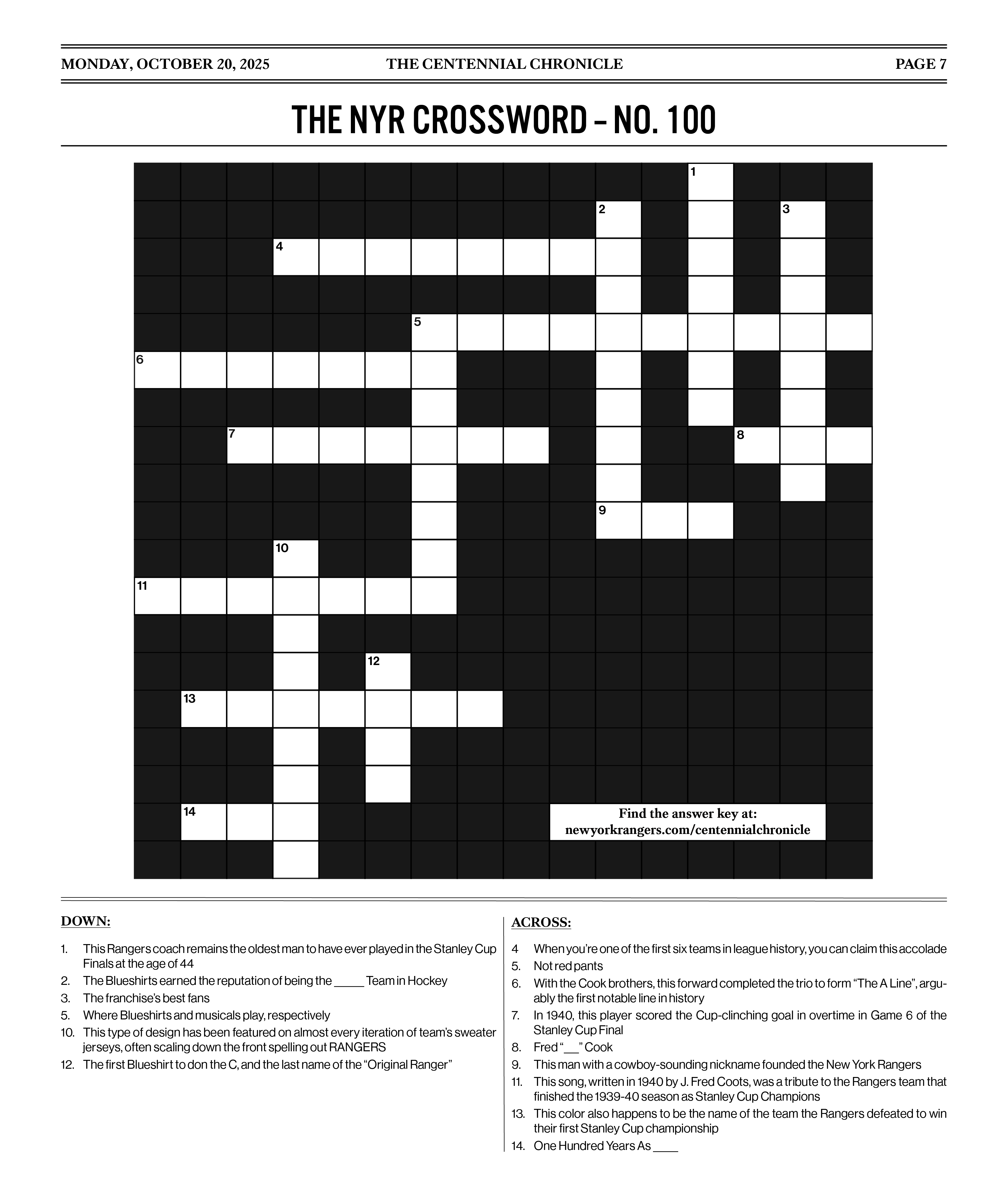
THE NYR CROSSWORD - NO. 100



THE NYR CROSSWORD - NO. 100


PRINT CROSSWORD
VIEW ANSWERS