NEB
EXPRESSIONS
A scientific update
Issue II • 2021
SCIENCE
INNOVATION
INSPIRATION
Read about PaqCI™ and what makes it a special addition to the NEB Golden Gate Assembly portfolio
Feature Article
1
An online tool to track SARS-CoV-2 variants that may impact primers used in diagnostics
Primer Monitor Tool
2
NEB has everything you need for RNA-related workflows at quality levels that support vaccine and diagnostics development
Product Highlight
4
NEBNext ARTIC kits for whole-viral-genome sequencing of SARS-CoV-2
Products Supporting COVID-19 Research
3
LunaScript Reverse Transcriptase, RNAse Inhibitor and Golden Gate Assembly
Find out more about our special priced products
5
NEB SPECIAL
Start your career off on the right path
NEB Starter Pack
6
Read about why we pursued certified B Corp status
NEB is a B Corporation
7
USA New England Biolabs, Inc. Telephone: (978) 927-5054 Toll Free: (U.S. Orders) 1-800-632-5227 Toll Free: (U.S. Tech) 1-800-632-7799 www.neb.com
BeNeLux: BIOKÉ Tel: (+31) 71 720 0220 (BE: 0800 - 71640) info@bioke.com www.bioke.com
CROATIA: BIOKÉ Diagnostica Skalpeli d.o.o. Tel: (+385) 1 377 8484 skalpeli@skalpeli.hr www.skalpeli.hr
CZECH REPUBLIC: BioTech a.s. Tel: (+420) 2727 017 39 info@ibiotech.cz www.ibiotech.cz
DENMARK: BioNordika Denmark A/S Tel: (+45) 39 56 20 00 info@bionordika.dk www.bionordika.dk
GREECE: BIOLINE SCIENTIFIC Tel: (+30) 210 522 6547 info@bioline.gr www.bioline.gr
HUNGARY: Kvalitex Kft. Tel: (+361) 340 4700 info@kvalitex.hu www.kvalitex.hu
ITALY: EUROCLONE S.P.A. SOCIETÀ ASOCIO UNICO. Tel: (+39) 02 38 1951 info@euroclone.it www.euroclonegroup.it
ISRAEL: Ornat BioChemicals & Lab Equipment Tel: (+972) 8 947 7077 ornatbio@ornat.co.il www.ornat.co.il
NORWAY: BioNordika AS Tel (+47) 2303 5800 info@bionordika.no www.bionordika.no
POLAND: Lab-JOT Ltd. Sp.z o.o. Sp.k. Tel: (+48) 2233 598 84 biuro@labjot.com www.labjot.com
PORTUGAL: Werfen Tel. (+351) 214 247 300 dac-pt@werfen.com www.werfen.com/pt
ROMANIA: BioZyme Tel: (+40) 264 523 281 contact@biozyme.ro www.biozyme.ro
RUSSIA: SkyGen LLC Tel: (+88) 0033 312 26 info@skygen.com www.skygen.com
SERBIA: Alfa Genetics d.o.o. Tel: (+38) 1011 2084 252 office@alfagenetics.rs www.alfagenetics.rs
SLOVAK REPUBLIC: BioTech s.r.o. Tel: (+421) 254 7744 88 info@ibiotech.sk www.ibiotech.sk
SLOVENIA: Mikro+Polo d.o.o. Tel: (+386) 2614 33 00 podpora@mikro-polo.si www.mikro-polo.si
SWEDEN, ESTONIA, LATVIA, LITHUANIA: BioNordika Sweden AB Tel: (+46) 830 60 10 info@bionordika.se www.bionordika.se
SOUTH AFRICA: Inqaba Biotechnical Industries (Pty) Ltd Tel: (+27) 1234 358 29 info@inqababiotec.co.za www.inqababiotec.co.za
SPAIN: Werfen Tel: (+34) 9022 030 90 customerservice-es@werfen.com www.werfen.com/es
SWITZERLAND: BioConcept Ltd. Tel: (+41) 6148 680 80 info@bioconcept.ch www.bioconcept.ch
TURKEY: EKA BIOLAB TEKNOLOJI Tel. (+90) 312 248 13 24 info@ekabiolab.com www.ekabiolab.com
For a complete list of all NEB subsidiaries and distributors, please go to:
www.neb.com/international-support
FINLAND: BioNordika Oy Tel: (+358) 207 410 270 info@bionordika.fi www.bionordika.fi
BULGARIA: ELTA 90M Ltd. Tel: (+359) 2 983 96 49 office@elta90.eu www.elta90.com
France New England Biolabs France Telephone : 0800 100 632 info.fr@neb.com www.neb-online.fr
Germany & Austria New England Biolabs GmbH Free Call 0800/246 5227 (Germany) Free Call 00800/246 52277 (Austria) info.de@neb.com www.neb-online.de
Using PaqCI™ for Golden Gate Assembly – What Makes it a Special Addition to NEB's DNA Assembly Portfolio?
By Rebecca Kucera, M.S., NEB Principal Development Scientist, New England Biolabs, Inc.
At NEB, we have placed focus on advancements in both the development of new enzymes and maximizing enzyme functionality for Golden Gate Assembly reactions. In that spirit, our Golden Gate Assembly choices now feature a new player: the exciting Type IIS restriction enzyme, PaqCI. In this article, read about how PaqCI (an AarI isoschizomer) can be used for simple to complex 24-fragment assembly, achieving our highest level of efficiency and fidelity yet, and with less concerns regarding the domestication of internal sites due to its 7 base-pair recognition sequence.
Golden Gate Assembly (GGA) is dependent on Type IIS restriction enzymes that have asymmetric DNA recognition sites and cleave outside of these sequences. NEB currently offers 50 Type IIS restriction enzymes, of which a subset have the necessary favorable characteristics for GGA. Enzymes such as BsaI-HF®v2, BsmBI-v2, and BbsI-HF have been Golden Gate workhorses, as they have historically been featured in published assembly protocols and NEB has extensive experience working with them. During this time, and with input from our customers, we recognized that it would be useful to offer an enzyme with a 7-base recognition site for assembly, along with fully optimized protocols and enzyme recommendations, for assemblies ranging from simple to complex, and at a reasonable price. The advantage of a Type IIS restriction enzyme with a 7-base recognition site (see Figure 1) is that these sites are less likely to be present in the DNA sequences being assembled, yet they are capable of the full range of assembly complexity that scientists require for their experiments. Through a collaboration between laboratories in NEB's Research, Applications Development, and Production Departments, PaqCI was identified and cloned, and its expression was optimized. A DNA activator for the enzyme was also optimized and protocols were developed for single inserts, as well as simple-to-complex assemblies.
The significance of PaqCI with regards to domestication
Domestication refers to converting any DNA fragment that will be part of an assembly into “Golden Gate-ready” form - flanking the DNA at both ends with the Type IIS restriction sites that will direct the assembly and removing any internal sites for that enzyme that might be present in the DNA and are not tolerated well in GGA. Statistically, a 7-base sequence will appear in any given DNA sequence less often than the 6-base sequence of the more commonly used Type IIS restriction enzymes. Internal sites significantly decrease GGA efficiency because they allow the finished construct to be susceptible to digestion by the restriction enzyme present in the assembly reaction, and could also lead to incorrect and unwanted assemblies. This is less of an issue when using Golden Gate for single insert cloning because the overall efficiency for single inserts is high; the desired construct will be assembled even if many of the successfully cloned inserts became linearized and did not efficiently transform. But typically, researchers are using Golden Gate for multiple inserts – and the greater the assembly complexity, the more important the assembly efficiency becomes. For this reason, the presence of an internal recognition site of the chosen restriction enzyme, hinders the assembly.
Figure 1: Type IIS enzymes recognize asymmetric DNA sequences and cleave outside of their recognition sequence.
Cleavage
Some enzymes have more intricate ways of interacting with their recognition sites in DNA than others. Most homodimeric enzymes, like the standard Type IIP restriction enzymes EcoRI and HindIII, have two identical subunits that bind cooperatively at the symmetric site with each subunit cutting one strand to result in a double-stranded cut. In contrast, multi-site enzymes like PaqCI have a more complex structure and mechanism. It is presumed that PaqCI utilizes multiple subunits to interact with two recognition sites in order to cleave a single target site. To be sure that PaqCI cuts all the sites during Golden Gate Assembly, NEB supplies an inert short oligonucleotide activator containing an extra PaqCI binding site, which functions in trans as an activator for PaqCI cleavage (see Figure 2).
The mechanism of multi-site enzymes and why they benefit from the addition of an activator
However, domestication of a DNA sequence is time consuming, further highlighing the benefit of a 7-base recognition site enzyme, which significantly decreases the probability of internal sites. PaqCI is a 7-base recognition restriction enzyme that has been optimized for Golden Gate Assembly, and is supplied at a concentration that enables use for complex assemblies up to 20+ fragments.
There are proven methodologies for eliminating internal sites while domesticating DNA sequences:
(2) designing an assembly junction point right at the internal restriction site with a base change to eliminate the site upon assembly.
(1) site-directed mutagenesis to eliminate an internal site in advance of the assembly reaction, or
Figure 2: Presumed mechanism for how the PaqCI activator assures complete cutting via trans binding if needed
By definition, during Golden Gate Assembly, every insert and every destination plasmid has an assembly active DNA fragment flanked by two sites, implying that there is no need for any added sites. But Golden Gate is a very dynamic process, with concurrent cutting and ligating – situations arise where PaqCI binds and cuts sites on different DNA molecules, leaving a remaining site on each molecule to be cut. So having an optimized number of extra sites available in the form of the PaqCI activator ensures that complete cutting in the assembly reaction occurs. It should be noted that the activator does not get cut or interact in any way with the assembly – it only provides a second binding site that can activate cutting. Different levels of complexity call for different levels of PaqCI and T4 DNA Ligase. In addition, PaqCI and activator amounts have been carefully optimized for different assembly complexities. The optimal amount of the activator can be different from what is recommended for a standard restriction digest with PaqCI, where using 1 µl of the enzyme (10 U) requires 1 µl of the activator (20 pmoles). The reason for this is that cutting of DNA in a typical restriction digest, where cut DNA remains cut, is different than what occurs in Golden Gate assembly reactions, where overhangs can sometimes be reannealed and ligated, reconstructing the original recognition site. In the latter case, any one DNA cut site can require being cut more than once throughout the assembly reaction. Because of the dynamic nature of GGA, these regenerated sites translate to less supplementary sites in the form of the activator being needed. From over a thousand test assembly reactions, NEB researchers have established the optimal amount of PaqCI, activator, and T4 DNA Ligase for everything from simple single insert cloning to a complex 24-fragment assembly (see Table 1).
Table 1: Recommendations for PaqCI Golden Gate Assembly
As assembly reactions increase in complexity, more units of enzyme are required for maximal performance; the range is from 5 to 20 U of PaqCI paired with 200-800 U of T4 DNA Ligase. Recommendations for how much activator to add to each assembly reaction are within a range of 5-10 pmoles. A 20 µM stock of the activator is provided with the PaqCI enzyme. One note regarding the buffer requirements: while rCutSmart Buffer is the recommended buffer for use in a simple DNA digest with PaqCI, for Golden Gate Assembly, there are better efficiencies achieved by maximizing the PaqCI and T4 DNA Ligase enzyme activities using T4 DNA Ligase Reaction Buffer.
Golden Gate Assembly is a molecular DNA assembly technique that utilizes simultaneous digestion with Type IIS restriction enzymes and ligation by a DNA ligase to enable the seamless, ordered assembly of multiple fragments. Type IIS restriction enzymes recognize asymmetric DNA sequences and cleave outside of their recognition sequence. The absence of internal sites in a sequence determines the choice of which Type IIS restriction enzyme to drive the assembly. With over 45 Type IIS restriction enzymes available and constant advances in both the development of new enzymes and research on maximizing enzyme functionality (e.g., ligase fidelity), NEB is the industry leader in pushing the limits of Golden Gate Assembly and related methods. Get started today. To simplify the workflow, NEB offers two kits for Golden Gate Assembly featuring BsaI-HFv2 or BsmBI-v2. Both kits can be used to assemble 2 or more than 50 fragments in a single step.
Learn more about the use of PaqCI in Golden Gate Assembly
Try our tool: NEB Golden Gate Assembly Tool
Get tips for your Golden Gate Assembly workflows
Back to top
Type IIS resctriction enzymes are the basis of Golden Gate Assembly.
Golden Gate Assembly workflow
Advantages:
• Seamless & ordered cloning • Assemble multiple fragments (2 to 50+) in a single reaction • Perform single insert cloning in just 5 minutes using fast protocols • Experience high efficiency, even with regions of high GC content and areas of repeats • Generate libraries with high efficiencies • Use with a broad range of fragment sizes (from less than 100 bp to over 15 kb)
Find more information, video tutorials, free primer design tool, ligase fidelity etc
Benefit from our special price offer:
Get started!
Product
E1602S/L
Size
NEB Golden Gate Assembly Kit (BsmBI-v2)
20/100 rxns
NEB Golden Gate Assembly Kit (BsaI-HFv2)
E1601S/L
Special Price*
until 31.12.2021
*Ask your local distributor for details.
Interested in fast and reliable DNA Cloning? Get started with Golden Gate Assembly.
NEB #
Primer Monitor: an online tool to track SARS-CoV-2 variants that may impact primers used in diagnostic assays
Matthew A. Campbell, Ph.D., Yanxia Bei, Ph.D., Nicole M. Nichols, Ph.D. and Bradley W. Langhorst, Ph.D., New England Biolabs, Inc.
Nucleic acid diagnostic tests for SARS-CoV-2, whether based on RT-qPCR, RT- LAMP or other amplification technologies, all depend on primers. While the SARS-CoV-2 genome seems to be less variable (1) than some other retroviral genomes, variants with potential effects on amplification efficiency have arisen and become prevalent in local areas. Some regions (e.g., Brazil; Madera County, CA, USA (2)) report greater than 15% of observed sequences with variants in genomic loci commonly used by diagnostic tests. We developed a streaming analysis method to identify variants that may affect specific primers, and an online tool (primer-monitor.neb.com) to allow interested users to register and track primer loci.
As SARS-CoV-2 variants continue to emerge across the world, diagnostic developers face increasing challenges to demonstrate that SARS-CoV-2 assays will continue to detect the virus variant that may be circulating in the population being tested. In the US, the FDA has issued a guidance document recommending that all test developers consider the impact of current and future variants on their COVID-19 assays during and post-development. To understand whether variants might impact assay performance, there is a need to first understand the nature of the variants that may be present in a given population. To that end, we have developed an online Primer Monitor tool to track SARS-CoV-2 variants as a function of geography and map those variants against user-defined and commonly used primer sets, such as those provided by the Centers for Disease Control and Prevention (CDC).
DESCRIPTION AND USE OF THE PRIMER MONITOR TOOL
As shown in Figure 1, the main page of the tool (Primer Variant Summary tab) shows an overview of the primer set of interest within the context of the SARS-CoV-2 genome (Figure 1A), and a broad view of variants that may impact primer binding, as observed across geographic region (Figure 1B). Data is regularly uploaded (multiple times per week) to the tool directly from GISAID, an initiative that promotes the rapid sharing of data from all influenza viruses and the coronavirus-causing COVID-19. To highlight emerging variants of interest, a variant fraction of at least 10% is depicted in dark blue. Note that only primer loci with variant fractions that meet user-defined minimum thresholds are shown in this panel. Registered users can subscribe to be notified when a variant overlapping a primer set reaches a threshold fraction of observed sequences in any geographic region.
INTRODUCTION
DESCRIPTION & USE
PRIMER SETS
VARIANTS OF CONCERN
CONCLUSION
To further investigate variant position as a function of primer location, a second visual is presented at the bottom of the main page (Figure 2). In this visual, variants are shown in the context of the full primer/probe sequences, enabling a complete assessment of potential impacts to primer/probe annealing dynamics. With qPCR primers, variants that occur closer to the 3´ end of primers/probes are typically more disruptive to assay performance than variants that occur closer to the 5´ end.
By evaluating both geographic and genomic regional variation, specific hotspots can be detected where primer assessment might be warranted. In the data above, a significant variant in South Korea with a mutation occurring near the 3´ end of the CDC N2 forward primer (position 29179) was detected. To further investigate the potential impact of this variant, RNA representing the N2 region from the wild-type SARS-CoV-2 sequence (Wuhan-Hu-1) and from the mutant S. Korean variant were assessed experimentally. Using the Luna SARS-CoV-2 Multiplex Assay Kit (NEB #E3019) based on the CDC N1 and N2 primer/probe sets described previously (FAQ), we observed a minor impact of the variant on assay sensitivity (from an LOD of 5 copies per reaction to 25 copies per reaction), and a consistent Cq delay across different RNA input amounts (Figure 3). For LAMP assays, most single point mutations are not disruptive enough to result in significant assay performance perturbations (3, 4), suggesting that this technique may offer additional benefits in the face of emerging SARS-CoV-2 variants. Additional information on NEB's LAMP-based SARS-CoV-2 assay can be found at www.neb.com/E2019.
The tool is preloaded with commonly used primer sequences from SARS-CoV-2 qPCR and LAMP assays and ARTIC sequencing workflows (currently v3). Users who create a free account may also upload additional primer sets, which will become public and available for any/all to monitor after a simple review and mapping process. Users who subscribe will also be able to receive notifications if variations within a specific primer set region cross a specified threshold in a geographic region of interest.
NAMED VARIANTS OF INTEREST/CONCERN
Numerous agencies have been tracking specific SARS-CoV-2 variants that have been recently classified by the CDC as Variants of Interest or Concern. These include named variants with mutations that may impact receptor binding, susceptibility to current treatments or vaccines, or represent an increased likelihood of transmission (e.g., B.1.1.7, P.1, etc). On the Lineage Variants page of the Primer Monitor Tool, static visuals representing many of these variants are depicted along with the genomic location of the mutations present within these named variants and potential overlap with commonly used primer sets (Figure 4). Specific genomic regions of interest are also presented in additional figures on the page to enable further investigation.
This tool provides diagnostic assay developers with additional resources to evaluate SARS-CoV-2 assay effectiveness by providing up-to-date data highlighting potential issues around primer/probe binding. It has been released quickly in response to ongoing concerns and needs in the scientific and diagnostic community in the hopes that this task will be made a bit easier for all. It is under active development at GitHub and additional features including time-course assessment, and primer-centric scoring are in progress or planned. Visualization is enabled by Tableau. Contributions, problem reports, and feature requests are welcome and requested.
Acknowledgements We are thankful for the team at GISAID and all who are working tirelessly to provide data, serve patients and otherwise lessen and shorten the impact of this global pandemic.
Figure 1: Primer variant summary
Users can choose from a variety of pre-loaded primer sets using a drop-down menu (A). The location of the chosen primer set is noted in the context of the SARS-CoV-2 genome by orange arrows. (B) shows an overview of variants that may impact primer binding across various geographic regions. Users can specify minimum thresholds using the right-hand panel. Hovering over shaded squares will reveal additional information, including total sequences deposited, to enable further evaluation of potential impact.
Figure 2: Variants by position
At the bottom of the main page, positions of the variants are shown in the context of the full primer/probe sequences (A). Dots indicate data points from the figure above and each dot reveals additional information upon hovering. A simple pictogram helps to orient the user to the forward and reverse primers and probe sequences (B). Data sharing, downloading, and further manipulation are all enabled using tools at the bottom right corner of the page.
A
B
Figure 3: Variant impact on N2 target detection
The Primer Monitor tool identified a prominent variant from some countries with a SNP close to the 3´ end of the 2019-nCoV-2_N2 forward primer included in the Luna Kit, which detects the Centers for Disease Control and Prevention (CDC) SARS-CoV-2 N1, N2 targets and human RNase P gene with modifications (See details) (A). To evaluate the impact of this SNP on the N2 target detection, we prepared two N gene RNA fragments containing the wild type and mutant N2 targets, respectively, by in vitro transcription and quantitated them using the SARS-CoV-2 RNA Control 2 from Twist Bioscience. Using the primer/probe set included in the Luna kit, we observed an average 4.2 Cq delay for the mutant N2 target (B). The limit of detection (LOD) for the mutant N2 target was 25 copies/reaction. Though all the reactions containing 10 copies of the mutant RNA generated amplification signal, only 11 of 24 had a Cq ≤ 40, the cut-off for detection (C).
Figure 4: Named variants of interest/concern
Commonly discussed variants of interest or concern are depicted along with specific mutational loci (A). Below the reference SARS-CoV-2 genome (blue) (B), commonly used primer sets that overlap variants of interest/concern are highlighted in orange.
SARS-CoV-2 Lineage Variant Summary
References 1. Kupferschmidt, K. (2020) Science, 369, 238–239. PMID: 32675355 2. Vanaerschot, V., et al. (2020) J Clin Microbiol, 59, e02369–20. PMID: 33067272 3. Wang, D. (2016) Biotechnol. Biotechnol Equip., 30:2, 314–318. Article 4. Tanner, N., Personal communication
Try our Primer Monitor Tool
Download this white paper
You heard the message.
NEB has everything you need for your RNA-related workflows.
We’ve told you before that we offer a broad portfolio of reagents for purification, quantitation, detection, synthesis and manipulation of RNA. But did you know that these products are available from bench-scale to commercial-scale to enable both academic and industrial needs? Further, we provide these products at quality levels that support vaccine and diagnostic manufacturing. Experience improved performance and increased yields, enabled by our expertise in enzymology.
Learn more about our growing selection of products for the following applications:
Monarch® Total RNA Miniprep Kit
Purify high-quality total RNA from a wide variety of sample types with the Monarch Total RNA Miniprep Kit. This comprehensive kit includes genomic DNA removal columns, DNase I, Proteinase K and a stabilization/preservation reagent, all at a competitive price. Purified RNA ranges in size from full length RNAs down to intact miRNAs and is ready for use in downstream applications, including cDNA synthesis, RT-PCR, RT-qPCR and RNA-seq.
Effectively purify total RNA of all sizes, including small RNA (<200 nt)
Validated for viral RNA extraction from clinically-relevant samples (automatable on the QIAcube® and KingFisher™ Flex)
Compatible with blood, cells, tissues, plants, tough-to-lyse samples, saliva, swabs and many other samples
Purify high-quality RNA from a wide variety of sample types
Total RNA from a broad array of sample types was purified using the Monarch Total RNA Miniprep Kit (NEB #T2010). Aliquots were run on an Agilent® Bioanalyzer® 2100 using the Nano or Pico 6000 RNA chip (S. cerevisiae RNA was run using a plant Nano assay). RIN values and O.D. ratios confirm the overall integrity and purity of the RNA.
Learn More
NEBNext® Ultra™ II RNA Library Prep
Our NEBNext Ultra II RNA kits have streamlined, automatable workflows and also are available for directional (strand-specific, using the “dUTP method”) and non-directional library prep, and are compatible with poly(A) mRNA enrichment or rRNA depletion. The kits are available with the option of SPRISelect® beads for size-selection and clean-up steps.
Minimize bias, with fewer PCR cycles required
Generate high quality libraries even with limited amounts of RNA
Save time with streamlined workflows, reduced hands-on time and automation compatibility
NEBNext Ultra II Directional RNA produces the highest yields, from a range of input amounts
Poly(A)-containing mRNA was isolated from Human Universal Reference RNA (Agilent #740000), and libraries were made using the NEBNext Ultra II Directional RNA Kit (plus the NEBNext Poly(A) mRNA Magnetic Isolation Module), Kapa Stranded mRNA-Seq Kit, Kapa mRNA HyperPrep Kit and Illumina TruSeq Stranded mRNA Kit. Library yields from an average of 3 replicates are shown.
Reagents, and adaptors and primers (12- and 96-index) sold separately
Luna® Probe One-Step RT-qPCR 4X Mix with UDG
Experience robust, sensitive detection and quantitation of up to 5 targets in a multiplexed reaction. Supplied at a 4X concentration, this mix enables higher amounts of sample input, which is relevant for applications where RNA is present in low abundance, such as pathogen detection. The Dual WarmStart®/Hot Start enzyme formulation enables room temp. setup and stability for up to 24 hours. This master mix also includes thermolabile UDG and dUTP for reduced risk of carryover contamination.
Luna WarmStart® RT paired with Hot Start Taq increases reaction specificity and robustness, enabling room temperature setup
Maximize your throughput by multiplexing up to 5 targets
Increase sensitivity of your RT-qPCR, as 4X concentration allows for more sample input
Simplify your reaction setup with a single-tube master mix format
Multiplex detection (5 targets) with the Luna Probe One-Step RT-qPCR 4X Mix with UDG
Multiplex RT-qPCR was performed using the Luna Probe One-Step RT-qPCR 4X Mix with UDG over a 5-log range of Jurkat total RNA (100 ng to 10 pg) on a Bio-Rad® CFX96 real-time instrument. Amplification standard curves and efficiencies for each of the 5 human targets are shown. Reactions (20 μl) included primers and probes at 200 nM each, and followed the product recommended cycling conditions. All five targets were detected linearly in the multiplex reactions with strong efficiency and R2 values.
From research to therapeutic production, NEB’s in vitro transcription portfolio will meet your needs
NEB’s portfolio of research-grade and GMP-grade* reagents support bench-scale to commercial-scale mRNA manufacturing. Our optimized HiScribe™ kits enable convenient in vitro transcription (IVT) workflows. When it is time to scale up and optimize reaction components, our standalone reagents are readily available in formats matching our GMP-grade offering for a seamless transition to large-scale therapeutic mRNA manufacturing.
ENABLING GRAM-SCALE RNA SYNTHESIS NEB manufactures and inventories the following enzyme specificities at GMP-grade, meeting customer needs with short lead times:
"GMP-grade" is a branding term NEB uses to describe reagents manufactured at NEB’s Rowley facility. The Rowley facility was designed to manufacture reagents under more rigorous infrastructure and process controls to achieve more stringent product specifications and customer requirements. Reagents manufactured at NEB’s Rowley facility are manufactured in compliance with ISO 9001 and ISO 13485 quality management system standards. However, at this time, NEB does not manufacture or sell products known as Active Pharmaceutical Ingredients (APIs), nor does NEB manufacture its products in compliance with all of the Current Good Manufacturing Practice regulations.
Feature
Vaccinia Capping Enzyme
M2080S
A full system for enzymatic capping based on the Vaccinia virus Capping Enzyme (VCE)
T7 RNA Polymerase
M0251S/L
RNA Polymerase used for in vitro mRNA synthesis, and is highly specific for the T7 phage promoter
mRNA Cap 2′-O-Methyltransferase
M0366S
mRNA Cap 2´-O-Methyltransferase adds a methyl group at the 2′-O position of the first nucleotide adjacent to the cap structure at the 5´ end of the RNA
RNase Inhibitor, Murine
M0314S/L
RNase Inhibitor, Murine, specifically inhibits RNases A, B and C
Pyrophosphatase, Inorganic (E. coli)
M0361S/L
Inorganic pyrophosphatase (PPase) catalyzes the hydrolysis of inorganic pyrophosphate to form orthophosphate
DNase I (RNase-free)
M0303S/L
DNA-specific endonuclease used for removal of contaminating genomic DNA from RNA samples and degradation of DNA templates in transcription reactions
HiScribe T7 High Yield RNA Synthesis Components
E2040S
Separate components available in GMP-grade format
Find Tips for Avoiding RNase Contamination
View other NEB products being used in RNA-related workflows
Find extensive technical resources, including brochures, technical notes and usage guides
Request your copy of our RNA Metro Map Poster
Avoiding RNase Contamination
Request RNAse-free Sticker Pack & RNA Metro Map Poster
Restriction enzymes from NEB — same high performance, now with BSA-free reaction buffer
To address the growing need for comparable performance using BSA-free reagents, we have begun switching our current BSA-containing reaction buffers (NEBuffer 1.1, 2.1, 3.1 and CutSmart® Buffer) to Recombinant Albumin (rAlbumin)-containing buffers (NEBuffer r1.1, r2.1, r3.1 and rCutSmart™ Buffer). These buffers have been rigorously tested, and there is no difference in performance when using either system. This switch started in April 2021, but may take up to 6 months to complete. Over this time, you may receive product with BSA- or rAlbumin-containing buffer — either will work for your reactions.
The NEBNext® ARTIC kits were developed in response to the critical need for reliable and accurate methods for SARS-CoV-2 sequencing, especially with the ongoing emergence of SARS-CoV-2 variants that affect virus transmission. These kits, for long and short read sequencing, were based on the original work of the ARTIC Network (1). The ARTIC SARS-CoV-2 sequencing workflow is a multiplexed amplicon-based whole-viral-genome sequencing approach. NEBNext ARTIC kits include primers and reagents for RT-PCR from SARS-CoV-2 gRNA and downstream library preparation for Illumina® and Oxford Nanopore Technologies® sequencing. The V3 ARTIC primers have been balanced, using methodology developed at NEB based on empirical data from sequencing, to provide greater uniformity of genome coverage from 10-10,000 SARS-CoV-2 genome copies. In combination with optimized reagents for RT-PCR, the kits deliver improved uniformity of amplicon yields from gRNA across a wide copy number range.
Improved uniformity of SARS-CoV-2 genome coverage
Effective with a wide range of viral genome inputs (10-10,000 copies)
Streamlined, high-efficiency protocol
NEBNext ARTIC SARS-CoV-2 FS Library Prep Kit (Illumina)
NEBNext ARTIC SARS-CoV-2 Library Prep Kit (Illumina)
NEBNext ARTIC SARS-CoV-2 Companion Kit (Oxford Nanopore Technologies)
NEBNext ARTIC SARS-CoV-2 RT-PCR Module
Figure 1: NEBNext ARTIC Workflow Overview
Figure 4: Genome Coverage at a wide range of input amounts, with the NEBNext ARTIC SARS-CoV-2 FS Library Prep Kit (Illumina)
Amplicons were generated from 1,000 copies of SARS-CoV-2 viral gRNA inputs (ATCC VR-1986 and VR-1991) in 100 ng of Universal Human Reference RNA (ThermoFisher QS0639) using NEBNext balanced ARTIC SARS-CoV-2 primer pools, with or without NEBNext ARTIC Human Control Primer Pairs. Libraries were constructed using the NEBNext ARTIC SARS-CoV-2 FS Library Prep Kit (Illumina) and sequenced on a MiSeq instrument (2x75 bp). The fraction of the genome covered at each depth was determined for a range of inputs and reads down-sampled to 10,000, 100,000, 500,000 and 1,000,000.
Figure 2: NEBNext ARTIC Kit Options
For more detailed workflows: NEBNext ARTIC SARS-CoV-2 Library Prep Kit (Illumina) Workflow NEBNext ARTIC SARS-CoV-2 FS Library Prep Kit (Illumina) Workflow NEBNext ARTIC SARS-CoV-2 Workflow for Oxford Nanopore Technologies Sequencing
Figure 3: Fewer reads are required to completely cover the genome with the NEBNext ARTIC SARS-CoV-2 Companion Kit (Oxford Nanopore Technologies)
Integrative Genome Viewer visualization of read coverage across the SARS-CoV-2 genome. Amplicons were generated from 1,000 copies of SARS-CoV-2 viral gRNA inputs (ATCC VR-1986 and VR-1991) in 100 ng of Universal Human Reference RNA (ThermoFisher QS0639) using IDT ARTIC nCoV-2019 V3 Panel (“Standard”) or the NEBNext balanced ARTIC SARS-CoV-2 primer pools. Libraries were constructed using the NEBNext ARTIC SARS-CoV-2 Companion Kit (Oxford Nanopore Technologies) and the Oxford Nanopore Technologies Native Barcoding Expansion kits 1-12 (EXP-NBD104) and 13-24 (EXP-NBD114), Ligation Sequencing Kit (SQK-LSK109) and SFB Expansion Kit (EXP-SFB001). Sequencing was on a GridION instrument using R9.4.1 flow cells. Minimap2 was used with 24500 reads or 250x data for the mapping against SARS-CoV-2 Wuhan-Hu-1.
1. Josh Quick 2020. nCoV-2019 sequencing protocol v2 (GunIt). protocols.io https://dx.doi.org/10.17504/protocols.io.bdp7i5rn.
Request a sample of an NEBNext ARTIC product
Learn more about ARTIC for SARS-CoV-2 sequencing
Featured Podcast with Joshua Quick, Ph.D., Univ.of Birmingham/ ARTIC network
Featured ARTIC workflow for ONT sequencing
E7650S/L
24/96 rxns
NEBNext ARTIC SARS-CoV-2 FS Library Prep Kit (Illumina)*
E7658S/L
NEBNext ARTIC SARS-CoV-2 Companion Kit (Oxford Nanopore Technologies)*
E7660S/L
NEBNext ARTIC SARS-CoV-2 RT-PCR Module*
E7626S/L
• Produces Illumina compatible libraries with library inserts in the 400 bp range • Compatible with 2 x 250 sequencing on Illumina instruments
• Compatible with sequencing on the Oxford Nanopore Technologies (ONT) platform • Used alongside kits from ONT to generate libraries with inserts in the 400 bp range, that can be sequenced on any ONT instrument, in 2-24 hour run times
Features
• Incorporates enzymatic cDNA fragmentation • Produces Illumina-compatible libraries with library inserts in the 150 bp range • Compatible with 2 x 75 sequencing on Illumina instruments
• Contains the reagents required for cDNA synthesis and targeted cDNA amplification from SARS-CoV-2 genomic RNA
LATE BREAKING NEWS!
Starting September
* These products now include additional new “VarSkip Short (VSS)” primer mixes at no extra cost for improved sequencing coverage of emerging SARS-CoV-2 variants!
• Single-tube 5X master mix contains Luna Reverse Transcriptase, dNTPs, and Murine RNase Inhibitor • Primer-free format enables user flexibility for choice of primers for optimal cDNA synthesis • Complete first strand cDNA synthesis protocol in less than 15 minutes • Eliminate pipetting errors with non-interfering, visible tracking dye • Includes No-RT Control Mix for increased confidence
The NEBNext Immune Sequencing Kit (Human) (NEB #E6320) and NEBNext Immune Sequencing Kit (Mouse) (NEB #E6330) enable detailed profiling of somatic mutations in the full-length immune gene repertoires of B cells and T cells via the expression of complete antibody chains. This includes modular primer sets, information for complete V, D, and J segments and full isotype information analysis (IgM, IgD, IgG, IgA and IgE), and TCR chain characterization. A unique, UMIbased mRNA barcoding process allows PCR copies derived from an individual molecule to be converted to a consensus sequence; this improves sequence accuracy and eliminates PCR bias. Based on the open-source pRESTO toolkit, a workflow is available via the Galaxy platform to enable robust bioinformatic analysis locally or in a cloud environment. A workflow tutorial ensures that users who are not familiar with Galaxy can successfully use the analysis workflow.
NEW: NEBNext Immune Sequencing Kits (Human & Mouse)
NEBNext immune sequencing workflow
NEBNext Immune Sequencing Kit (Mouse)
E6330S/L
E6330
NEBNext Immune Sequencing Kit (Human)
E6320S/L
New Products supporting ARTIC workflows
SARS CoV-2 Seq
Immune Seq
LunaScript Reverse Transcriptase – The fastest and hottest cDNA Synthesis solution available!
Luna Reverse Transcriptase (RT) is a unique in silico designed thermostable RT with improved performance: It supports elevated temperatures, and extremely fast protocols making it the best RT available outperforming any competition. LunaScript RT is part of our convenient Luna Universal One-Step RT-qPCR Kits and is now also available in two separate Master Mix formats: 1. The LunaScript RT SuperMix Kit (#E3010) contains Luna Reverse Transcriptase plus random hexamer and oligo-d(T) primers, dNTPs, Murine RNase Inhibitor. The SuperMix is optimized for cDNA synthesis in a two-step RT-qPCR workflow. It is also featured in the ARTIC SARS-CoV-2 sequencing workflow and is a component of the NEBNext ARTIC SARS-CoV-2 kits. 2. The LunaScript RT Master Mix Kit (Primer-free) (NEB #E3025) features an optimized 5X master mix containing all the necessary components for first strand cDNA synthesis, except primers. The mix is compatible with random primers, oligo d(T) primers, and gene-specific primers, thus enabling maximum cDNA synthesis flexibility. The cDNA product generated can be used in a variety of downstream applications incl. full-length cDNA analysis with cDNA products up to 9 kb.
• Specifically inhibits RNases A, B and C • Improved resistance to oxidation compared to human/porcine RNase inhibitors • Ideal for reactions where low DTT concentrations are required (e.g., Real-time PCR) • Isolated from a recombinant source for reliable performance • Tested for the absence of DNases and RNases • No inhibition of polymerases, i.e. Taq DNA Polymerase, AMV or M-MuLV Reverse Transcriptases, or Phage RNA Polymerases (SP6, T7, or T3)
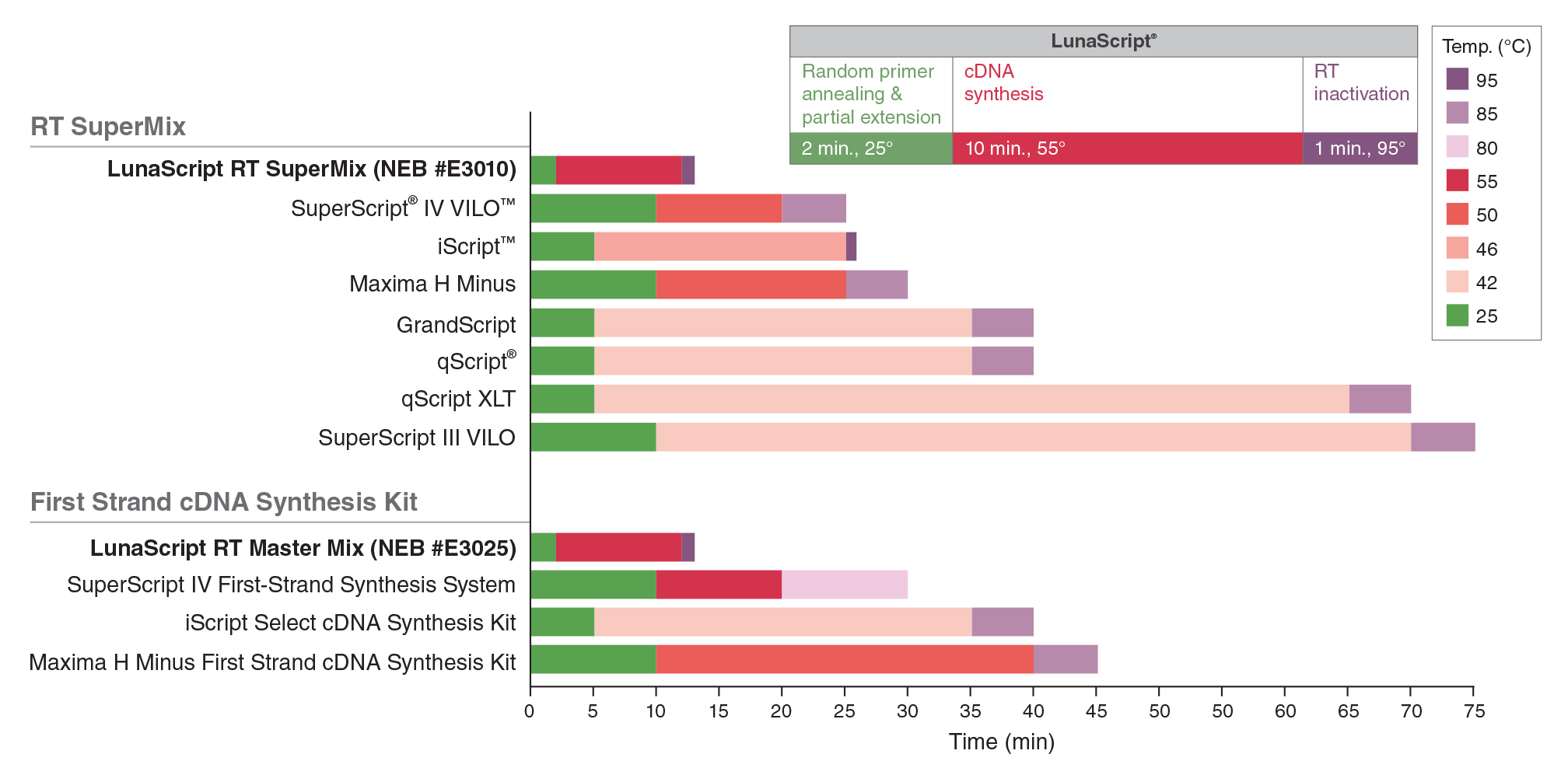
Comparison of recommended protocols for cDNA synthesis. Both LunaScript RT SuperMix Kit and LunaScript RT Master Mix Kit require the shortest reaction time and tolerate elevated temperatures, reducing complications from qScript XLT RNA secondary structure.
At just 13 minutes, LunaScript offers the shortest available first strand cDNA synthesis protocol!
By adding different primers including a Random Primer Mix, d(T)23VN oligos, or random hexamers, the LunaScript RT Master Mix can produce cDNA that is ideally suited for various downstream applications such as RT-qPCR, RT-PCR, and RNA-seq studies.
LunaScript RT Master Mix (Primer-free) supports numerous applications
LunaScript RT Master Mix Kit (Primer-free)
E3025S/L
LunaScript RT SuperMix Kit
E3010S/L
Do you want to be on the safe side? Use NEB's murine RNase Inhibitor!
Murine RNase Inhibitor (NEB #M0314)
Schematic visualization of RNA degradation: (A) RNA Ladder, (B) sample with RNase Inhibitor, (C) sample without RNase Inhibitor, sample has been degraded.
Murine RNase Inhibitor
M0314L
15,000 units
M0314S
3,000 units
Find more about Golden Gate Assembly
LunaScript Reverse Transcription
Golden Gate Assembly
RNAse Inhibitor
Choose your favorite topic:
The free NEB Starter Pack is available to all research students, PhD students, PostDocs and PIs who are starting their career or a new project in Molecular Biology*.
*Offer available through to Jan. 31st, 2022, or while stocks last. Limited to one pack/person. Content may vary from those shown. The 20% discount voucher/offer is void where prohibited by regional or institutional laws or regulations. Please ask your local distributor for details and availability. The full terms and conditions following GDPR can be found at www.neb-online.eu/starterpack.
%
The NEB Starter Pack contains*:
Start your career off on the right path. Get your free NEB Starter Pack!
NEW TO MOLECULAR BIOLOGY?
• Free DNA Ladder Sample • Voucher: 20% discount on your first purchase of any NEB product!
Register at www.neb-online.eu/starterpack or contact your local distributor*!
Already an experienced Molbio Pro?
Swimming sea turtle and sandy seabed. Underwater video from scuba diving. Credit: blueseacz/Pond5, Adobe Stock
Browse through to find the latest NEB products, including recommendations for which product will work best for your application. Check out our popular technical reference section, which includes:
Each edition of the catalog contains a collection of mini-reviews that addresses various scientific, environmental and/ or humanitarian topics. This year, we are dedicating the catalog to our Founder, Donald G. Comb, and are sharing some of the values that he was passionate about.
• • • •
Extensive information on maximizing product performance Technical tips Troubleshooting guides And much more!
All of this information comes to life with the NEB AR App – just download at the Apple® App Store or Google Play™ and scan the icons to find videos, tutorials and immersive experiences!
• NEB Catalog & Technical Reference 2021/22 incl. Buffer Poster • Year planning calendar poster 2022 • Technical Guide "Molecular Cloning" • Technical Guide "RNA" • Brochure "PCR Reagents" • Electrophoresis Marker Poster • RNA Metro-Map Poster • Water bath floatie • NEB Pencil & Lab Marker • NEB Notepad & Post-It • RNase-free Zone Stickers • NEB Pull Reel Key Ring
You don't need the NEB Starter Pack? But you still want your copy of the new NEB Catalog & Technical Reference 2021/22, don’t you?
Request your free copy
Contact local Distributor
Request your free NEB Starter Pack 2021
Why are so few life sciences companies Certified B Corps?
Brian Tinger, Corporate Controller, New England Biolabs, Inc.
Earlier this year, NEB announced that it had achieved Certified B Corporation™ status – one of 4,000 pioneering companies worldwide that meet the highest verified standards for social and environmental responsibility, legal accountability and public transparency. Together the B Corp community works to reduce inequality and poverty, build stronger communities, create high-quality jobs, and promote a healthier environment.
NEB has embraced B Corp values since the company’s founding in 1974
In 1975, NEB printed its first catalog on 100% recycled paper
Only a handful of life science companies are B Corps
NEB’s Corporate Controller, Brian Tinger, was interviewed to answer some questions about why we pursued B Corp certification. The following is an excerpt from an interview conducted by Christopher Marquis for Forbes.com on May 7th, 2021.
Christopher Marquis: Why did NEB pursue B Corp certification?
Tinger: The B Corp assessment helped to provide a detailed roadmap for improvements that we could incorporate into our business. We examined several aspects of our business — from the way we work with our customers to the impact on our community to the happiness and satisfaction of our employees — to really understand what we were doing right and what area we could improve upon. We found that we lacked documentation of certain metrics referenced in the B Corp assessment and by measuring these aspects of the business we’ll be in a better position to monitor our performance going forward. However, attaining certification is only the first step. We see the B Corp assessment as a way to challenge NEB to evaluate its actions and enhance its ability to use business as a force for good™, not just today but 20 or 30 years from now. We foresee many more businesses embarking on this journey because awareness of our social and environmental responsibility will continue to grow.
Tinger: There are a number of reasons why more life science companies are not B Corps. Through our own research, we noticed that B Corp status is more often associated with and pursued by consumer brands, such as Patagonia and Ben & Jerry’s, so there may be a general lack of awareness in our industry. Secondly, since the life science industry is capital intensive and typically requires significant outside investment, I suspect that it’s challenging to find the right investor or corporate structure to support the policies and procedures that B Corp certification requires. In addition, every organization is different but there are always competing priorities that a business has to consider and becoming B Corp may simply not be a priority. Ultimately, however, B Corp certification is recognition that a company is meeting very high standards of social and environmental accountability, which is something that all life science and healthcare companies should strive for.
Marquis: Why should (or should not) more science based companies become B Corps?
View full article
Brian Tinger: NEB was founded with the advancement of science and stewardship of the environment as its highest priorities. Since the mid-1970s, NEB has worked on a number of initiatives through the company and the community that speak to this ideal, including establishing the first shipping box recycling program in the U.S., creating the New England Biolabs Foundation to foster community-based conservation, commissioning the design of a LEED® (Leadership in Energy and Environmental Design)-certified laboratory, hosting science events for the community and engaging with art-based programs worldwide.
Marquis: What benefits did NEB see from the certification and what did you learn by going through the process?
Marquis: Why do you think there are not more life science and healthcare companies that have become B Corps?
Tinger: As B Corporations continue to gain prominence and visibility, I think the value of B Corp will resonate strongly within the scientific community. However, just like any other industry, life sciences can also leave behind a carbon footprint, which is why it’s critical to have a more holistic approach towards corporate responsibility. As a result, aiming for B Corp certification can further expand that mission by placing more emphasis on social responsibility, corporate culture and environmental sustainability. Long term, this has great benefits for the company as well. From attracting new talent who are equally invested in sustainability to partnering with customers who are seeking companies committed to the values expressed by B Corp.