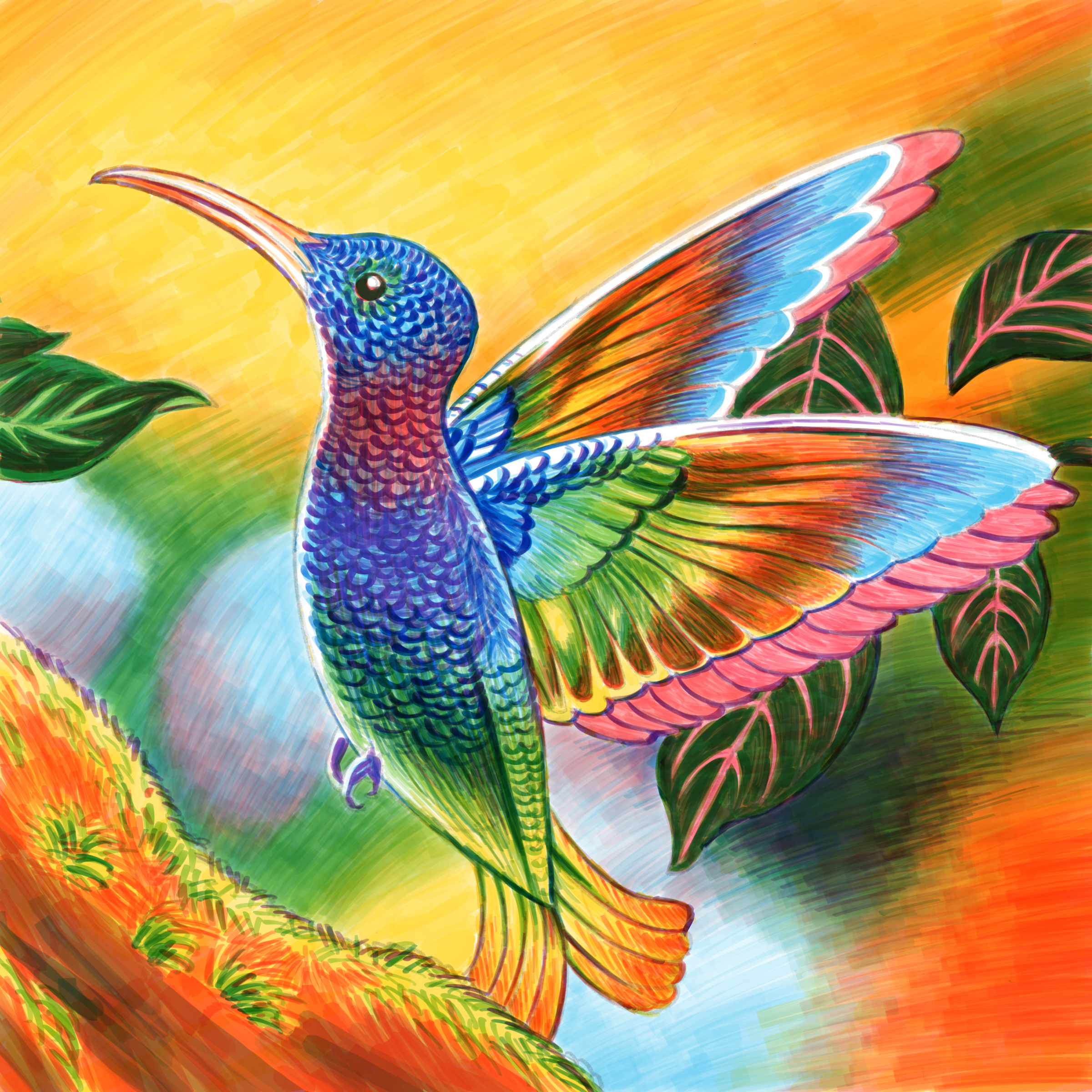
Coloring the Hummingbird
Learn to Draw
a Hummingbird
Sketching the Hummingbird
Sketching the Hummingbird
Previous Step
Next STep

Congrats on Finishing
Your Hummingbird!
Explore more of what
Prismacolor has to offer
Preview what each Prismacolor Technique
series has in store for aspiring artists!
EXPLORE

More Lessons
A Step by Step Guide
Download PDF Version
© 2024 Newell Office Brands. All Rights Reserved


Use #prismacolor to share your work
and find more inspiration
Coloring the Hummingbird
Previous Step
Next STep
Step Ten:
Finally, use PM 50 to complete the darker details on the ground in the lower left corner. Then, add darker finishing touches to the feathers and wings, and draw an outline around the tail for definition. Add just a hint of shading to the feet.
Congratulations!
You have now completed
a beautiful piece of art!
Markers Used: PM 50


Step One:
Begin by drawing your hummingbird.
Start by sketching two tapered ovals to represent the centers of the head and body.
Recommended Materials:
Pencil, Any Plain Paper
Step Two:
Next, outline your hummingbird. Begin at the upper left corner, near the head's oval. Draw the bird’s beak using two curved lines that meet at one end and attach to the head oval at the other. Add a few angled lines to indicate where the feathers will meet the beak.
Then, draw two curved lines to form the neck, connecting the head to the body. Include a triangle shape at the bottom of the oval of the bird’s body. Finally, on the right side, sketch two curved lines for the top of the wings and several smaller curves for the bottom of the wings.
Step Three:
Next start adding additional details, with a circle for the eye, long tail feathers, and curved edges to the wings’ feathers to capture the flapping movement of wings.
Step Six:
Finally, create the background shapes for your drawing. Begin with a small patch of ground in the lower left corner, using textured lines to represent grass.
Next, draw the leaves with curved lines.
Your drawing is now complete and ready for coloring!
Step Five:
Now, draw a curved line inside the beak to represent the mouth. For detailing the inside of the wings, use this example as a guide.
Begin your feather lines at the body and ensure they extend to and connect with the points outlined by the wings' edges.
Step Four:
Now, begin adding detail to the body feathers by making marks and half-circles.
Place a small circle inside the upper right part of the eye to create a highlight. Draw two feet on the left-hand side of the body, just below the bottom of the wings. Remember to erase any preliminary sketch lines that are no longer needed.
Step Eight:
Next, using PM 39, color and begin to draw-in the shapes of the body feathers.
Do the same to the feathers of the tail and wings. Add a little dark shading to the mound in the lower left as well.
Markers Used: PM 39
Step Seven:
Next, use PM 186 to color the darker green areas of the background. Make sure to blend these areas well with the lighter greens and oranges, as well as the edges
of the adjacent colors.
Next, finish coloring all the darker green areas in all of the leaves. Then, proceed to add dark green details to the feathers and wings, blending carefully with other colors at the edges as needed. Add more detail to the grass
in the mound.
Markers Used: PM 186
Step Six:
Next, using PM 167, color the small background area to the left of the bird surrounding the abstract shapes. Then, completely fill in the leaf on the left and the four leaves on the right. The light green color will mix with the pink, resulting in a brownish-green hue.
Next, color the green parts of the feathers and wings, ensuring to blend the edges with the adjacent blues, yellows, and reds. Add some light green strokes to the grassy area of the mound in the lower left.
Markers Used: PM 167
Step Five:
Using PM 47, color the lower left and right areas of the background near the bird, blending
it with the existing pink tones to create
simple, abstract shapes.
Next, color the light blue sections of the feathers and wings. Carefully blend some of the edges where the blue meets red to subtly transition into light purple.
Markers Used: PM 47
Step Four:
Using PM 8, color the darker reddish sections of the background, ensuring you blend these areas smoothly with the existing orange tones.
Then, proceed to color the parts of the feathers and wings that are red, reddish-orange, and reddish-purple. Add some details to the tail feathers. Finally, fill in the areas of the mound on the bottom left that will be brown.
Markers Used: PM 8
Step Three:
Using PM 6, add some pink tones in the background in the lower left and right of the bird. Color in the leaf on the left partially for shadows (this will make a darker green later on) and similarly fill the leaves on the right. Add a bit of pink just inside the top wing, and color in the wings’ flapping edges.
Markers Used: PM 6
Step Two:
Using PM 15, add some depth to your drawing by coloring over and blending with the yellow areas in the background.
Next, fill in the orange sections of the feathers and tail. Finish by adding some orange shading to the beak.
Markers Used: PM 15
Step One:
Start by using PM 19 to color the majority
of the background in the upper left, top, right, and lower left areas. Additionally, color a patch
of background to the left of the bird’s tail.
Allow the edges of these colored areas to fade, setting them up for easier blending with other colors later.
Next, focus on the bird’s feathers. Follow the direction of the feather growth, color in the areas that are yellow or have yellow as a base color.
Markers Used: PM 19


Step Nine:
Next, use PM 128 to apply darker shading to the right side of the background. Add a little more detail to the beak, and continue to draw-in the details of the feathers and wings.
Draw a thin outline around the flapping wing outer edges. Color in the bird's feet, but leave the tops white to create highlights. Add a little detail to the grass edges on the ground in the lower left.
Markers Used: PM 128