30 Days of Strength


Presented by
You are stronger than you think! Live that truth by nurturing the key types of strength that keep your mind and body operating at their best—even if it takes just a few minutes or one simple move in the right direction. To set you on a course toward a stronger you, follow this 30-day plan packed with expert advice. Every week, we’re releasing a fresh set of tips for training well, eating well, living well, and feeling great. Lean into this daily guidance and grab a think! High Protein Bar to provide your body with delicious fuel to crush your goals. Each week adds up to a unique routine with advice according to a different expert from the following pillars of overall vitality:
up next
Stronger
cardio fitness


Make It Easy to Get Out the Door
Hit the Gym for Endurance
Water is Life
Limit Medium Days
Forget Your Big Goal
Pace Yourself

Crystal Anthony, professional mountain biker and gravel cyclist who rides for Liv Racing Collective. She’s also an endurance sport coach helping cyclists, runners, and triathletes get stronger while they increase their mileage. Anthony knows it’s hard to stick with a fitness routine, especially if it requires you to build cardio by logging long biking or running miles. “Endurance can be boring,” Anthony says. “You need to find a way to enjoy it, and it needs to be harmonious with the rest of your life.”
And when it comes to enjoying fitness, don’t forget to fuel with a think! High Protein Bar to help you add more endurance to your routine.

Crystal Anthony


“You wouldn’t expect to drive your car somewhere if it was on empty,” Anthony says. “For any cardio pursuit, fueling properly is going to make it more enjoyable, enable you to complete longer distances, and help you recover for the next session.”
Hydration is the cornerstone of fueling through cardio, and chances are you’re not drinking enough water to fuel your effort. Here’s an easy guide to water intake before and during cardio.
Water is LIfe

Drinking by the Numbers:
Drink 8-ounce cups of water two hours before a session.
Drink more cup 10 minutes before exercise.
Drink cup of water for every 20 minutes of hard exercise.
2–3
1
1
You’ll run or ride more often if it’s easy to get out the door. From a logistical standpoint, have your setup prepared well before it’s time to workout. Get your kit ready the night before with apparel, shoes, water, and snacks like the think! Brownie Crunch High Protein Bar, packed with 20 grams of protein, ready to go.
From an emotional standpoint, it’s easier to go for a run or ride if you’re meeting someone. Join a club or find a training partner. Having another person or group to hold you accountable will help you miss fewer training sessions.
If you can’t find someone to train with, there are other ways to stay motivated. Use a GoPro or phone to document your rides or runs. Get on Strava or Trailforks and find segments to knock out or a fastest known time (FKT) to create or shoot for. Find new trails and roads to run or ride in your hometown. You don’t have to travel far to find new routes, and exploring new terrain can keep you motivated.
Make It Easy to Get Out the Door
Most athletes start out too hard and fast, both during their individual workouts and within their overarching goal. “Go slower than you think you should at first,” Anthony says. “Sprinting up a hill will only wear you out and leave you exhausted for the rest of the workout.”
The same principle applies for your big goal. If you want to run a marathon in 12 months, getting out of the gate too hard and fast the first week of training will only wear you out for the long haul, and it’ll most likely result in injury or loss of interest. Cardio strength builds slowly over time. You can’t rush it.
Pace Yourself
Follow the Two/Five Rule
Any given week of training should consist of two hard days and five easy days. You can still exercise on those easy days, but your effort needs to be minimal. Your hard days, though, need to be legitimately hard, where you’re pushing either the pace or the duration of your effort.

“Most everyday athletes go too easy on their hard days and too hard on their easy days,” Anthony says. “You need both to get better. The worst place to hang out is in the middle. The problem with stacking medium-hard days together without rest is you’ll get overtrained and never recover. You’ll never get stronger if you’re always doing the same effort, day in and day out.”
Limit Medium Days
M
T
W
T
F
S
S

Balance Board Squat
Start by standing on a balance board. Once you’re stable, slowly lower into a full squat. Return to standing and repeat.
Most people run or bike for cardio, but you have to think about all the muscles involved in supporting you through those endurance efforts. “Training the muscles that help you maintain your posture as you run or bike over lots of miles is super important,” Anthony says, adding that you should focus mostly on movements that incorporate your whole body. “But there is no one right gym movement. There’s no magic lift that works for everyone.”
Anthony likes the balance board for targeting her core muscles and hitting small muscles in her lower body that help support running and cycling.
Hit the Gym for Endurance
Balance Board Plank
Get in a push-up position with your feet on the floor and your hands spread shoulder-width apart on a balance board. Hold a plank, balancing on the board. Slowly shift your weight to the left and right, so the board moves slowly, transferring your weight to either side. Start with 30 seconds total and work toward 60 seconds.

You want to ride 100 miles of gravel, or run an ultra, or just finish a local 10K. Great. Set that goal, then forget it. “Focusing on a big goal can be intimidating, and can keep some people from even trying,” Anthony says. “Instead, break that big goal into a series of smaller, more manageable steps. Showing up everyday, doing little things every day, will get you to your big goal. You just have to go out and do the work today. Don’t worry about tomorrow.”
Forget Your Big Goal


Oct 9
Oct 16
Oct 23
Oct 30


1
2
3
4
6
5


20g
Protein!


Presented by


Slowly breathe in through your nose for several seconds, then exhale through your nose for several more seconds, slow and relaxed to the point where you begin to feel light air hunger—that stimulates the vagus nerve, slows the heart rate, and activates the rest response. Repeat the process for 10 minutes.

Calming down after a hectic day can be difficult, but slow, deep exhalations have been proven to activate the vagus nerve, which signals the brain to relax, enabling you to fall asleep easier. Try this simple breathing sequence to calm down before bedtime.
Breathe to Relax

20g
Protein!
Do you have a treat-sneaking routine before bed? Or maybe you like a beer after dinner? If you’re having trouble sleeping, it’s time to refine the timing of your snacks. Grab a think! Chocolate Peanut Butter Pie protein bar earlier in the evening to stave off those late-night munchies. Eating late at night affects sleep quality, says McKeown, and alcohol has been proven to make people more restless at night.
“A lot of people, including myself, experience restless sleep if they eat too late, in theory because the body is metabolizing the food, which may affect sleep quality,” McKeown says. “We should wake up feeling hungry in the morning. After all, the word ‘breakfast’ literally means ‘break the fast.’”
As bedtimes and dinner times vary, there’s no hard-and-fast rule about when you should stop eating, so spend some time experimenting on your own. Try not snacking after dinner and see if that improves your sleep quality.
Skip the Midnight Snack…and Beer

This sounds like tough love, but sleeping an extra four hours on Saturday disrupts your sleep patterns and establishes bad sleep hygiene. “It’s like jet lag,” McKeown says. “It throws off your schedule.” You’ll actually feel more refreshed if you skip your weekend slumberfest.
Establish a sleep/rise schedule and stick to it daily.
Don’t Sleep In on Weekends
Establishing a bedroom setting that’s conducive to deep sleep is key. Your bedroom should be completely dark, silent, airy, and cool. “I go so far as to cover up the red light on the TV if I’m sleeping in a hotel room,” McKeown says.
If you can’t get the room completely dark, McKeown recommends using a sleep mask. He also finds that spraying lavender on his pillow helps create a relaxing atmosphere, and magnesium spray on his skin helps restless muscles. People who live in noisy surroundings might also find value in experimenting with white-noise machines.
Succumb to Total Darkness


Circadian rhythms are our body’s natural response to light and darkness. We want to be awake during daylight and asleep when it’s dark, but modern tendencies (getting up early to get a workout in before heading to the office, or staying up late to binge Netflix) disrupt those natural circadian rhythms.
Getting back on track is simple: Expose yourself to daylight for 20 minutes first thing in the morning. That tells the brain it’s time to start the day. At night, avoid blue light, like from your computer screen or television. McKeown recommends wearing blue-light-filtering glasses after 8 P.M. if you want to watch TV at night; next to your bed, put a lamp that simulates sunlight and acts as a sunrise alarm in the morning.
Establish Circadian Rhythms
Multiple studies show a link between mouth breathing and poor sleep.
Nasal breathing enables you to spend more time in slow-wave deep sleep and less time in light sleep, but roughly half of the population breathes through their mouth while sleeping, according to McKeown. “How did you feel when you woke up this morning?” McKeown asks. “Did you feel totally refreshed? Did you have energy throughout the day? That’s what it’s all about.”
Create good nighttime habits by breathing through your nose during the day; how you breathe during wakefulness can affect how you breathe during sleep. Starting the path toward nasal breathing is as simple as paying attention to your breathing during the day and actively trying to breathe more often through your nose.
Breathe Through Your Nose

Patrick McKeown, a sleep and breathing expert and author of four books, including the bestseller The Oxygen Advantage, which shows the link between good breathing, good sleep, and good performance. His new Oxygen Advantage app functions as a virtual breathing instructor, with hundreds of tips and exercises designed to help you take control of your breathing and sleep better.
“Getting good sleep is important in every aspect of our lives,” McKeown says. “It affects cognition, mood, productivity, recovery from exercise, and more.”
PATRICK McKEOWN


Breathe to Relax
12

Skip the Midnight Snack…and Beer
11

Don’t Sleep In on Weekends
10

Succumb to Total Darkness
9

Establish Circadian Rhythms
8

Breathe Through Your Nose
7
Stronger
sleep habits

Slowly breathe in through your nose for several seconds, then exhale through your nose for several more seconds, slow and relaxed to the point where you begin to feel light air hunger—that stimulates the vagus nerve, slows the heart rate, and activates the rest response. Repeat the process for 10 minutes.
Calming down after a hectic day can be difficult, but slow, deep exhalations have been proven to activate the vagus nerve, which signals the brain to relax, enabling you to fall asleep easier. Try this simple breathing sequence to calm down before bedtime.
Breathe to Relax
Do you have a treat-sneaking routine before bed? Or maybe you like a beer after dinner? If you’re having trouble sleeping, it’s time to refine the timing of your snacks. Grab a think! Chocolate Peanut Butter Pie protein bar earlier in the evening to stave off those late-night munchies. Eating late at night affects sleep quality, says McKeown, and alcohol has been proven to make people more restless at night.
“A lot of people, including myself, experience restless sleep if they eat too late, in theory because the body is metabolizing the food, which may affect sleep quality,” McKeown says. “We should wake up feeling hungry in the morning. After all, the word ‘breakfast’ literally means ‘break the fast.’”
As bedtimes and dinner times vary, there’s no hard-and-fast rule about when you should stop eating, so spend some time experimenting on your own. Try not snacking after dinner and see if that improves your sleep quality.
Skip the Midnight Snack…and Beer
This sounds like tough love, but sleeping an extra four hours on Saturday disrupts your sleep patterns and establishes bad sleep hygiene. “It’s like jet lag,” McKeown says. “It throws off your schedule.” You’ll actually feel more refreshed if you skip your weekend slumberfest.
Establish a sleep/rise schedule and stick to it daily.
Don’t Sleep In on Weekends
Establishing a bedroom setting that’s conducive to deep sleep is key. Your bedroom should be completely dark, silent, airy, and cool. “I go so far as to cover up the red light on the TV if I’m sleeping in a hotel room,” McKeown says.
If you can’t get the room completely dark, McKeown recommends using a sleep mask. He also finds that spraying lavender on his pillow helps create a relaxing atmosphere, and magnesium spray on his skin helps restless muscles. People who live in noisy surroundings might also find value in experimenting with white-noise machines.
Succumb to Total Darkness
Circadian rhythms are our body’s natural response to light and darkness. We want to be awake during daylight and asleep when it’s dark, but modern tendencies (getting up early to get a workout in before heading to the office, or staying up late to binge Netflix) disrupt those natural circadian rhythms.
Getting back on track is simple: Expose yourself to daylight for 20 minutes first thing in the morning. That tells the brain it’s time to start the day. At night, avoid blue light, like from your computer screen or television. McKeown recommends wearing blue-light-filtering glasses after 8 P.M. if you want to watch TV at night; next to your bed, put a lamp that simulates sunlight and acts as a sunrise alarm in the morning.
Establish Circadian Rhythms
Multiple studies show a link between mouth breathing and poor sleep.
Nasal breathing enables you to spend more time in slow-wave deep sleep and less time in light sleep, but roughly half of the population breathes through their mouth while sleeping, according to McKeown. “How did you feel when you woke up this morning?” McKeown asks. “Did you feel totally refreshed? Did you have energy throughout the day? That’s what it’s all about.”
Create good nighttime habits by breathing through your nose during the day; how you breathe during wakefulness can affect how you breathe during sleep. Starting the path toward nasal breathing is as simple as paying attention to your breathing during the day and actively trying to breathe more often through your nose.
Breathe Through Your Nose
Patrick McKeown, a sleep and breathing expert and author of four books, including the bestseller The Oxygen Advantage, which shows the link between good breathing, good sleep, and good performance. His new Oxygen Advantage app functions as a virtual breathing instructor, with hundreds of tips and exercises designed to help you take control of your breathing and sleep better.
“Getting good sleep is important in every aspect of our lives,” McKeown says. “It affects cognition, mood, productivity, recovery from exercise, and more.”
PATRICK McKEOWN
Breathe to Relax
12
Skip the Midnight Snack…and Beer
11
Don’t Sleep In on Weekends
10
Succumb to Total Darkness
9

Establish Circadian Rhythms
8
Breathe Through Your Nose
7
Stronger
sleep habits


Add the Clock
18

Get Your Heart Rate Up
17

Save Time with Couplets
16

Focus on a Few Key Movements
15

Find the Right Load
14
Lift Something Heavy
13
Stronger
muscles and mobility


Deadlift EMOM
Choose a weight that you can safely deadlift for 10 reps. Set a timer for 20 minutes. Complete eight deadlifts at the top of every minute. It should take you 20 seconds to complete the exercise. Rest for the remaining 40 seconds, then repeat the lift at the top of the next minute. At the end of 20 minutes, you’ll be tired and have completed 160 deadlifts.

20g
Protein!
Putting a time limit on your strength workout adds an element of intensity while also ensuring your workout doesn’t take too long or require more equipment. An EMOM (every minute on the minute), where you’re repeating a certain movement at the top of every minute for a set duration of time, is the simplest way to use a timer to accelerate your workout. (And when the intensity ends, begin your workout recovery effectively with a high-protein snack like a think! High Protein Bar.)
“You can increase the intensity by adjusting the clock or adding to the reps with each round,” Kelly Starrett says.
Add the Clock
There’s no reason to isolate your cardio and your strength workouts from each other. In fact, the Starretts like to combine the two, bringing their clients’ heart rates up with a hard cardio effort, like a minute on the spin bike followed by a heavy lifting movement, like squats.
“Hugging a 50-pound sandbag and doing five squats after sprinting around the block challenges your coordination and skill under load,” Kelly Starrett says. “And the sky’s the limit with your pairings. Just do a minute of some sort of cardio, and in the off-minute, do three to five reps of lifting something heavy. Repeat that couplet seven to 10 times and you’ll be smoked.”
Get Your Heart Rate Up

Push-up (This is a high-rep movement; focus on the full range of movement, pausing at the bottom of the push-up.)
+
Squat
Pull-up (Pull-ups are hard. If you can’t do a single pull-up, jump up on the bar and hang with your chin parallel to the bar. Slowly lower yourself down. Rest and repeat.)
+
Lunge
Overhead press
+
Deadlift

Pairing two of the foundational movements together into a couplet, like a set of pull-ups followed by a set of squats, is the foundation of the Starretts’ approach to strength training. Couplets help target multiple muscle systems, while keeping the workouts short. “If you’re spending so much time in the gym that you don’t have time to run or ride or do the things you love, then that’s a problem,” Juliet Starrett says.
Three Effective Couplets
Choose one couplet to do each day for a week, performing three to five sets of each exercise. Each workout shouldn’t take more than 20 to 30 minutes.
Save Time with Couplets
The Foundational Movements
“Athletes think they need a specific strength program for their chosen sport, but if we’re being honest, most people don’t need a specialized strength program,” Juliet Starrett says. “They just need to focus on building strength through these key movements, and that sort of strength will make them better at their sport.”


Squat
Overhead press
Lunge
Hinge (deadlift or kettlebell swing)
Push-up
Pull-up
Forget about isolating specific muscles with machines at the gym. “The goal isn’t to get better at bench press,” Kelly Starrett says. “The goal is to get stronger and better at your sports.” Instead of isolating muscles, focus on building strength through a handful of key movements. You don’t have to do all these movements in every workout, but you should try to touch each one at least once a week.
Focus on a Few Key Movements
Overhead Sandbag Press
Stand with feet shoulder-width apart, knees slightly bent, core engaged, holding a sandbag in front of your chest. Push the sandbag toward the ceiling, then lower it slowly back toward your chest. Your core should be engaged and knees slightly bent throughout the entire movement.
To make sure you’re lifting a safe weight—again, find a load you can lift for three to five sets of three to five reps, completing each rep easily. Start with that weight and follow a linear progression where you add a little weight every time you return to that movement in the future.
Keep a journal and record your weights and reps so you can chart your progress.
Find the Right Load
The Sandbag Squat
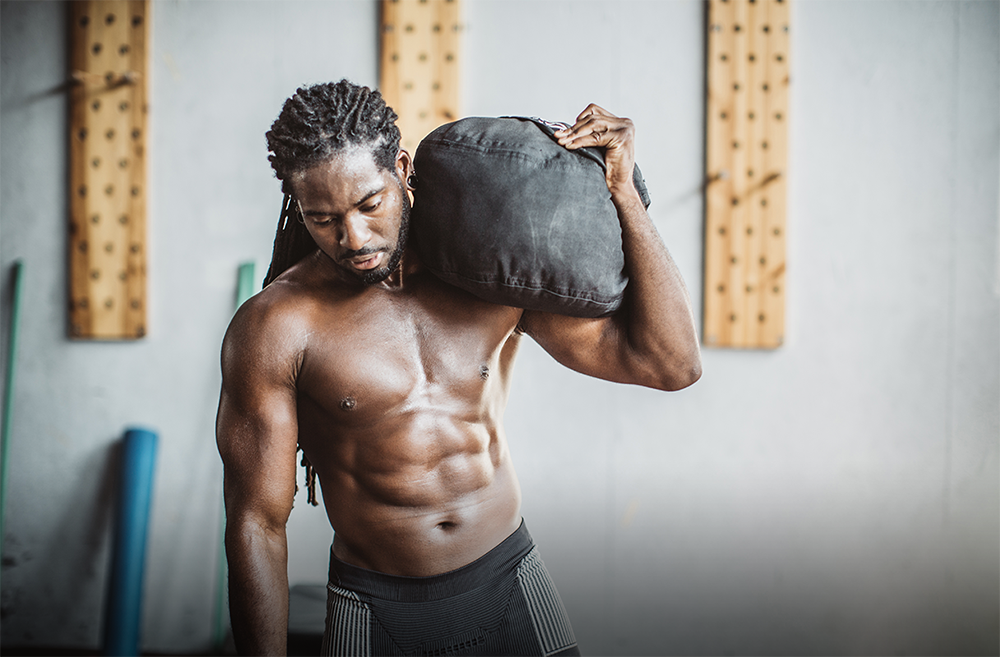
Perch a sandbag on your right shoulder. Find a load you can lift for three to five sets of three to five reps, completing each rep easily. With your feet slightly wider than shoulder-width apart, lower your upper body toward the ground, sticking your butt out, as if you’re sitting in a chair, and keeping your back straight, with the weight balanced on your shoulder. Drop slowly toward the ground until your butt is parallel with your knees, then explode quickly to the standing position.
Repeat, going slowly as you descend and exploding as you stand.
The Starretts want athletes to understand they need to look past the popular HIIT and bootcamp workouts if they want to build actual strength. “Bootcamps are a great way to build muscular endurance, but that’s not the same thing as strength,” Kelly Starrett says. “In order to gain strength, athletes have to put themselves under more significant load.”
To put it simply, you have to add weight to your exercises. Instead of doing 100 air squats, put a sandbag on your shoulder and squat. You don’t need a lot of equipment for strength training, either. You can do this in your garage with a sandbag or a set of dumbbells. Even a backpack loaded with books and clothes can work in a pinch.
Lift Something Heavy
Juliet and Kelly Starrett, who have been at the forefront of the fitness movement for decades. Having founded one of the first CrossFit gyms in California and now training professional athletes and military personnel in the nuances of strength and mobility, the couple co-hosts The Ready State Podcast, and their latest book, Built to Move: The Ten Essential Habits to Help You Move Freely and Live Fully, walks readers through how strength training and mobility exercises can help you live a more complete life.
“Not all strength training is equal,” Kelly Starrett says. “We like to focus on a series of movements, like swinging a kettlebell or pressing a sandbag over your head, which build strength while also incorporating mobility and coordination. All of which will make you better at your chosen sports.”
Juliet and Kelly Starrett
Deadlift EMOM
Choose a weight that you can safely deadlift for 10 reps. Set a timer for 20 minutes. Complete eight deadlifts at the top of every minute. It should take you 20 seconds to complete the exercise. Rest for the remaining 40 seconds, then repeat the lift at the top of the next minute. At the end of 20 minutes, you’ll be tired and have completed 160 deadlifts.
20g
Protein!
Putting a time limit on your strength workout adds an element of intensity while also ensuring your workout doesn’t take too long or require more equipment. An EMOM (every minute on the minute), where you’re repeating a certain movement at the top of every minute for a set duration of time, is the simplest way to use a timer to accelerate your workout. (And when the intensity ends, begin your workout recovery effectively with a high-protein snack like a think! High Protein Bar.)
“You can increase the intensity by adjusting the clock or adding to the reps with each round,” Kelly Starrett says.
Add the Clock
Push-up (This is a high-rep movement; focus on the full range of movement, pausing at the bottom of the push-up.)
+
Squat
Pull-up (Pull-ups are hard. If you can’t do a single pull-up, jump up on the bar and hang with your chin parallel to the bar. Slowly lower yourself down. Rest and repeat.)
+
Lunge
Overhead press
+
Deadlift
Pairing two of the foundational movements together into a couplet, like a set of pull-ups followed by a set of squats, is the foundation of the Starretts’ approach to strength training. Couplets help target multiple muscle systems, while keeping the workouts short. “If you’re spending so much time in the gym that you don’t have time to run or ride or do the things you love, then that’s a problem,” Juliet Starrett says.
Three Effective Couplets
Choose one couplet to do each day for a week, performing three to five sets of each exercise. Each workout shouldn’t take more than 20 to 30 minutes.
Save Time with Couplets
The Foundational Movements
“Athletes think they need a specific strength program for their chosen sport, but if we’re being honest, most people don’t need a specialized strength program,” Juliet Starrett says. “They just need to focus on building strength through these key movements, and that sort of strength will make them better at their sport.”
Squat
Overhead press
Lunge
Hinge (deadlift or kettlebell swing)
Push-up
Pull-up
Forget about isolating specific muscles with machines at the gym. “The goal isn’t to get better at bench press,” Kelly Starrett says. “The goal is to get stronger and better at your sports.” Instead of isolating muscles, focus on building strength through a handful of key movements. You don’t have to do all these movements in every workout, but you should try to touch each one at least once a week.
Focus on a Few Key Movements
Overhead Sandbag Press
Stand with feet shoulder-width apart, knees slightly bent, core engaged, holding a sandbag in front of your chest. Push the sandbag toward the ceiling, then lower it slowly back toward your chest. Your core should be engaged and knees slightly bent throughout the entire movement.
To make sure you’re lifting a safe weight—again, find a load you can lift for three to five sets of three to five reps, completing each rep easily. Start with that weight and follow a linear progression where you add a little weight every time you return to that movement in the future.
Keep a journal and record your weights and reps so you can chart your progress.
Find the Right Load
The Sandbag Squat
Perch a sandbag on your right shoulder. Find a load you can lift for three to five sets of three to five reps, completing each rep easily. With your feet slightly wider than shoulder-width apart, lower your upper body toward the ground, sticking your butt out, as if you’re sitting in a chair, and keeping your back straight, with the weight balanced on your shoulder. Drop slowly toward the ground until your butt is parallel with your knees, then explode quickly to the standing position.
Repeat, going slowly as you descend and exploding as you stand.
The Starretts want athletes to understand they need to look past the popular HIIT and bootcamp workouts if they want to build actual strength. “Bootcamps are a great way to build muscular endurance, but that’s not the same thing as strength,” Kelly Starrett says. “In order to gain strength, athletes have to put themselves under more significant load.”
To put it simply, you have to add weight to your exercises. Instead of doing 100 air squats, put a sandbag on your shoulder and squat. You don’t need a lot of equipment for strength training, either. You can do this in your garage with a sandbag or a set of dumbbells. Even a backpack loaded with books and clothes can work in a pinch.
Lift Something Heavy
Juliet and Kelly Starrett, who have been at the forefront of the fitness movement for decades. Having founded one of the first CrossFit gyms in California and now training professional athletes and military personnel in the nuances of strength and mobility, the couple co-hosts The Ready State Podcast, and their latest book, Built to Move: The Ten Essential Habits to Help You Move Freely and Live Fully, walks readers through how strength training and mobility exercises can help you live a more complete life.
“Not all strength training is equal,” Kelly Starrett says. “We like to focus on a series of movements, like swinging a kettlebell or pressing a sandbag over your head, which build strength while also incorporating mobility and coordination. All of which will make you better at your chosen sports.”
Juliet and Kelly Starrett
There’s no reason to isolate your cardio and your strength workouts from each other. In fact, the Starretts like to combine the two, bringing their clients’ heart rates up with a hard cardio effort, like a minute on the spin bike followed by a heavy lifting movement, like squats.
“Hugging a 50-pound sandbag and doing five squats after sprinting around the block challenges your coordination and skill under load,” Kelly Starrett says. “And the sky’s the limit with your pairings. Just do a minute of some sort of cardio, and in the off-minute, do three to five reps of lifting something heavy. Repeat that couplet seven to 10 times and you’ll be smoked.”
Get Your Heart Rate Up

Add the Clock
18
Get Your Heart Rate Up
17
Save Time with Couplets
16
Focus on a Few Key Movements
15
Find the Right Load
14
Lift Something Heavy
13
Stronger
muscles and mobility


Teach Yourself to Suffer Better
24

Get Control of Your Inner Monologue
23

Practice Nonjudgmental Self-Awareness
22

Give Yourself a Pep Talk
21

Yes, You Should Practice Mindfulness
20

Make Yourself Uncomfortable
19
Stronger
mental fortitude


Hutchinson says there’s plenty of evidence that elite athletes can tolerate more pain than recreational athletes, and recreational athletes can tolerate more pain than nonathletes. What’s interesting is that the pain tolerance of elite athletes waxes and wanes with their training, which suggests that pain tolerance isn’t a fixed trait; it’s something that can be developed.
Elite athletes often use “adaptive” coping strategies with tactics like reframing discomfort as a challenge, as opposed to “maladaptive” strategies like interpreting discomfort as a signal to stop.
One of the most valuable adaptive strategies is acceptance. Recognize the difficulty of your situation, whether it’s knee pain, an incredibly steep climb, or a 4 a.m. wake-up call. Accept that difficulty and realize there’s nothing you can do about it; you can either move forward through that difficulty or quit. Then forge ahead.
Teach Yourself to Suffer Better

The words in your head affect how difficult you perceive a given task to be. That inner monologue can alter your sensation of effort, which means the phrases “I can do this” and “I can’t do this” are self-fulfilling prophecies.
It’s difficult to control your inner monologue in the heat of the moment, so you need to spend time figuring out what mantras you’ll respond best to when you need them, and then spend time practicing those mantras while you’re training. If you practice positive self-talk enough, you’ll be able to recall it when you need it most, like muscle memory.
Here’s an example: If you’ve been training for a race, verbally recognize the effort you’ve put into reaching that goal. Literally tell yourself over and over, “You’ve put in the work. You prepared for this. You can do this.”
Get Control of Your Inner Monologue


20g
Protein!
“Nonjudgmental self-awareness” is a fancy way of saying you want to separate the experience of discomfort from your emotional response to it.
For example, if you feel a twinge in your knee halfway through a marathon, your knee hurts. But if you immediately leap to the conclusion that you’ll have to drop out, and you’ve wasted the past six months of training, and you might never be able to run again, and you’re going to miss the post-marathon brunch you planned with your family because you’ll be stranded out on the course, then you’re dealing with a lot more than just a sore knee.
You need to be able to filter out all the secondary responses and just dial in to what your knee is telling you. Is it too painful to continue? Does it seem likely that it’ll become too painful to continue or result in lasting damage? If not, carry on.
Don’t spin out over simple, easy-to-solve discomforts like hunger, either. Pack a protein-rich snack like a think! High Protein Bar to stay aware of the bigger issues ahead.
Practice Nonjudgmental Self-Awareness

This is a simple strategy when you’re prepping for a workout or event, or in the middle of a hard effort, or just trying to get your toddler’s shoes on in the morning. When you’re talking to yourself, instead of using the first-person perspective, use the second-person perspective. So, instead of saying, “I can do this,” you say, “You can do this.”
“Using the second-person perspective helps create distance, so you can view your current situation more objectively,” Hutchinson says.
Go a step further the next time you’re in a difficult situation and ask yourself what sort of advice would you give a friend who was in the same situation. Again, that distance can help put your current situation in perspective.
Give Yourself a Pep Talk
Body Scan Meditation
Lie on your back, legs extended, arms to your side, palms facing up. Focus your attention on a single body part at a time for several seconds, working from your toes up your body to your head. Be aware of any sensations, emotions, or thoughts associated with each part of your body. Don’t judge those thoughts—just be aware of them and move on.

Mindfulness is the ability to be present and aware of where we are and what we’re doing and not overly reactive to the situation at hand. It’s a great tool for developing mental strength because “it helps you create space between the stimulus and your response to that stimulus,” Hutchinson says.
Hutchinson recommends using an app like Headspace for athletes looking to develop mindful strategies, like moving meditation.
Try this simple mindfulness exercise to get started.
Yes, You Should Practice Mindfulness

This doesn’t mean turning every training session into an all-out race. But it does mean it’s useful to get out of your comfort zone. For runners, that might mean hard interval or tempo sessions once or twice a week and really hard super-sessions once or twice a season.
“The best way to develop this kind of pain tolerance, not surprisingly, is to suffer in training,” Hutchinson says. “It’s not that you deaden your nerves or anything like that. Instead, suffering gives you plenty of practice in how to handle discomfort and helps you develop mental strategies for dealing with it.”
Make Yourself Uncomfortable
Alex Hutchinson, author of Endure: Mind, Body, and the Curiously Elastic Limits of Human Performance, which takes readers on a journey into the cutting edge of sports psychology to show how some athletes are using mental fortitude to bolster their performance. “To me, mental strength is the ability to keep doing something when you’d rather stop,” Hutchinson says, adding that developing mental strength is key for athletes and nonathletes alike. “Reaching any difficult goal is going to require pushing through some discomfort. And pursuing difficult goals can be extremely satisfying.”
Alex Hutchinson
Hutchinson says there’s plenty of evidence that elite athletes can tolerate more pain than recreational athletes, and recreational athletes can tolerate more pain than nonathletes. What’s interesting is that the pain tolerance of elite athletes waxes and wanes with their training, which suggests that pain tolerance isn’t a fixed trait; it’s something that can be developed.
Elite athletes often use “adaptive” coping strategies with tactics like reframing discomfort as a challenge, as opposed to “maladaptive” strategies like interpreting discomfort as a signal to stop.
One of the most valuable adaptive strategies is acceptance. Recognize the difficulty of your situation, whether it’s knee pain, an incredibly steep climb, or a 4 a.m. wake-up call. Accept that difficulty and realize there’s nothing you can do about it; you can either move forward through that difficulty or quit. Then forge ahead.
Teach Yourself to Suffer Better
The words in your head affect how difficult you perceive a given task to be. That inner monologue can alter your sensation of effort, which means the phrases “I can do this” and “I can’t do this” are self-fulfilling prophecies.
It’s difficult to control your inner monologue in the heat of the moment, so you need to spend time figuring out what mantras you’ll respond best to when you need them, and then spend time practicing those mantras while you’re training. If you practice positive self-talk enough, you’ll be able to recall it when you need it most, like muscle memory.
Here’s an example: If you’ve been training for a race, verbally recognize the effort you’ve put into reaching that goal. Literally tell yourself over and over, “You’ve put in the work. You prepared for this. You can do this.”
Get Control of Your Inner Monologue
20g
Protein!
“Nonjudgmental self-awareness” is a fancy way of saying you want to separate the experience of discomfort from your emotional response to it.
For example, if you feel a twinge in your knee halfway through a marathon, your knee hurts. But if you immediately leap to the conclusion that you’ll have to drop out, and you’ve wasted the past six months of training, and you might never be able to run again, and you’re going to miss the post-marathon brunch you planned with your family because you’ll be stranded out on the course, then you’re dealing with a lot more than just a sore knee.
You need to be able to filter out all the secondary responses and just dial in to what your knee is telling you. Is it too painful to continue? Does it seem likely that it’ll become too painful to continue or result in lasting damage? If not, carry on.
Don’t spin out over simple, easy-to-solve discomforts like hunger, either. Pack a protein-rich snack like a think! High Protein Bar to stay aware of the bigger issues ahead.
Practice Nonjudgmental Self-Awareness
This is a simple strategy when you’re prepping for a workout or event, or in the middle of a hard effort, or just trying to get your toddler’s shoes on in the morning. When you’re talking to yourself, instead of using the first-person perspective, use the second-person perspective. So, instead of saying, “I can do this,” you say, “You can do this.”
“Using the second-person perspective helps create distance, so you can view your current situation more objectively,” Hutchinson says.
Go a step further the next time you’re in a difficult situation and ask yourself what sort of advice would you give a friend who was in the same situation. Again, that distance can help put your current situation in perspective.
Give Yourself a Pep Talk
Body Scan Meditation
Lie on your back, legs extended, arms to your side, palms facing up. Focus your attention on a single body part at a time for several seconds, working from your toes up your body to your head. Be aware of any sensations, emotions, or thoughts associated with each part of your body. Don’t judge those thoughts—just be aware of them and move on.
Mindfulness is the ability to be present and aware of where we are and what we’re doing and not overly reactive to the situation at hand. It’s a great tool for developing mental strength because “it helps you create space between the stimulus and your response to that stimulus,” Hutchinson says.
Hutchinson recommends using an app like Headspace for athletes looking to develop mindful strategies, like moving meditation.
Try this simple mindfulness exercise to get started.
Yes, You Should Practice Mindfulness
This doesn’t mean turning every training session into an all-out race. But it does mean it’s useful to get out of your comfort zone. For runners, that might mean hard interval or tempo sessions once or twice a week and really hard super-sessions once or twice a season.
“The best way to develop this kind of pain tolerance, not surprisingly, is to suffer in training,” Hutchinson says. “It’s not that you deaden your nerves or anything like that. Instead, suffering gives you plenty of practice in how to handle discomfort and helps you develop mental strategies for dealing with it.”
Make Yourself Uncomfortable
Alex Hutchinson, author of Endure: Mind, Body, and the Curiously Elastic Limits of Human Performance, which takes readers on a journey into the cutting edge of sports psychology to show how some athletes are using mental fortitude to bolster their performance. “To me, mental strength is the ability to keep doing something when you’d rather stop,” Hutchinson says, adding that developing mental strength is key for athletes and nonathletes alike. “Reaching any difficult goal is going to require pushing through some discomfort. And pursuing difficult goals can be extremely satisfying.”
Alex Hutchinson
Teach Yourself to Suffer Better
24
Get Control of Your Inner Monologue
23
Practice Nonjudgmental Self-Awareness
22
Give Yourself a Pep Talk
21
Yes, You Should Practice Mindfulness
20
Make Yourself Uncomfortable
19
Stronger
mental fortitude


Your food-first approach to fixing fatigue:
Incorporate more carbs during long workouts to decrease feelings of tiredness afterward.
Increase your pre-workout carb intake to top off glycogen stores.
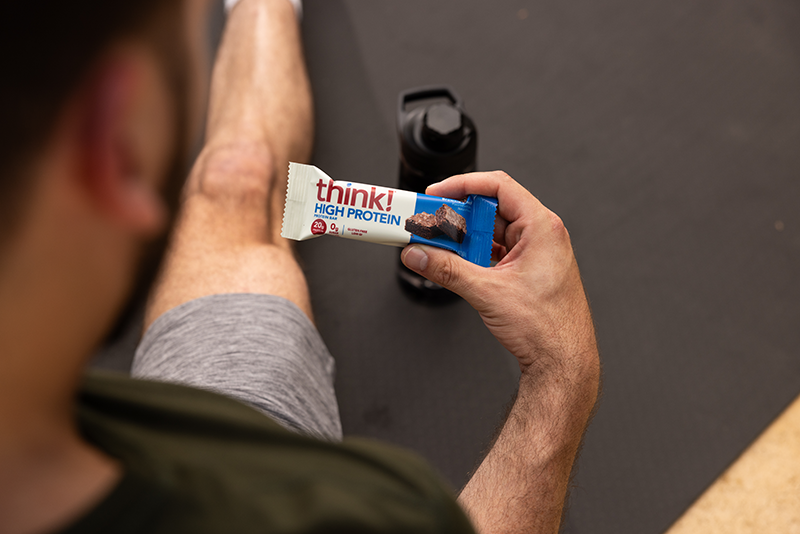
Consistently look to add in nutritious snacks like think! High Protein Bars throughout the day to increase and keep energy levels steady.
Increase the overall amount of calories you’re taking in; you might feel tired if you’re not eating enough to support training.

20g
Protein!
It’s not normal to feel exhausted after every workout, and a lot of athletes will make the assumption that they’re deficient in some micronutrient, like iron or magnesium. Van Horn says a micronutrient deficiency might be the cause, but athletes should look to food first to fix the problem. “Taking 50 supplements because you heard on the latest social media post that something could give you a possible health and performance edge is not the way to go,” Van Horn says. “The biggest gains you will see in health and performance will come from focusing on overall intake, composition, and timing of nutrition. Supplements are not regulated well by the FDA, and many times you end up taking things that you don’t realize.”
Fuel with Food First

“For the large majority of people, particularly women, extreme low-carb diets can have unintended physical and mental aftereffects,” Van Horn says, adding that carbs are one of the easiest ways to get a performance boost. “By cutting carbs and limiting large groups of food, you’re putting your physical and mental health at risk.”
Also, don’t be afraid to eat a Pop-Tart or processed fuel like gel. “We aren’t telling you to eat cookies all day, every day,” she adds. “But you can eat these foods, enjoy them, and achieve your health and performance goals.”
As you approach your race or big adventure, increase your carb intake one to three days out from the adventure. Aim for around 5 to 12 grams of carbs per kilogram of bodyweight.
Carbs Are Your Friend
Have a long training run planned? Here’s an easy guide to fueling.
Eat 250 to 300 calories during your run, depending on the length. If it’s marathon length or less, make it mostly carbs; if longer, include protein or fat, but not more than 10 grams of each per hour.
Consume fluids and electrolytes one to three hours before the run.
Eat 500 to 700 calories before the run, focusing on carbs with a little protein and fat.
Post-run, eat at least 20 grams of high-quality protein and 45 to 60 grams of carbs.
Before
During
After
Many athletes try to train while purposely underfueling, but engaging in calorie restriction is not a good way to achieve your goals, according to Van Horn. “We see a lot of athletes trying to get by on the least amount of fuel possible,” she says. “But training with no fuel increases risk of injury and can leave the athlete frustrated because they aren’t seeing improvements in performance.”
Fueling targets depend on your amount of training and other factors, but underfueling during training means your body will not fully adapt to the effort and you won’t make the gains you need.
Prioritize regular fueling around and during training. You can even set alarms as a reminder to eat if you often get too busy and forget.
Less Is Not Better

Fuel your training by timing your nutrition. Eating food too close to a workout can ultimately lead you to feel sick both during and afterward. The digestive process slows down when exercising, so any food left undigested can cause you to feel sick.
Consume a pre-workout snack like a think! High Protein Bar at least one to three hours before a workout.
And keep a food journal. Keeping track of what you’re eating and using trial and error can help you pinpoint certain foods that might be causing GI distress.
Time It Right

20g
Protein!
You have to fuel yourself as a human first and an athlete second. “So many athletes think they need to ‘earn their food’ through exercise, but your body needs fuel to operate outside of exercise,” Van Horn says. “Without regular fuel that is enough to support your hardworking body, it will break down on you.”
You have to adjust your calorie intake to match your training, otherwise you will feel hungrier each day and become prone to cravings and binge sessions. Don’t skip meals because you’re “too busy to eat,” and listen to your hunger and fullness cues, which can help you eat more intuitively.
Honor your hunger, especially during a training day—even if that means going against the best sleep advice and eating a bedtime snack. Having a high-protein bedtime snack, not too sweet or carb-heavy, can help aid recovery and help you feel better in the morning. Shoot for 10 to 20 grams of protein with a little bit of carbohydrates.
Eat with Intention and Intuition

“We see a lot of athletes looking for the next ‘nutrition hack’ or following some extreme practice because they think it’s all they need to do to get better,” Van Horn says. “This usually backfires and leaves athletes burned out and does not help all that much because they haven't dialed in foundational nutrition habits.”
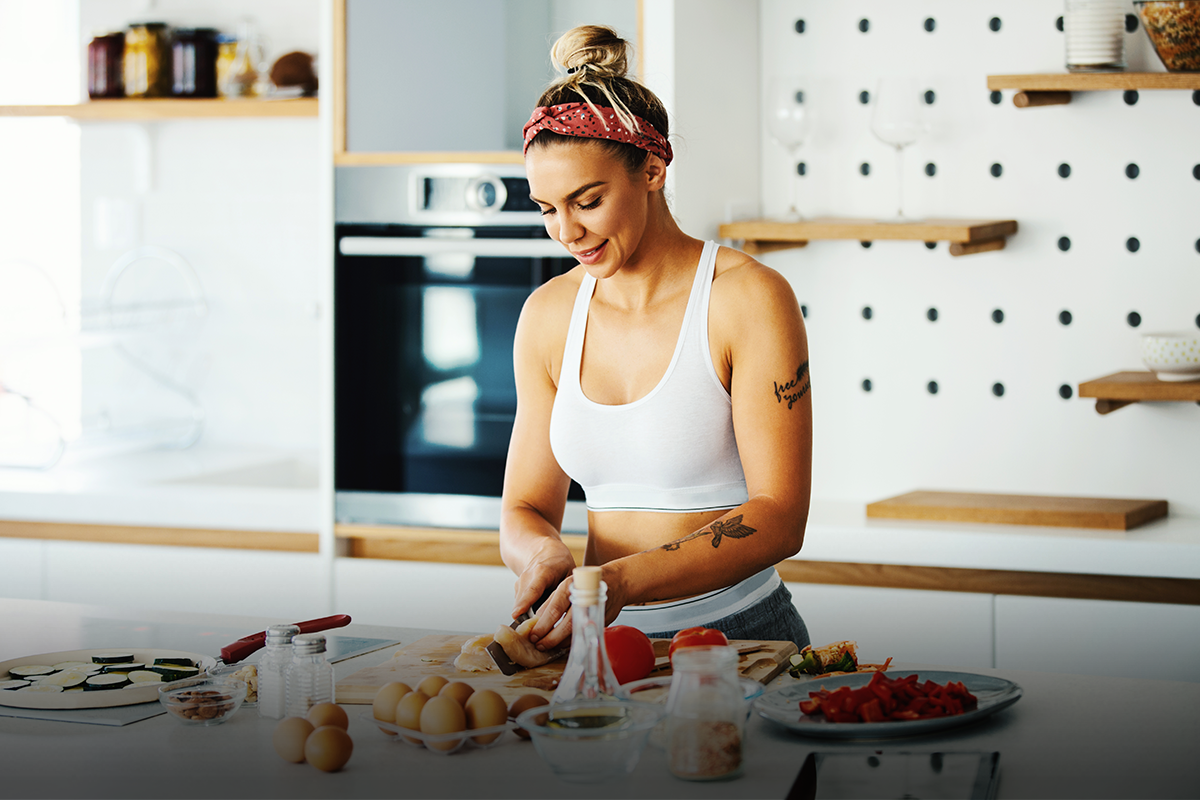
It’s not trendy, but foundational nutritional habits are simple: Eat frequent balanced meals consisting of carbs, protein, fruits, veggies, and a bit of healthy fat. As you increase your activity through training, you also have to increase your calorie intake. And don’t let busy get in the way of healthy: Grab convenient protein options like a think! High Protein Bar to stay on top of your daily nutrition when you’re on the go.
Ignore the Quick Nutrition Fads


20g
Protein!
Kylee Van Horn, a trail runner, registered dietician, and co-founder of Fly Nutrition, where she helps athletes of all shapes and sizes cut through the noise to build fueling plans that help them achieve their goals. “There are no quick fixes, and good nutrition isn’t necessarily ‘sexy,’” Van Horn says. “Everyone deserves to know how to fuel the work they are doing and the health goals they have. Whether it’s for injury prevention, to get through that next finish line, or for longevity, fueling the body intentionally is a core foundation for getting there.”
Kylee Van Horn

Fuel with Food First
30

Carbs Are Your Friend
29

Less Is Not Better
28

Time It Right
27
Eat with Intention and Intuition
26

Ignore the Quick Nutrition Fads
25
Stronger
nutrition plan


Your food-first approach to fixing fatigue:
Incorporate more carbs during long workouts to decrease feelings of tiredness afterward.
Increase your pre-workout carb intake to top off glycogen stores.
Consistently look to add in nutritious snacks like think! High Protein Bars throughout the day to increase and keep energy levels steady.
Increase the overall amount of calories you’re taking in; you might feel tired if you’re not eating enough to support training.

20g
Protein!
It’s not normal to feel exhausted after every workout, and a lot of athletes will make the assumption that they’re deficient in some micronutrient, like iron or magnesium. Van Horn says a micronutrient deficiency might be the cause, but athletes should look to food first to fix the problem. “Taking 50 supplements because you heard on the latest social media post that something could give you a possible health and performance edge is not the way to go,” Van Horn says. “The biggest gains you will see in health and performance will come from focusing on overall intake, composition, and timing of nutrition. Supplements are not regulated well by the FDA, and many times you end up taking things that you don’t realize.”
Fuel with Food First
“For the large majority of people, particularly women, extreme low-carb diets can have unintended physical and mental aftereffects,” Van Horn says, adding that carbs are one of the easiest ways to get a performance boost. “By cutting carbs and limiting large groups of food, you’re putting your physical and mental health at risk.”
Also, don’t be afraid to eat a Pop-Tart or processed fuel like gel. “We aren’t telling you to eat cookies all day, every day,” she adds. “But you can eat these foods, enjoy them, and achieve your health and performance goals.”
As you approach your race or big adventure, increase your carb intake one to three days out from the adventure. Aim for around 5 to 12 grams of carbs per kilogram of bodyweight.
Carbs Are Your Friend
Have a long training run planned? Here’s an easy guide to fueling.
Eat 250 to 300 calories during your run, depending on the length. If it’s marathon length or less, make it mostly carbs; if longer, include protein or fat, but not more than 10 grams of each per hour.
Consume fluids and electrolytes one to three hours before the run.
Eat 500 to 700 calories before the run, focusing on carbs with a little protein and fat.
Post-run, eat at least 20 grams of high-quality protein and 45 to 60 grams of carbs.
Before
During
After
Many athletes try to train while purposely underfueling, but engaging in calorie restriction is not a good way to achieve your goals, according to Van Horn. “We see a lot of athletes trying to get by on the least amount of fuel possible,” she says. “But training with no fuel increases risk of injury and can leave the athlete frustrated because they aren’t seeing improvements in performance.”
Fueling targets depend on your amount of training and other factors, but underfueling during training means your body will not fully adapt to the effort and you won’t make the gains you need.
Prioritize regular fueling around and during training. You can even set alarms as a reminder to eat if you often get too busy and forget.
Less Is Not Better
Fuel your training by timing your nutrition. Eating food too close to a workout can ultimately lead you to feel sick both during and afterward. The digestive process slows down when exercising, so any food left undigested can cause you to feel sick.
Consume a pre-workout snack like a think! High Protein Bar at least one to three hours before a workout.
And keep a food journal. Keeping track of what you’re eating and using trial and error can help you pinpoint certain foods that might be causing GI distress.
Time It Right
20g
Protein!
You have to fuel yourself as a human first and an athlete second. “So many athletes think they need to ‘earn their food’ through exercise, but your body needs fuel to operate outside of exercise,” Van Horn says. “Without regular fuel that is enough to support your hardworking body, it will break down on you.”
You have to adjust your calorie intake to match your training, otherwise you will feel hungrier each day and become prone to cravings and binge sessions. Don’t skip meals because you’re “too busy to eat,” and listen to your hunger and fullness cues, which can help you eat more intuitively.
Honor your hunger, especially during a training day—even if that means going against the best sleep advice and eating a bedtime snack. Having a high-protein bedtime snack, not too sweet or carb-heavy, can help aid recovery and help you feel better in the morning. Shoot for 10 to 20 grams of protein with a little bit of carbohydrates.
Eat with Intention and Intuition
“We see a lot of athletes looking for the next ‘nutrition hack’ or following some extreme practice because they think it’s all they need to do to get better,” Van Horn says. “This usually backfires and leaves athletes burned out and does not help all that much because they haven't dialed in foundational nutrition habits.”
It’s not trendy, but foundational nutritional habits are simple: Eat frequent balanced meals consisting of carbs, protein, fruits, veggies, and a bit of healthy fat. As you increase your activity through training, you also have to increase your calorie intake. And don’t let busy get in the way of healthy: Grab convenient protein options like a think! High Protein Bar to stay on top of your daily nutrition when you’re on the go.
Ignore the Quick Nutrition Fads
20g
Protein!
Kylee Van Horn, a trail runner, registered dietician, and co-founder of Fly Nutrition, where she helps athletes of all shapes and sizes cut through the noise to build fueling plans that help them achieve their goals. “There are no quick fixes, and good nutrition isn’t necessarily ‘sexy,’” Van Horn says. “Everyone deserves to know how to fuel the work they are doing and the health goals they have. Whether it’s for injury prevention, to get through that next finish line, or for longevity, fueling the body intentionally is a core foundation for getting there.”
Kylee Van Horn
Fuel with Food First
30
Carbs Are Your Friend
29
Less Is Not Better
28
Time It Right
27
Eat with Intention and Intuition
26
Ignore the Quick Nutrition Fads
25
Stronger
nutrition plan