Research & Design
high-resolution pressure mapping data points, as well as white papers and research publications, generated by Haworth/Human Performance Institute at WMU to investigate relationship between human body and chair
5.5
Lorem Ipsum

The Life Sciences
Lookbook
Haworth's commitment to investing in research, development and innovation remains unchanged. As a privately held company, Haworth reinvests most of its profits into research and development for long range product enhancements and new introductions. More than 35% of the total sales for Haworth can be attributed to recent product introductions.
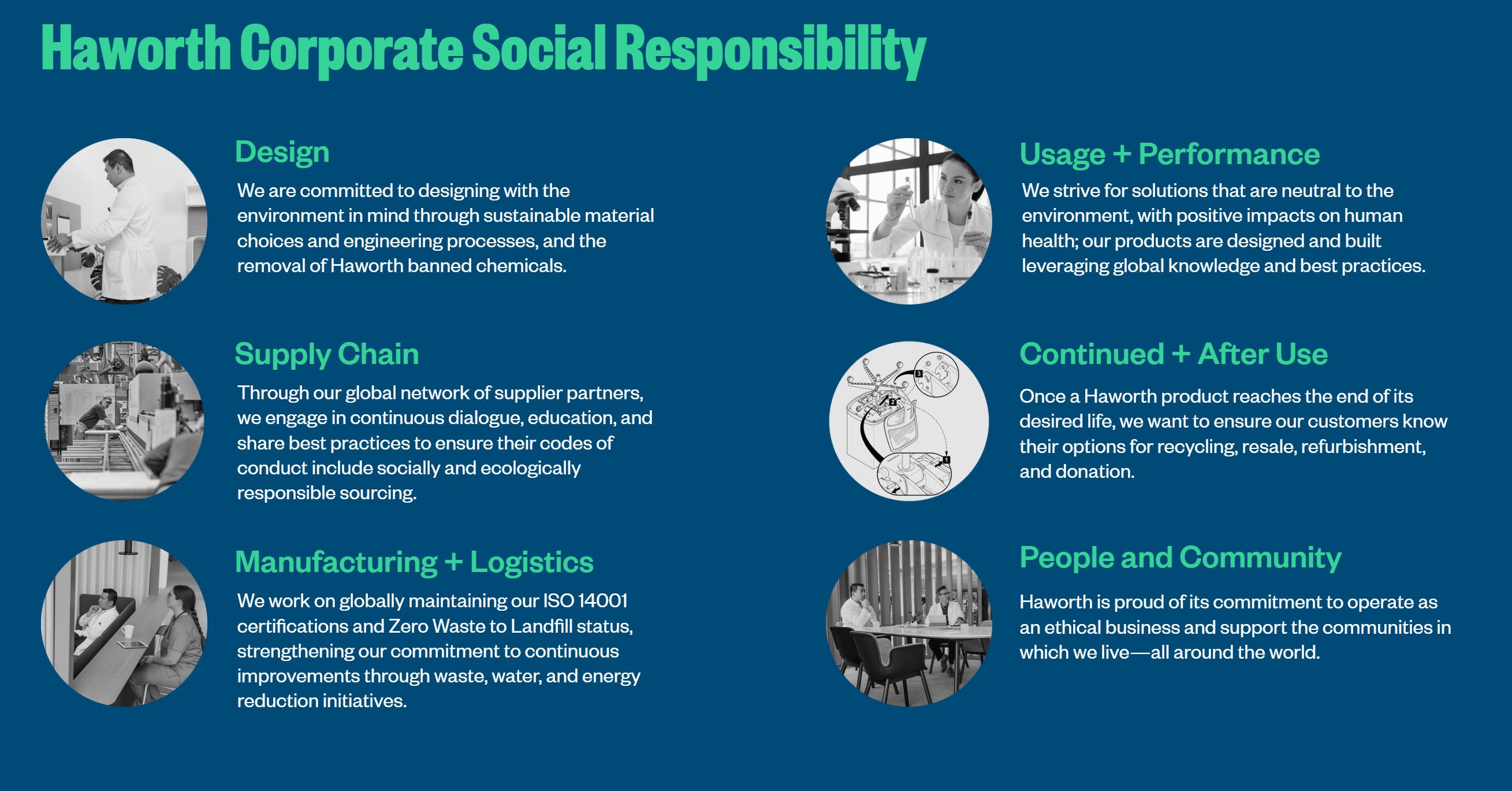
Haworth remains dedicated to maintaining the highest environmental standards in the market and will continue to be transparent in its efforts and progress reporting on its material transparency efforts. Complying with applicable legal requirements on chemicals, such as REACH, is a matter of course and is considered as minimum standard for all Haworth's operations. Haworth is working diligently toward reducing potentially hazardous chemicals beyond regulatory restrictions assosciated with its parts and materials.
Copyright PeopleSpace 2022 All Rights Reserved


Scientific Data & Testing
Since 2004, Haworth has partnered with the Human Performance institute at Western Michigain University to investigate the physical relationship between the human body and chair. The effort has generated over 5.5 billion high-resolution pressure mapping data points, as well as white papers and several research publications, validated through critical scientific peer reviews. This enables their seating engineers to confidently bring you the latest substantiated scientific research through their chairs.
Our task chairs are engineered to exceed user expectations, as well as global indsutry standards for performance and quality, including those set by BIFMA. Complementing research efforts, this rigorous testing informs every aspect of our chairs- from design to features and adjustments to ensure we're meeting the needs of all people at work.
This testing includes:
•Evaluation of chair component design
•Pressure mapping of seats and backrests
•Posture observation and research
•Analysis of spine shape when seated
•Seating comfort surveys
•Material and cushion evaluations
•Evaluation of design and activation of adjustment controls
billion
Compose was designed for customers that were looking for ease of inventory and ease of installation. Therefore, the connections from panel to panel and trim pieces are simple. We decided to make these connections universal and use a 1/4-20 x 3" Carriage bolt. The benefit is that assembly requires no special tools and no unique connectors. If during a reconfiguration the hardware to make these connections is missing, an installer can source everything they need from a local hardware store, so as not to delay installation.
•Tiles are manufactured for moves, adds and changes – with a welded steel frame; attachment clips for the panel are mechanically fastened to the steel frame structure so they will stay in place and not get lost during configurations.
•Full extension drawers with accessories (pencil tray, dividers & file compressor) and steel ball bearing slides are standard.
•Pedestals and storage cabinets feature a box-in-box construction for enhanced durability and performance over time.
Quality Assurance


Idea Starters


Competing Values Framework
Individual Spaces
Group Spaces


Competing Values Framework
Knowledge Community
Quality Efficiency
Growth Innovation
Profit Speed
Individual Spaces
Leader Type:
Facilitator, Mentor, Team Builder
Value Drivers:
Commitment, Development, Communication
Theory of Effectiveness:
Human development and participation, produce effectiveness
Leader Type:
Coordinator, Monitor, Organizer
Value Drivers:
Efficiency, Timeliness, Consistency and Uniformity
Theory of Effectiveness:
Control and efficiency with capable processes produce effectiveness
Leader Type:
Innovator, Visionary, Entrepreneur
Value Drivers:
Innovative outputs, Transform, Agility
Theory of Effectiveness:
Innovativeness, New resources and Vision produce effectiveness
Leader Type:
Hard driver, Producer, Competitor
Value Drivers:
Market Share, Goal Achievement, Profitability
Theory of Effectiveness:
Aggressively compete and customer focus produce effectiveness
Group Spaces

Why we gather with one another at work can be distilled down to four reasons:
1. To connect socially
2. To think together
3. To inform one another
4. To do something specific
While colleagues may interact in all four ways, one collaboration mode for a group is likely to stand out as preferred – best supporting their primary goals and activities.
Since goals are driven by culture, they are often inferred from the culture type. Let's look at how organizational culture and collaboration needs may intersect.
Competing Values
Research continues to build evidence that we are social and thrive in community. We often accomplish more
together than alone, and these tenets are inherently intertwined in the workplace
Key Spaces
Click image to enlarge


Collaborate
Café
Open Team Space
Lounge
Create
Project Space
Team Workspace
Retreat / Restore Lounge
Control
Individual Workspace
Meeting Room
Private Office


Compete
War Room
Touchdown
Community


Collaborate

Collaborate

Collaborate

Create

Create

Create

Control

Control

Control
Compete
Compete
Compete

B2C

Rise of the Entrepreneur

Harnessing Healthy Habits

Supply Chain Rebalance

Hybrid Culture

Big Data

Air Quality

Stress & Resilience
Workplace Engagement Knowledge
Share Ideation insights with customers, dealers and A&D firms on research, experience and knowledge of the changing nature of work.
Intent:
Interactive sessions designed around knowledge presentations on a variety of topics such as Culture, Collaboration, Workplace Trends and Change Management.
Process: