The Secret Ingredient
Is Time


Most of the time when you think of goat cheese, you think of the fresh spreadable stuff that tastes good on toast points. But Cypress Grove’s Humboldt Fog, one of the most recognizable American artisan cheeses of the last 20 years, is decidedly different. Named for the iconic gray mist that’s perpetually rolling over Northern California’s Pacific Coast, Humboldt Fog begins as crumbly, fresh goat’s milk curds and becomes a lush cream with a toothsome rind with notes of black peppercorn, and a bright paste bisected by a thin ripple of edible vegetal ash.
“Growing mold on a cheese is a very clever and ingenious trick,” says Matt Groff, Cypress Grove’s production manager. “You’re growing a protective packaging for your cheese.” Penicillium candidum and Geotrichum candidum, the two strains of mold at play with Humboldt Fog, grow this protective layer while also changing the character of the cheese over time.
As it matures, a fluffy, cloudlike bloomy rind forms on the surface of the cheese, growing puffier and fuzzier over the two weeks Humboldt Fog is aged. Gently and methodically, the cheesemakers pat down this delicate wooly layer, eventually rendering the rind we’ve come to recognize. This process ripens the cheese from the outside in, eventually developing a silky creamline between the rind and paste. As the proteins and fats break down, the process coaxes out herbaceous and floral notes, which coalesce with the tangy, milky overtones present throughout the cheese’s inner paste. �
And because those molds are living organisms, Humboldt Fog doesn’t stop changing until the very moment when it is eaten. “It’s undergoing transformation up until the very last day of its shelf life,” Groff says. “Time is what gives this product its entire character. It’s what creates the variety of experiences that you can have with Humboldt Fog, because it is so different at every point in its life.” —Amy McCarthy
Humboldt Fog
Natto
At its core, natto is an extremely simple dish to make: It’s just soybeans (although the specific natto variant) inoculated with Bacillus subtilis. What gives natto its signature flavor, and gooey texture, is time. “It takes the bacteria a little while to start making this sticky substance, which, in biological terms, is called a biofilm,” says Dr. Ann Yonetani, the founder of natto brand NYrture Food. (She also happens to be a microbiologist.) “Biofilm is scaffolding for the bacteria and also protects them from other harmful species of microbes. As a result, it protects the natto from spoilage by other microorganisms.”
�
Natto was something Yonetani frequently ate throughout her childhood while visiting her grandparents in Japan, and something she rediscovered through veganism in her early adult life. But she found it difficult to find fresh natto at home in New York City — which is why she began to cultivate her own in 2014, a few years after receiving her PhD. Yonetani compares her batches of natto, which only take about a day to make because they’re blasted with a high concentration of the Bacillus subtilis bacteria, to cheese. “It’s like Boston baked beans crossed with an expensive European cheese crossed with okra.”
�
Another perk of the fermentation process, according to Yonetani, is the resulting health benefits. “The bacteria themselves are a probiotic, but there’s also vitamin K2 and nattokinase enzyme,” Yonetani says, which is linked to cardiovascular, bone, immune, and gut health. But the real draw is the complex and nostalgic flavor. “You can eat it with anything you might put cheese on — so, toast, grits, oatmeal, polenta, something with a little bit more of an absorbent quality.” But one of Yonetani’s favorite ways to eat natto is the simplest: over a bowl of steaming white rice with shoyu, the way she grew up having it.” —Kat Thompson
Fat-Washed Spirits
Have you ever had a Negroni that somehow just tasted better — more full-bodied, round, and expensive? That’s something that can be attributed to fat-washing, the technique in the mixology world that infuses a spirit with a fat before straining the lipids out, leaving behind an enhanced version flavored with whatever fat was used. Sesame oil, bacon fat, duck fat, and coconut oil are all commonly used in this technique.
�
But fat-washing a spirit isn’t just about adding flavor. “Yes, we’re infusing some of the flavor that comes from that fat, but more often we’re looking for the added texture,” says Kaitlyn Stewart, a bartending champion, beverage consultant, and author of the cocktail book Three Cheers. “Bringing in that body, that lush feel, takes away a bit of the bitterness without changing the actual elements of the drink.”
�
The simplest way to fat-wash a spirit is to combine the two liquids and leave it for 24 hours, agitating and shaking the mixture every so often. The alcohol acts as a solvent to impart some of the fat’s texture and flavor on a molecular level. When the mixture is deemed properly fat-washed (shortcuts to speed up the process include using a centrifuge or submerging the mixture in a sous vide machine), it can be placed in a freezer. The fat will harden and can easily be removed, leaving behind the fat-washed liquor.
�“When you’re using a technique like fat washing, especially at home, it kind of makes you feel like a mad scientist,” Stewart says. “You’re changing the structure and how it feels on the palate, and you can really mess with people’s minds that way.” —KT
Crystal Candy
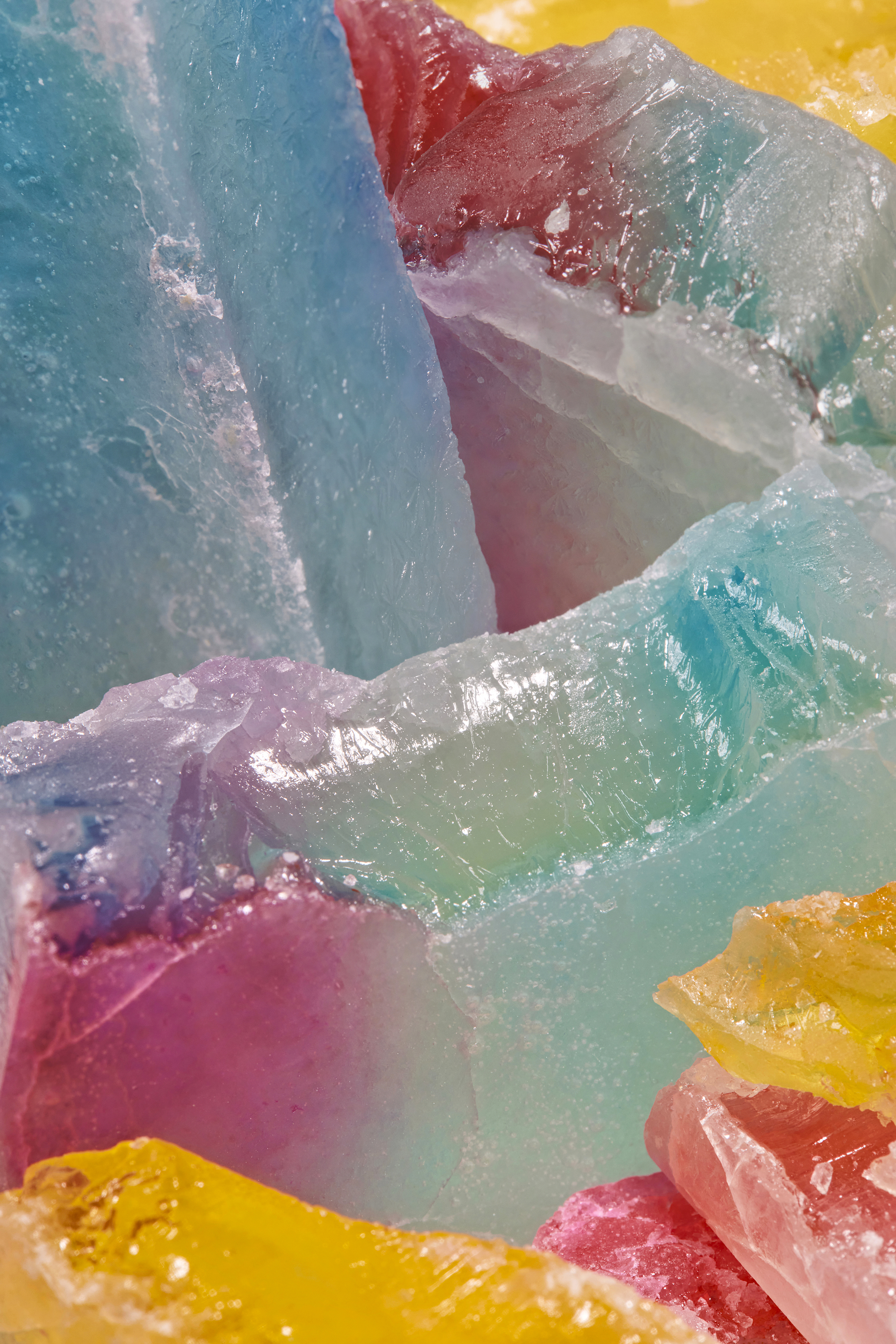
“I feel happy whenever I see people’s eyes light up when they first try a crystal candy,” says Gia Huynh, the founder of crystal candy brand Silky Gem. “You think this will be a rock-hard candy, but then you bite into it and it’s smooth with a jelly in the middle.”
�
Crystal candy is known for a shell — creating an ASMR-approved crunch — encasing a soft, gelatin middle. To make the candy, which has its origins in both Vietnam and Japan, sugar is combined with juices (for flavoring) and agar agar — a plant-based substance derived from red algae — and brought to a boil, activating the agar agar. “It basically turns into a jelly agent that we then pour into a tray to let it set,” Huynh says. “You then take the firm jelly out, cut them into crystal or whatever shape you want, and place them on parchment paper to air dry.”
�The air-drying process can take anywhere from five to 14 days. To expedite this, Huynh uses a dehydrator, which shortens the crystal drying process to three to five days. “When the jelly comes out fresh, straight out of the tray, it’s shiny,” Huynh says. As the crystal dries, moisture evaporates from the gel-like mixture, forming a crunchy, sugary crust. “After a day or two, you will begin to see a crystallized surface, almost like a snowflake.” The longer the candy dries, the thicker the crunchy exterior shell gets. —KT
Gumbo
In Louisiana, there are as many ways to make gumbo as there are pelicans. Some are thickened with gumbo filé powder, the leaves of the sassafras plant. But at Brennan’s, the New Orleans institution that’s been slinging bowls of gumbo for nearly eight decades, the dish always begins with a rich, peanut butter-colored roux.
�
The roux begins with equal parts neutral oil and flour, slowly warmed over low heat. In the process of cooking, starch in the flour (specifically, amylose, a long-stranded kind of glucose) starts to break down and expand; over heat, as those strands loosen in structure, they absorb liquid and hit a point of gelatinization — this chemical reaction gives roux its thickening abilities. When cooked on the stove, the roux must be stirred constantly. “If that roux burns, you’ve got to throw it out,” says Haley Bitterman, corporate chef for the Ralph Brennan Restaurant Group. “It’s the foundation of the whole dish, and there’s no coming back from a burned roux.”
�
At Brennan’s, the roux lends the resulting gumbo a deep nutty character, thickening it just enough to coat a spoon. Once the roux has cooked for an hour or more, the aromatics — onion, celery, and bell pepper, which form Louisiana’s culinary holy trinity — are stirred in, along with chunks of smoky Andouille sausage. Then, shrimp or crab stock — depending on what’s available — is slowly stirred into the roux and brought to a simmer, where the flavors are given a few hours to mingle. Finally, Gulf oysters, shrimp, and crab is added and given just enough time to cook before it’s delivered to the table.
�
You could simmer it for only an hour or two and this gumbo would be perfectly serviceable, but three or four hours is always better. And for Bitterman, gumbo just keeps getting better even after the cooking process is complete. “I love to let a gumbo rest overnight, or even for a couple of days, because that’s when those flavors really come together,” she says. “There’s no such thing as too much time when it comes to a gumbo.” —AM
An up-close look at the transformative moments that make food magical

Photography
Ellen Mary Cronin
Words
Amy McCarthy & Kat Thompson

Photography
words
Amy McCarthy & Kat Thompson