Since legal weed is still in its infancy, we’re all a little green (pun intended) when it comes to cannabis strains. Between the wacky names (Alien Cheese?!) and sheer volume of what’s available, it’s pretty difficult to narrow down what cannabis strains you may actually want to partake in. So, we chatted up Nick Denney, cultivation manager of Strane, a cannabis brand that’s all about genetics (seriously, they have over 400 different cultivars) to break down everything from what different strains
exist, to how they’re identified, grown, and categorized.

paid for by
How Exactly Are Cannabis Strains Created?
We Asked an Expert.
GOOD
GENES



By CHRISTIE ROTONDO
Cannabis strains fall into three categories: sativas, indicas, and hybrids. Generally speaking, sativas are believed to produce more of a mind-high, with an energizing, creative effect. Indicas, on the other hand, are considered to be more for chilling
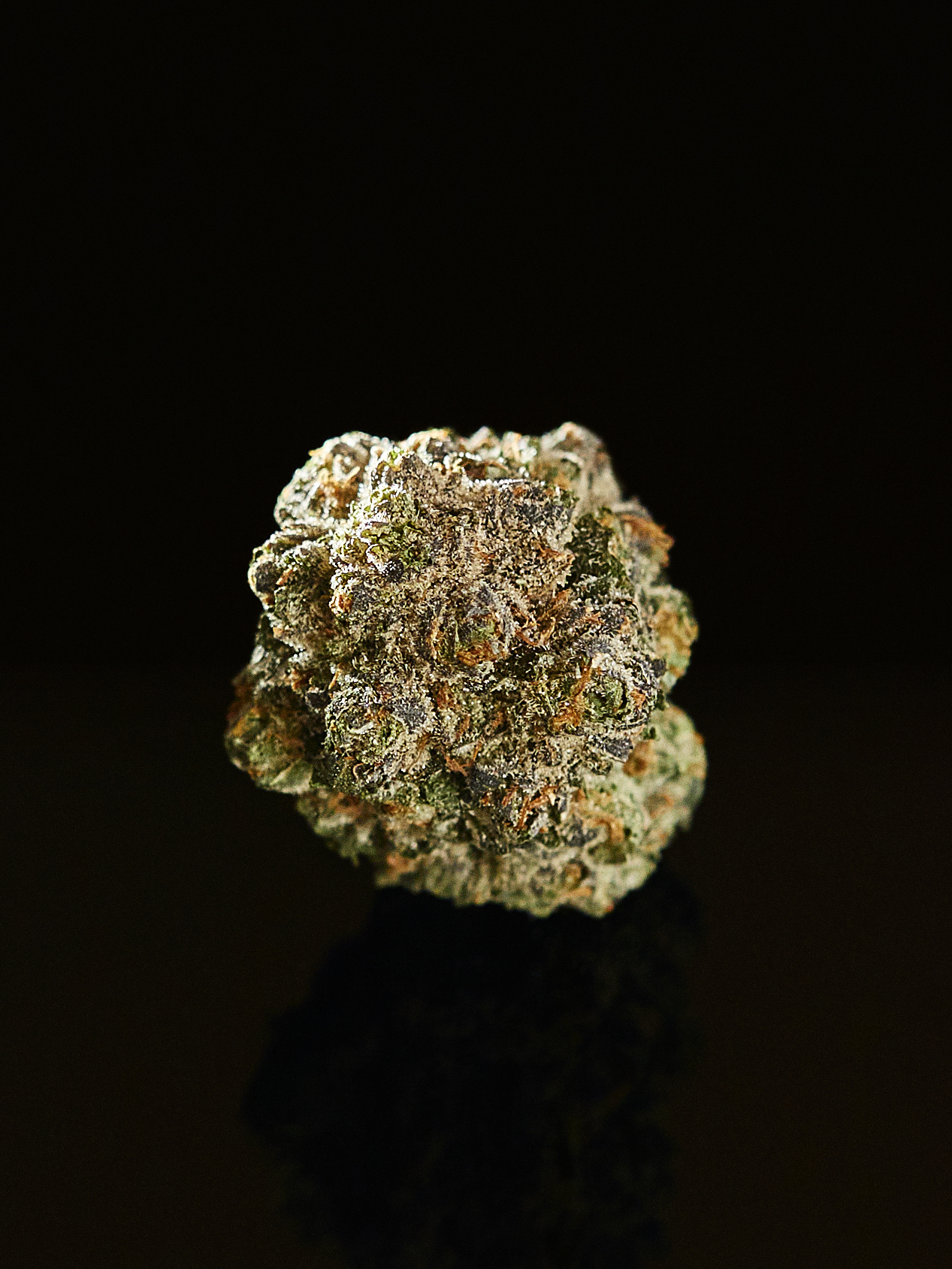
out. (“In-da-couch” is a common saying for that exact reason.) Hybrids, of course, are a mix of both. According to Denney, it’s important to think beyond these three general categories, though. “The genetic pool in cannabis is probably one of the most hybridized plants currently, because of all the breeding that’s been done in people’s closets and basements where there’s not a lot of stability.” So while this is a good jumping off point to understanding different strains and their potential effects, veteran enthusiasts should dig a little deeper into genetics, lineage, and identifying characteristics of the flower itself to identify which strains they like best.
Treat common categorizations as the jumping off point
So how do we get new cannabis strains in the first place? Well, it starts the same way we get different varieties of tomatoes: with the plant. “If I start a 50-pack of tomato seeds, every single plant is essentially a clone, because they are selecting for those traits and stabilizing those [genetic] lines,” Denney says. The goal at Strane is to eventually achieve the same consistency, but with several different cannabis strains. So, first, they start with a variety of cannabis seeds. As they begin to grow, Denney identifies the males and females — females produce the actual flower that can be harvested, while male plants just assist in reproduction. If they want to create a new strain, they’ll allow the male and female plants to reproduce. But, because they want the results to be as consistent as possible, the males are usually killed off, while the females are tested on a variety of characteristics: How is the quality? How much flower does one plant yield? How quickly does it finish growing? How are the cannabinoid test results? The plant that produces the best results in all these categories is identified as the “keeper.” Just like you would with your houseplants, cuttings are taken off that keeper (now known as the mother plant) and propagated to continue to stabilize the process. This is all called “pheno-hunting,” and it’s Strane’s way of testing and reproducing different strains in order to find the most consistent cannabis plants to grow.
Cannabis strains are just like any other plant
While growing conditions and genetics are key to producing quality bud (and recreating the results), all that can go haywire if the finishing process isn’t up to snuff. “Growers take strains 90 percent of the way there, but the dry and cure process is just as important,” Denney explains. These processes help preserve the cannabinoid makeup, and even accentuate a strain’s flavor. Plants are typically dried for a few days, just enough so that it’s still nice and sticky. (It should stick slightly to your fingers when you rub it, but it shouldn’t feel tacky enough to be able to stick to a wall.) It also shouldn’t be so dry that it flakes everywhere, as overdrying can ruin a strain’s quality. From there, it’s either sold as a flower, or grinded and wrapped into pre-roll. Tinctures, edibles, and concentrates are all made from flower, too – Strane uses carbon dioxide as a solvent to make a hydrocarbon extraction to create these products.
How strains are finished is just as important
as how they’re grown


Birthday Cake, Garlic Cookies, LA Confidential, Big Foot Glue, Bleu Cheese… the names of cannabis strains are pretty out there, to say the least. “That was something that cracked me up so much when I came to the cannabis industry,” Denney says. “I think it’s just marketing to the crowd.” That’s not to say the names
of different strains should be totally disregarded, though. Grandaddy Purp, for example, is usually associated with indica strains, so if you see a strain with “purple” or “GDP” in the name, it may be a hybrid of this OG. Haze, on the other hand, is usually a sativa, as are Jack Herrer strains. The names usually offer clues to some aspect of the strain’s lineage, smell, taste, or color of the flower itself, so ask the budtender for the background.
No one really knows why the names are so weird
Beyond cloning mother plants through propagation, the environment has to be controlled in order to ensure that the flower remains consistent. “Weed is called weed for a reason, it can grow like one,” Denney says. That said, while you might be able to find a thriving plant in less-than-ideal growing conditions, it may not be something you want to smoke. That’s why Strane grows all their plants indoors under grow lamps: it’s the easiest way to ensure the irrigation, light, and temperature are consistent. Those environmental factors are usually what determine a flower's coloring, too, alongside genetics. (Cooler temperatures, for example, can lead to a purple flower.) “Color is really a function of the environment and genetics,” Denney says. “Really, that applies to any expression of the flower: meaning smell, look, density, even the cannabinoid and terpene profile.”
Controlled environments are key
Rather than using just those general categories of indica, sativa, and hybrid,
Denney recommends leaning into your senses to identify which strains you like best. “Instead of indica, sativa, hybrid, I look at [strains] more like flavors,” he says. Specifically, he categorizes strains by fruits, gasses, and desserts. Meaning that if
a particular strain smells and tastes like citrus, it would fall into his “fruit” category, whereas ones with a smell like “Chem Diesel” would fall into gas. How a strain smells or tastes is much more consistent in the industry than potential effects, he explains. Beyond leaning into your senses, he recommends asking your budtender about
the kind of experience you want to have. Because they’ll have knowledge about a strain’s breeding, genetics, and flavor profile, they’ll be better suited to identify one you’ll like, rather than just winging it based on the three traditional categories.
Use smell (and your budtender) to choose your
preferred strains
Instead of indica, sativa, hybrid, I look at strains more
like flavors.
PHOTOGRAPHER Matthew Zach
ASSOCIATE CREATIVE DIRECTOR Colleen Lennon
FOOD STYLIST Sean Dooley
PROP STYLIST Catherine Pearson
PRODUCER Cassie Doyle
PRODUCTION COORDINATOR Hannah Lee
The FDA has not approved marijuana to treat, cure, or prevent any disease. There are health risks associated with the consumption of marijuana. Marijuana has intoxicating effects that may cause impairment of concentration, coordination, and judgment and may be habit-forming and addictive. It is illegal to drive a motor vehicle while under the influence of marijuana. Do not operate machinery under its influence. Keep out of reach of children. Women who are pregnant or breastfeeding should not use marijuana due to potential harm. Please consume responsibly. AR, MI, MD: Medical marijuana is for use only by a qualifying patient. AK, ME, MI, NV, OR, WA: For use only by adults 21 years of age and older. MI: National Poison Control Center 1-800-222-1222.


“
“
“
“
Color is a function of the environment and genetics. Really, that applies to any expression of the flower.
When it comes to weed, there’s a strain
for damn near everything, and sometimes choosing one is just confusing. First,
you have to decide if you prefer indicas, sativas, or hybrids, then you have to figure out how you want to enjoy it by choosing a concentrate, tincture, pod, or actual flower. Ultimately, your decision should be based on your desired effects. As a content creator and writer for all things cannabis, I’ve learned a thing or two about this miracle plant, including that different strains do their thing best in different situations. Each one delivers a unique response, which is why shopping for your strain and knowing which THC dosage works best for you is essential. Whether you’re feeling introspective, exhausted, or just missing the tropical taste of Tangie, there’s a strain for every kind of ganja enthusiast looking
to catch a vibe.
paid for by
The Right Strain of Cannabis for 5 Types of Enthusiasts, According
to a Cannabis Writer
By Sarah Michel
Let’s face it: Rolling a joint is an art form — and a difficult one at that. We’ve all experienced that (failed) attempt where our joint ends up looking like a limp, soggy mess. Sometimes, simple is simply the way to go. Skip the papers and filters for a convenient pre-roll. Strane’s six-packs feature a variety of strains, so you can dabble in different tastes and tailor your choice to your mood. Whether you’re looking for a pick-me-up or a Netflix-and-chill vibe, there’s a pre-roll for every type of scenario.
Invest in pre-rolled joints
Cannabis strains fall into three categories: sativas, indicas, and hybrids. Generally speaking, sativas are believed to produce more of a mind-high, with an energizing, creative effect. Indicas, on the other hand, are considered to be more for chilling out. (“In-da-couch” is a common saying for that exact reason.) Hybrids, of course, are
a mix of both. According to Denney, though, this is a pretty over-generalized categorization, as most strains available today are some kind of hybrid. “Personally,
I think that categorization is a little outdated,” he explains. “The genetic pool in cannabis is probably one of the most hybridized plants currently, because of all the breeding that’s been done in people’s closets and basements where there’s not a
lot of stability.” So while this is a good jumping off point to understanding different strains, veteran enthusiasts should dig a little deeper into genetics, lineage, and identifying characteristics of the flower itself to identify which strains they like best.
Think beyond indica, sativa,
and hybrids
Invest in pre-rolled joints
Think beyond indica, sativa,
and hybrids
Cannabis strains fall into three categories: sativas, indicas, and hybrids. Generally speaking, sativas are believed to produce more of a mind-high, with an energizing, creative effect. Indicas, on the other hand, are considered to be more for chilling out. (“In-da-couch” is a common saying for that exact reason.) Hybrids, of course, are
a mix of both. According to Denney, though, this is a pretty over-generalized categorization, as most strains available today are some kind of hybrid. “Personally,
I think that categorization is a little outdated,” he explains. “The genetic pool in cannabis is probably one of the most hybridized plants currently, because of all the breeding that’s been done in people’s closets and basements where there’s not a
lot of stability.” So while this is a good jumping off point to understanding different strains, veteran enthusiasts should dig a little deeper into genetics, lineage, and identifying characteristics of the flower itself to identify which strains they like best.
“
“
Instead of
indica, sativa, hybrid, I look at strains more
like flavors.
Rather than using just those general categories of indica, sativa, and hybrid,
Denney recommends leaning into your senses to identify which strains you like best. “Instead of indica, sativa, hybrid, I look at [strains] more like flavors,” he says. Specifically, he categorizes strains by fruits, gasses, and desserts. Meaning that if
a particular strain smells and tastes like citrus, it would fall into his “fruit” category, whereas ones with a smell like “Chem Diesel” would fall into gas. How a strain smells or tastes is much more consistent in the industry than potential effects, he explains. Beyond leaning into your senses, he recommends asking your budtender about the kind of experience you want to have. Because they’ll have knowledge about a strain’s breeding, genetics, and flavor profile, they’ll be better suited to identify one you’ll like, rather than just winging it based on the three traditional categories.
Use smell (and your budtender) to identify strains
Let’s face it: Rolling a joint is an art form — and a difficult one at that. We’ve all experienced that (failed) attempt where our joint ends up looking like a limp, soggy mess. Sometimes, simple is simply the way to go. Skip the papers and filters for a convenient pre-roll. Strane’s six-packs feature a variety of strains, so you can dabble in different tastes and tailor your choice to your mood. Whether you’re looking for a pick-me-up or a Netflix-and-chill vibe, there’s a pre-roll for every type of scenario.
Invest in pre-rolled joints
NIX THE DIY EDIBLES
The days of playing Russian roulette with weed brownies are over. These days, pre-made edibles come packaged with a disclosed amount of THC, so you can avoid that hours-on-end intense high. Plus, they come in all shapes and forms — from mints and gummies to tinctures that can be added to just about anything. If you’re a chocolate lover through and through, chances are your local dispensary carries brownies as well, and they probably taste just as delicious as those sketchy homemade alternatives.
The FDA has not approved marijuana to treat, cure, or prevent any disease. There are health risks associated with the consumption of marijuana. Marijuana has intoxicating effects that may cause impairment of concentration, coordination, and judgment and may be habit-forming and addictive. It is illegal to drive a motor vehicle while under the influence of marijuana. Do not operate machinery under its influence. Keep out of reach of children. Women who are pregnant or breastfeeding should not use marijuana due to potential harm. Please consume responsibly. AR, MI, MD: Medical marijuana is for use only by a qualifying patient. AK, ME, MI, NV, OR, WA: For use only by adults 21 years of age and older. MI: National Poison Control Center 1-800-222-1222.

