Three Lynx Village
From Camp to Village
Visual Timeline
Aladdin Houses
c.1920 - 2022
The Beginning of Three Lynx Village
Pre - 1920s - The Start
Earliest references to the area of Three Lynx village refer to it as “Camp 8,” one of series of camp sites that were established by Southern Pacific Railroad crews mapping and logging the area for future development beginning around 1907-1908.
1921 - Clackamas River
Due to increased power demands, PGE expands operation up the Clackamas River and begins development of the Oak Grove Powerhouse and Flowline. Oak Grove construction workers tent-camped at Camp 8 but once the project went into operation, PGE needed a place for them to live that didn’t require traveling up and down the valley every day.
PEPCO built or revived several railroad construction camps to support the huge workforce responsible for Oak Grove construction. Camp #8, developed at the Three Lynx site in late summer 1922, included a sawmill, various warehouses, and rudimentary canvas tents for workers. The Camp’s location was an important one, close to the Oak Grove Powerhouse site and easily accessible with the rail line nearby. As a result, Camp #8 was designated as the headquarters for construction and by February 1923 several frame dwellings and a bunkhouse had been erected there to provide more suitable housing and office space for the project engineer and other staff. An arc-shaped terminal building was built on the line and served as the trolley station.
– (McArthur & McArthur, 2003:951)
1923 - 1925 - Birth of Three Lynx
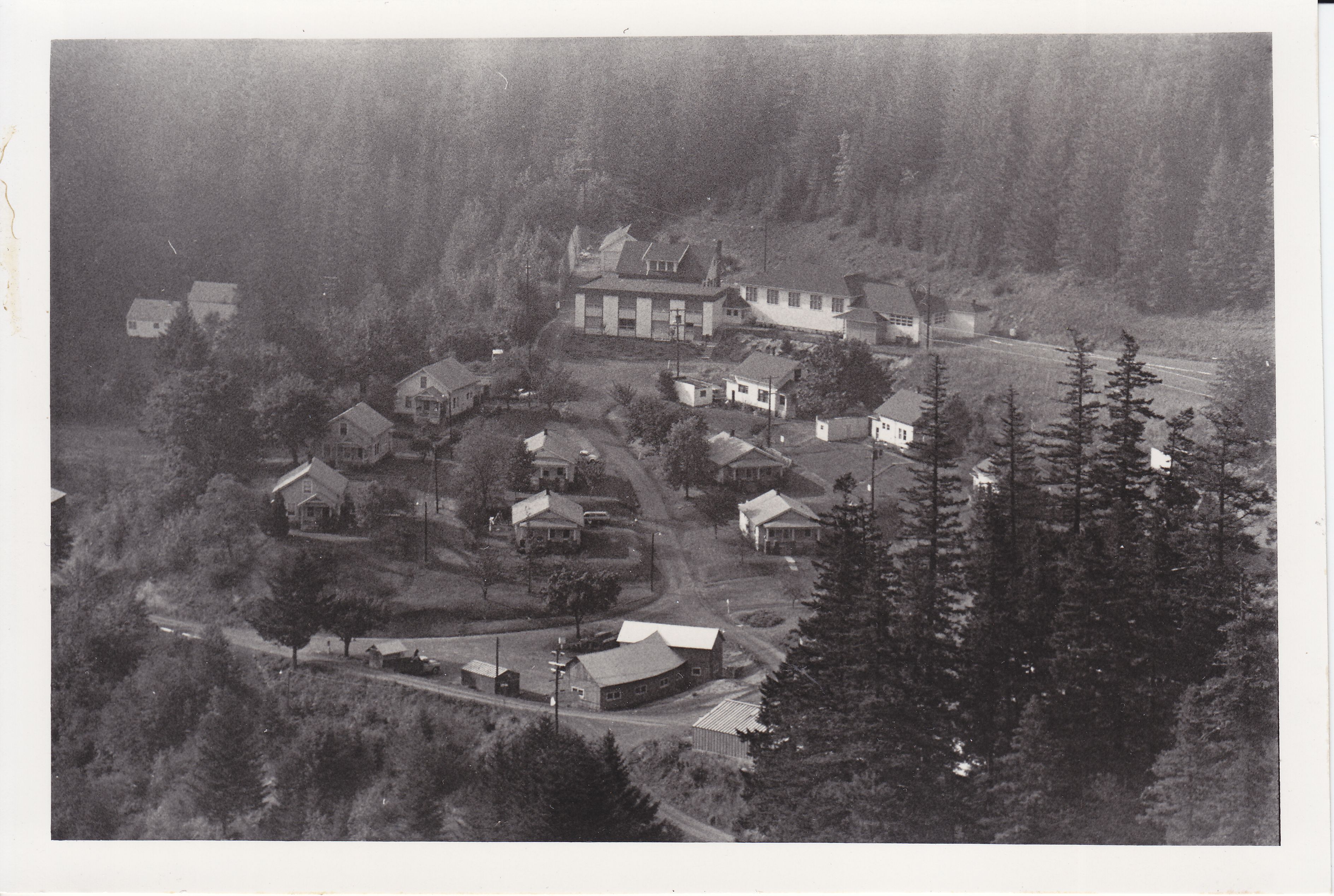
In preparation of Oak Grove going online in 1924, PGE needs to have operators and maintenance staff on-site, so Camp 8 is converted into permanent employee housing and Three Lynx Village is born. Seven “traditional” cottages were built on the outer ring.
Decline and Preservation
The Growth
The Beginning
1923 - 1925 - Birth of Three Lynx
In preparation of Oak Grove going online in 1924, PGE needs to have operators and maintenance staff on-site, so Camp 8 is converted into permanent employee housing and Three Lynx Village is born. Seven “traditional” cottages were built on the outer ring.
PEPCO built or revived several railroad construction camps to support the huge workforce responsible for Oak Grove construction. Camp #8, developed at the Three Lynx site in late summer 1922, included a sawmill, various warehouses, and rudimentary canvas tents for workers. The Camp’s location was an important one, close to the Oak Grove Powerhouse site and easily accessible with the rail line nearby. As a result, Camp #8 was designated as the headquarters for construction and by February 1923 several frame dwellings and a bunkhouse had been erected there to provide more suitable housing and office space for the project engineer and other staff. An arc-shaped terminal building was built on the line and served as the trolley station.
– (McArthur & McArthur, 2003:951)
1921 - Clackamas River
Due to increased power demands, PGE expands operation up the Clackamas River and begins development of the Oak Grove Powerhouse and Flowline. Oak Grove construction workers tent-camped at Camp 8 but once the project went into operation, PGE needed a place for them to live that didn’t require traveling up and down the valley every day.
Pre - 1920s - The Start
Earliest references to the area of Three Lynx village refer to it as “Camp 8,” one of series of camp sites that were established by Southern Pacific Railroad crews mapping and logging the area for future development beginning around 1907-1908.
The Beginning of Three Lynx Village
Three Lynx Village
c.1920 - 2022
For more than 60 years, the school served children from PGE, USFS, and other families that lived in the upper Clackamas drainage. With classes from Kindergarten to Grade 6, the school was the heart of the community and the basketball team was a source of pride.
– (McArthur & McArthur, 2003:951)
1927 - Community for PGE Workers and Their Families
PGE’s workers lived at Three Lynx with their families. It was a long way to go into the nearest town of Estacada so Three Lynx School District No. 123 was formed and operated under a special use permit from the Mount Hood National Forest. In 1927, the bungalow style school was built overlooking the houses.
1929 - 1930 - House Kit
PGE added a 2nd generation unit at Oak Grove and expanded Three Lynx. A group of “kit houses” were purchased from the Aladdin Company and built to form the “inner ring” of the village.
The house kits were shipped on the company’s own trolley line from Portland and built on site. PGE chose the “Victory” Model, for $1,098 each. They even paid another $175 for the optional front porch.
– (McArthur & McArthur, 2003:951)
Prev
Next
For more than 60 years, the school served children from PGE, USFS, and other families that lived in the upper Clackamas drainage. With classes from Kindergarten to Grade 6, the school was the heart of the community and the basketball team was a source of pride.
– (McArthur & McArthur, 2003:951)
1927 - Community for PGE Workers and Their Families
PGE’s workers lived at Three Lynx with their families. It was a long way to go into the nearest town of Estacada so Three Lynx School District No. 123 was formed and operated under a special use permit from the Mount Hood National Forest. In 1927, the bungalow style school was built overlooking the houses.
The house kits were shipped on the company’s own trolley line from Portland and built on site. PGE chose the “Victory” Model, for $1,098 each. They even paid another $175 for the optional front porch.
– (McArthur & McArthur, 2003:951)
1929 - 1930 - House Kit
PGE added a 2nd generation unit at Oak Grove and expanded Three Lynx. A group of “kit houses” were purchased from the Aladdin Company and built to form the “inner ring” of the village.
History of PGE
Electrifying Oregon
Powering Progress
A Thoughtful Transition
History of PGE
Electrifying Oregon
Powering Progress
A Thoughtful Transition
History of PGE
Electrifying Oregon
Powering Progress
A Thoughtful Transition
Forever Evolving
Powering the Future
A Thoughtful Transition
Clackamas Project Expansion
Building Reliable Power Plants
Powering Progress
Willamette Falls
Clackamas River Construction
Electrifying Oregon
History of PGE
Aladdin Houses
Decline and Preservation
Growth of Three Lynx
Beginning of Three Lynx
From Camp to Village
From Camp to Villiage
