We’ve also got a full report on the inaugural British Air Rifle Championships that were staged at Maldon in early July, and with all the competitors reporting back that they want to do it again next year we’ve already booked June 3rd 2018 (at M.A.D. again, of course!) for the second running of what was a very enjoyable and unique competition – best put the date in your diaries now!
With so many high-quality shooting to be had around the UK, it’s sometimes easy to forget that both disciplines of our sport are popular overseas. With Field Target shooting has been established for longer than HFT, it will come as no surprise to learn that it is better established and more widespread than HFT. However the upsurge in HFT in this country is one that has very much been mirrored abroad, and so in this issue of CompAir we take a look at the second round of the Czech Republic vs. Poland HFT Cup, now in its fourth year and very much on the up. Keeping with the international theme, our U.S. correspondent Paul Oswalt reports on how UKAHFT-style competitions have now reached our cousins across “The Pond” in eastern Alabama.
We’re at that stage of the year when both the FT and HFT calendars are absolutely rammed with “must-do” competitions that you sometimes find yourself almost craving a weekend off from shooting – almost!
Places for what is undoubtedly the highlight in the HFT calendar have been selling out increasingly quickly over the last few years, with a number of familiar faces on the HFT circuit having missed out in 2017 due to having left it too late the get their entries submitted.
A one point lead over the rest of the field meant that Dave Hunter took victory at this year’s English Open at the Misfits HFT Club on August 20, leaving Daz Taylor, Sarah Pantling and James McLachlan to scrap it out in a three-way shoot-off for 2nd and 3rd place honours.
The Central Southern Field Target Association have just published the dates of their Winter League competitions for both Field Target and HFT.
Shortly before this issue of CompAir went to press, we heard from Pete Sparkes that entries for the WHFTA HFT World Championships at Kelmarsh next Easter would soon be accepted.
Sunday 3rd June is the date that you need to put in your diaries now, and once again we are delighted to confirm that Maldon & District Air Rifle Club will once again be hosting this prestigious competition, with both courses once again being set by the maestro himself, Mr Richard Woods
Such was the success of the inaugural event that no sooner had the dust settled on the 2017 British Air Rifle Championships held at Maldon (M.A.D.) on 9th July, we quickly checked the FT and HFT calendars to see when next year’s competition could be fitted in.
Round 5 of the HFT Masters Series took place at Meon Valley Airgun Club just prior to this edition of CompAir Magazine being published.
Naturally, we’ll have a full report and round-up of the competition in the next edition of CompAir
The host club’s Colin Medway took the top slot in the Open Class with a very impressive score of 58, just a single point ahead of Steve Edmondson. Kyle Hampton was winner of the recoil class (56), Jason Lockett triumphed in the .22 category (52), Katy Ellis won the Ladies Class (52), Terry Trott took the Veterans Class, and top Junior was the rapidly-improving Scott Sommerville (52).
Full results of what by all reports proved to be an excellent day’s sport can be found HERE
Further details can be found on the C.S.F.T.A Website
As a result, it is highly likely that entries for 2018 will be taken up quicker than ever, and so the organisers suggest competitors get their application forms in pronto, in order to avoid disappointment. Entry forms and other information are available via the WHFTA Website
Full results of the competition can be found HERE
Is this a record, or do you know of a shoot-off that involved 5 (or more!) shooters? Answers on a postcard, please……. Chris Bedding ran out as the overall winner, followed home by Mike Barkus and Mike Seagrave. Full results are available HERE
Shoot-offs to decide who gets to take the silverware home are nothing new, but the last weekend in July saw no fewer than 4 competitors each tied on 58 points at the “Big Cat Bash” open competition at the Black Cats HFT Club’s ground near Swindon.
This year saw entries for the Air Arms RSN10 Memorial Shoot all taken before mid-August – testimony to how just how popular the event has become due to Air Arms getting “the formula” for a great day’s shooting exactly right and giving HFT shooters what they want from their sport.
Northall Farm at Fletching in East Sussex once again plays host to what has become one of the most enjoyable and popular shoots on the HFT calendar on September 3.
There was a lot of glass for the winners to take home
Ian Phillips took 1st place in the FT Class after a 3-way shoot-off
M.A.D.’s Alex Larkin trying something new.....
Andy Watkins is another one of those fellows who’s starting to carve a name out for himself on both the FT and HFT circuits
Quick on the draw - Paul Relf produced the fastest time of the day at the Air Arms Speed Shoot
To the victor the spoils - Dave Ramshead (left) lifted the winner’s trophy and title of British Air Rifle Champion 2017
Richard Woods presents fellow MAD member Simon Vant with his trophy for 3rd place in the HFT Class
Bob Pattenden’s 3D-printed stock was quite a talking point at the B.A.R.C.
Waste not, want not - Rex Bennett and his unique take on what constitutes and FT hamster
The FT guys had some lovely-looking bits of kit that they brought along for the competition
One man and his springer - Gary Chillingworth enjoyed his day out at the inaugural B.AR.C.
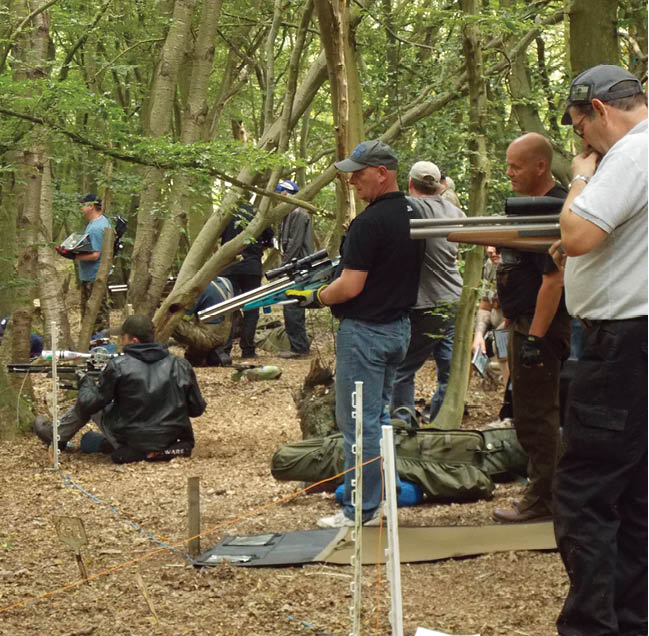
The first running of the British Air Rifle Championships attracted a very good sized field of competitors
Beelzebub incarnate - Dopper seemed to be relishing the pain his courses caused some of the entrants
The Air Arms Speed Shoot was very popular throughout the day
Whether you classed yourself as an FT or an HFT shooter, you still had to be sure you were correctly zeroed
The quality and planning behind Richard’s courses are renowned throughout the UK, but he also came up with a most ingenious idea, namely to have both the FT and HFT courses set along the same firing line in the Maldon woods – and not just one course following on from the other, but rather HFT pegs intermingled with FT gates. This was the first time something like this had ever been done, and it turned out on the day to be an absolutely inspired idea – with shooters from both disciplines literally shooting side-by-side each other, there was no chance of any “us and them” feelings arising between the two camps.
One thing that is beyond dispute is that the top FT shooters are not shy when it comes to investing goodly amounts of money into their kit, on the basis that to get the best result you need the very best equipment. At the other extreme, we have a certain Mr Rex Bennett, who “adapted” his trusty HFT springer for his afternoon on the FT course by taping a milk carton to the underside of his rifle to give him a suitably sized hamster when in the FT sitting position. They do say that necessity is the Mother of Invention, though maybe Rex’s take on this proverb highlights the need for a better form of “innovation-driven contraception”?
Once the combined scores from both courses had been totted up, it was Dave Ramshead who emerged as he overall winner by a solitary point (he and Richard Woods had both come in with scores of 24 from the FT course), and had the honour of being the first shooter to lift the title of British Air Rifle Champion – making the long trip down from “ooop north” well worthwhile. In the Combined .22/Springer category, it was .22 shooter Jason Lockett with a very creditable score of 60 who came in ahead of the springers of Gary Chillingworth (58) and Vince Holland (57).
The most pleasing aspect of the day? Definitely the brilliant atmosphere that surrounded the whole day’s events – and that is something that is solely down to those who took part, and a complete lack of “prima dona” behaviour by all concerned. Perhaps my most abiding memory will be of Ian Phillips, an FT shooter of some repute who took 1st place in that category, but also shot his first-ever HFT course that afternoon and emerged from the woods saying just how much he had enjoyed it – so much so that he would be heading out the following week to by himself a proper HFT rig. Happy days!
So, who were the better shooters – FT or HFT? The question will have to go unanswered for the time being as Overall Winner Dave Ramshead is one of those rare creatures who has considerable experience in both forms of the sport, as does Runner-Up Richard Woods. With the first running of the BARC having been so well received and no clear answer to the above question, we decided pretty much there and then that the best thing to do was to have another go at finding the answer next year – Sunday 3rd June 2018 is the date you need to put in your diaries, and it’ll be a Maldon again (naturally!)
Air Arms had also kindly supported the event by coming along with their highly popular speed shoot, and it was Paul Relf who emerged victorious on the day with a lightning fast time. Air Arms had also been very generous by way of supplying a whole mountain of prizes for the post-shoot raffle, whilst the CompAir Financial Director got a bad case of the sulks when we decided to put in £125 up as Bonus Bunny prizes (he’ll get over it - in time).
In the FT category, it was a very close run thing with Ian Phillips, Gary Keogh, and Graham Jopson all coming in with scores of 27 ex 30, so it was over to the MAD plinking range for the shoot-off, with Ian Phillips emerging the eventual winner. Things weren’t quite so close in the HFT category but there was no room for error, with Dave Ramshead’s excellent score of 48 just pipping Richard Woods’ 47, who in turn was one point ahead of Simon Vant.
Despite all the laughter and smiles, there was something missing from the day – the sound of the stoppage whistle. It must be surely be a record, but nearly 70 competitors went round 2 courses (comprising 55 targets in total) and not once was the whistle blown, a statistic that bears testimony to the exceptionally high standard of targets used and preparation in setting both courses by Dopper and his team of helpers.
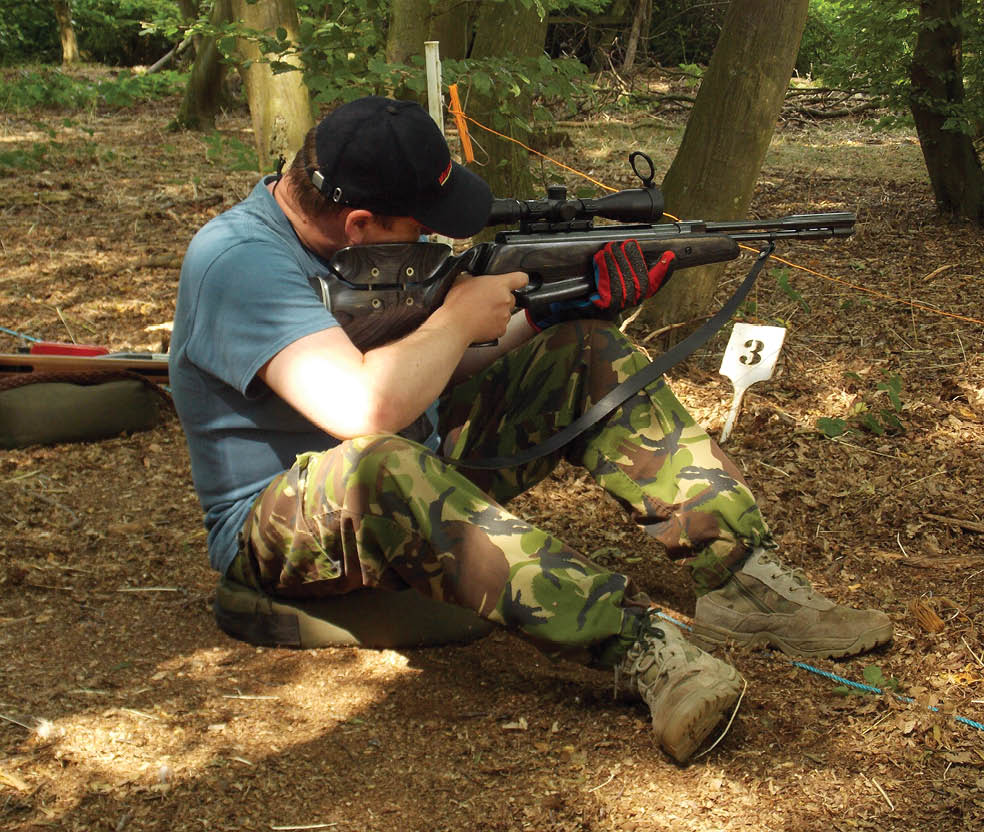
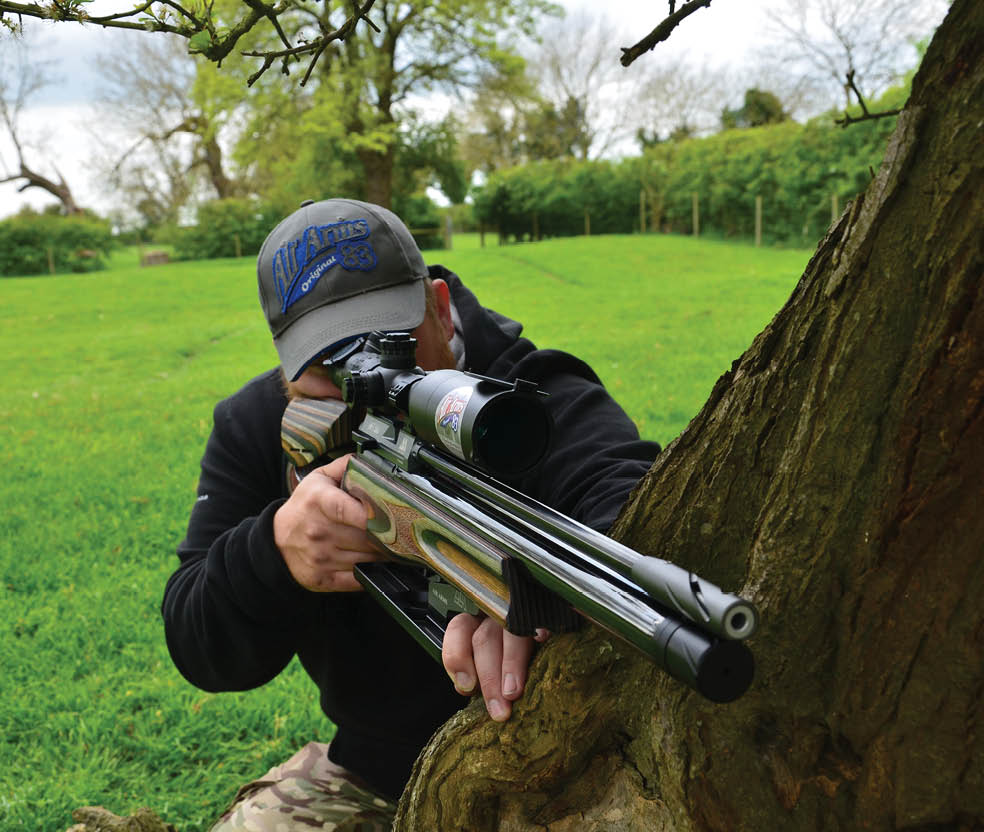
Almost as soon as the start whistle was blown, it became evident that the thing that almost everyone was determined to do was to have fun and enjoy themselves – the HFT guys had the opportunity to discover what their pellets did when they left the previous comfort zone of 45 yards and to find out that the FT seated shooting position takes some getting used to. For their part, the Field Target people had to come to terms with shooting targets both near and far that were considerably out of focus, as well as not being allowed to sit down. Steep learning curves all round then!
The 45 minute break for lunch didn’t reveal too much by way of whether it was going to be an FT or an HFT shooter who would carry away top honours later in the day, but one thing that was very noticeable was the great atmosphere that was developing amongst all those taking part. Indeed, a couple of FT shooters remarked that taking part in competitions with good amounts of jovial banter and witty remarks was something that they would like to do a lot more of – especially when combined with such the close yet friendly rivalry.
Come the day of the competition, just under 70 competitors arrived and booked in, with most having the choice of whether to tackle the HFT or the FT course first. The all-important safety brief done and dusted, it was off to the woods to sample the delights of Dopper’s course-setting. The previous weeks had seen extraordinarily and uncomfortably high temperatures, but these had abated somewhat when the day of the competition came around, and the woodland setting offered some welcome shade from the July sun when it did put an appearance in.
Pretty much as soon as we’d come up with the concept of a shoot where competitors would be shooting both an FT and an HFT course to establish an overall winner, we’d agreed that both the venue and courses for such a unique event had to be first rate – and when Richard Woods confirmed that the grounds at Maldon would be available on the date we wanted, we were unanimous in that M.A.D. was THE place to stage the inaugural B.A.R.C.
The initial idea behind CompAir putting on a shoot of its own was to come up with a competition that would bring our Field Target and HFT readers together, so that each could have the opportunity to try out a form of air rifle shooting that they normally wouldn’t get to sample. However, with both sides of the sport having shooters of a highly competitive disposition, battle lines were quickly drawn and the event became the British Air Rifle Championships, with the aim of discovering whether it is FT or HFT that produces the better shots…
If this has whetted your appetite to give benchrest shooting a try, why not come along to one of the many game fairs or shooting shows that are held up and down the country throughout the year where “The Air Arms Experience” taking place. You’ll be able to have a go at this unique style of air rifle shooting, have a chat with someone who shoots UKBR22 style of benchrest, and see if it’s for you. One of the big advantages of benchrest shooting is that it is open to pretty much anybody – young or old, able-bodied or disabled, one of the big attractions of this format of shooting is that it’s a fantastic sport that everyone can take part in and enjoy.
So you now know what sort of rifle you can use and in what class, what next? Let’s take a look at the rest of the equipment permitted in UKBR22 rules benchrest shooting.
This is made up of 25 scoring targets (numbered 1 to 25) into which you must place one shot each that will count towards your final score, and there are additional targets on one side of the card that you can use for sighting shots. You may shoot as many shots as you like into these designated sighting targets within the allotted time of 20 minutes per card, although additional shots in a scoring target incur a penalty - so be careful! Taking a closer look at the photo of one of the sighter targets on a Competition Card, you can see the various scores allocated to each ring; if you miss the scoring rings but still remain in the box then you score a 4. The targets are all scored with a .22 gauge and are plugged to indicate the score where necessary. The scoring is INWARD and the gauge needs to touch the line but not necessarily cut it. By touching or breaking the inner most circle you score a 10, however if you manage to obliterate this scoring ring, you score the magic 10X! If when the .22 plug is inserted and any part of the inner circle remains visible when magnified you will only score a 10. A .22 pellet is 5.4mm and the centre scoring ring is 2mm, so you can only deviate by a maximum of 1.7mm, from dead centre, in any direction to shoot the maximum score. With 25 targets on a Competition Card, the maximum possible score is therefore 250, with 25X’s. Now for the down side…..you have just 20 minutes to shot the card, and the clock starts running from the moment that you are told to take your first shot and includes any time spent shooting at sighters. Now factor in the wind if you are shooting outdoors and then tell me that benchrest shooting is easy! We don’t say it’s the “ultimate challenge” for nothing. Further information on the UKBR22 can be found at the website HERE including full rules and many useful links. Members of the UKBR22 Association can take advantage of the postal competitions that are run twice a year and are included in the annual membership fees - all you need to do is just pay for your targets. The postal competitions are shot in divisions, where everyone shoots against others of similar ability and stands a chance of winning a medal. There are also a small number of “shoulder-to-shoulder” competitions each year, as well as our National Competition.
You are allowed to use a fully-adjustable front rest, and this means a rest that can be mechanically adjusted to allow for windage and elevation and to move across the target face. A mechanical rest must incorporate a sandbag between the rifle stock and the metallic parts of the rest - this helps deaden vibration. The rifle is also held between uprights at either side of the sandbag, however it must be noted that the rifle must not be clamped into the rest, as the rules state that you must be able to lift the rifle out of the rest at any time. The rear bag is a sand-filled bag with “ears” to support the butt of the rifle, this can be made of leather or other materials, though it must be pliable when filled with sand. It’s worth noting that this equipment need not be expensive - a simple block of wood with a sandbag on top and a hand-held sock filled with sand for a back bag will get you started and is perfectly within the rules.
In this group similar rules to those for the Sporter Air Rifle category apply, save for the weight limit (15 pounds (6.8 kg) maximum, including the scope), inclusive of sight. Also, any modification may be made to the rifle and any magnification scope may be used. There is no restriction on cylinder size or capacity as long as 15 joules/12 ft.lbs. maximum power is not exceeded, and once again the cylinder must be integral within the rifle. Separate air cylinders are not permitted, and the cylinder must be part of the rifle and will count as part of the gun’s overall weight.
Once again, the rules are identical to those governing Sporter Air Rifle guns, save for that there is no restriction on cylinder size or capacity (as long as the 15 joules/12 ft.lbs. maximum power limit is not exceeded), and it is integral within the rifle. Separate air cylinders are not allowed; the cylinder must be part of the rifle and the overall weight.
This group is the same as the Sporter Air Rifle category, but with maximum permitted scope magnification of 6.5X, and the gun’s power is restricted to 8.13 joules/6 ft.lbs. maximum.
This category encompasses any rifle having a manually and mechanically (including electronic triggers) operated firing mechanism, with a maximum weight not more than 101/2 pounds (4.762 Kg), including the scope (and bi-pod, if one is used). Factory stock or stocks that meet the ‘Stock Clarification’ rules may be used. The action can be either spring or pneumatic, and air regulators, muzzle flip compensators, variable air strippers and custom brakes are permitted but will be included in the overall weight of gun. Any scope may be used with maximum magnification of 12X; scopes capable of greater magnification power will have to be taped in position for duration of a competition. The trigger may be reworked (or replaced). Return to battery shall NOT be permitted. Power to be restricted to 15 joules/12 ft.lbs. maximum.
A benchrest sighter target, showing the score values for each ring
A benchrest competition card
The UK Asscotiation of Rimfire and Air Rifle Benchrest Shooting is the leading body of the sport of benchrest shooting in this country
A typical benchrest set-up, showing the kit required for this precision sport
Your rifle needs to be a UK legal (i.e. not to exceeding 12 f.p.), in either .177 or .22 calibre, with the majority of shooters using .177 pre-charged pneumatic (PCP) rifles, on account of the flatter trajectory and the faster speed of the pellet. Let’s take a quick look at the various classifications and rules regarding the rifles that are permitted in UKBR22:
Competition air rifle shooting is so much more than Field Target and HFT, and in this edition of CompAir we take a look at the UKBR22 style of benchrest shooting…
“I’d been hooked on pretty much all forms of shooting for most my life, but my main focus and interest during those years had been shotguns - that was up until 1996, when an industrial accident forced me to give up work, as well as activities such as playing football, golf, and pretty much all the other sports that I enjoyed. However, I was determined that I wasn’t going to give up my shooting totally. As my hunting trips were becoming less and less frequent, I decided that I needed to look for some form of shooting that I could take part in on a regular basis without suffering too much pain afterwards….. My “shooting career” had in fact started with airguns, with my first ever gun being a Webley Jaguar when I was 10 or 11 years old, and all those years later I realised that I still had a great fondness for both the skills required and the fun to be had in shooting airguns. Back then, what we know as HFT today had existed for quite some time, but in various differing formats in a number of regions and clubs up and down the country. After being introduced to one of these formats and giving it a try over the course of a few weekends, I started to realise that here was pretty much exactly the type of shooting that I’d been looking for – from a physical perspective, my body could cope well with what I needed it to do in order to take part in a competition, I was really enjoying getting back into shooting airguns, and above all, this HFT business was bloody good fun! I started to get into this style of shooting more and more, and I remember well many of the fun competitions and great weekends away that we had with TPC at Chester, Lea Valley and in Swansea. In 2000, I tried to get something off the ground called “HFT-TPC Style” along with Lee Cleugh and Ty Reynolds, though at the time there wasn’t much interest from anyone I approached, apart from a few regular die-hard shooters who always came along to the shoots, and so I shelved the idea – but just for a while! Shooting HFT had very quickly become almost an obsession for me, and still I couldn’t get the idea out of my head of setting up some form of organisation to bring the various forms of the sport that existed in various parts of the country together. I explained the idea to quite a few shooters and also people I met through the Internet such as Jon Purssell and Nev George (to name just a couple) and we soon had enough willing volunteers to help get the project off the ground. Even back then some of the airgun manufacturers started to show interest in what we were doing, and in 2001/2002, the basis of what was to become the U.K.A.H.F.T. Championship came into being. In late 2002, I started to contact local field target clubs with a view to seeing if they might be interested in giving HFT a go, as a way of offering members something new and a bit different from conventional FT shooting. After a bit of searching and digging around on the ‘Net, I chanced upon Quarry Rifles near Blackwood in South Wales. A meeting the land owner and representatives of the field target club followed and it was agreed that we could start a club there running shoots and competitions on Sundays. There then followed conversations with local hunters Gary Didwell and Colin Fear, who both immediately saw the advantages that such a club could offer to local shooters, and with that Quarry Hunters HFT Club was born! Shortly after the Club had come into being, it held its first major competition with over 100 shooters entering and prizes worth over £1,500 pledged by 3 manufacturers - Simmons, Deben, and Theoben. Even back then in those formative years of the sport, manufacturers and other companies in the air rifle business were quick to recognise HFT as a valuable way of reaching their customers. The 2003 season seemed to go well but of course there were still a few things that needed to be ironed out, and the following year was even better. 2004 also saw Lou Martin coming aboard to assist with the organisation and running of U.K.A.H.F.T. events. Nearly 15 years on and we have come a very long way from those early days when typically we might have around 20 or 30 competitors at some rounds, and what is really nice to see is that many of them are still taking part in HFT shoots in 2017 - not bad for a sport that some of the nay-sayers reckoned wouldn’t last more than a couple of years! One thing I would like to add as we come to the end of the first instalment about how HFT evolved into what it has become today is that the United Kingdom Association for Hunter Field Target (U.K.A.H.F.T.) would never claim to have “invented” HFT – as previously mentioned at the start of this article, HFT had been going in one form or another for donkey’s years before it was formed. Rather, what the U.K.A.H.F.T. has done is to have been at the very centre of the sport since its inception, and it has been instrumental in growing HFT into a well-organised national, and indeed international, sport.
In the first of a 3 part feature series, Pete Sparkes takes a look back at how Hunter Field Target has gone from strength-to-strength over the last quarter of a century, how the U.K.A.H.F.T. came about and how it grew into what it is today.
Full results can be found HERE and our thanks go to Jakub Vicher for his help in compiling this article. We very much hope to bring you more news in future editions of CompAir about HFT in the Czech Republic, Poland and other countries.
The almost windless conditions over the weekend meant that even though the courses were tough (but fair), there were some high scores handed in at the end of each day’s competition, and at the end of the first day there were potentially 10 different shooters who were in with a chance of taking first place overall in the Open Class. Come Sunday evening, it was Grzegorz Mazur who claimed victory by just 1 point (112) over Ladislav Pusztai and Martin Krupka (second and third respectively, following a shoot-off). Grzegorz’s victory also meant he was the lucky recipient of a very special limited edition Air Arms 510 rifle that had been produced to mark the 30th anniversary of the company. In the Ladies Class last year’s winner Marta Růžičková once again triumphed, ahead of Marcela Bolková and Maria Beňušová, whilst in the Junior Category Tobiáš Dygrýn claimed first place, followed home by Matěj Grega and Marie Kvapilová.
Other stand-out features of the weekend at Bohumín included the post-shoot facilities and the catering arrangements – enough tables and seating for everyone under the specially-erected marquees (which offered some very welcome shade from the hot sun that put in an appearance shortly after the morning’s tropical deluge), making it the perfect place to enjoy a well-earned beer and some absolutely first-rate Czech cuisine (goulash on Saturday and schnitzel on Sunday). UK shoot organisers should take note - the ladies and gentleman of the Czech Airgun Field Target Association really know how to do things properly and we could all learn a lot from them!
The course-setters had been hard at work, laying out 2 very different, 30 shot courses using the natural topography of the grounds at Bohumín to very good effect – even pressing an inverted builder’s wheel barrow into service as an obstacle on one of the lanes! In addition, the hinges on a number of the targets had been hidden or obscured so as to make the dark art of bracketing much more difficult, meaning that competitors had to rely on other more traditional methods of range-finding. The course-setters also deserve special mention for their painstaking preparations; over the 2 days of the competition more than 100 people shot at 60 targets – and there was not a single stoppage during the whole weekend, and this surely must be some sort of record!
The weather plays a part in many sports, and HFT is no exception; come the first day of competition on Saturday, the 30ºC temperatures of the preceding day were replaced with a torrential downpour which delayed the start of the shoot for just over an hour. Most managed to stay dry during the deluge by taking shelter beneath the marquees and awnings that the organisers had arranged to be put up for the event – and as the rain started to ease, there was also the opportunity to test your open-sight shooting skills on the JSB side shoot.
Here in the UK, one of the very best things about HFT is that it brings together people from all walks of life, from different parts of the country, and yet for all the intense competition and the desire to win, there remains a strong sense of camaraderie and friendliness amongst shooters. Well, it’s just the same with the Czech-Polish HFT Cup – only more so; not only does the competition embody all that is good about the sport, it also bring competitors of two neighbouring countries together. Then there’s the very special atmosphere of the 2 day shoot at Bohumín – even those who’ve taken part in it since the very beginning can’t quite put their finger on exactly what it is, other than to say it’s the one competition above all others that they wouldn’t ever want to miss – all of which probably goes a long way to explaining why the event this year attracted over 100 competitors!
Now in its fourth year, this increasingly popular competition comprises 4 rounds - 2 being staged in Poland, 2 in the Czech Republic - and tradition dictates that early June sees Round 2 being held in the woodlands near the JSB factory at Bohumín...
You don’t mind doing a spot of marshalling when the weather’s like this - Lee Meadows definitely thought so, judging by the grin factor
It might have been a lovely sunny day for Round 3, but Tommy Russell was taking no chances with the notoriously unpredictable Rivi weather - even in mid-July!
Rock steady - but did Mark Lloyd get the free stander over, we wonder......
Karyn Macfarlane tackles the supported stander
The smart money is on John Oldroyd being a bit of a closet Dutchman
Andy McLachlan takes aim in the sunshine
Paul Kelly carefully consults his aim point card
The walk up the hill to T1 gives you time to curse the course-setters (Oh! Can’t do that this time!), and then T2 saw the course steal its first point off Paul – a free-stander punisher skull target at a good length. In fairness though, this particular target claimed a point off most of the field (or so it seemed by the end of the day’s competition).
As Paul and I finished the course and started to chat with other shooters on the way up to the hut, it became clear that most shooters’ scores had suffered due to a combination of what was a pretty “technical” course and the typically unpredictable Rivi wind – all apart from Justin Grice that is, who managed a phenomenal score of 58. The course was certainly a tester worthy as a practice before the double-header at Maldon the following weekend…...
Doing the scores after a shoot often gives an insight to how this kind of target affects the competition as a whole, with a third of competitors hitting this particular target and two thirds missing it, making it one that was fairly high up the difficulty scale. The stats for the free stander? Well these tell a really good story, with only 5 shooters knocking it down, 36 shooters missing it and 4 of those were doughnuts!
And so the course continued, claiming the odd point here and there from us both. T3 for me with an elevated 15mm target that I just didn’t give enough wind, plus T10, a 40 yard, inch kill Rivi wheel at the highest point on the course. It was one of those targets you look at and it gives absolutely nothing away in terms of history – clusters of misses all over the place. An inside left edge placement sees my pellet join a cluster of other victims further left, so a wind switch further up the field – caught out by my own trap!
The feel good factor didn’t last that long though as the very next lane, a near full distance target quartering against the wind, saw my pellet strike bang on my vertical cross hair, unfortunately I wasn’t aiming inside kill! Discussing the shot with Paul after we had both shot, he had given near identical aim point to me but got the target, so looks like it’s going to be a tough day doing battle against the wind pixies.
Today is considerably warmer than when we last shot together (well, warmer by northern standards anyway!), with temperatures around 14 degrees C., rising to high teens by Noon, with The Met Office saying wind speeds of around 11mph with gusts up to 18mph – yes, it’s a mid July shoot but not really a midsummer’s day by a long chalk. T29 is our start, a supported stander and lengthy, but with a 35mm kill. I’m up first and choose a just inside left edge placement and watch the pellet strike a pellet off centre on the fresh paintwork. A great start and one that Paul matched as well; it’s always nice to get a good start, especially on a positional target.
After the 10.15am safety briefing, it’s down to the start lanes; today my shoot buddy is Paul Kelly and so I’m looking forward to a good competition and a general catch up with him, as the last time we shot together was at a really cold and snowy round of the Winter Gauntlet Series at Oldham back in the Winter. It’s amazing how you remember some little gems and “pearls of wisdom” (a.k.a. excuses) used in competitions, such as one of the reasons given for a missed mid-range target was “I think my pellet hit a snowflake” ..... Classic! It was very funny at the time, and made it so much harder to take your next shot with tears in your eyes.
On course-setting duty for Round 3 were Simon Gibson, Mark Millward and myself - a relatively small team but one that works well. The general layout for this round was to use a section of the ground we call “the horse shoe” for approximately two thirds of the course, with the final targets over the brook towards the higher section of the grounds. We generally find the top part of the course and the horse shoe sections generally pick up more switches in wind due to their location on the hillside and are just the job to make competitors work for a good score.
One week before the UKAHFT MAD double-header as usual means a Summer Gauntlet at Rivington Riflemen’s Turton Tower range. The Gauntlet calendar is usually scheduled so that Rivington is used just before one of the major HFT competitions to give that all-important final practice at what is renowned as one of the more testing venues on the HFT circuit - a train hard, compete easier type of philosophy, if you like. However, this does put high expectations with regards to the standard of course the club needs to provide for the competition......so no pressure then!
So, depending on what rifle you’re using for HFT, if it’s a quality bit of kit such as the BSA Gold Star then it’s eminently possible to make a few changes and find out if FT might just be for you. Give it a try – you might just surprise yourself!
If you wanted to switch back and forth between FT and HFT, it would be pretty simple - just remember to jot down a few measurements for scope and riser positions in each configuration. Then it just a case of swapping scopes and reverting back to your HFT setting on the posts, check your zero and it’s job done. Then, when you switch back into FT mode, reassemble, return adjustments and finally re-zero and return top turret to correct range.
Ditto that.
Much the same as Don has suggested - extended posts for the hamster and cheek-piece to make the range of adjustment more suitable for FT usage. I’d also go for an FT-style butt hook; whilst the standard butt pad is fairly grippy and quite curved, something to help with stability at the back end wouldn’t go amiss. And as already mentioned, perhaps some additional weight.
There are few minor things that you might want to look at if you were going to use the Gold Star on a regular basis as an FT rifle, and probably the first would probably be the degree of height/depth adjustment in the cheek-piece and the hamster. Running a large objective lensed scope on the BSA is just about do-able with the full 25mm of adjustment being used, but should you wish to run a riser rail or blocks then you’d probably like to have another 25mm to play with. Similarly with the hamster, which could do with that little bit extra lift for comfort in the seated position, especially so on elevated shots. Another small thing is the weight; with a Falcon T50 and a few bits of associated scope “gubbins” bolted on, the BSA Gold Star came in at a fraction over 10lbs all in. Relatively substantial but I personally feel another couple of pounds in the right places would certainly help stability and in turn, accuracy, out on the course. The gun felt a little top/front heavy with the T50 and might benefit from some weight lower down to negate this feeling.
The Gold Star’s good points from an FT shooter’s point of view again fall to adjustability and accuracy categories - having a gun that shoots straight is of no use if the fit is too poor to make use of that accuracy. It certainly covers all the bases in terms of accuracy and, for the majority of shooters of average build and flexibility, the fit will be good enough to get a good feel for the gun’s capabilities and potential.
Out of the box, it’s certainly usable for FT. Although it’s very much a sporter/hft biased rifle, the adjustability of key parts such as the hamster, cheek piece, and butt assembly definitely helps in overcoming issues normally suffered by other sporter- style guns when they are pressed into service as FT kit. The accuracy of the Gold Star is on par with any modern pcp, and the trigger, whilst not quite up to the likes of Steyr and Anschutz, was nonetheless very good and the adjustable post and blade helped to make the most of the unit. Shot count was certainly more than enough to cover a pre-shoot plink and still complete a full FT course.
Obviously, the more you change the rifle and your set-up to meet your FT needs, the more things there’ll be to switch the rifle back for HFT and to comply with HFT rules, but by and large, I’d say it would be a pretty straight forward operation.
In addition to those bits and pieces I’ve just mentioned, I’d also go for a spirit level and a windicator.
If I were to use the Gold Star for FT regularly, I’d definitely fit an FT-style butt hook to help on the positional shots. I’d also look at extending the cheek-piece and hamster posts, as I would use risers to raise my scope and being 6ft 2” tall and not liking being hunched over the rifle, being able to have the hamster lower down would help me sit in a more upright and therefore more comfortable position.
The only aspect of the Gold Star that I had an issue with was the weight; the test rifle had a walnut stock and was a little bit on the light side for me. However, if it had been in a laminate stock (the black pepper one caught my eye!) then I think it would have been perfect. In fact, I’m thinking about giving the .22 HFT category a go in the not-too-distant future, and the Gold Star is definitely one of the guns that I am looking at using for this.
Well, from any shooter’s perspective, one of the very first things that struck me was how little wind it appeared to take! Ever since its release, there have been whispers and gossip doing the rounds that pellets fired from a Gold Star were taking less wind – and from my (very unscientific) tests in what might best be described as variable wind conditions, there does appear to be a some truth in these rumours! I’d have loved to be able to hang on to the Gold Star for a few months, in order to put these initial impressions to the test under a various conditions. I also own a R10 SE and use a single shot loader with this rifle, and being right-handed I sometimes find it a little bit fiddly when it comes to loading, as it loads from the left. However, with the test gun being a single shot version of the Gold Star, loading was an absolute doddle – and they do say that a single shot rifle is likely to be a little more accurate.
If you discover that FT is your thing, then it would probably be worth investing in slightly longer hamster posts
Whatever your shape and size, the BSA Gold Star stock can be adjusted to give a good fit
And if you really enjoy a challenge, try FT with a springer!
You don’t need to shell out on loads of expensive kit to give FT a try, but if you do find out that you enjoy it......
The BSA Gold Star offers good adjustability for both the cheek piece and the butt pad
Although designed primarily for HFT, the Gold Star is more than capable of giving a very good account of itself well on an FT course
The Gold Star wearing its FT clothes
The BSA Gold Star SE is a proven rifle and a popular choice on the HFT circuit
Absolutely, yes you can! Although most top air rifles are very accurate these days, you really wouldn’t need to do a lot to the Gold Star in order to get out there and enjoy yourself shooting a bit of Field Target - once you have mapped out your aim points/clicks to the scope you are using, of course.
We wanted to discover whether you could “dip a toe” into the world of FT competition shooting with a really good HFT rifle, to see if you might like it before going out and spending a king’s ransom on an FT specific rig – and without making a complete berk of yourself and being laughed off the course! With this brief, we handed over the Gold Star to our intrepid testers, told them to go and strap an FT scope onto it, and come back to us afterwards with their thoughts and comments on a few key points……
What we asked these two fine chaps to do was to take a BSA Gold Star SE in .177 and use it as a Field Target rifle, to see how it would fare doing a job that it wasn’t designed to do. Why did we choose the BSA Gold Star? Well, not only is BSA the oldest manufacturer in this country of rifles and the company that was responsible for supplying the machine guns that went into the Spitfire - so they not only have a superlative heritage, BSA do know a thing or two about making truly great firearms! For those unfamiliar with the BSA Gold Star SE, it is an exceptional bit of kit, very much aimed at HFT shooters, that has carved out an excellent reputation on the competition circuit since its launch a just few years backs over the last few years. It’s a rifle that is exceptionally accurate, yet at the same time offers excellent value for money; for example, a top-of-the-range Steyr or Walther are both capable of placing 10 pellets within a 5p piece at 50 yards. When we tested the Gold Star for accuracy, its best group was only 1mm larger than that of a brand new Steyr – a rifle costing more than double the Gold Star. In addition to being a rifle that’s very much been designed to do the business out there on an HFT course and one that has a number of notable wins to its credit, the Gold Star has also earned itself something of a reputation for taking less wind than some of its (pricier) competitors. BSA are rightly proud of the Gold Star’s cold hammer forged barrel, and it’s the barrel’s efficiency that gives the pellet a good ballistic coefficient downrange and this in turn is what helps in the wind.
Last winter, a couple of my fellow Meon Valley Airgun Club members decided that they didn’t want to spend any Sundays indoors (no doubt for fear of being bullied into doing some decorating, or DIY, or something equally ghastly), and made the decision to compete in the Central Southern Field Target Association’s FT and HFT Winter League Series. Vince Blackman is a well-known figure on the UKAHFT National Series circuit and has been into air rifles most of his life, and has shot both HFT and FT competitions. By way of a contrast, Don Vickers has been shooting HFT for the last 4 years and last Auntumn decided that he’d like to see what FT, “the other side” of air rifle shooting, had to offer.
Whether Field Target or HFT is your thing, what is beyond dispute is that whichever side of the fence you are on, you can spend a great deal of money on a top quality rifle and scope. Having said that, with some high-end Field Target-specific scopes running out at nearly £3,000, FT is generally acknowledged to be the more expensive of the two if you are going out and buying the best kit that there is. Now, whilst what a shooter requires from his scope for FT is a very different list from what he needs his HFT scope to do, we started to wonder if there was really that much difference in the rifles. These days, most quality air rifles are supremely accurate and apart from large butt hooks and monster hamsters an FT rifle and an HFT rifle must surely be pretty much the same thing – mustn’t they??
At the recent British Air Rifle Championships a number of the regular HFT shooters, keen to experience what Field Target shooting was all about and to find out how it compared to Hunter Field Target, pressed their trusty HFT guns into service and headed out onto the FT course. And this got us thinking…….
If you buy a second-hand EB Sniper, be sure to get the sunshade included with the deal - they came as standard when new (2)
The turrets are quite chunky, and can be prone to snagging on your bag handles, etc.
Robust and well-engineered - just two of the hallmarks of the EB Sniper scope
No prizes for guessing who this EB belongs to!
One of the all-time classic HFT combinations - a Steyr with an EB Sniper sat on the rail
Large turrets (which can sometimes catch on the handles of your gun bag) Non-lockable turrets No illuminated reticle (a handy feature on many other scopes in dark woodland settings)
Solid one piece aluminium tubing Good optics for the money Good DOF & FOV Nice size Mil-Dots (on the early version, on the later version they were slightly thicker) Fast Focus is smooth (check as on some scopes it can be too lose and moves too easily after setting)
Tru Mildot reticule Fixed 10 magnification 42 objective front lens 30mm tube, with a side parallax which goes from 10m to infinity Target turrets Sunshade was included as standard
Although now the EB Sniper has been discontinued, you do see a few second-hand ones do come up for sale now and again, but you need to be aware there were two versions of the scope produced, with the older version having the edge on the later ones (that came into production around 2010). One important thing to remember is that first time EB owners don’t realise initially that the parallax setting is marked in metres not yards, and so (as with any scope) make sure that you set it up to suit your eyes – not what it says on the side! It’s also worth bearing in mind that the EB Sniper is something of a “Marmite” scope – you’ll either love it or hate it, but if it is the right bit of kit for you then be very happy as the stats achieved by this almost legendary piece of glass speak for themselves.
When the EB Sniper first appeared on the scene, there were of course other scopes to choose from including the Tasco Super Sniper and the Nikko Sniper, but the EB quickly proved it was the one to have and rightly became the scope of choice for many in the HFT community. As if further proof of its pedigree were required, it’s still out there doing the business and delivering the goods in fine style, with shooters such as myself (winning the UKAHFT Extreme at the start of the year using my EB) and Vinny Blackman still doing well, and you’ll always see a goodly number of EB Snipers out there on the national HFT circuit.
Since its debut in HFT, the EB Sniper (also less commonly known as the Optimate Edgar Brothers 10x42 scope) has been chalking up numerous wins at the highest levels of HFT including numerous clear rounds, 4 overall UKAHFT Open Championships, as well as the .22, Ladies, Recoiling, and Junior titles. These are just the “big wins” at national level that the EB Sniper has had a hand in, and we must of course add to this “roll of honour” all those regional and club shoots that it has helped shooters triumph, making it surely the most successful scope used in HFT – ever!
Launched way back in 2003, the EB Sniper scope has notched up a whole string of notable victories since then. However, unlike many other scopes that have come and gone over the years, it hasn’t been pensioned off and retired to a quiet little bungalow by the sea – instead, the EB Sniper is still out there on the HFT circuit doing the business. Pete Sparkes takes a look at one of the all-time best bits of glass that ever sat atop an air rifle……
And then the sun put in an appearance! Round 5 saw just about every type of weather imaginable in the course of just one day
Billy Hutton snuck past Graham Livingston and Alex Cruickshanks in the Veterans Class
Mrs Fleming seems as though she enjoyed her day out, despite the rain!
Tayside’s Gareth Hunttook first place in the Springer category by just one point - and we’re loving the poncho, Gareth!
A delighted Steph McCall was the winner in the Ladies Category, 6 points clear of her nearest rival
Following a shoot-off in the .22 Class, it was Ian Munro who took first place honours
A sodden but delighted Dave Carter secured his first ever win in the Open Class
No-one go near him until he’s taken the shot - in case the ground moves!
The Veterans Class needed a shoot-off to determine 2nd place
Weather asides, the New Callie Massive had done both themselves and the rest of us proud, laying on a belting course, with some incredibly close-fought battles taking place in the various classes. During the shoot, two of the regular protagonists in the Veterans category, Alex Cruickshanks and Graham Livingston were both doing well - but then Alex forgot to load a pellet as he took his shot at Peg 18! We’ve all done it at one time or another, but it allowed Billy Hutton to sneak up on the inside rail and take the class win, leaving Alex and Graham in a shoot-off for second place honours. In the Open Class, Dunfermline’s David Carter secured his first ever win, ahead of “the usual suspects” of Grant Thomson, Greg Morss, Wullie Hoggan, and James Hesson.
Not only were there copious amounts of the wet stuff falling out of the sky, the ground had become so sodden that a special request was made during the safety brief that when moving between lanes, namely that if you encountered another shooter laying prone and about to take the shot then you were to stay put – on account of conditions underfoot being so wet that if you passed close by to someone laying prone, that you would probably cause the ground he was laying on to move! I was soon to discover once I started out around the course that this really was no exaggeration – you could actually feel the ground moving as you walked upon it. The best plan it seemed was to carefully pick one’s way around the course, making judicious use of the various pallets and Astro Turf that had been thoughtfully laid out in strategic positions to try and save some of the hapless souls from being swallowed alive by the Auldhouse quicksand.
Round 5 of the STS Air HFT League (formerly known as SARPA) was held at New Caledonian A.R.C. ground at Auldhouse in East Kilbride on 30th July. Numbers were slightly down due to an HFT Masters shoot being held that same day, and the weather conditions were pretty extreme - even by Scottish standards! The was so much water on the road leading to the ground that it was more like shooting the white water rapids of a river than a quiet trip out into the country by car! Conditions didn’t improve as the start time for the competition approached and some decided that the conditions were so atrocious that this was a day better spent indoors and headed straight back home again.
It’s no secret that the weather up in Scotland can sometimes be a little on the moist side, but the conditions that greeted shooters at Round 5 of the STS HFT series took even the locals aback somewhat. CompAir’s Scottish Correspondent, Tommy Fleming just about managed to keep his feet on “terra firma” to bring us all the soggy details…
Peter Knight was the lucky winner of the £300 Jack Pyke voucher on Saturday
2016 HFT World Champion was the worthy winner of the .22 Class on Sunday, finishing 3 points ahead of the rest of the field
Finn Cochrane went home with a sleeve of pellets, courtesy of JSB, who sponsored Round 4
Megan Reed took the win in the Junior 9-13 Year Old Class on both Saturday and Sunday
It was Mark Wilson who came out on top in a very closely-fought battle in Round 3 of the Open Class
Elles Thomassen made the trip all the way over from Holland to take part in Rounds 3 & 4 of the UKAHFT Series
Meon Valley’s Colin Medway takes aim on the hill section of Saturday’s course during Round 3
Smiles all round as Gary Chillingworth collects the first of his trophies for winning the Recoil Category on both days of the M.A.D. weekend
Michelle Parsons triumphed in the Ladies Class on both days at Maldon
Yes, it was as challenging as it was scary! This target was placed in a position that was almost as high as it was long.....
Gordon Burns and his compatriots from North of the Border consider distance to be no object in their ceaseless quest for quality HFT shoots
Following on from claiming the British Air Rifle Championship at MAD a fortnight before, Dave Ramshead made the return trip down south to compete in the UKAHFT Series
The Maldon Field of Tears combined with a tricky wind ensured that shooters had to work hard for every point
One of the big attractions of shooting the M.A.D. weekend is that you get to experience the full pain and terror of a course set by Satan himself (a.k.a. Richard Woods or Dopper, these being aliases that the Prince of Darkness also uses from time to time) not once, but twice! This year, the devil incarnate had set out 2 very different courses, the first on Saturday wound its way through the club’s woods and then out onto the adjoining sloping field, and finally onto the flat open area beside the plinking range. This ensured that competitors skills’ were tested in a number of ways, not least in the field with the targets positioned at almost every possible angle to the prevailing wind, meaning that no two shots were ever the same. You only had to look at the history on the faceplates to realise that shooters of all abilities were being challenged in every way possible. Even if the day had been calm and still, the course would have been a difficult one, but with a gusty and changeable 10-15 mph wind doing its worst, you didn’t have to look very far to see expressions of disbelief and pain etched onto competitors’ faces. Yet somehow, despite the conditions there were those who managed to read the wind exceptionally well including Mark Wilson, James McLachlan and Daniel McMahon who all managed formidable scores of 56 apiece in the Open Class, whilst Megan Reed and Tom Willingham both ended the day top of the 2 Junior Classes by some margin over their nearest rivals. It was much closer in the Ladies, Veterans, and Recoil Classes, with Michelle Parsons, Ken Pothecary and Gary Chillingworth respectively clinching victory, whilst Ed Tandi enjoyed a welcome return to the top slot of the .22 Class. The rest of us were left to give some thought to the benefits of either putting The Samaritans on speed-dial on our mobiles, or turning to strong drink – most of us chose the latter and headed off to the pub after the prize-giving and post-shoot drawer.
Sunday dawned bright, breezy and a little cooler than the previous day, though with the course for Round 4 being set entirely in M.A.D.’s woodlands and the direction it was coming from, the wind was to have very little effect that day, unlike the “starring role” that it had played during Saturday’s shoot. Instead, Sunday’s course was very much a “technical” one, with a liberal sprinkling of range-traps (“Crowzilla” putting in an appearance on the peg immediately after the free-stander), some very long/full distance shots and a goodly number of 15 mm size kills, all going towards making a course that was every bit as tricky as Saturday’s – but in a completely different way. One can only feel pity for the poor souls who were drawn to shoot in the afternoon session on Sunday, as one of the predicted “heavy showers” arrived about halfway through the proceedings and unloaded a deluge of biblical proportions on the competitors. I have certainly never shot in conditions such as we experienced that afternoon (for “heavy shower” read “tropical monsoon”), and nearly 10 of the field decided to call it a day and headed off before they drowned. Special mention must go to Marius Wisniewski who managed a score of 55 in those atrocious conditions, all the more given the top score in the much more favourable conditions of the morning session was just 3 points higher.
Full results of Round 3 can be found HERE on the UKAHFT website and for Round 4 HERE.
www.jackpyke.co.uk
JSB need absolutely no introduction to airgun shooters - there can’t be many people around who aren’t familiar with their truly world-class range of pellets, and a very large percentage of HFT shooters whether they are competing at club, regional, or national level choose JSB as their “go-to” choice of lead. JSB produce a wide number of pellets in different weights and sizes and it’s well worth taking a look the full range they have available and trying a few different ones, especially if you have a very “pellet-fussy” rifle – there’s a very good chance that JSB produce a pellet that will suit your gun really well. It’s always good to see one of the mainstays of our sport putting something back into it and JSB certainly stepped up to the plate for Round 4, putting up 4 sleeves of pellets and a selection from their clothing range for Sunday’s draw; check out the extensive JSB range at HERE.
Not to be outdone, Aim-Point Air Rifles & Accessories continued their ongoing support for the premier HFT series with another couple of their £50 vouchers being won by David Stephenson and Simon Vant, whilst the ever-generous Richard Woods once again put an impressive selection of his innovative FlopOver Targets up for grabs in both Saturday’s and Sunday’s prize draws. Once again, the trophies for the winning Manufacturers Team were sponsored by Solware, and the British Association for Shooting & Conservation (B.A.S.C.) sponsored the trophies in the Ladies, .22, and Recoil Classes.
Saturday saw Peter Knight, Daz Taylor and Mark Smith collect Jack Pyke Gift Vouchers to the value of £300, £200, and £100 respectively – and with the wide range of products that Jack Pyke have on offer, the lucky winners were spoilt for choice when it came to deciding what to use their vouchers for. The full range of Jack Pyke products can be seen by visiting their website
Competitors at the M.A.D. double-header weekend didn’t just have 2 bites at the cherry with regards to winning some silverware, thanks to the generosity of Jack Pyke (sponsors of Round 3 of the UKAHFT Series) and JSB (who kindly sponsored Round 4) they also had the chance to take home one of several prizes that were up for grabs in the post-shoot raffles.
After the sodden and dishevelled PM session shooters had made their way back to hand their soggy scorecards in and the numbers all totted up, it was 2017 HFT World Champion James McClachlan who took victory in the Open Class, whilst Megan Reed, Tom Willingham, Gary Chillingworth and Michelle Parsons all managed to “do the double” by repeating their class wins from Saturday. Mike Burgess this time took top honours in the Veterans Class and it was Simon Howorth who took home the .22 silverware.
The rain that had threatened on Saturday had the good manners to hold off until just after the last competitor from the afternoon session had managed to make his way to the final peg, though we were not to have seen the last of it over the weekend…
This year, a number of those taking part had arrived before lunchtime on Friday, though some of the really keen ones had even turned up the day before, determined to make the very most of their weekend away. The weather elsewhere in other parts of the country could politely be described as “mixed” or “variable” – Met Office-speak for chucking it down quite a lot - but Maldon seemed set to escape most of what the rest of the UK had to put up, with occasional and scattered showers, heavy in places being the order of the day.
For many HFT shooters, the (in)famous “double-header” weekend at Maldon & District Air Rifle Club has become one of competitions that simply can’t be missed; banter of the highest order and a very convivial atmosphere are combined with a couple of days camping in a pleasant part of the Essex countryside to make the apres-shoot fun and games just as important as shooting itself.
Everything about the HFT500 is quality
The butt can be readily adjusted to suit the shape and size of most shooters
No question, the HFT500 is a quality piece of kit that delivers exactly as I had hoped it would
For me, the addition of a hamster was an essential extra - rather than an optional one
It’s a sizeable and weighty rifle, so maybe not the first choice of gun for a junior shooter
Pellet Perfect sample packs are the ideal and affordable way of finding out what is the right pellet for your rifle
The button trigger is fully adjustable
The Minelli laminate stock really is a thing of beauty
The HFT500 is a full size, weighty bit of kit, standing at 1020mm (40.1 inches) long and weighing in at 3.7Kg (8.2 lbs) unscoped, so it probably wouldn’t be the rifle of choice for a junior or smaller-framed shooter. But if you’re an adult then you’ll enjoy the benefits of a 16mm diameter, 485.8 mm (19.25 inches) long free-floated Lother Walther barrel with a beautifully crafted air stripper to top it off. The beautiful Minelli laminate stock also gets a big thumbs up and is superbly finished with a hard-wearing, semi-gloss coating that feels smooth to the touch with well-placed stippling on the pistol grip and fore end. The cheek piece is fully adjustable for height and is mounted on a ball joint, allowing the shooter to get perfect eye-to-scope alignment. The curved rubber butt pad is also adjustable for height and depth, with the latter being adjusted using the spacers supplied (and additional ones can be purchased, if required). Personally, I do like a bit of depth to the belly of my rifles, so thankfully there is a rail under the fore end where you can slide an accessory of your choice. Then, to nicely complete the whole look and feel of the HFT500 is a beautiful swept back pistol grip with a generous thumb-up groove. As one would expect, there’s an on-board manometer showing recommended pressures, and on a full charge you get 90 shots, with around 60 of them in “the sweet spot” when it comes to competition shooting. Last but by no means least, you have a fully adjustable match grade trigger with a post-and-button style trigger, which can be adjusted in just about every possible direction, enabling you to set it up exactly to your liking.
Next time I’ll be taking it out of its comfort zone though, and seeing how it fairs in bench rest shooting…
So does the HFT500 deliver what we were promised it would? Speaking personally, most definitely it does! I consider it to be an ideal gun for HFT, one that can very much hold its own against some of the more exotic (and pricier!) rifles from overseas. The HFT500 is deadly accurate, superbly put together using quality components and has the all-important adjustability that shooters require. It ticks all the boxes for me and it is very much my “go-to rifle” as when the lure of HFT calls.
For standing and kneeling shots however, the lack of belly for me means that a hamster is a must, and thankfully Air Arms have designed a one that suits the rifle perfectly, giving enough depth to bring it up to aim, and once again you can buy additional spacers if required.
Due to the longer air cylinder, the rifle is a tad forward heavy compared to it predecessor the MPR FT, but personally I find that a plus. It holds on target beautifully, and thanks to the stock design shooting butt down whilst prone is both stable and easy.
But what’s it like to shoot I hear you cry? Well, I ordered one of Pellet Perfects sample packs to find what pellet best suited the barrel, and in my case it turned out to be JSB Exact 4.52s that worked great. Having settled on the right bit of lead, I soon discovered the HFT500 is a fantastically accurate rifle, easily capable of producing one hole groups out to 40 yards, only opening up at 45 yards - but then still less than the size of a 5 pence piece! I’m certainly the first shooter to make the comment that the HFT500 is an unregulated rifle that offers regulated performance!
So what can I say about it that hasn’t already been said? Well, having lived with the HFT500 for a few months now and having used it in a variety of scenarios, let’s first of all look at some of the numbers and stats that go to make up the rifle, before looking at its “real life” feel and performance.
Right from the first days of the HFT500 becoming available, it was a very popular choice for a number of competition-orientated shooters – after all, it was from Air Arms (universally acknowledged for the quality and reliability of their products), and as the name suggests it was very much aimed (excuse the pun) at the HFT market.
Whenever a new air rifle is launched, its arrival in the gun shops is often accompanied by a flurry of hype, loads of advertising and other promotional activity that has been whipped up by the manufacturer’s marketing department. With a few seasons out on the competition circuit under its belt, we thought we’d revisit the HFT500 from Air Arms to see if it is up to the job and capable of delivering what we were told it would. CompAir’s Paul Relf takes a look to see if the HFT500 really can do what it says on the tin…
There’s no doubt that what is driving all aspects of the sport to excel is the skill and determination of the field, but while it might seem as if the heady heights of FT are harder to reach lets just remember the toughest title in the world has just been won my a young man equipped simply with an EV2 and a Big Nikko, a combination that can be sought for well under 4 figures. The Worlds await.
There’s a whole gamut of battle and stories we’ve not covered, and by concentrating on just the top title, we appear to dismiss them. But this isn’t the case. However this year, more than any other I can remember, the series was just about two people. Different styles of approach, Jack’s relaxed style masking his hard work, Neil’s determination and drive worn on his sleeve. Everyone else, old hands and new, are just scrabbling for traction. The technology is evolving faster than ever. Each year there’s a new super scope, a messiah machine to bolt it to. Grounds are struggling to keep pace.
Jack once again got out of bed early, doing all his could do to get on with Emley’s notoriously testing ground. In mid summer the foliage offered some protection from the wind’s exposure but it’s fickle nature would still be tricky to master. Proving his is, Jack duly did all he could to leave Neil very little room and again missed just one target. Neil electing to shoot the afternoon session paced the car park in anticipation, but despite lighter winds suggesting to onlookers it would be an easier task, the fickle nature of the wind was something that Neil couldn’t quite bring under his control and he dropped two targets too many and the title was Jacks.
Going into the final round it was all about two people. Whilst Neil and Jack hadn’t won every Grand Prix they hadn’t been far behind. Neil had 4 wins out of 7 to his name and and was never more than 4 targets away from the winner in the remaining 2 counting rounds. Jack had just two wins, but had never been further away than two targets. With a series that had seen the lowest winning score never lower than a 47, for one person to keep that consistency was outstanding, for two to manage it and turn it into such a battle is just a demonstration of how much FT has moved on.
Where the start of the season had seen newer grounds, Grand Prix 7 was about as classic as it gets. Sywell. A name that throws shivers down seasoned shooters. Something that has to be experienced. It’s said you can never hope to master all 3 areas of the open ground and it’s notorious wind. It starts on the Plain of Despair, where nothing shields you from a light breeze taking kills of wind. You move onto the Garden of Evil, where a switching and contradictory wind can rob you of the most simple of targets. And if you’ve held your own so far then it’s the Bank of Doom that will rip any hope of glory away from you with high targets requiring off plate precision and close targets requiring steel to stay in or go out even at very close ranges. But it has been conquered. After several years away the GP circus returned to show it a few new tricks and Mark Henson mastered the lot with a 47. Simply unheard of for a ground that barely lets anyone get away with less than double figures of misses.
With the series now in it’s groove it was off to Castle in the MFTA’s region. A popular club ground a Grand Prix course was packed tight into the the wooded area and the wind outside mostly kept at bay, except for a few targets around it’s edge where it was a real test of nerve. Jack Harris got out of bed early and put a 49 in. Another Grand Prix where little room was left. But in the modern era of FT, light conditions meant that there was a queue of people trying to squeeze him out of a win. Rob O’Neill and Keith Gilyard couldn’t quite make the clear missing one, but they were also joined by Neil Hague who was seemingly able to turn a 100% on just by determination. With two rounds to go this was turning into a heavyweight battle between a few players.
Following the traditional theme of Bisley, Iceni in SEFTA was the setting for Grand Prix 5, and the series was starting to take shape. Red made another swipe at the series with a 48, but Neil Hague was determined to seize control and equalled that in the AM session. With Jack arriving for the afternoon he had only one choice to keep Neil behind him and that was to beat or equal his score, managing the latter with another 48.
With GP 3 over it was back to Bisley for a nice flat course where everyone knew what to expect. The wind had other ideas. With a course that wasn’t overly long in distance or challenging in the length of positionals, the Bisley breeze kept all the shooters busy switching second by second. Hard work payed off for many, but it was down to the man who could make the least mistakes and keep his cool. Neil Hague was the man for that, and despite a slip up on an easy kneeler he kept himself just one ahead of Jack Harris on 47, shared with fellow Welshman Dorian Falconer.
For the 3rd GP the series had a 3rd shooter on the top shot, 3rd time with a big score, and 2nd time it was youngster. Red Gallagher decided it was his turn to shine, and he did it in fine style mirroring Dylan’s 49 from the first GP. Again, in his wake lay many a wrecked percentage and a dropped score.
With Tawd Vale being a regular ground in NWFTA that everyone was familiar with, WAFTA’s Blaenau Gwent was something that many a Grand Prix shooter hadn’t experienced. If Avon Hawks was set on the side of a hill, Blaenau Gwent was on the side of a mountain. It was a course on steroids, unrivalled on the circuit. Sticking to a familiar layout, the first few lanes were level, but that soon changed. As the gate number increased the gates worked their way up the hillside, but not the target position. Soon all targets would be steep downhill challenges. Once you got used to that, the targets went uphill. A short steep stander before turning back on yourself gave an inkling of what was to come, except it would be steeper, and longer. A barrage of kneelers, long sitters was ended by a last set of standers, and just as you were recovering from that, two long flat sitters in open ground kept you thinking while you tried to get your heart rate down.
With the NWFTA Grand Prix 2 at Tawd Vale, everyone was hopeful that a more familiar spread of scores would be the order of the day. Neil Hague wasn’t having any of it. Being uncharacteristically absent from the top runners of Grand Prix 1, Neil was intent on putting his name back into lights and he did it in fine style missing just 3 out of the 50 in very testing conditions.
With many eyes on who would be first out of the gates after Neil Hague’s superb British Championships, Dylan Varney decided it was time to teach the old dogs a few new tricks and set the standard high. As about as high as you can get it without a clear, 49 ex 50. One hell of a start and it stamped home the idea that if you wanted to win, leave as little room as possible to be beaten.
First round was Avon Hawkes in SWEFTA. Avon Hawkes has pretty much every sort of challenge for the modern FT shooter. Light, dark, high and low, sheltered and exposed, both easily readable but just as capable of keeping a trick or two up its sleeve. The AM session was packed, local knowledge said that it would be the gentler session in terms of heat and breeze as this year we were into good weather predictions once again. Heat wasn’t so much of a problem as most of the line sits in shade. Breeze however could be. And it certainly was. Both sessions were treated to fickle breeze with perhaps the PM session having a small edge as it dropped off late in the last session to allow some targets to be salvaged. However, both sessions were treated to gusts requiring some very bold windage and then lulls that required just as much commitment to stay inside the kill, or sometimes to even pick the right side as it flicked from side to side, or appeared to go a different way downrange to what it was showing on the line.
That’s what will be written on the trophy. But that will miss out why this season, more than any other could be considered a watershed season in British Field Target.
The Mount Cheaha Airgunners Club have got themselves some great grounds to shoot round
Steady as she goes - Paul Oswalt applies maximum concentration to his shot from Peg 14
Whether you’re shooting in the US or the UK, the one thing that can be guaranteed is that HFT will always put a smile on your face - Rod Bradley enjoying his day in the woods
Getting to grips with those tricky supported standing shots is always fun - Rob Seiden does the business nicely
No prizes for guessing Mike Loar probably also hunts, as well as enjoying a morning’s tin chicken shooting
Rod Bradley lines up his shot on the supported kneeler peg
Good to see Ken Hughes adopting the correct kneeling position - well done, Sir!
Gabe Salluista puts his shooting mat to questionable use to assist his kneeling shot
Hunter Field Target (or HFT as it is more usually referred to) seemed to fit the bill nicely, and with this in mind I’d made contact a few months back with Pete Sparkes in the UK, who heads up the United Kingdom Association for HFT (UKAHFT), the governing body for the sport over there. Pete is a super guy, really passionate about the sport and he’d been very helpful, patiently answering all my questions regarding how we should best go about getting started. One big concern that I had was the use of “over-power” guns – almost every spring gun sold at the big outlets here in the U.S. is over the UK legal limit of 12 ft./lbs. I explained the situation to Pete and we came up with a simple solution, namely that we run 2 classes within the competition – one for guns over the 12 ft./lbs limit (but with a maximum permitted power of 20 ft./lbs., the same as allowed under A.A.F.T.A. rules), the other class being for guns running beneath that threshold. This was the only deviation that we’ve made to the UKAHFT rules, and one that seems to work nicely for shooters in the Mount Cheaha Airgunners Club.
Here’s how the match played out, and congratulations definitely go to Rod Bradley who achieved the highest score of the day – using a sub-12 ft./lbs. rifle!
I would definitely recommend HFT to any other clubs over here, and shooting to the UKAHFT set of rules is most certainly for us the way to go – getting your club formally affiliated is very straight forward, and there is also a world governing body; it’s just a matter of sending your information in and setting up according to the rules - easy peasy!
For this first competition, we shot a round of 15 pegs, with 2 shots per peg (I did have 30 available but could not get everything set out beforehand due to the storm). I would rate the difficulty level as being easy/moderate; I didn’t want to make it too hard the first time out and everyone seemed to be appreciative of this, and most importantly all those who took part had a great deal of fun! The 2 different power classes also seemed to work well; we had an AAFTA Hunter shooter use his 20 ft./lbs. PCP rifle and one of the spring gun guys was over 12 ft./lbs as well, and I think this is a good representation of what we can expect from local shooters in future competitions.
Undaunted by the less than perfect conditions, we set to and shot our very first HFT competition as a UKAHFT Affiliated Club – and I can honestly say that it was a great success! Although the format is different from those of the FT, WFTF or even AAFTA Hunter, everyone seemed to enjoy themselves - in spite of there being a bit of a learning curve for some of us. HFT requires a completely different skill set than that of traditional Field Target shooting, and although it is a completely separate discipline from FT, it is very easy to set up and run concurrently/alongside FT. Accordingly, we are planning at least one more match to coincide with our regular FT match, before then moving on to having a separate match day for HFT. When we do change over, the UKAHFT match will be held on the 4th Saturday of the month and the normal FT match will return to the 1st Saturday.
The one thing that the rulebook didn’t cover is the weather, and it was just bad luck that come the day of our first UKAHFT-rules competition we were dealing with the remnants of Tropical Storm Cindy that had blown across our corner of the USA a few days earlier. At least though on the day there was no more wet stuff falling from the sky, although the same could not be said for the ground – shooting mats were to prove an invaluable accessory for those taking part.
Over here on this side of “The Pond”, although there’s quite a range of airgun-related sports and competitions available to the shooter, I’d had this idea kicking around inside my head for a while that it would be great if we could come up with a format that could introduce a field target sport to those in the community that have airguns but don’t currently take part in competitions, and primarily I was thinking of kids with their dads.
Last month the Mount Cheaha Airgunners Club, located in the foothills of the Appalachian Mountains in eastern Alabama, held their first ever HFT shoot as a UKAHFT Affiliated Club. CompAir’s U.S. Correspondent Paul Oswalt reports on how a very British format of airgun competition went down with his compatriots………
The view of The Arms Experience from the stand.
Next we find Colin and Andy from URBR22 set up to demonstrate 10m and 25m Bench rest.
We then have Mike Burgess, Jean Greatrex, Graeme Cargan and myself from UKAHFT showing HFT and either local members of BFTA or if unavailable our UKAHFT team showing FT.
At the left hand side you find Ian Smith and his team from British Shooting demonstrating 10m pistol and rifle shooting as well as explaining target Sprint and the five plate knock down targets they use for their 10m match MPR rifles.
Maybe see you at the Midland Game Fair? Charles Peal Photos by Mike Burgess and Nick Byrne
So there you have it so far over 600 people getting 25 shots with 5 different voluntary coaches, Air Arms provide all the rifles scopes pellets, air and facilities to run this. We certainly get a steady number of those having a go asking for more information on the organisations and we absolutely expect to see them popping back up again at a competition in the future. I know I am biased but I do think they all (Air Arms and volunteers) deserve our appreciation for this level of support!
Finally, if you just want to blast as much lead down the range as possible we have John and Martin our two range officers running the have a go section (everyone wants to know what the Galahad is like to shoot) and finally the speed shoot where there are 8 electronic knock down targets to shoot against the clock, fastest time of the show wins the prize.
It has to be said the look of surprise and pleasure on the faces of first time shooters who were knocking those targets over or even experienced shooters who have never had someone sit next to them and explain how to shoot accurately, what makes a good standing shooting position, or how a pellet trajectory affects your aim points makes the whole day very well worthwhile.
All the disciplines are frequently handing out information on how get more involved or directing them to clubs local to where they live. We have a number of repeat visits with folk coming back to the stand on subsequent days or shows.
We see a wide range of people having a go from small children who have never held a rifle before, through those who shoot regularly but have not considered or had the opportunity to try these disciplines (many clay shooters with many bad habits..) and a fair few who assure me the last rifle they used was either their childhood BSA Meteor or a Mk4 Lee Enfield. Particularly among this latter category the amazement at how air rifles have developed since they last tried one is profound!
They thus get to try 10m MPR match rifles and 10m Alpha Proj pistol with a British Shooting Coach at their elbow, UKBR22 have targets at both 10m and 25m with two HFT500 rifles in Bench rest stocks, as with the British shooting stand their targets are on electric carriages so each shooter takes their targets away with them. When they get to the UKAHFT and BFTA section they are introduced to knock over (or Flop over) targets which are set out from 8yds (10 for FT) out to 45 yards where show ground space allows, even indoors at Stoneleigh we had 30 yards which was far enough to make 20mm targets look very small. To allow us to get the numbers through we are set up to shoot sitting at a chair with the rifle rested on a table, we explain about prone for HFT and sitting for FT but with the numbers coming through the stand actually getting everyone into the correct position might be a step too far!
When any member of the public come on the stand they are met by Karen or Miranda who relieve them of £6 and give them a card which they get signed off at each discipline when they have had a go (five shots on each). They can then either work their way round the stand in any order or do one or two, wander off round the show and return later to complete their card.
We now have a firing point 24m long covered by three of the largest gazebos you are ever likely to see, covering the firing line and tables for all the disciplines to shoot from under cover (which is lucky).
The stand has had a total of 663 people come through all of whom have been able to have a go on all five different disciplines;
In that order we have burnt, frozen, frozen again, and drowned in mud but for some reason we enjoy it and come back for more!
Since that point we have run the Air Arms Experience at the Midland Game Fair at Weston Park in September 2016, The Shooting Show at Stoneleigh in February 2017, the Great Northern Shooting Show in Harrogate in May and most recently the Game Fair at Hatfield House in July, shortly we will be back to the Midland Game Fair for this year!
I first heard about the Air Arms Experience while chatting to Claire West at Air Arms early last year, her idea was to provide a platform for some of the UK air rifle shooting associations to demonstrate what they do to the general public, at the same time it allows Air Arms to offer some ideas to people who have bought their rifles (or who might be thinking of doing so) of what types of sports they might have a go at.
Total Length: 110cm Total Weight: 3.8kg Barrel Length: 480mm Price: At the time of writing around £1250 to £1500 plus the cost of conversion. Importer / Distributor: RUAG AmmotecUpton Cross, Liskeard, PL14 5BQ Email Link: enquiries.uk.ammotec@ruag.com Tel: 01579 362319 Conversion: Harris Engineering West Midlands
My first thought on shooting the 9015 ONE in February 2016 was that it was something special and a possible step forward in the evolution of the FT rifle, I still think that is the case. These days improvements in the rifles we shoot are more marginal gains than giant steps, the 9015 feels like a little more than one, and a little less than the other. It is an accurate rifle with an excellent trigger, it is light, well balanced and with no felt recoil at all, not sure what more you could want in a rifle.
The true test of any rifle is in competition and in my first outing I managed to put in a sensible score, but lower than I would have liked. The problem was me being too cautious and in a difficult but light wind I was just not trusting enough of the 9015 to put the cross hair where I really knew it should have been, the reassuring thing was that at no time did I feel doubt as to the capability of the rifle, after a handful of targets I really had complete confidence it its ability to deliver the pellet to the kill, and that is a major bonus with any rifle.
Standers: This is a tradeoff position with the 9015 in standard set up. If I did my bit as well as I could I was getting about 60% of my standing shots but suffering left / right wobble. I have since fitted a TEC-HRO Puck positioned right under the point of balance and this has improved matters noticeably on both standers and kneelers.
Kneeling: With the hamster fitted and with a reasonably light set up the 9015 is a good kneeling rifle. There is a little wobble but it is manageable and allowed me to reliably hit kneelers out to just past 40 yards.
Sitting: The 9015 Club needs to be fitted with a hamster of some sort. Once that is done the reach and balance of the rifle are excellent and it is possible to hold the crosshair exactly where you want while you compose the shot.
We all know how important standing and kneeling shots are, they can easily make or break a score. I am poor standing shooter, but every dog has his day and I occasionally do well.
This is an important point with an Anschutz. Many have found in the past that summer and winter velocities can vary a lot and such was the case with some of the early 9015’s. Jon has worked hard on this aspect of the conversion and when I collected the rifle I got a test sheet showing no more than a 6fps variation over strings of shots taken with both 8.4grn and 7.9grn pellets. I did not bother rechecking the rifle until I had fired well over 1000 shots through it, but when checked it was running between 784 and 782 with one 780fps in a 20 shot string. Changing JSB’s to Air Arms 8.4 grain pellets made no difference.
So, what about pellets and accuracy, after all, it can have the sweetest firing cycle on the planet but unless you can reliably hit what you’re aiming at then it is of no use. Accuracy is excellent, on the first occasion I shot the 9015 it was breezy and blustery and I was trying different pellets. Shooting off the knee and more or less side on to the wind I was able to put pellet on pellet at 30 yards three times out of five and keep all groups easily within 15 to 20 mm. Next time out on the zero range at East Devon I was getting nice little fingernail sized groups at 55yards and groups half that size at 45 yards, not exactly precision testing I know, but good enough to give me an excellent idea of how the rifle performs. Pellet selection does not seem nearly as critical as with some rifles I have owned, the 9015 seemingly happy with different batches of both JSB and Air Arms pellets.
Another benefit if a very dead shot is the ability to watch the pellet right out to the target. I can manage this from time to time with other rifles, usually those with moderator or shroud fitted, the 9015 has neither.
The trigger is typically match grade and typically Anschutz with a nice light first stage followed by a solid wall that then breaks like glass. I fancy the break is a little cleaner than my other Anschutz trigger equipped rifles but it’s marginal and possibly accentuated simply because as mentioned there is no movement from the rifle when the shot is released, regardless, the trigger is excellent.
Firing the first shot it is apparent that the stabiliser has been set up very carefully, as just like all the previous 9015’s I have tried this one is absolutely dead when the shot is released. What is also apparent is that releasing the trigger the shot is gone instantly; now I know there are those who say that felt lock time is a myth, that we are talking fractions of a second which the human senses just cannot perceive, but I am sure that if I fired a handful of shots from a Pro-Target or early EV2 and then immediately changed to the 9015 I could easily feel the difference a light hammer and short stroke make. Whether real or not the 9015 feels like it has very fast lock time, it is not unique in this but it just feels a bit different and … special.
Loading is a very familiar process, the long side lever is pulled all the way back and if you listen very carefully you will hear two tiny but separate clicks as you do so, the first sets the stabiliser and the second sets the trigger. With the level back the breech end of the barrel is exposed allowing you to thumb the pellet straight into the barrel.
The rest of the layout is totally conventional. The stainless steel barrel is clad in a bonded stainless shroud and in standard form this has the front sight mount at the muzzle end, on my rifle the shroud has been shortened slightly and a recognisable muzzle has been installed. Underneath, the screw off alloy cylinder has had the manometer replaced with a quick fill valve and a cover that matches the muzzle…. or vice versa.
On the action, the cocking lever is on the right, but by the looks of things it will easily move to the left, making this a proper ambidex rifle. Above the action there are dovetails front and back of the breech opening and I asked Jon to supply the rifle with a low level bridge as I tend to use adjustable scope mounts and they are pretty tall. Those with sharp eyes will have already spotted that the bridge is of a cantilever design, Jon not being keen to use the rear dovetails. At the bottom of the action, the trigger blade is fully adjustable for both height and reach as well as being adjustable to either left or right bias. The blade itself can be rotated to touch your finger at just the right spot.
There is not much more to say about the stock, it has a lacquered finish which Anschutz say is waterproof, but Jon and I are dubious about that. It also has a more or less full length accessory rail on the underside, which is where I have installed my Rowan Engineering hamster.
The grip is a good size, possibly a little on the large size for smaller female or junior shooters, but there are other stock options in the range that would better suit those users.
Above all this is the shelf type cheek piece. I am a fan of this design having started my FT life with a series of Air Arms Pro-Target’s. Height is adjustable using a 5mm allen key but there is no tilt or twist adjustments as found on other FT specific rifles.
As this is the Club, the action, which is common to all 9015 models, is housed in blue and blonde ambidextrous laminate stock of a pretty familiar form. Right at the very back is the butt pad mounting plate and adjuster, this has a very simple adjustable rubber butt pad fitted. On my rifle this has been changed for a Brian Sampson HFT pad. The plate has a number of adjustments for position, height and depth, so there is no real reason why it can’t be adjusted to fit just about anyone.
Anyone who has owned a 2002, 8002 or 9003 will find the layout of the 9015 very familiar, but for everyone else I’ll run through the rifle.
Twelve months on and I was back at the Shooting Show when I spotted that Matt had something new. The 9015 ONE was still looking amazing but next to it was something much more my style, a 9015 action in a blue and white laminate stock, the 9015 Club, again converted by Harris Engineering. I tried it, I liked it (a lot) and by the time I got home I had decided to order one.
At The Shooting Show in 2016 RUAG released a 12ft/lb version of the brand new 9015 model. The rifle I was able to try was a 9015 ONE, it was in the hands of Matt Hirst and had woodwork and 6 to 12ft lb conversion by Jon Harris of Harris Engineering. It was immediately evident that this was something a little bit special, but it was also clear this was a flagship model with all the complexity and cost that goes with it.
Anschutz have been around the FT scene for many years, they have been used to win many major titles including World FT Championships and yet they seem to be the domain of a very few shooters mostly based in the South East of the Country, but things are changing, fast.
Davy Thomas
DAVY: One long-held ambition of mine was to open a new airgun club, and this has now been achieved with the formation of Black Cats, which was made possible with help from Charlie Harman, Nigel Gosling, Roger James, David Lockey and all the regular members who also help out. To be honest, I don’t really have any goals or ambitions for myself, though I would love to see some of the Black Cat shooters to be recognised as real contenders for a bit of silverware? We can only but praise and encourage good shooting - whether you are young or old!
DAVY: I don’t really shoot competitions frequently enough to be able to answer that one as fully as some people might, but hats off to Gary Chillingworth and his boinger, of course! Oh and you’ll need to keep an eye on the Black Cat HFT shooters, lol.
DAVY: I see airgun shooting in general getting even more popular, especially with all the competitions that are now going on all around the UK, and with new clubs such as “Black Cats” continuing to start up. It would be great to see more HFT competitions in the south west region though – it’s a long old day when you have to leave home at 5:30 in the morning because of the travelling times to most of the shoots.
DAVY: Funny you should ask that question of me, as when Dave Maun resigned from the Southern Hunters Series, he asked me to take it over and run it. However at the time I was way too busy with other commitments and had to decline his offer – though I did feel very honoured that he approached me. Regarding any changes to the rules of our sport, I subscribe to the view that what we have now is a very good format as things stand, and “if it ain’t broke, don’t fix it”, as the saying goes! Though I would come back again to trying something along the lines of a competitor being given a raffle ticket when they book in for a shoot, and then after the safety brief the numbers are drawn to pair you up with your shooting partner for the day along with your allocated start peg number. This would help mix the shooters up, and encourage people to get to know one another a bit more – as well as helping to put a stop to any cheating.
DAVY: Not to mince my words - the cheating that goes on in the sport; I’ve witnessed it myself and other shooters have said that they’ve seen it going on as well. I certainly don’t have all the answers as to how to put a stop to it, but one idea might be for competitors to put their names down on the entry list on the various forums or when they book in and then for the host club to pick who gets paired up with who for the day. That way a shooter turns up on the day and has no idea who he’ll be shooting with - pretty much like the Winter League format. As for the cheaters, they are only cheating themselves at the end of the day.
DAVY: It’s all about enjoying a really great day out, meeting like-minded people, seeing some familiar faces, having a laugh, not taking it too seriously but still enjoying the day. I enjoy the various forum and Facebook meets that are sometimes arranged, and in terms of HFT competitions I really enjoy the HFT Masters and Southern Hunters Series, although it’s been a while since I took part in the latter.
DAVY: I use several different airguns for competition and vermin control, but I mainly shoot a spring rifle when I’m doing a spot of HFT – an Air Arms TX200HC .177 with an MTC Mamba 3-12x44, or my HW97 in .177 with a Hawke Sidewinder 4.5-14x42 (a.k.a. Chieftain, and tuned by Sandwell Fieldsports). Both of my springers are zeroed at 35 yards and I shoot them on x10 magnification. I’m hoping to soon have the same Hawke scope on the TX200 - thanks to a friend!
DAVY: I first started shooting airguns back in 1970’s, on and off; I later got back into it in 2000. As for HFT, there was an Air Arms Owners’ Club meet in 2008 at Shepreth Airgun Club (a.k.a. Cambridge HFT Airgun Club). We had a forum meet and an HFT shoot was organised by the then admin team.
Paul kindly donated one of his creations for the post-shoot draw at the recent British Air Rifle Championships
Paul’s bolt-action gun pens are exquisite works of art - as well as being beautiful writing implements
Paul makes every pen by hand in his garden shed
One for the ladies - it’s not all guns and ball points that Paul produces!
The range of styles and colours that are available is amazing
Whether you would like a pen to give as a gift or maybe you just fancy treating yourself, all you need to do is look me up on Facebook (Paul Relf) and we can run through the various styles and price options available, as each pen is unique and custom-made to your own specifications.”
Being a shooter, I one day decided to have a go at making myself a little present - a bolt-action bullet pen. Without blowing my own trumpet too much, the end result was one that I was pretty chuffed with. So much so that I took it to my local gun club, showed it to some of the other members, and the rest, as they say, is history. I’m now at the stage where I take commissions and do my best to make pens for anyone who wants one, and I pride myself on the fact that all my pens are hand made by me in my garden shed.
Once I had grasped the basics and had gained a bit of confidence in what I was doing and able to produce, it was once again mainly presents for family and friends that I was making. Soon however, I started getting requests from “friends of friends” who wanted one, and things just seemed to snow-ball from there.
Then one year at the Lincoln Christmas Market, I met a wood turner on a stall who was selling handmade pens. I immediately fell in love with the idea of something handmade being so functional, and I kept the poor chap talking for simply ages so that I could learn as much as I possibly could about the whole process. I was so taken with the idea that the very next day I ordered the tools that I would need, and as soon as they arrived I set about teaching myself how to make a wooden pen.
One day I told my dad about my newly-discovered fascination with wood turning and without hesitation he took me straight to a local shop and bought me my first small lathe. I ended up making all sorts of little bits and pieces (and ended up almost completely filling my parent’s house up with all my handiwork!), and very soon I then had enough confidence to start making gifts for family and friends.
I read up as much as I could on the subject, but as is often the case in life with so many things, I ended up learning more getting my hands dirty and getting stuck in. The more I practiced, the more I realised just how much I loved using the lathe, and gradually my “projects” grew in size to the point where they included such tasks as making large decorative pieces for conservatories.
Hidden away in the back of the workshop was a beaten-up old lathe and a load of rusty tools. My job was to recondition the lathe and all of the tools, and then learn how to use them to make a few bits and bobs, such as newel post tops.
“My wood turning journey started when I was 17. I was an apprentice bench joiner, working for a small local joinery company. My duties were varied, such as sweeping up, making tea and coffee and being a general dog’s body, but my foreman also gave me another job one that nobody else wanted.
In addition to being more than being just a bit handy at benchrest shooting and HFT, CompAir contributor Paul Relf is also a dab hand at wood turning, and produces a full range bespoke bolt-action bullet pens that are absolute works of art as well as being a joy to use. Paul takes up the story of how he first got into wood turning, and how his love of it led to him making his first bullet pens…
Junior shooter Myla Parsons-Smith is carving quite a name out for herself on the HFT circuit
Maximum concentration from Ian Roberts as he takes aim.
Bill Jones telling me that he thought it was a 2 - but I know he plated it and only scored a 1
Jim Harney (left) shows off the Summer 2017 Oldham Dayglo Collection for the fashion-conscious marshall
Harry Compton squares up to the dreaded free-stander that was 30plus yards away and on an incline - way outside of most peoples’ comfort zones
Mark Kirby decides the target is worth a good, long look at before settling down to take his shot.
Special thanks must definitely go to the host club, with Oldham putting in a massive amount of hard work to provide competitors with a superb new course that was very much appreciated by all who took part in Round 4.
With the final scores on the doors, it was the man from Cumbria, Justin Grice, who once again took the top slot with a superb 58, which put him in a very good position at the top of the table, with 3 of his counting 4 scores being 100%
By the time we were 20 targets in, the general feedback coming from up and down the shooting line was that most of the competitors who are usually in with a shout for the top honours were a couple or more targets down, so the new course, combined with tricky light breeze, was definitely doing its job. On the run in for the final section of the course, Mark suffered a little, dropping a couple of unexpected shots, most likely by around 1pm the conditions were definitely changing a little, with a bit more wind drift, less light as the cloud cover came over; the changing conditions certainly made some of the tunnel-effect targets very different compared to when they were shot earlier in the day with clear skies. Sometimes, you need that little bit of luck on the start and finishing lanes as we’ve all seen at many big competitions in the past - practice, skill, and ability can take you most of the way, but it’s often Lady Luck that helps you over the final hurdle.
Mark manages to get a clear string of 8 targets together before we arrive at the free-stander, by which time Harry was one down and I had dropped two. As free-standing shots go, this one was quite high in terms of its degree of difficulty, not because of wind, but rather a combination of range, the kill size and a slight upwards incline to put you just slightly outside of a nice, comfy shooting position. The lane steals Mark’s first target and Harry’s second, but is kinder to me. When you watch other shooters who are “in their rhythm”, it’s surprising just how an unexplained shot, poor range-finding, or a bad call on wind direction and strength can suddenly put them off their stride. After quite a few years of doing the series scores, one trend that I’ve often noticed is just how common it is for one miss to be immediately followed by a second one (a trend that sadly Mark followed), and it’s especially annoying when your second miss happens on a target you know full well that you should be pulling the reset string on after your shot. A quick look around our neighbouring shooters and I was able to identify another trend, namely the growing popularity of the new Anschutz guns it seemed as though there was one on every other lane!
Assembling at the start peg, Mark and I are joined by Harry Compton; a quick shuffle of cards and the start order is set - Mark, Harry, then myself. Both the guys downed the first target which looked like a 40 yard 25mm kill, though I managed to misread the wind drift and plated just outside right – having aimed just inside right edge! It was one of those targets that instantly punishes you for reading the wind....or in my case, trying to! The same target with the “poke” option would have gone quite nicely. You just know sometimes when it’s going to be one of those days, and on these occasions you just need to buckle down and avoid many more glitches if a counting score is going to be achieved.
My shoot buddy for the day is one of the Fort shooters, Mark Kirby, who is putting in quite consistent and solid scores this year (especially in the Gauntlet Series), and so I’m looking forward to a challenging day. Once the shoot safety briefing is done, it’s off to lane 16 for our start peg, taking note whilst we’re en route of the new layout and some of the tasty targets to come. The first thing that becomes apparent is just how busy the course-setters have been, as the route to the new course leads you past range 1 and 2, on a little bit of a trek through the woods. With the dense bushes, the twists and turns through the course definitely cause you to lose your bearings somewhat, and can mask the general wind direction.
“Oldham seemed to have nailed the weather patterns over the past few series, being blessed with pleasant shooting weather for their rounds and Round 4 was no exception, temperatures around the 17 – 20 degree C. mark and about 9mph wind drift, which is usually “tamed” quite well by the dense foliage. Speaking with some of the home club boys on arrival, it seemed that we were in for a real treat; another completely virgin course had been cut into the ground by Steve Wild and his bunch of keen helpers - you have to admire the dedication and effort that Oldham Club puts in for their rounds of the Gauntlet Series. Booking in revealed we had some visiting guest shooters from Kingsley and Misfits, so Round 4 was to see a more varied mix of people as well as a brand new course - which is a good way of comparing how the “Gauntlet standard” matches up to shoots in other regions.
Round 4 of the Gauntlet Summer Series to saw shooters heading to Oldham for their second visit of the competition. It’s also stage in the 6 round series when aggregate scores are starting to firm up and a provisional leader board starts to evolve. CompAir’s Dave Ramshead brings us all the news on how the day went…..
Whether it’s to let us know about what’s going on in your area or at your local club, or maybe let us have your thoughts about what you’d like to see featured in future issues of CompAir, all you have to do is drop us an Email or contact us via our Facebook Page.
Make sure that you don’t miss future editions of CompAir by Subscribing and we’ll deliver it directly to your Inbox.