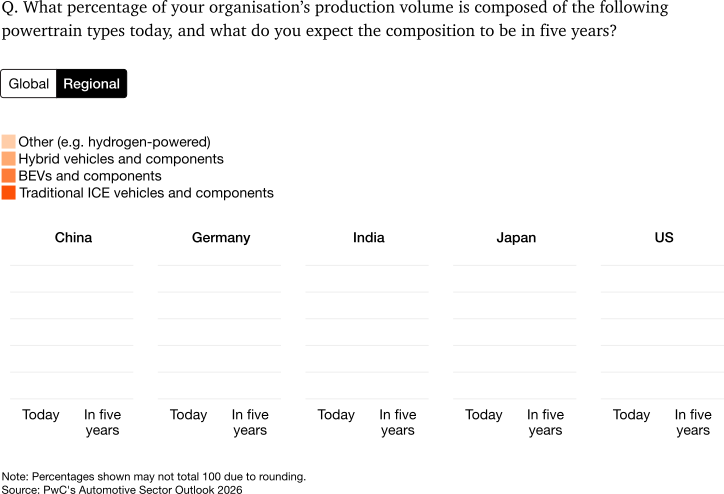
Within the next five years, respondents expect BEVs and their components will grow to an average 30% of global production, up from 18% today; the share of internal combustion engine (ICE) vehicles and their components is expected to fall from 60% to 41%. There are significant regional differences. In China, BEV share is expected to rise to 40%, while ICE share is expected to fall to 29%. In the US, by contrast, ICE vehicles are projected to continue to represent the majority of production in 2030 (51%).
The competitor shift
The customer shift
The product shift
The powertrain shift


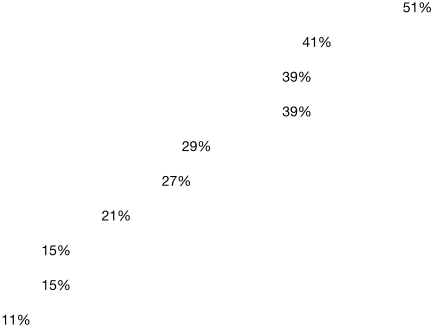
The vehicle is no longer defined primarily by the steel, plastic, and rubber that leaves the factory. Rather, in-vehicle software, digital services, and data analytics are becoming a primary source of value. The median use of advanced technologies across value chain activities is expected to rise from 47% today to 72% in five years. (For a deep dive into this topic, see “Software-defined vehicles.”) In our survey, 51% of respondents identify artificial intelligence as one of the three most important technologies for achieving their strategic goals over the next five years.
The competitor shift
The customer shift
The product shift
The powertrain shift


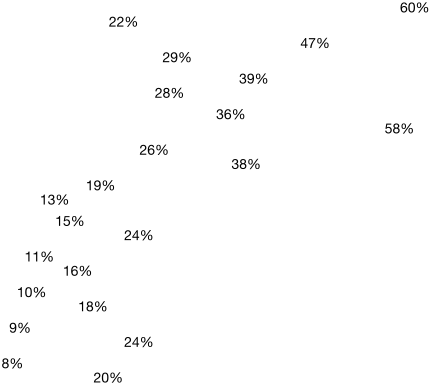
The industry’s traditional customer, the individual private purchaser buying through an independent dealer, is declining in importance as a strategic axis. Respondents expect 33% of revenue to come from new customers within five years, up from 21% today. OEMs, for their part, are pivoting towards commercial fleet operators, mobility service providers, and government purchasers as growth segments. When Tier 1 suppliers were asked to identify their top three revenue sources, the proportion identifying traditional OEMs fell from 77% today to 61% in 2030.
The competitor shift
The customer shift
The product shift
The powertrain shift


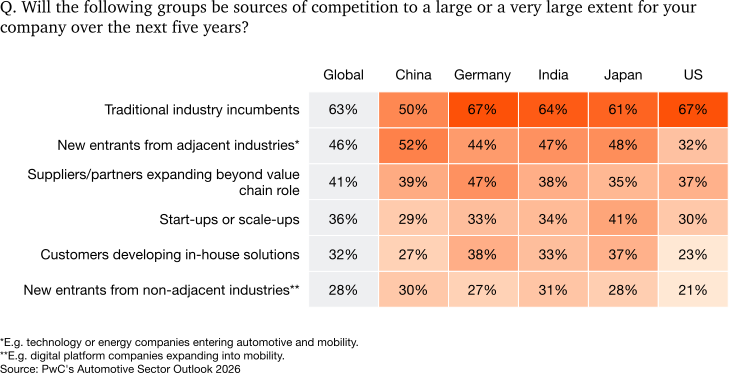
Traditional incumbents remain the dominant competitive force, at 63% globally, but they no longer define the boundary of the industry. The Xiaomi effect—a consumer electronics brand that delivered its first car in 2004 and its 500,000th in August 2026—is only the most visible signal of a broader structural shift. Some 46% of global respondents now cite new entrants from adjacent industries, especially technology and energy companies, as a source of competition over the next five years.
The competitor shift
The customer shift
The product shift
The powertrain shift