PAID FOR BY GOLD SERIES FROM PANTENE AND ROYAL OILS BY HEAD & SHOULDERS


Home
Growth
Product Guide
Repair
Nourishment
Moisture
Scalp Health
The distinctive, beloved coily curl patterns of highly textured hair — which evolved as a natural way to allow air circulation and regulate body temperature in warm climates in Africa — require unique care because of their unique structure. The solutions to common challenges, such as dryness and breakage, all trace back to hair maintenance and scalp health. To understand how to best care for natural hair, you must also understand what happens each time you wash it, comb it, pull it, stretch it, heat it or treat it.

Growth
Moisture
Scalp Health
Nourishment
Repair
Natural Hair
Topics
Product Guide

DO YOU EVER WONDER WHY YOUR HAIR GROWS SO SLOWLY? ARE YOU EVER SUSPICIOUS THAT IT DOESN’T GROW AT ALL?
Women might think their hair isn’t growing because their hair isn’t getting any longer, when in reality for most of us (with the exception of those with alopecia) it’s just breaking off. Coily hair is brittle, and can easily break when hair fibers aren’t healthy. Naturally curly hair fibers want to stay curly, and so are a little bit less resilient to manipulation. Damaged hair can become brittle to the point of snapping or breaking. When you extend or elongate hair fibers that have not been moisturized or nourished, the hairs have no plasticity, which means they can pop and snap (even detangled pieces of hair).
Challenge
It's crucial to remember that in order to promote healthy hair growth, you need to start with a healthy scalp. When a scalp is unhealthy, the hair fibers that emerge from it will be unhealthy, too.
How can you encourage the growth of healthy hair? By considering what exactly happens to your hair and scalp in between washes, especially considering the extended wash frequencies common in natural hair care. Symptoms such as irritation, product buildup and chemical imbalances all relate back to oxidative stress, which means your scalp needs to detox. That’s why you need to find products for washing and styling with formulas that not only make your hair fibers look healthy, but help restore balance to your scalp in the form of leave-on treatments, shampoos, conditioners and oils.
Protective styles can also help with growth. Because you’re not touching your hair or combing through it often, the strands are left alone, which allows for relatively undisturbed hair growth. Don’t forget to moisturize the hair under your protective styles, too.
Solution


MYTH:
“My scalp is flaky and itchy, because it’s too dry.”
The fungus Malassezia globosa exists on the scalp naturally, and is a part of hair’s unique scalp biome. But some scalps react to the presence of the fungus as if it’s not supposed to be there. The skin tries to protect itself by overproducing skin cells, which we see as flakes and dryness. Irritation, itchiness, flaking and redness can all be signs of a chemical imbalance on your scalp. How do you get that balance back? By using products that help remove buildup on the scalp and include zinc-based actives.
See Products Related To Growth


ZINC PYRITHIONE (ZPT)
CHEMISTRY SPOTLIGHT:
HAIR GROWTH TIPS FOR PROTECTIVE STYLES:
Protective styles can encourage growth, because your hairs are left alone to grow undisturbed. Remember that you must be delicate with your hair when you wear protective styles, extensions and weaves.


1
The traction that comes with protective styles, if done too forcefully, will cause your hair to break, and long term tension damage can result in hair loss.
2
It’s easy to damage fragile hairs along the hairline, because they aren’t as deeply rooted in your scalp as other hair fibers. Take care when you brush and lay your edges.
3
BACK TO TOP


NATURAL HAIR IS UNIQUE.

In partnership with Gold Series from Pantene and Royal Oils by Head & Shoulders, we’re exploring the science behind highly textured hair and the unique care it requires. Rolanda Wilkerson, or “Dr. Ro” as she’s known, is a senior beauty scientist at Procter & Gamble, where she
has worked in product development and formulation, scientific communications and consumer research for over 15 years. Her Ph.D. in organic chemistry, technical experience and passion for beauty are the foundation of her deep understanding of women and their hair care needs. Read on to learn about Dr. Ro’s advice for natural hair care and the science that supports it.

Growth
READ ON TO LEARN HOW TO PROMOTE HEALTHY HAIR GROWTH.
Happy Scalp Happy Hair
=
DR. ROLANDA JOHNSON WILKERSON, SENIOR BEAUTY SCIENTIST AT PROCTER & GAMBLE
ZPT combats the side effects of fungal presence on the scalp, which is a common challenge among people with highly textured hair. In fact, as Dr. Ro says, 50% percent of Americans experience problems with scalp health, but the percentage for Black women is about 77%. As a hair product ingredient, ZPT can diminish fungal presence to relieve itchy, dry and flaky irritation.
Zinc Pyrithione (ZPT)
SECTION I:


BACK TO TOP
TIPS FOR KEEPING YOUR SCALP HAPPY:
If your products feel too heavy and greasy on your hair and scalp, you can dilute them with water or opt for a liquid-based product, such as a hair milk or lightweight conditioner.
1
Frequent shampooing can strip your hair of nutrients and essential oils. Don’t wash your hair every day. Find a wash day cadence that complements your style routine.
2
Scalp massages stimulate blood circulation (which brings oxygen and nutrients to your scalp) and help to evenly distribute product to the roots of your hair.
3


MYTH:
“Using oils is a fix-all solution for my scalp issues.”
Not all oils are well-suited to moisturize scalp skin. In fact, some oils can clog pores so much that moisture and nutrients can’t be absorbed (even if they give your hair softness or shine). Switch out heavy oils and pomades with products that nurture your scalp. Essential oils in the right concentration, can help alleviate discomfort from challenges like eczema, psoriasis and stress; for example, peppermint oil has soothing characteristics, and tea tree oil has antimicrobial properties. Emollient oils like coconut can both keep your skin soft but also lock in moisture for your scalp and hair.

CHEMISTRY SPOTLIGHT:
Micellar Water
Micellar water cleanses skin gently by first breaking down product buildup and then lifting product off the surface of the scalp so that it can wash away easily. Because it’s not a harsh chemical, it won’t disturb your natural pH balance or remove nutrients that cultivate a healthy head of hair. When combined with glycerin, it acts as a hydrating agent that attracts moisture.


MICELLAR WATER
See Products Related To Scalp Health

You can’t care for your scalp if you underestimate the importance of wash days. Delivering nutrients to your skin is a vital step in any scalp care regimen, but it’s just as crucial to routinely cleanse your hair and scalp with a wash frequency that works for your curl pattern and style. Do you style your hair with a lot of product? Try using a water-activated scalp scrub before you shampoo your hair to remove product buildup. That way, the ingredients in your shampoo and conditioner can actually reach your scalp. In fact, your in-shower shampoos and conditioners play an important role in your scalp’s chemical balance. While you don’t want products to leave residue of your styling gels, creams and sprays, you also don’t want harsh ingredients like sulfates and silicones to strip your hair dry of the nutrients and oils it already has. For everyday care in between wash days, consider using a scalp cream that’s leave-in, lightweight and shields your scalp from irritation — especially if you wear a protective style.
Solution

Combat Product Buildup
EVEN IF YOU KNOW YOUR SCALP IS UNHEALTHY, THE SOLUTION ISN’T ALWAYS OBVIOUS.
LEARN MORE ABOUT WHAT YOU CAN DO TO KEEP YOUR SCALP HEALTHY AND BREAK OUT OF THE ITCH-AND-SCRATCH CYCLE.
It can be tricky trying to give your scalp all the nourishment it needs while also letting it breathe. It’s important to make sure your scalp skin is moisturized and nurtured, but product buildup can prevent your skin from detoxing. Without using products with the right ingredients in the right concentrations, you can put a lot of stress on your scalp. As every woman with natural hair knows, even if you don’t wear protective styles that expose the symptoms of scalp issues, you can feel when your scalp isn’t happy.
Scalp Health
SECTION II:
Challenge


BACK TO TOP
TIPS FOR DEEP MOISTURIZING:
Apply leave-on conditioners and other products when your hair is damp — but not drenched — because the strands can more easily absorb nutrients once wet.
1
Sleep on a satin or silk pillowcase, which won’t take moisture away from your hair as cotton pillowcases do.
2
Bag your hair in a warm towel or a shower cap when you have a conditioning mask on to trap heat around your hair, which boosts product absorption.
3


MYTH:
“If my hair has slip and shine, it’s moisturized.”
Gloss and shine aren’t necessarily signs of moisture. Some product ingredients merely sit on the surface of your hair because they don’t have a small enough molecular structure to penetrate the outer layer of each strand. What you want is a product that will evenly distribute moisture along each strand of your hair and also protect those strands from drying out.

CHEMISTRY SPOTLIGHT:

Histamine
Histamine is a chemical messenger that your immune system releases to maintain chemical and temperature equilibrium in your body. When used as a hair care ingredient, it can help your scalp and hair detox. And histamine isn’t only active on the surface of your hair; these molecules can penetrate your hair strands to help defend against damage to the DNA inside your hair follicles.


HISTAMINE
See Products Related To Moisture
Because curly hair is less porous than straight hair, it’s harder to keep hydrated. It’s helpful to provide moisture at every possible step of your hair routine, including when you shampoo on wash days. For some, that means eliminating shampoos from your routine entirely. “Co-washing” is the practice of washing your hair with a conditioner, rather than shampoo. It can be helpful for women who are concerned about stripping their hair of nutrients, especially if their method of styling requires frequent washing. When you’re done washing and detangling your hair, seal in your moisture with a product that forms a protective layer around your hydrated strands, such as a leave-in conditioning cream.
And remember, moisture doesn’t only come in the form of water. Your hair can absorb moisture from plant-based ingredients such as aloe vera, natural oils, such as jojoba, and fats, such as shea butter. When you use products with these ingredients, be sure to work them through your whole head of hair, section by section, to maximize the hydration benefits. Using your fingers is better than any brush or comb.
Solution

Shampoos Condition
CHARACTERISTICS SUCH AS SOFTNESS, SLIP AND SHINE AREN’T ALWAYS EVIDENCE THAT YOUR HAIR IS HYDRATED.
GET FAMILIAR WITH THE REAL INGREDIENT HEROES OF MOISTURE.
You can’t always gauge how healthy your hair is by looking at it. Internal and external factors contribute to your hair’s overall strength, resiliency and radiance. Some products are formulated to merely coat the outside of your hair instead of using ingredients that penetrate the strands and deliver lasting moisture. Although physical characteristics can fool you, moisturizing the right way can protect your curls so they feel as good as they look.
Moisture
SECTION III:
Challenge


BACK TO TOP
TIPS FOR PROTECTING YOUR HAIR FROM HEAT TREATMENTS:
Typically, hot irons set between 200 and 300 degrees Fahrenheit is a safe temperature range for highly textured hair. Your goal: Find the lowest temperature setting that still allows you to get your styling done efficiently.
1
When you blow your hair out, use a downward motion, so that the cuticles (the outer layer of each strand) will lay flat.
2
Follow the “one and done” hot iron rule: Pass over each section of your hair only once. If it takes more than one pass to achieve the style you want, try a slightly higher temperature.
3


MYTH:
“Heat styling gone wrong will fry my hair.”
Heat styling does not “fry” hair as many people think. Rather, it can boil the water in your hair and damage the surface of the hair. When those water molecules are heated to a certain temperature, they form bubbles along your strands of hair, and those bubbles cause breakage. Because water acts as a heat insulator, it increases the stress that heat tools put on your hair. To avoid this boiling, always take care that your hair is bone dry before you apply any heat manipulation to it.

CHEMISTRY SPOTLIGHT:

Alcohol
When you think about rubbing alcohol or liquor, drying properties come to mind. But certain alcohols can actually moisturize your hair. Emulsifying alcohols, such as stearyl and cetearyl, have fatty acids which can help to hydrate, lubricate and lock moisture into your hair. They can also smooth down the damaged outer layer of your hair strands to achieve slip, shine and softness.


ALCOHOL
See Products Related To Nourishment

It’s important to use products that restore hair health to its natural state in between treatments. Applying a thermal heat protectant to your hair before applying heat will protect the structure and nutrients in your hair so that your curls can bounce back when you wash out your style. On wash days, use a deep-moisture product to balance out the dryness that heat can cause. Leave-in conditioners and puddings are both great options for reactivating your curl pattern while you wear it natural. However, if you find that your leave-in treatments and products feel heavy on your curls, you should dilute them with water so that the weight doesn’t pull down on their coily structure while they recover. If you regularly style your hair using hot tools, incorporate a weekly mask into your hair routine.
It’s also important to evenly distribute heat along your hair strands. Irregular heat application will not only result in an uneven texture for styling but also an uneven texture for your hair in its natural state.
Solution

Beat The Heat
ANYONE WHO STYLES THEIR HAIR WITH HOT TOOLS KNOWS THAT HOT IRONS OFTEN PRESENT CHALLENGES. WORRIED YOUR HAIR IS TOO DRY? TOO FRAGILE?
READ ON TO LEARN HOW YOU CAN NOURISH YOUR CURLS.
Repeated heat treatments and other processes, such as color dying, can damage hair to the point that the natural curl pattern cannot be restored or breakage occurs. Heat styling is designed to break down the bonds that give curly hair its structure and shape, but too much heat — whether in temperature or styling frequency — can irreversibly break those bonds. Once those bonds are loosened beyond repair, the only way to get your curls back is through new growth.
Nourishment
SECTION IV:
Challenge

BACK TO TOP
TIPS FOR CARING FOR DAMAGED HAIR:
Knots can cause stress on your hair, as can the brushes you use to detangle them. Your fingers are the most gentle tool, or you can try a wide-tooth comb.
1
Using a microfiber towel to dry your hair will cause less friction than other towels, and therefore won’t disturb your curl pattern.
2
Massaging coconut oil or even conditioner on your hair before swimming in a pool or at the beach can help protect your hair from chlorine and saltwater.
3


MYTH:
“There’s nothing I can do about my split ends.”
There are many ways to care for split ends, and the more methods you use the more effective each will be. If you struggle with damaged split ends, it’s best to minimize or avoid heat styling, which will only add more stress to your hair and lead to further damage. If you cut your hair routinely, don’t skip any trims. If you don’t trim your hair regularly, every 12 weeks is a good place to start. It’s also a good idea to incorporate leave-in conditioners into your weekly hair routine.

CHEMISTRY SPOTLIGHT:
Coconut Oil
Coconut oil is rich with vitamin E, which has antioxidant properties that is known to help repair damaged follicles, as well as fatty acids that reduce protein loss. This oil’s molecular structure allows it to penetrate strands and may protect them from environmental stressors, such as smoke, wind and ultraviolet rays from the sun. It’s a safe product ingredient for everyday use.


COCONUT OIL
See Products Related To Repair
Chemical relaxing, if not done mindfully, can strip hair fibers of moisture, leaving them frail and dry. Deep conditioning tools (in the form of masks and leave-in treatments) are important for restoring that lost hydration. If your hair is damaged, it’s time to re-evaluate your hair care regimen. That could mean a big chop, limiting how often you style your hair using heat and chemical processes, or simply modifying your everyday hair care routine with the addition of a weekly deep-conditioning mask. The less you process your hair, the better. When it comes to damage control and repair, the more often you condition and treat your hair with products that enrich the follicles and scalp, the quicker and stronger you’ll see your hair rebound from damage. As with any moisture-focused routine, co-washing is another way to help minimize chemical imbalances that leave your hair dull and brittle.
Solution

Extra Lye, Extra Dry
IF YOU TREAT YOUR HAIR WITH CHEMICAL RELAXERS, YOU CAN’T EXPECT IT TO BEHAVE THE SAME AS IT DOES IN ITS NATURAL STATE.
READ ON TO LEARN HOW YOU CAN MANAGE DAMAGE DONE TO OVER-PROCESSED HAIR.
Chemical relaxers break down chemical bonds that permanently change hair structure to straighten curls. When these bonds are broken, processed hair loses some of its natural elasticity and becomes much more fragile and brittle. Because chemical manipulation changes the structure of a curl pattern, relaxers — such as sodium hydroxide and calcium hydroxide — leave natural hair vulnerable to damage that usually comes in the form of breakage and split ends.
Repair
SECTION V:
Challenge


SECTION VI:
GOLD SERIES
Sulfate Free Shampoo

Product Guide
ROYAL OILS
Instant Soothe Scalp Elixir
ROYAL OILS
Seal & Prep Moisture Milk
ROYAL OILS
Moisture Renewal Conditioner
Growth


Scalp Health
ROYAL OILS
Pre-Shampoo Build Up Remover


ROYAL OILS
Daily Moisture Scalp Cream
ROYAL OILS

Moisture Boost Shampoo

ROYAL OILS
Water Activated Scalp Scrub
Moisture
GOLD SERIES
Moisture Boost Shampoo


GOLD SERIES
Hydrating Butter-Creme
GOLD SERIES

Moisture Boost Conditioner

ROYAL OILS
Moisturizing Co-Wash
Nourishment
GOLD SERIES
Instant Nourishing Spray


GOLD SERIES
Curl Defining Pudding
GOLD SERIES

Thermal Heat Protector

GOLD SERIES
Triple Care Braid Cream
Repair
GOLD SERIES
Deep Hydrating Co-Wash

GOLD SERIES
Repairing Mask Sachet
GOLD SERIES

Split Ends Treatment

GOLD SERIES
Intense Hydrating Oil


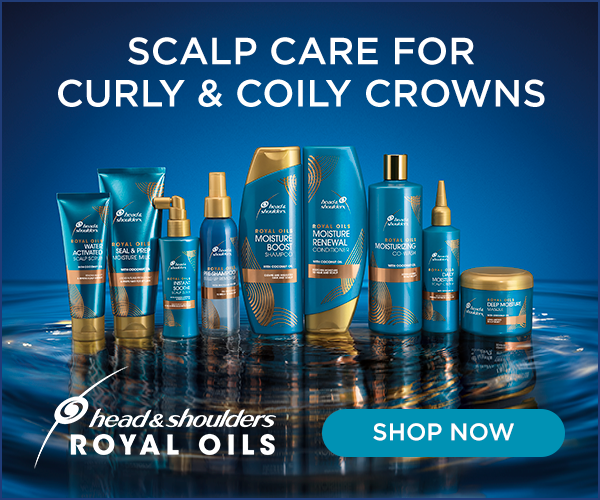
There is a vast ecosystem of shampoos, conditioners, cremes, oils, masks, milks, puddings and sprays for highly-textured hair. Here’s a guide that helps to narrow down the list, featuring products from Royal Oils by Head & Shoulders and Gold Series from Pantene, formulated especially for natural hair.

The Gold Series collection provides deep moisture to strengthen and protect your hair from within. Created by Black PhD’s and scientists, Gold Series works better because it’s made better.
For visibly healthier hair, start at your scalp with the Royal Oils collection, specifically designed for curly and coily crowns. Achieve a healthier scalp and healthier hair in just 3 weeks.
This article was paid for by Gold Series from Pantene and Royal Oils by Head & Shoulders and co-created by RYOT Studio. HuffPost editorial staff did not participate in the creation of this content.
FROM GOLD SERIES AND ROYAL OILS:
BACK TO GROWTH
PRODUCTS FOR
PRODUCTS FOR
PRODUCTS FOR
PRODUCTS FOR
PRODUCTS FOR
BACK TO SCALP HEALTH
BACK TO MOISTURE
BACK TO NOURISHMENT
BACK TO REPAIR


BACK TO TOP
ART CREDIT: RYOT STUDIO / GETTY IMAGES


SELECT A TOPIC TO READ MORE
BACK TO TOP


2020
Culture
Shifters