
Seerist Event Report
SCroll down to explore
17th BRICS Summit
6-7 July 2025
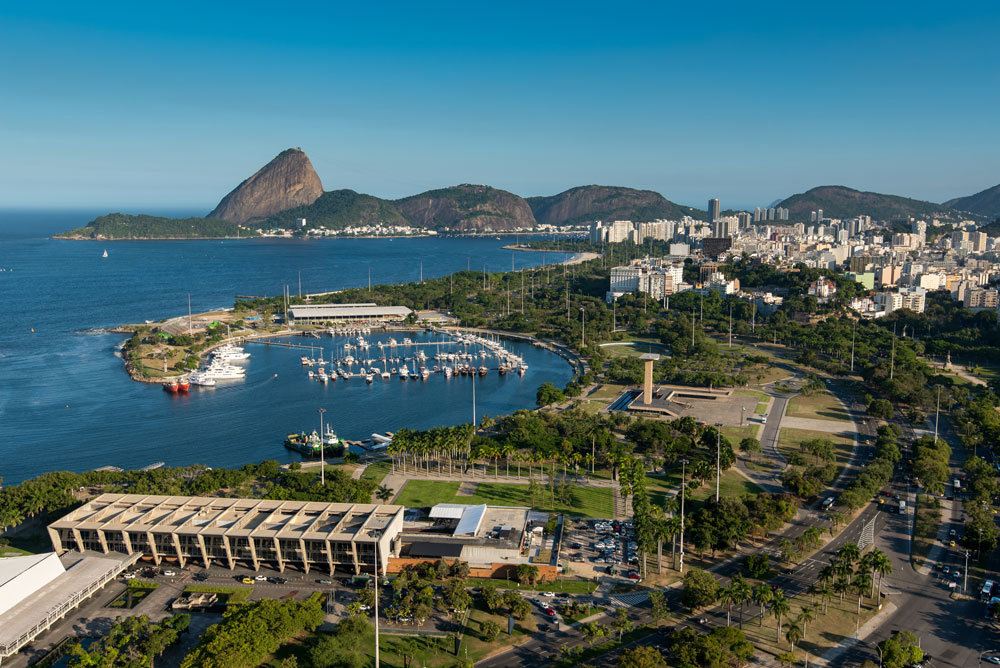
Rio de Janeiro
Event Overview
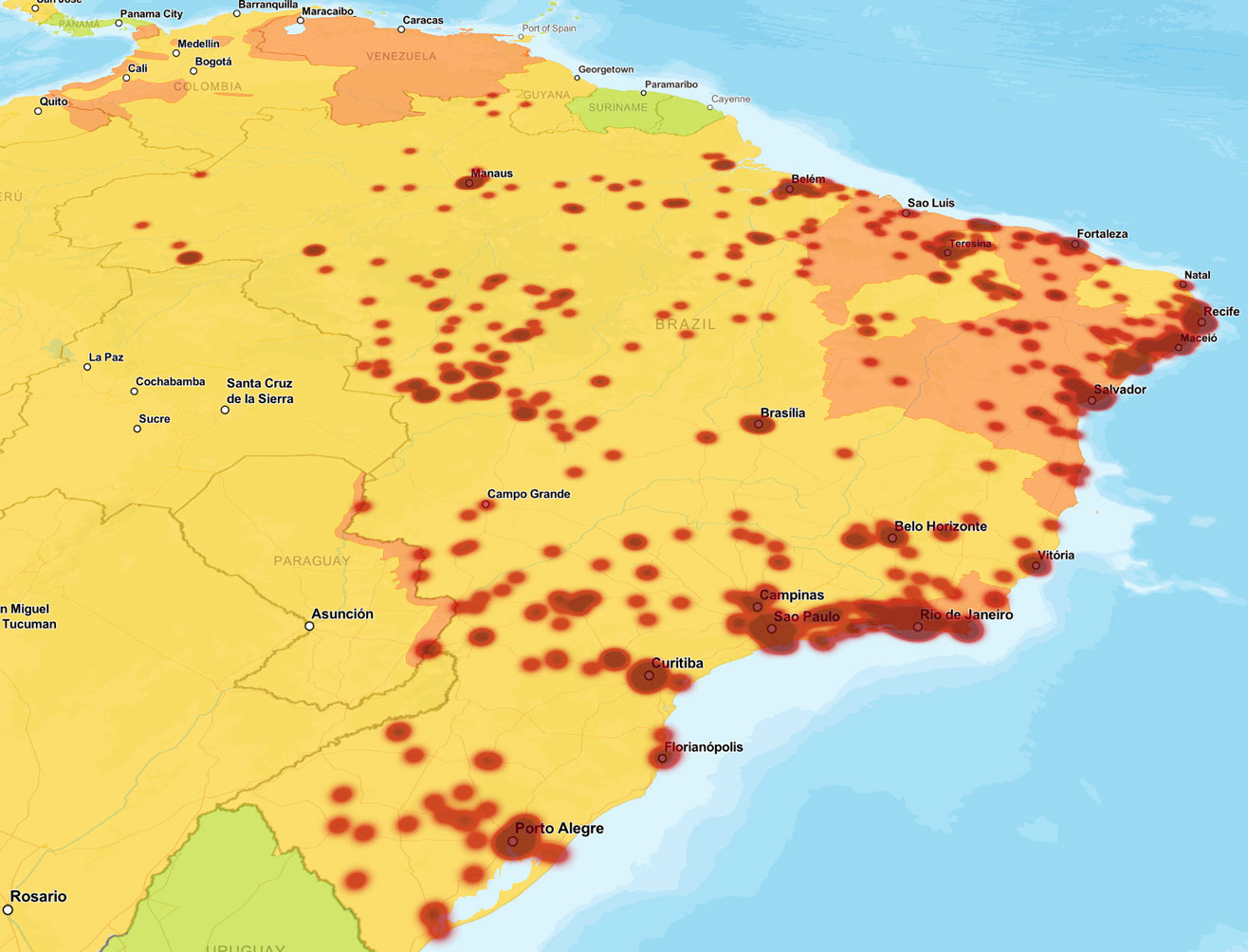
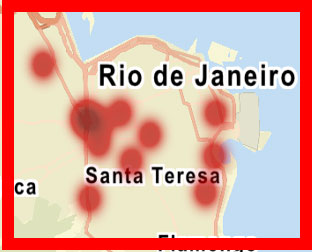
Heatmap of Verified Events (VE) recorded in Brazil between 23 June 2024 – 23 June 2025�
The annual BRICS Summit will be held on 6-7 July 2025 in Rio de Janeiro, with the attendance of the heads of state of 10 member countries, namely Brazil, Russia, India, China, South Africa, Egypt, Ethiopia, Indonesia, Iran, and the United Arab Emirates. The summit will be the first for Indonesia since its induction as a full member state in January 2025. �
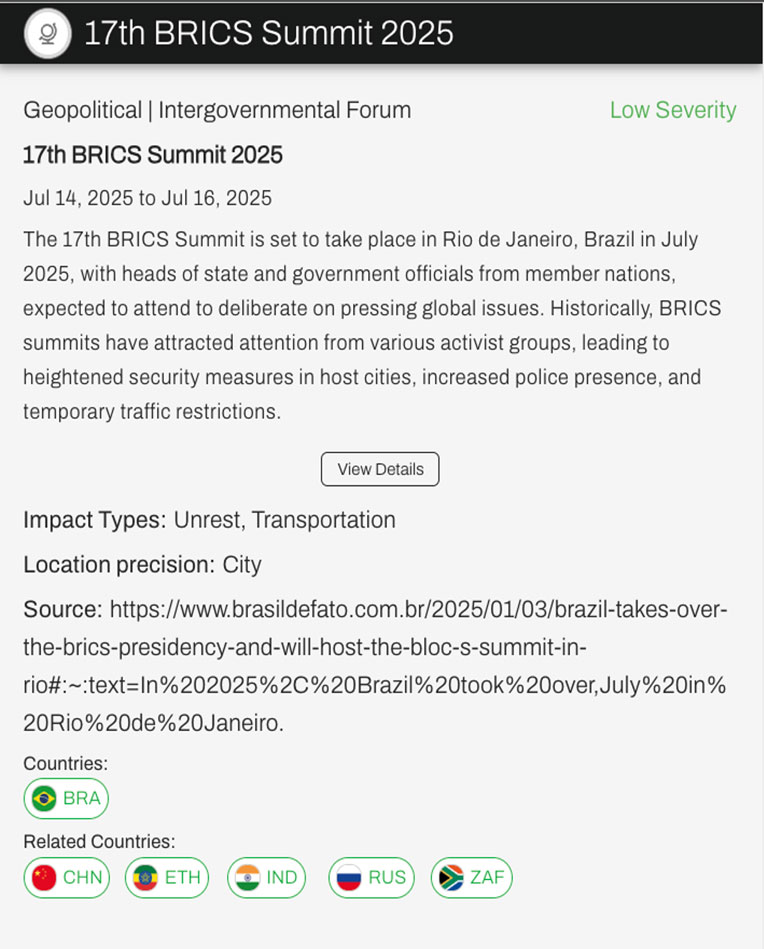
The 17th BRICS Summit will be chaired by Brazilian President Luiz Inácio Lula da Silva, under the motto “Strengthening Global South Cooperation for More Inclusive and Sustainable Governance”. �
Core priorities for the summit include, cooperation on health projects among member states; trade, investment and finance; climate change; artificial intelligence (AI) governance; multilateral peace system and security architecture; and institutional development.�
Due to the high-profile nature of the summit and its attendees, security will be heightened in the area with road closures likely to be implemented near BRICS meetings to control traffic and crowds.
1 of 4


2 of 4
3 of 4
4 of 4
Source: Seerist
The following report uses Seerist features to provide an assessment of the security landscape in Brazil and Rio de Janeiro ahead of and during the BRICS Summit.�
Rio de Janeiro
The Pulse AI History and Trendline in Rio de Janeiro shows that over the past 60 days, stability has ranged between 63.9 and 69.9 points. Seerist’s seven-day Pulse forecast predicts a decrease in stability with scores anticipated to fall between 62.9 and 67.4.�
The 17th BRICS will be held in Rio de Janeiro between 6-7 July, under the theme "Strengthening Global South Cooperation for more Inclusive and Sustainable Governance."�
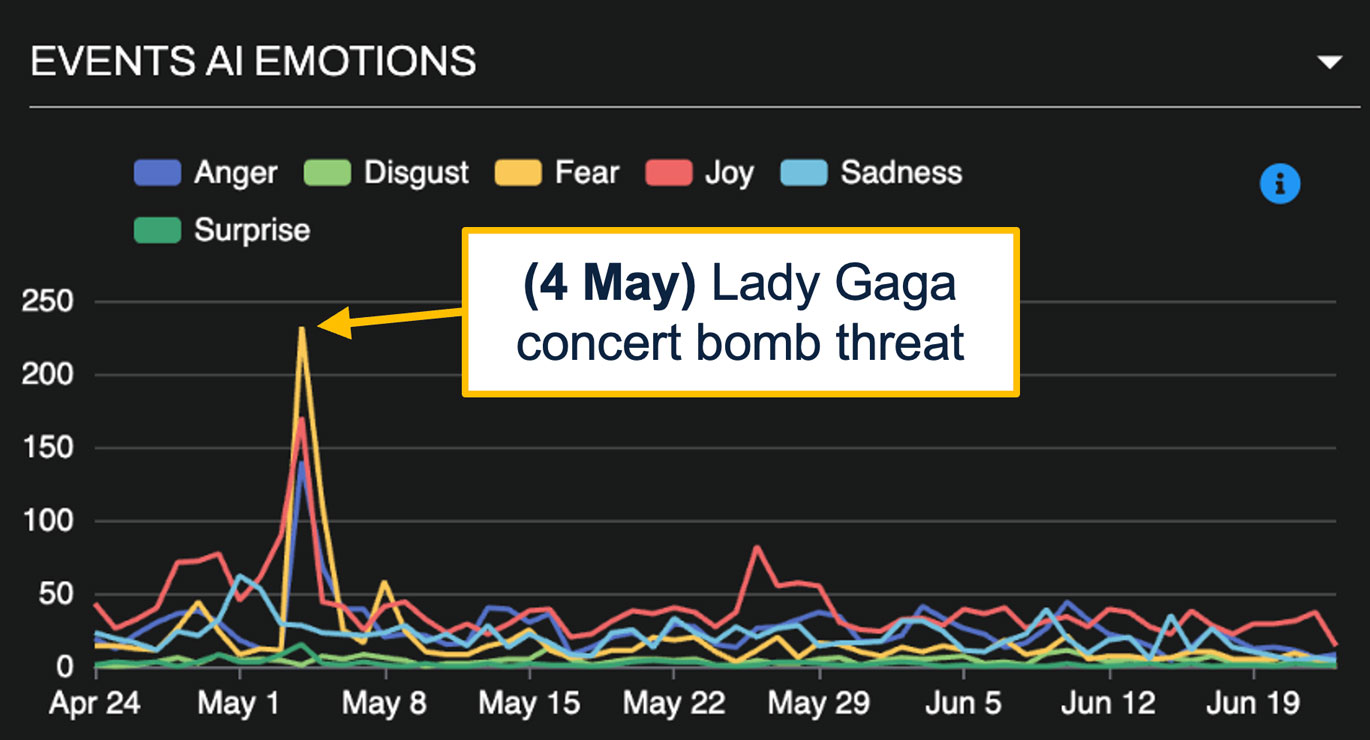
Seerist EventsAI records levels of fear, joy, and anger depending on the way the incident has been portrayed.�
Rio de Janeiro PulseAI Score
Emotion: Joy
Emotion: Fear
Emotion: Anger
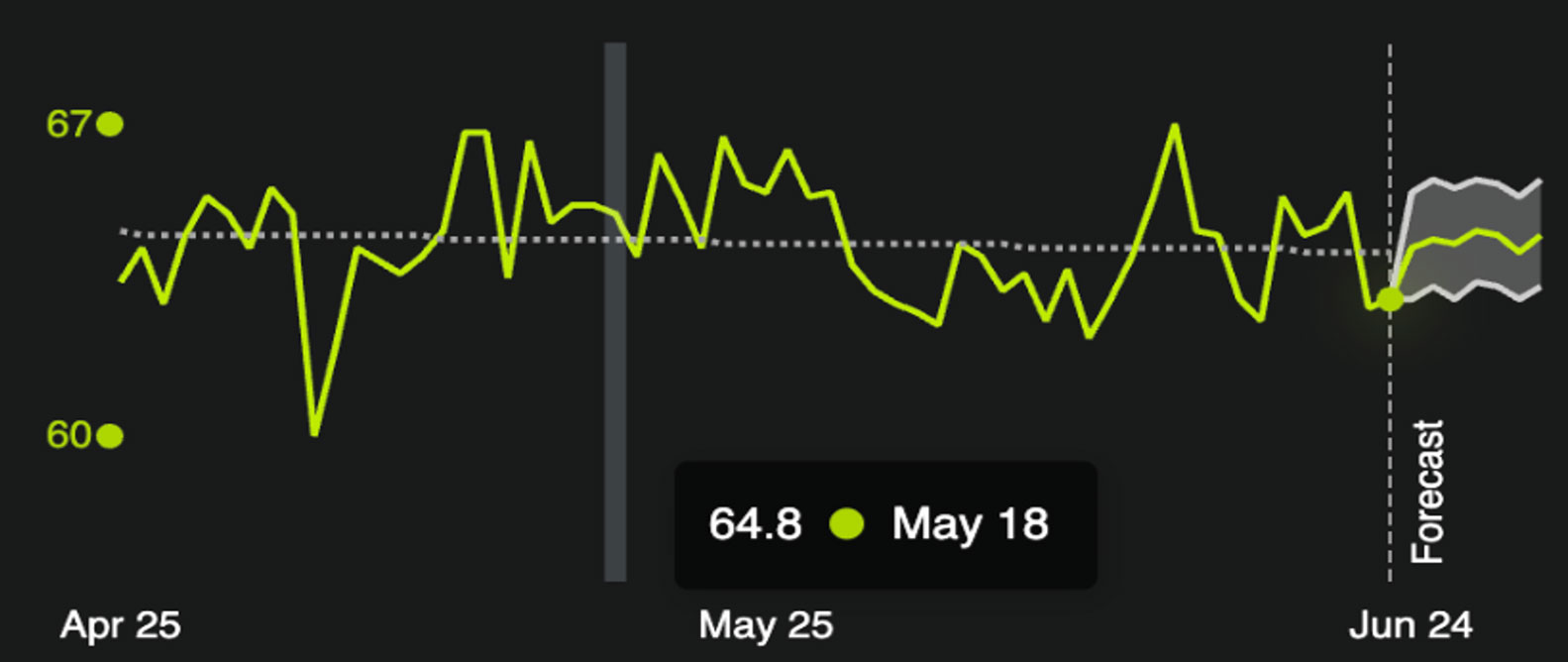

Rio de Janeiro Pulse History and Trendline�


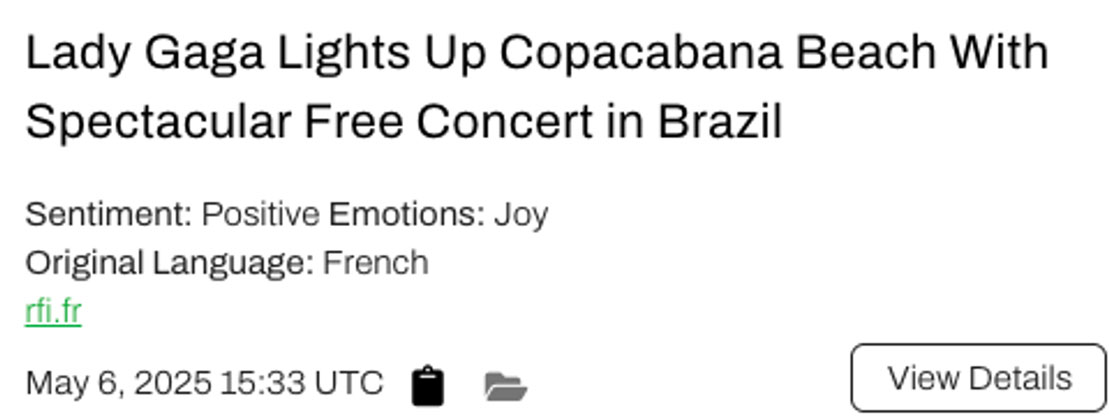
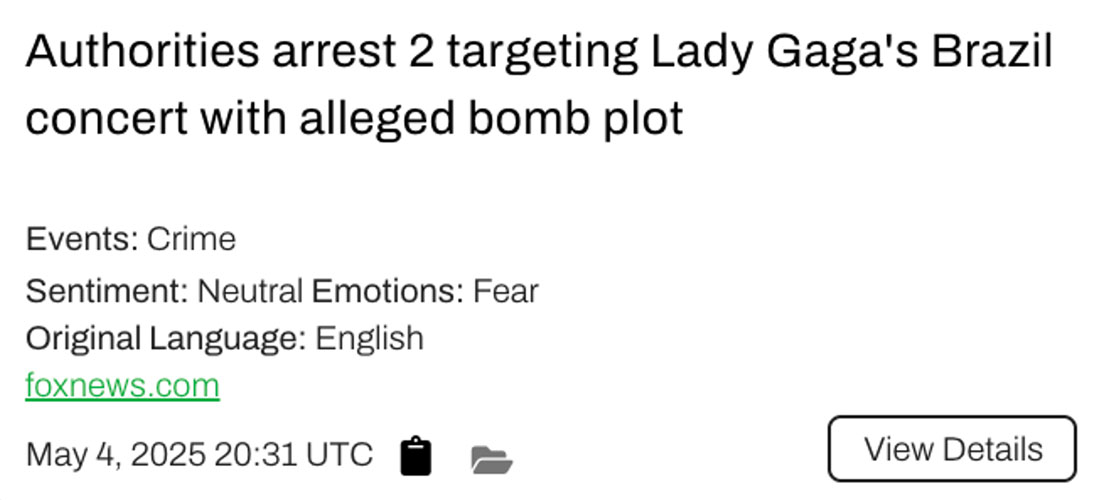
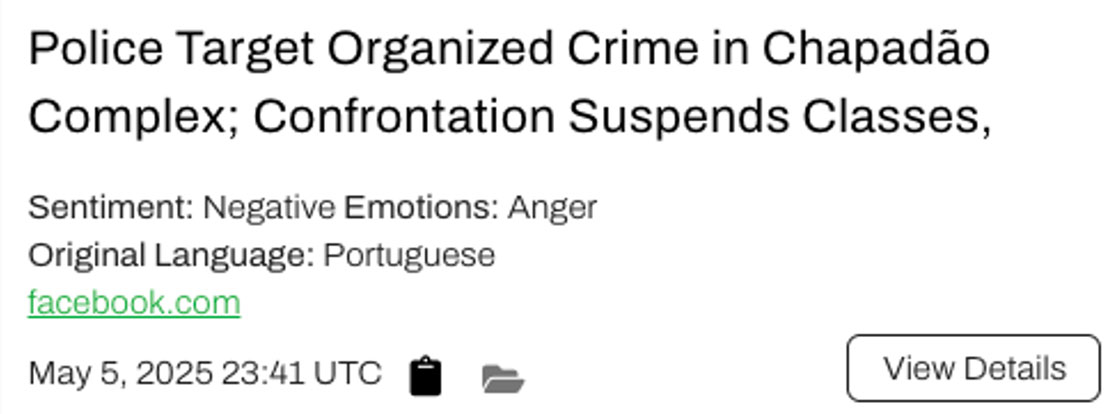
Seerist recorded a sharp spike in negative public sentiment in Rio de Janeiro on 4 May, after authorities thwarted a bomb threat at a Lady Gaga concert. Negative sentiment remained consistent till 9 May and gradually decreased after.�
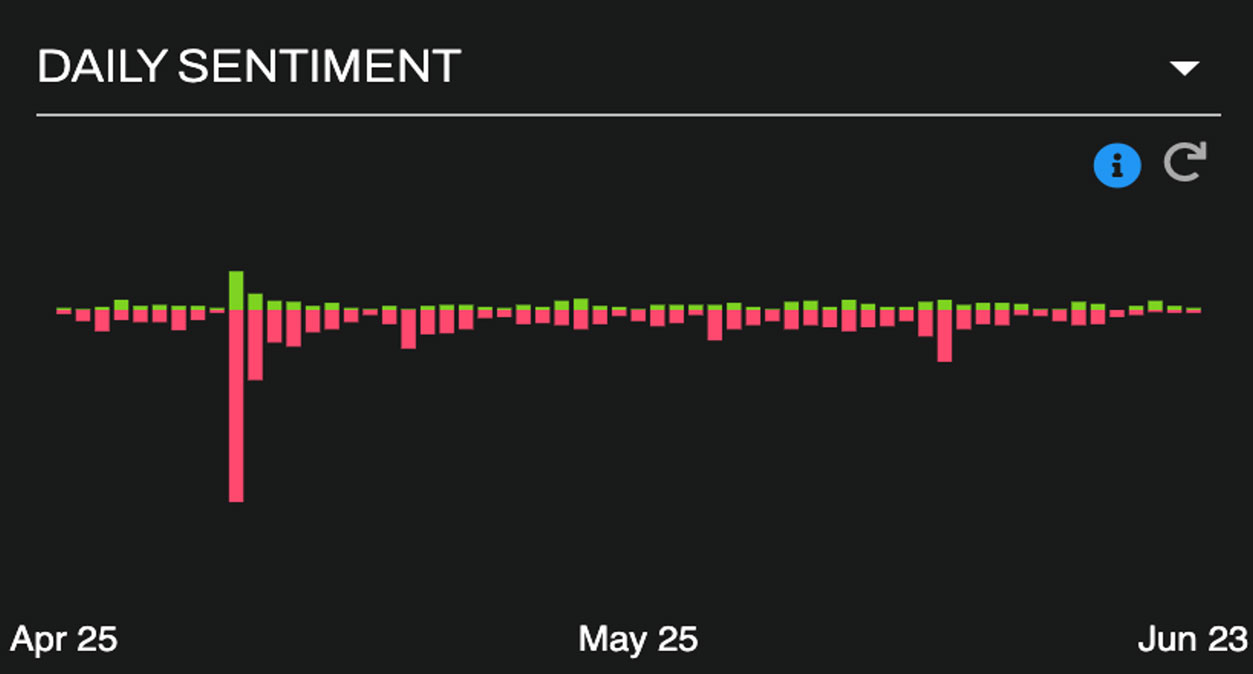
Events AI Sentiment shows public sentiment across Rio de Janeiro. �
EventsAI Emotion

A spike in Fear, Joy, and Anger emotions was also observed on 4 May, coinciding with the bomb threat at a Lady Gaga concert.�
EventsAI Sentiment

Seerist Events AI Emotion uses natural language processing to identify and categorize emotions expressed in textual data. �
CITY OVERVIEW
Rio de Janeiro
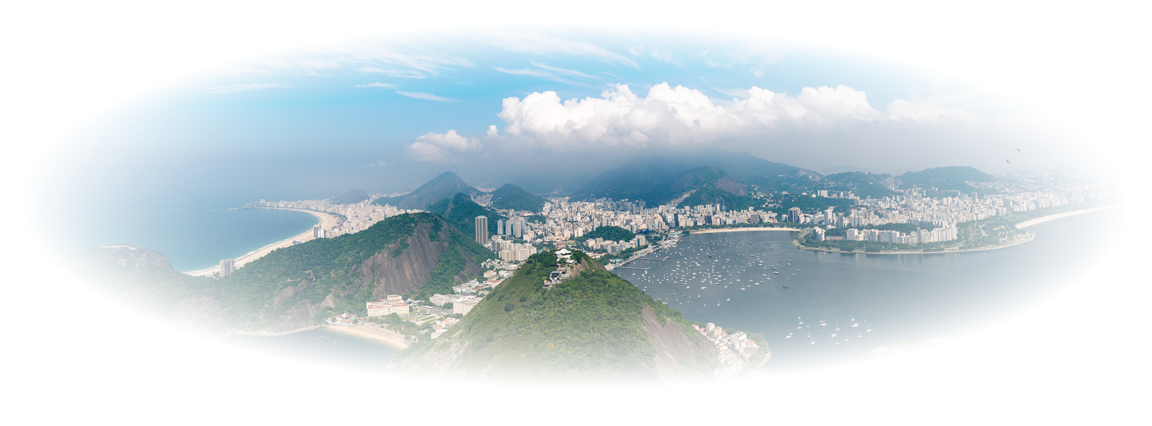
Rio de Janeiro is Brazil’s second-most populous city, with the country’s second-largest economy. It is the capital of Rio de Janeiro state and was the national capital from 1763 to 1960, when it was replaced by Brasília. Many companies set down offices in the city, which holds the second-largest amount of registered businesses, only behind São Paulo (São Paulo state). As Brazil’s top tourist destination, the city often hosts international business, entertainment and sporting events.�
CITY PROFILE
Source: Seerist
Crime
The primary security risk for travellers in Rio de Janeiro is opportunistic crime such as pickpocketing and bag snatching. Street robberies do occur and criminals are often armed and prepared to use violence if victims show any resistance. Most serious violent crime is confined to the favelas and North Zone of Rio de Janeiro, which are rarely frequented by foreign visitors. There are also “arrastões”, or flash mob robberies, where groups of robbers, usually young people, swarm a popular destination, rob everyone found there, and disappear within a few minutes. Travellers should be cautious of scams such as credit card fraud and ATM skimming.
Kidnap
Kidnapping for ransom takes place sporadically in Rio de Janeiro. Kidnappers usually target middle-class locals, including businesspeople and their economic dependants, but foreigners are occasionally targeted for their perceived wealth. Travellers are particularly susceptible to express kidnapping, which typically involves a brief abduction – usually lasting only a few hours – of an individual, who is forced with withdraw funds from ATMs and surrender their valuables. Kidnap gangs are also known to utilise an instant payment platform introduced by the Central Bank of Brazil in 2020 called PIX, which enables criminals to obtain higher amounts of cash than from ATMs. ��
Unrest
Protests, demonstrations and strikes occasionally occur in Rio de Janeiro, with regular reports of arrests and clashes between police and protesters resulting in transport disruption. Peaceful events can turn confrontational and escalate into violence suddenly. Police are known to regularly use rubber bullets and tear gas to disperse protesters, with the effects of tear gas felt several hundred metres beyond the immediate site of demonstrations. The most common protest locations are situated in the downtown areas of Cinelândia (Praça Floriano) and Central do Brasil, in addition to Copacabana waterfront (Atlântica Avenue) and Palácio Guanabara
Crime
Kidnap
Unrest



Take standard precautions to mitigate the risk of petty and street crime. Travellers should dress modestly and avoid displaying expensive items, such as cameras and mobile phones. Travellers should also stay vigilant and remain aware of their belongings.
1 of 3
Use ATMs located inside banks, hotels or malls where possible, as criminals are less likely to approach or tamper with these machines. Check for suspicious devices attached to credit card readers. Regularly monitor financial statements for suspicious transactions. Avoid paying with cards in non-reputable businesses.
2 of 3
Protests occasionally create mobility restrictions and incidental security threats (particularly in the Copacabana waterfront). Avoid large gatherings as a precaution, and do not stop to watch or photograph protests.�
3 of 3


Personal Safety

Source: Control Risks
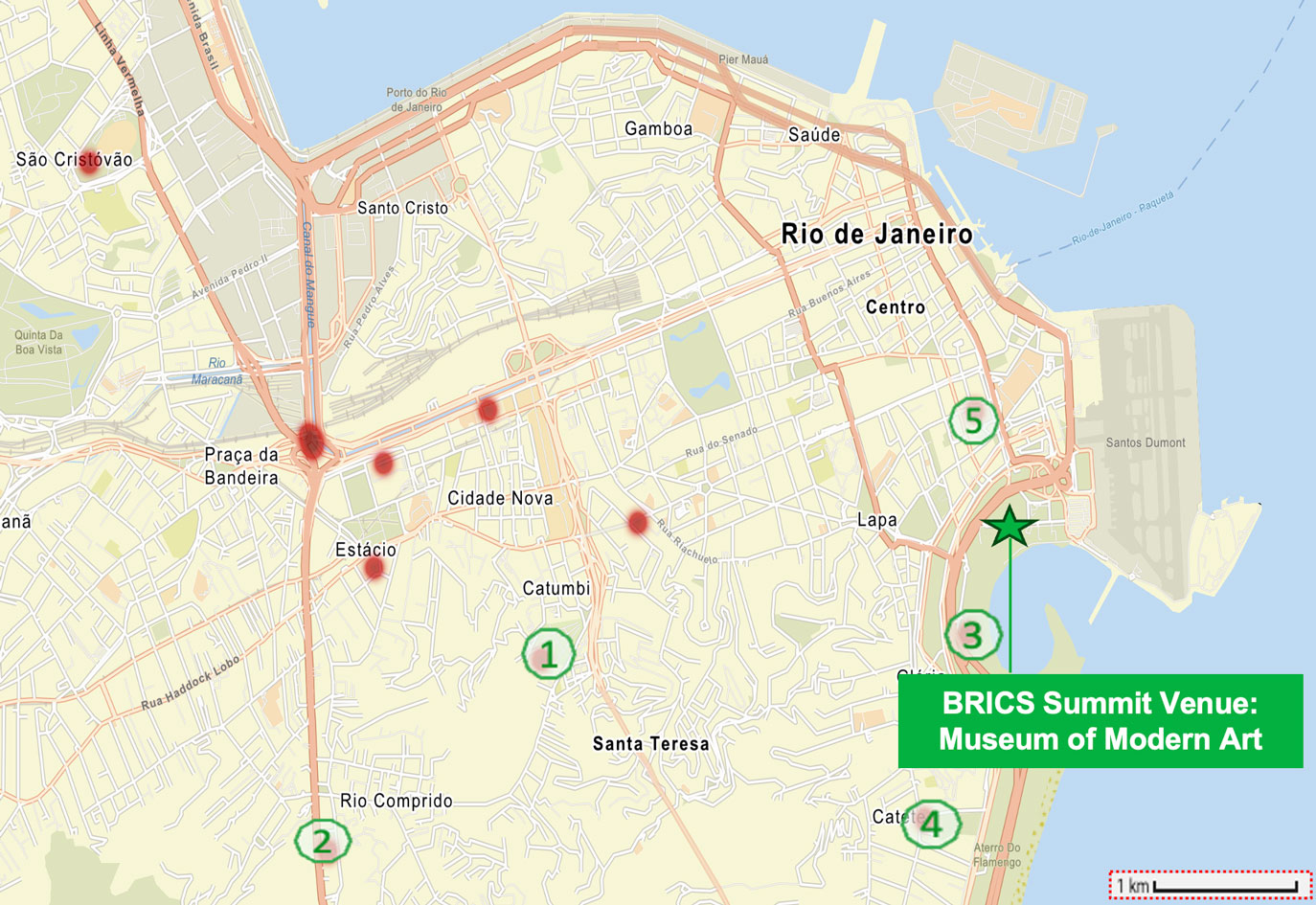
Verified Events near the Museum of Modern Art
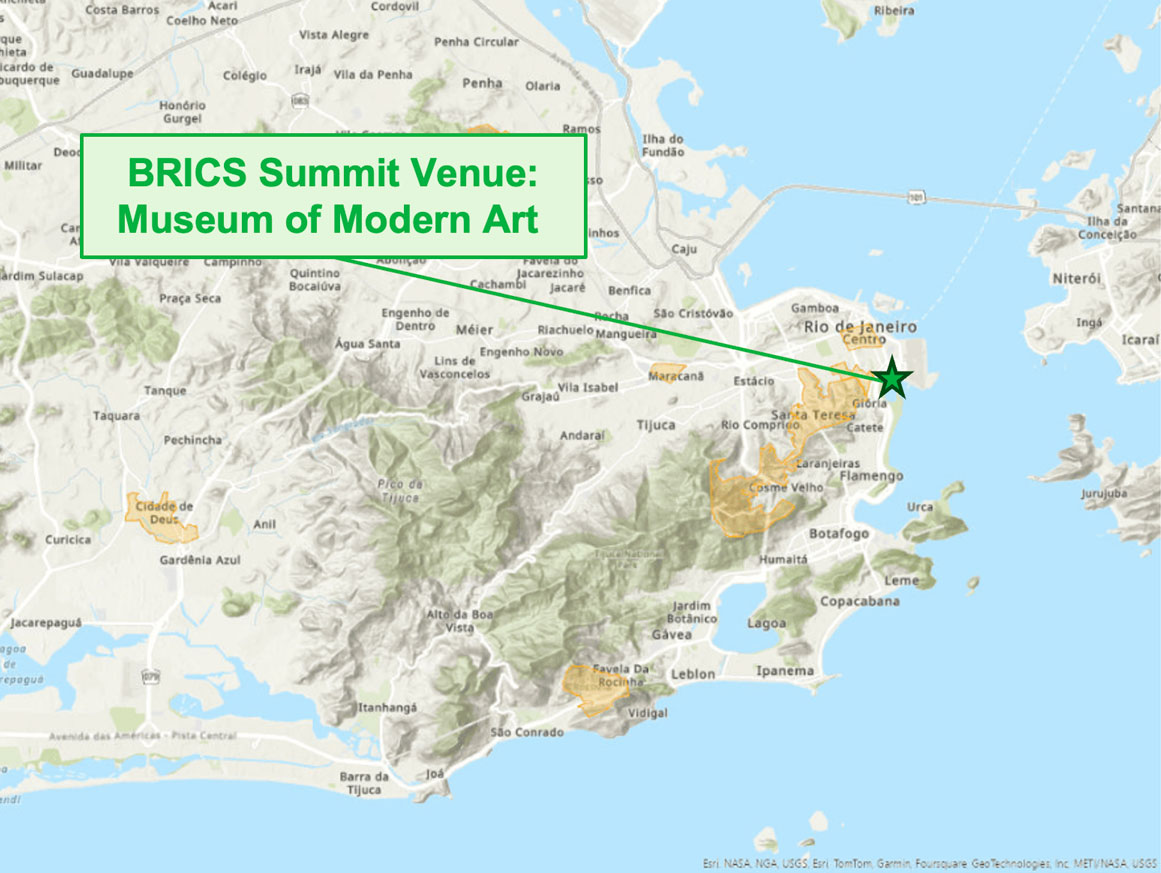
The venue for the BRICS Summit, the Musuem of Modern Art (MAM), can be found in Pistóia Park in the Glória neighbourhood of the city. The venue is close to many cultural buildings and adjacent to Santos Dumont Airport (which services only domestic routes).
While isolated incidents of unrest and violent crime have been recorded within 1km of MAM in the past year, the immediate area (1km) is not a hotspot for crime or unrest events.
However, areas less than 2km away, such as Santa Teresa and parts of Centro, are areas with elevated security threats. People are advised to take additional precautions if visiting these areas.
venue focus
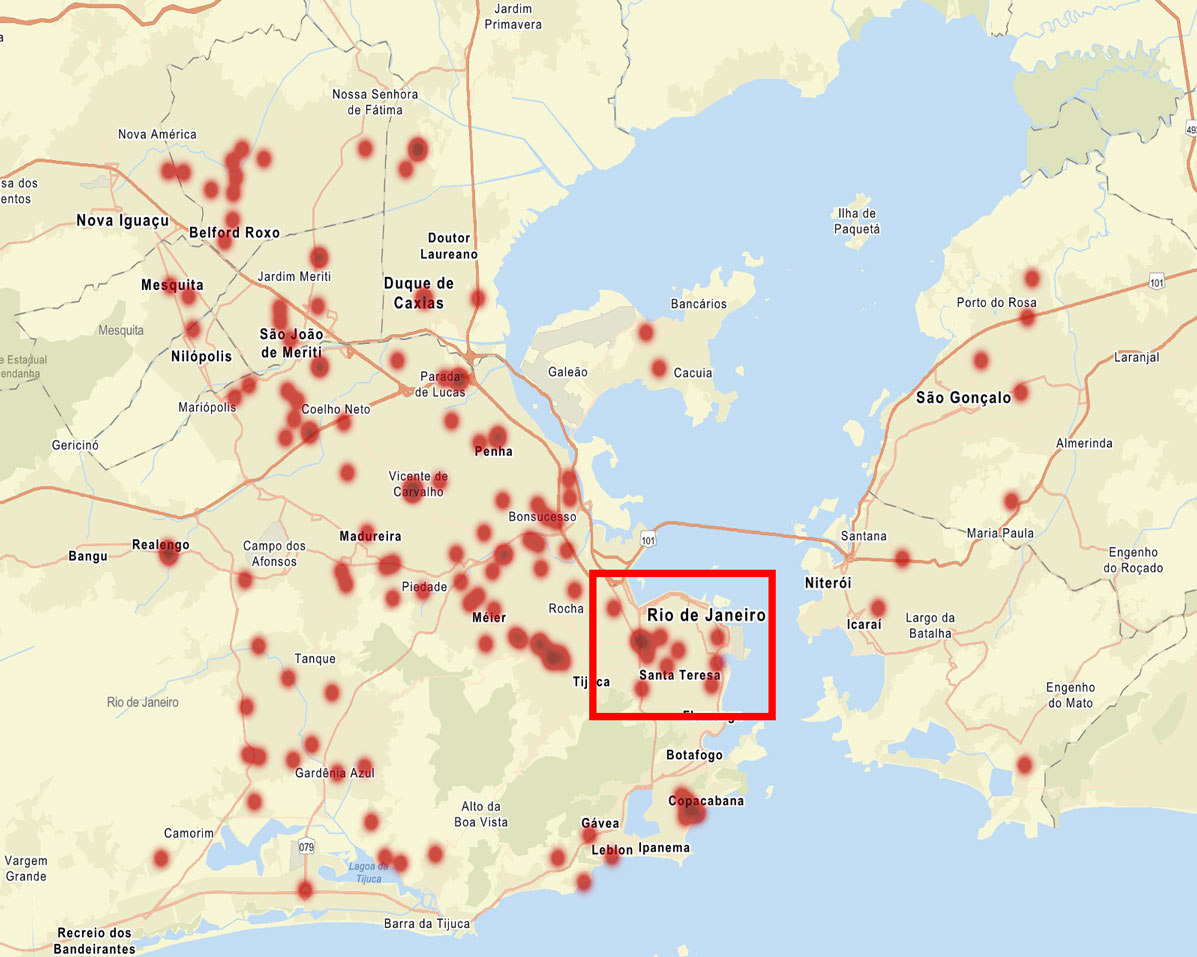
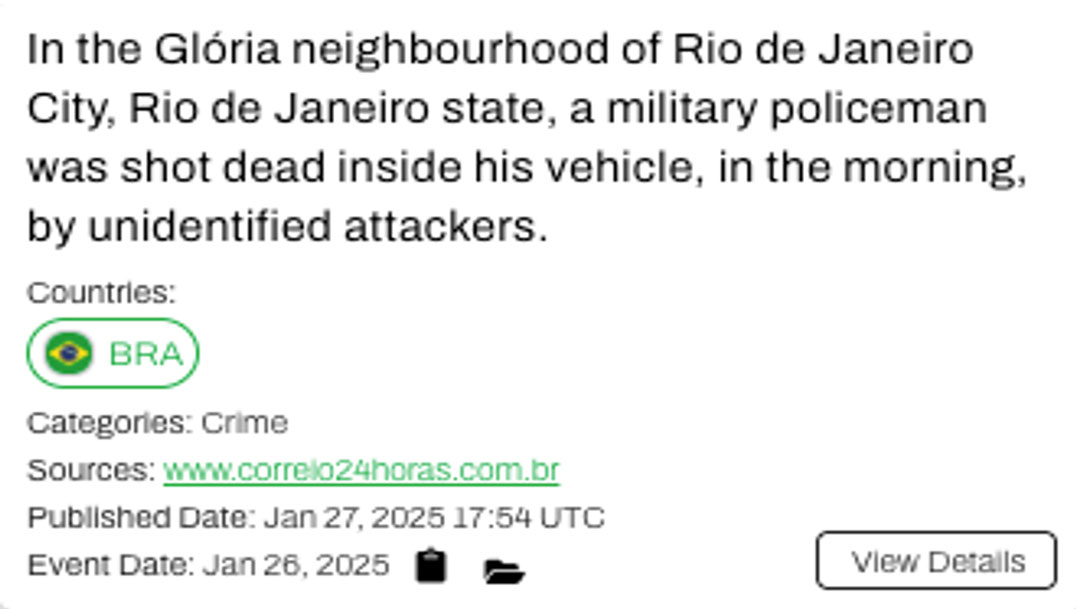
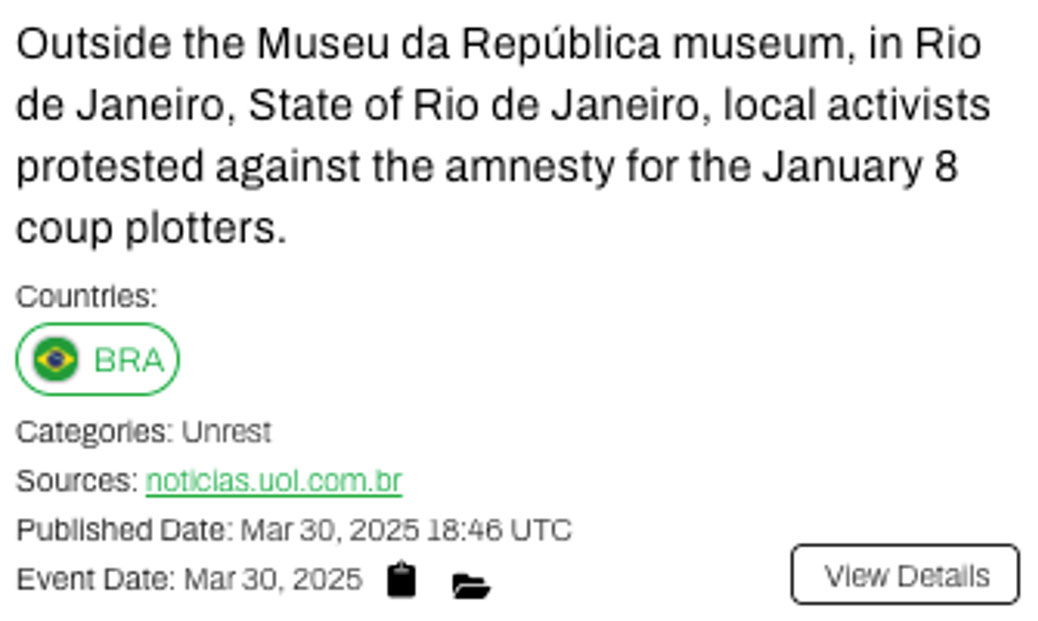
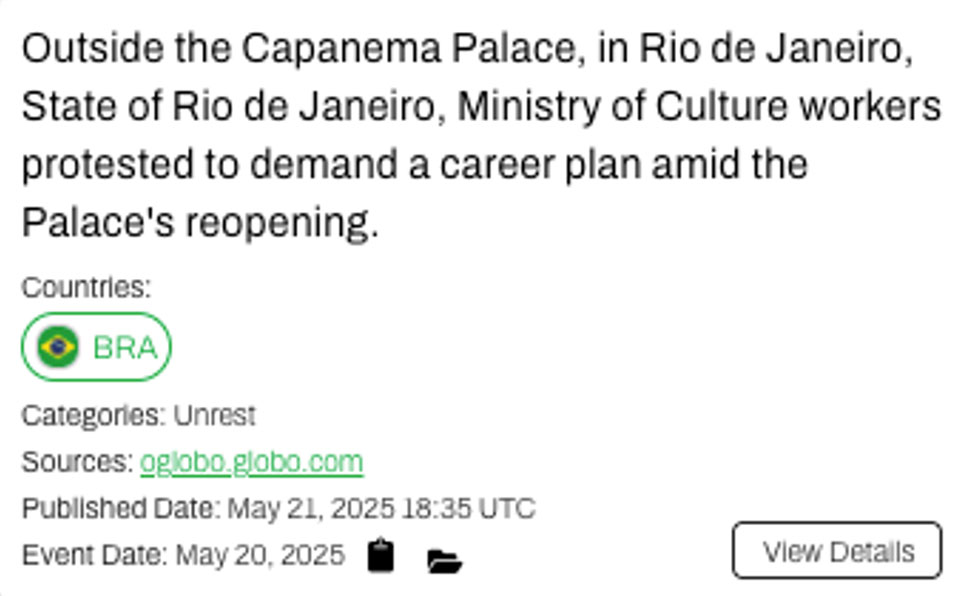
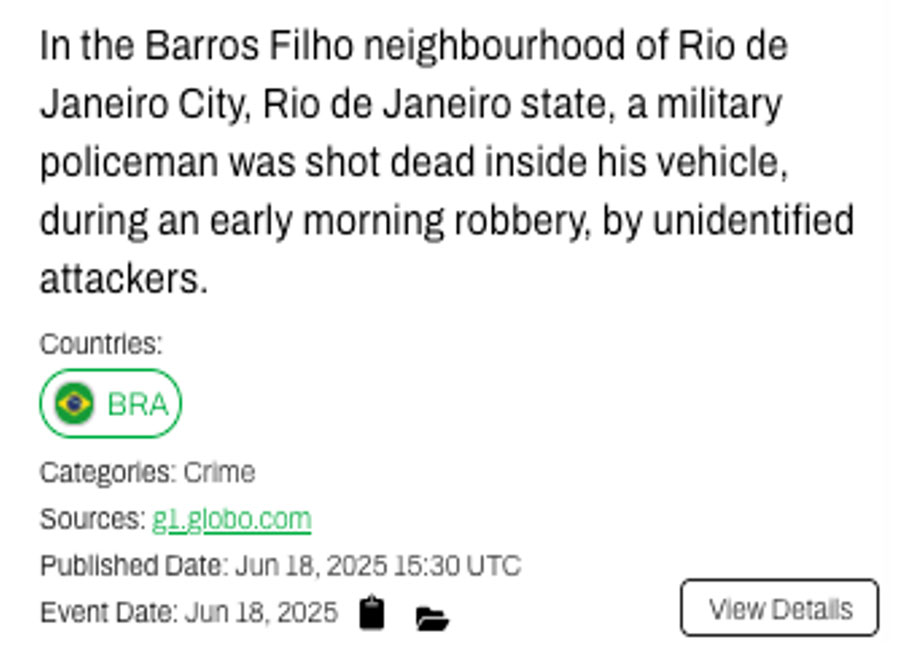
The above heatmap of Verified Events (VE) shows all verified crime, unrest, and terrorism events in Rio de Janeiro between 1 June 2024 and 2 June 2025.�
Click the red box for a closer look at the Verified Events.

1
2
3


4
5
Rio de Janeiro Verified Security Event Trends
Source: Seerist
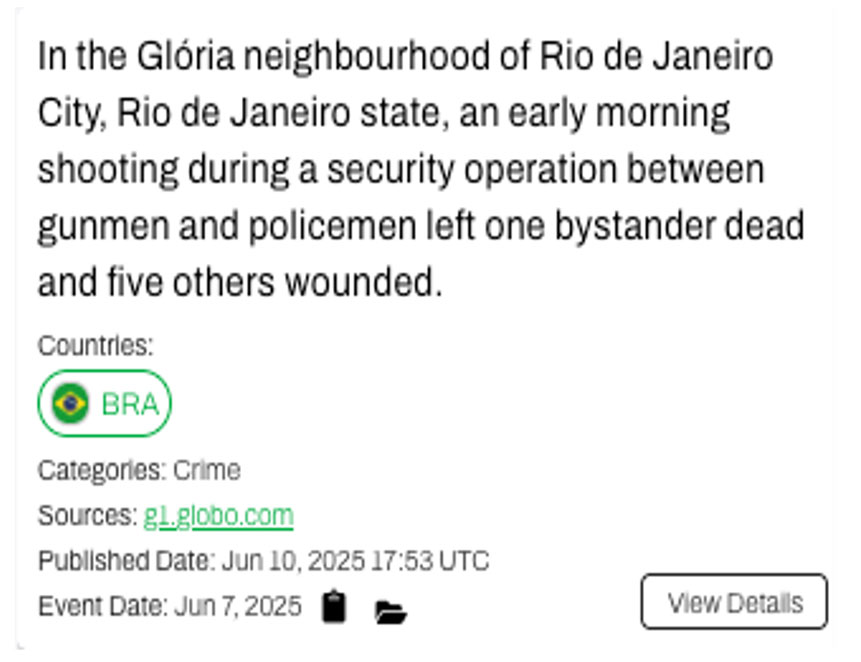
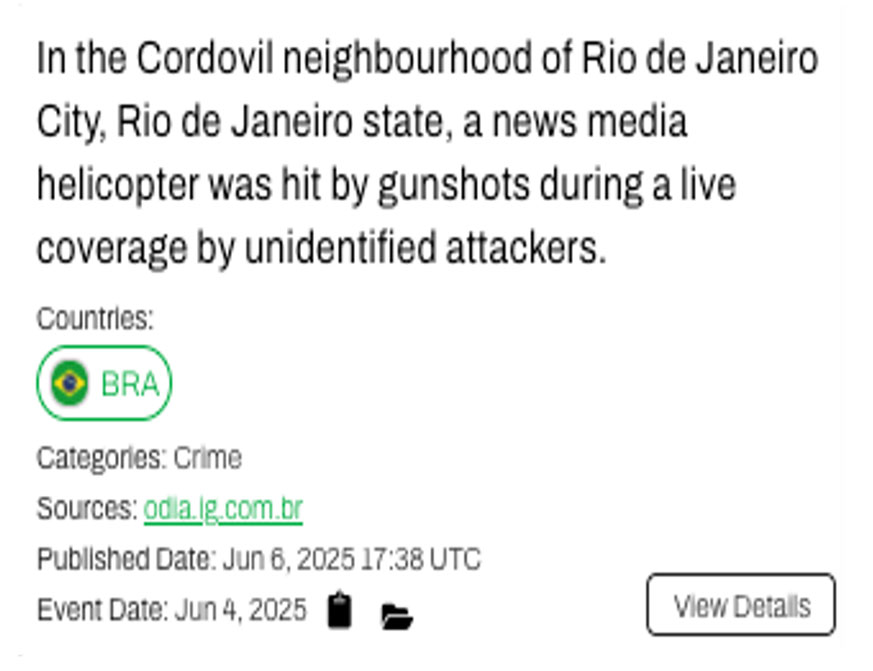
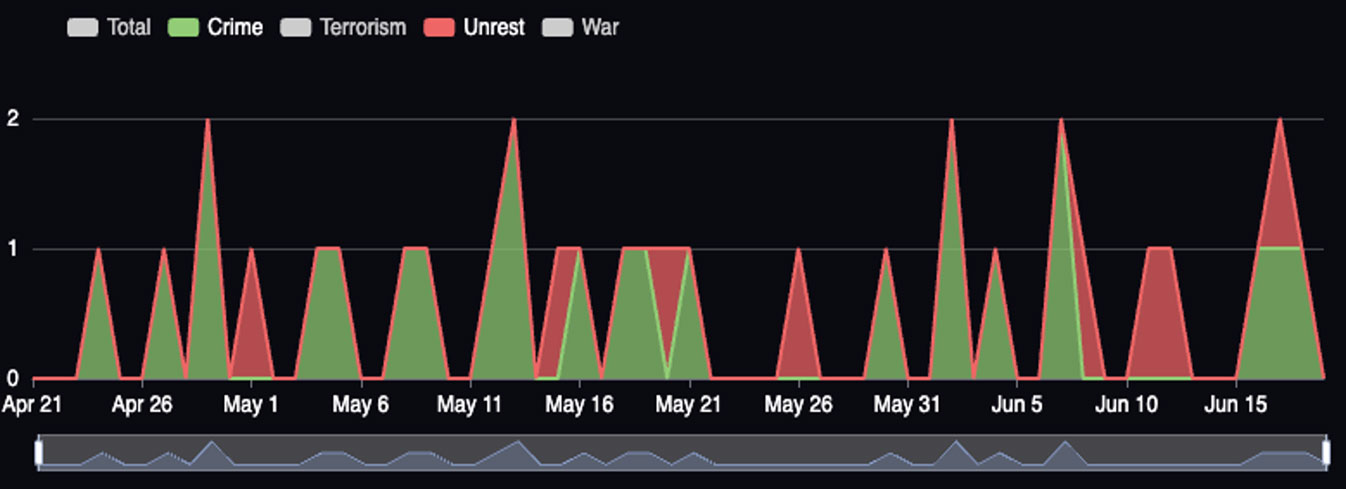
Verified crime events accounted for most security events recorded on Seerist in Rio de Janeiro. Key drivers of crime are clashes between security forces and gunmen during security operations, also crime activity like armed robberies involving casualties and shootings between rival groups. The main areas of these events are northern and central parts of the city.�
1 of 3
2 of 3
3 of 3


Verified Security Events (unrest and crime) Trends�
Source: Seerist
Rio de Janeiro Verified Events by ‘Sector’
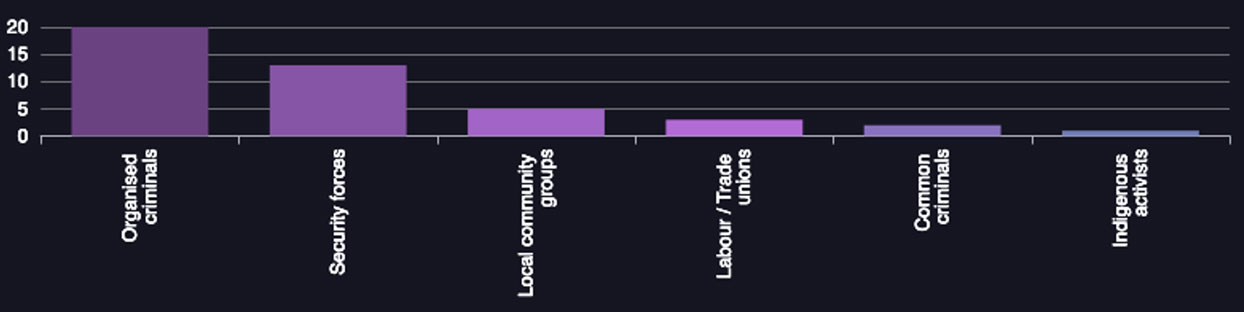
Organised criminals
Security forces
Local community groups
Labour/ Trade Unions
Common criminals
Indigenous activists
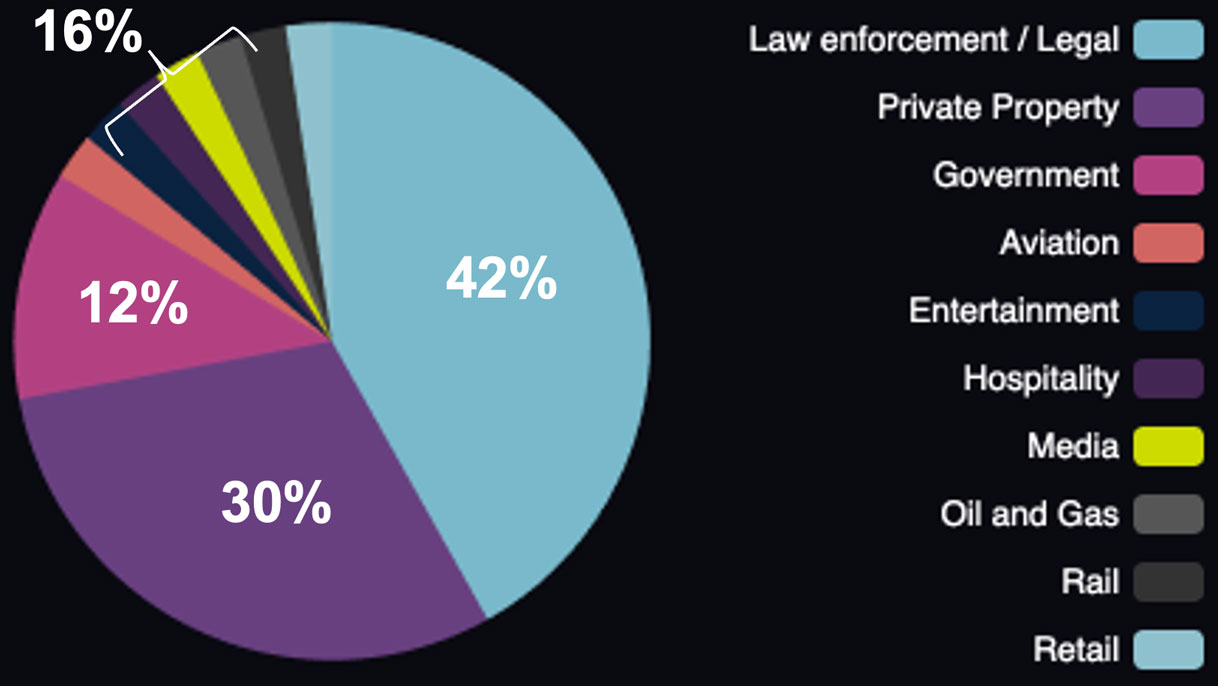
Rio de Janeiro Verified Events by ‘Perpetrators’
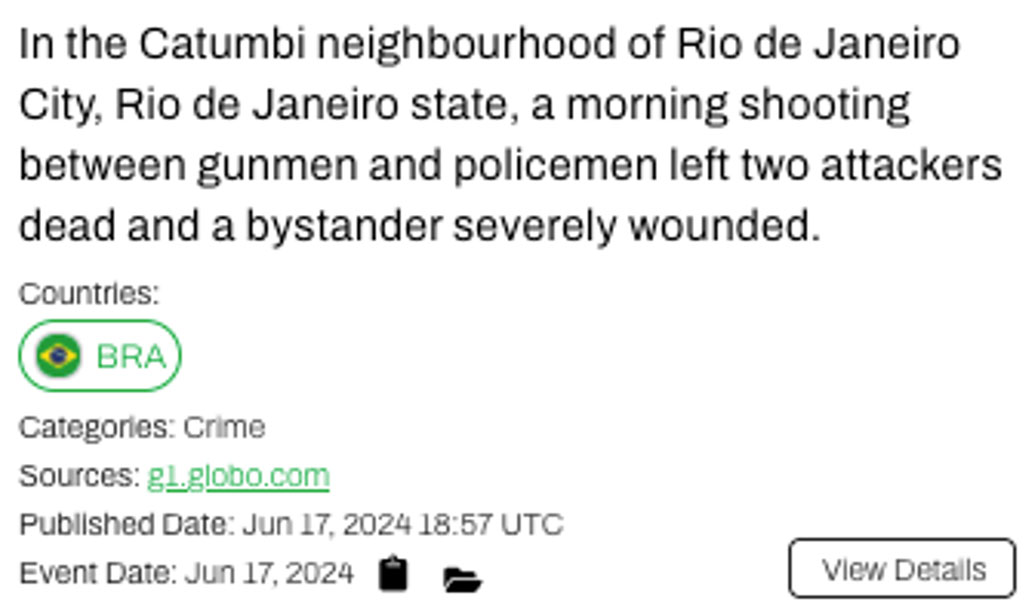
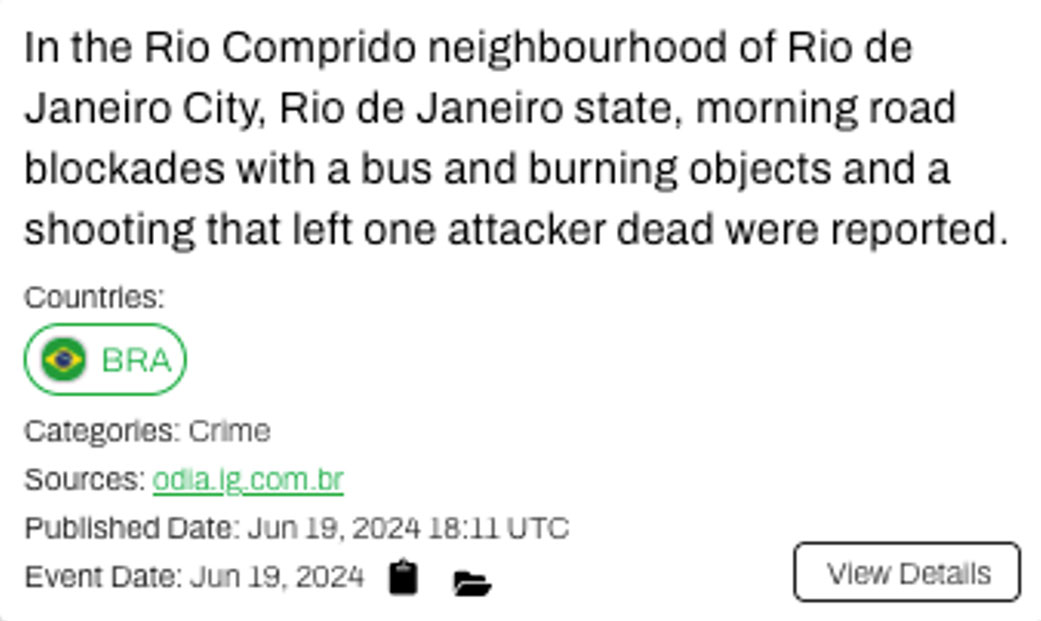
Examples of Major Verified Events
Monitor Security Developments in Rio de Janeiro using EventsAI
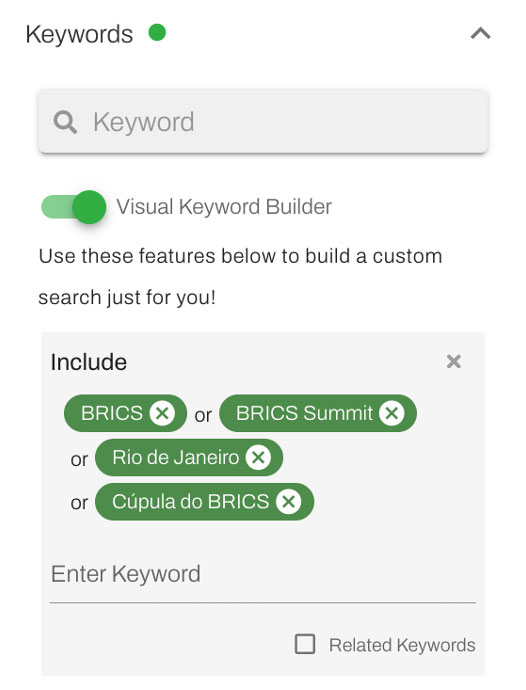
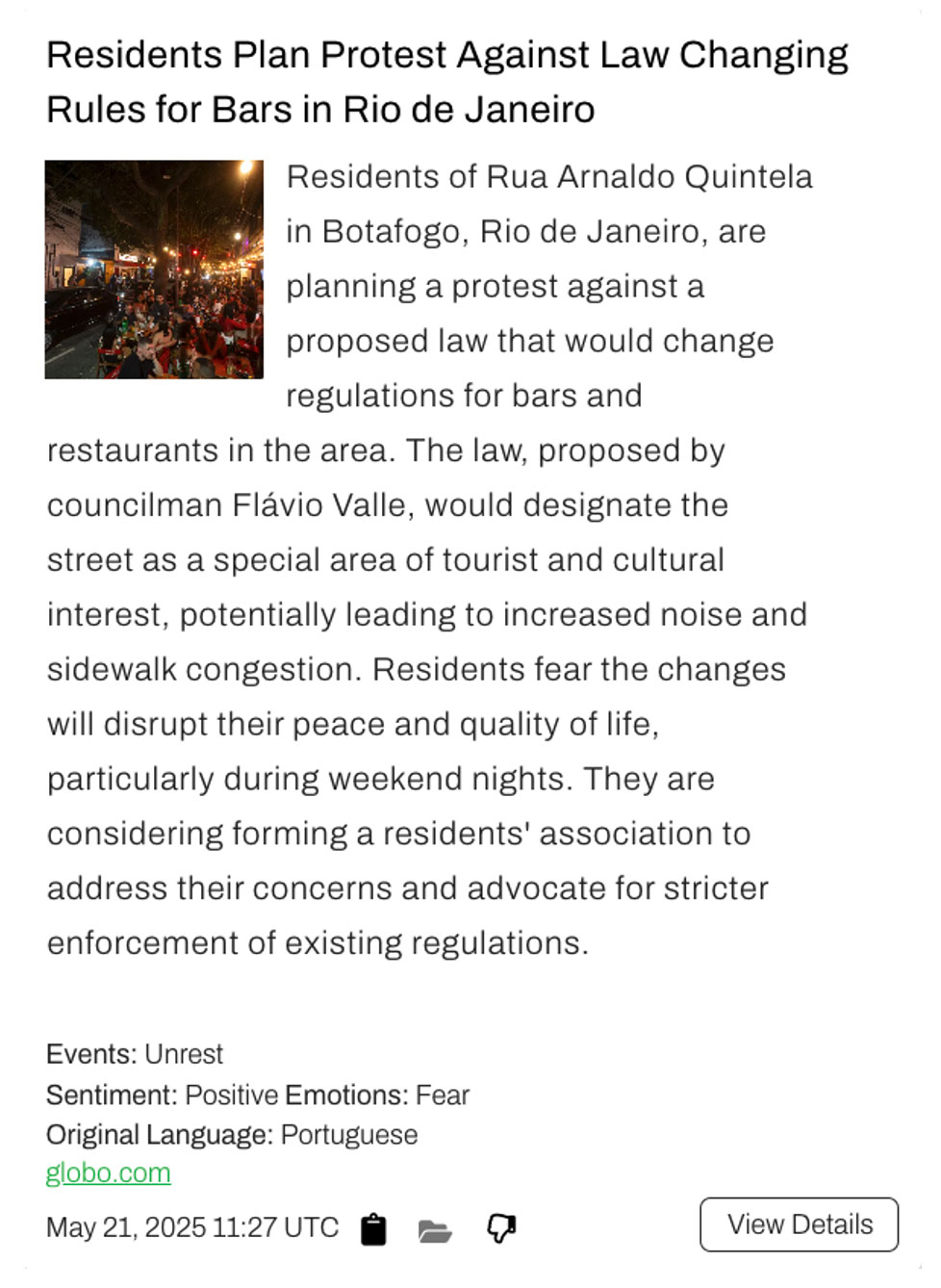
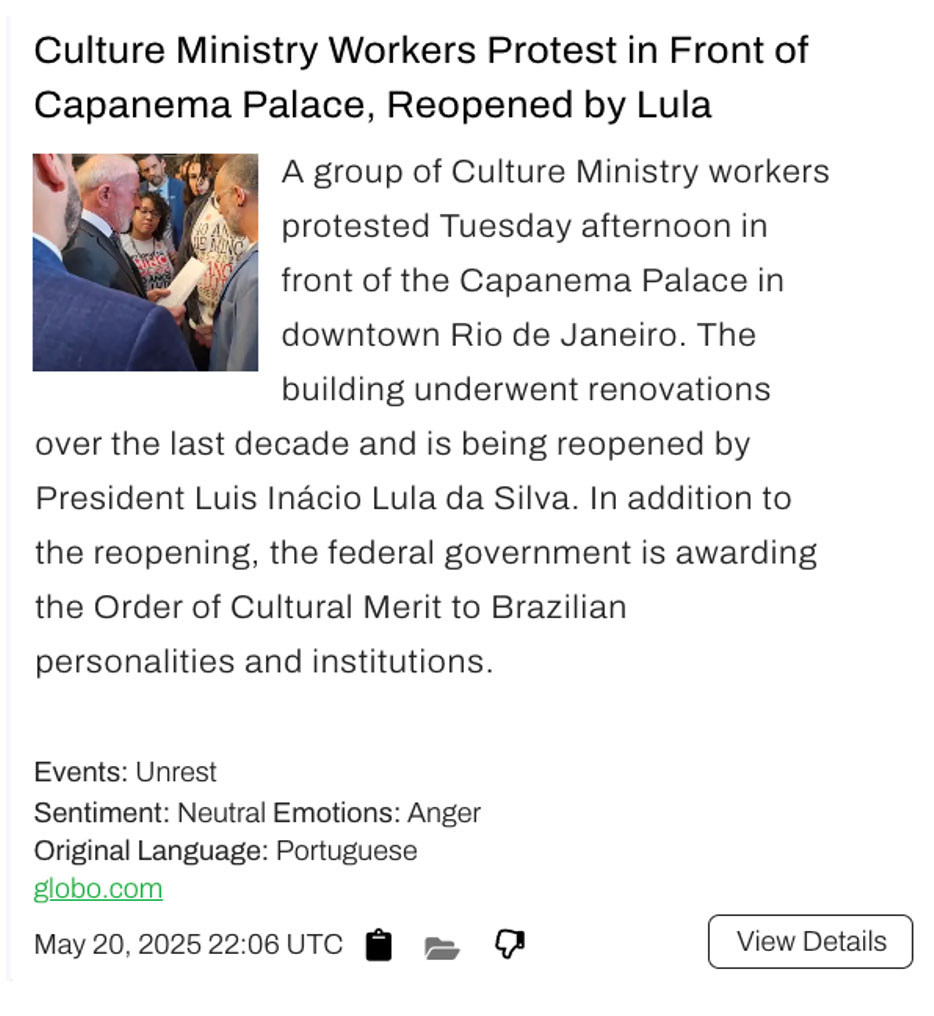
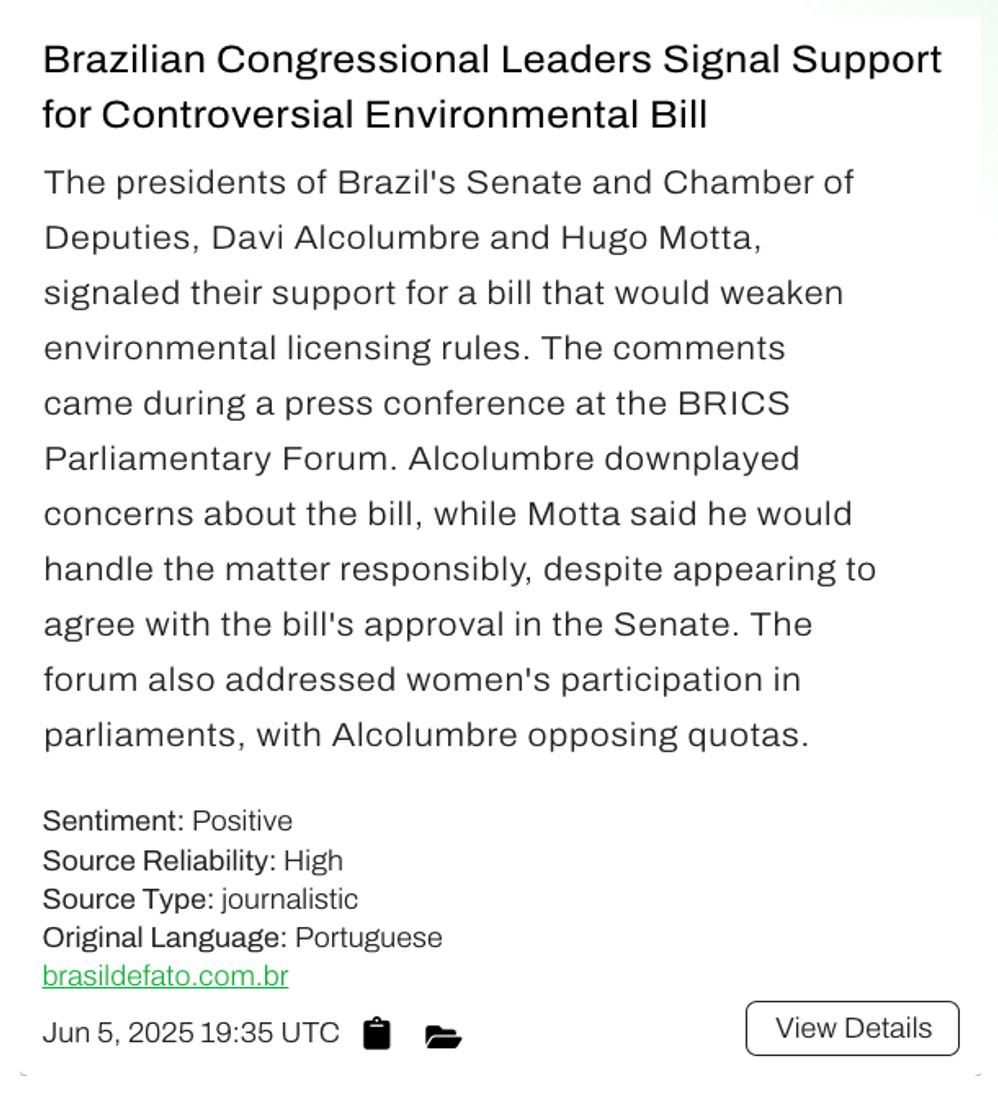
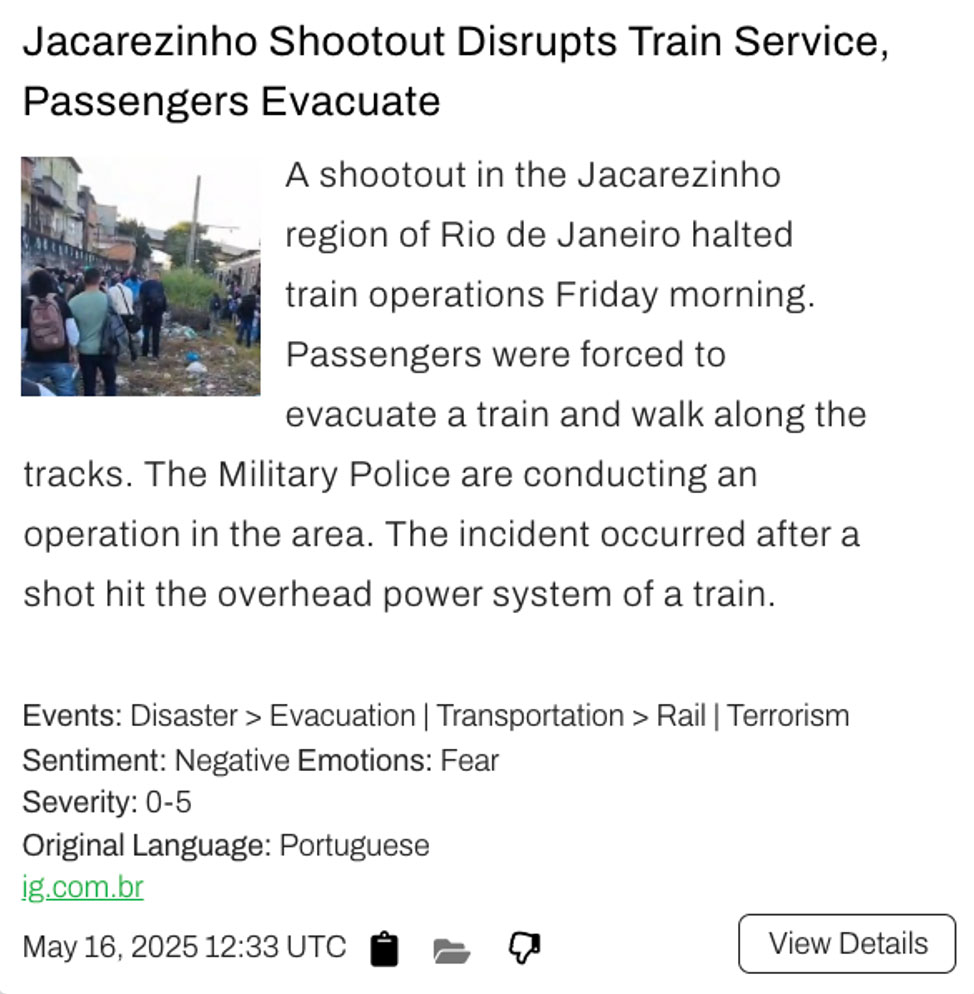
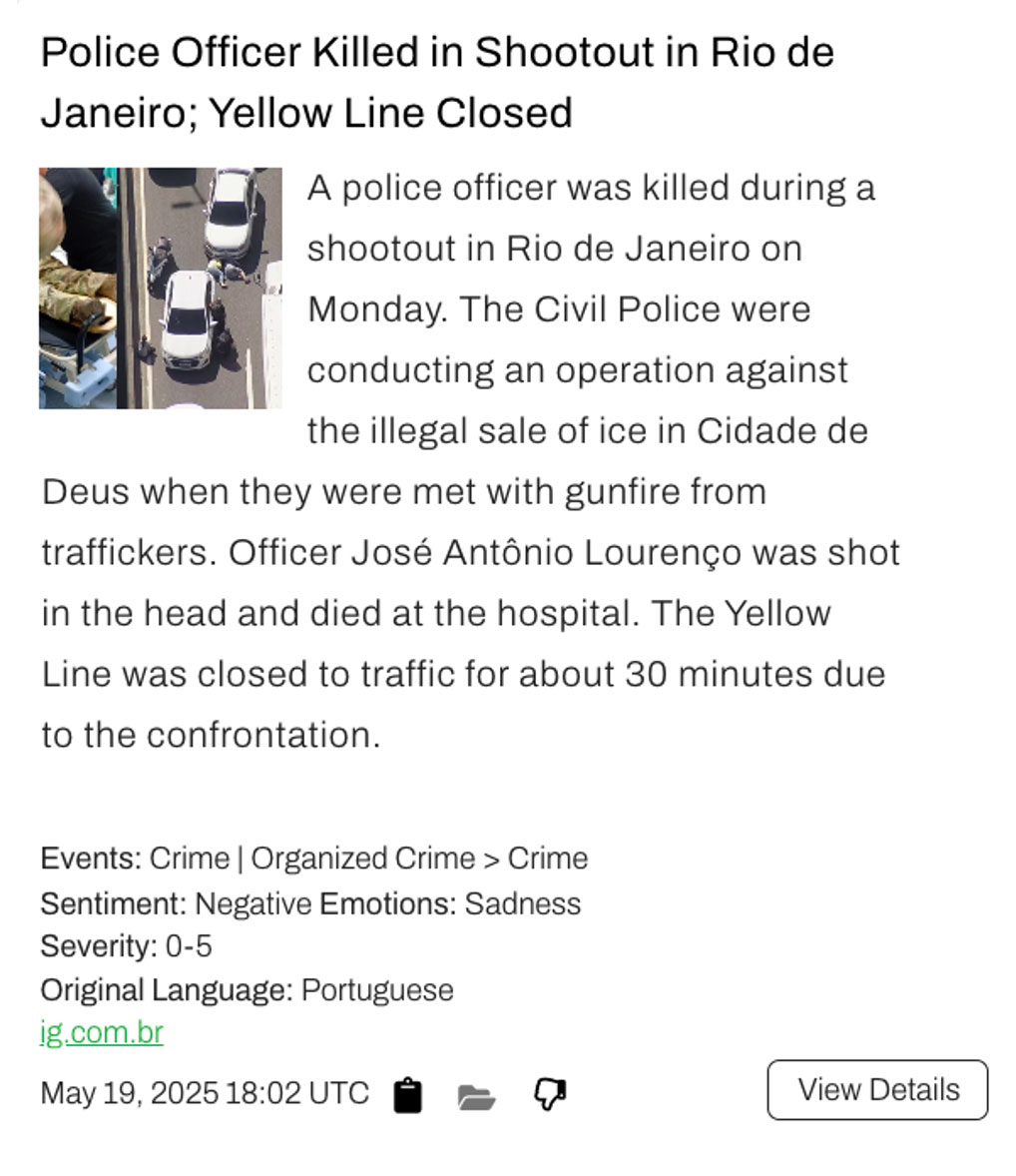
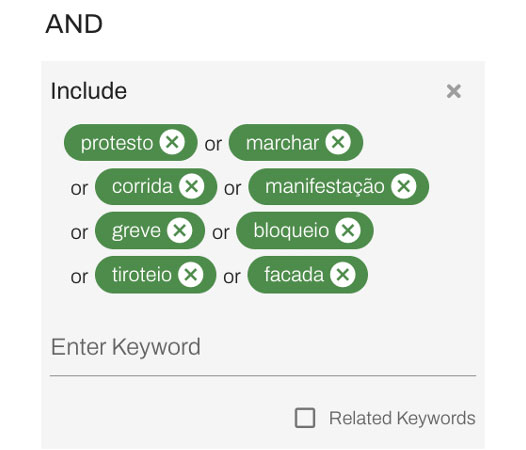
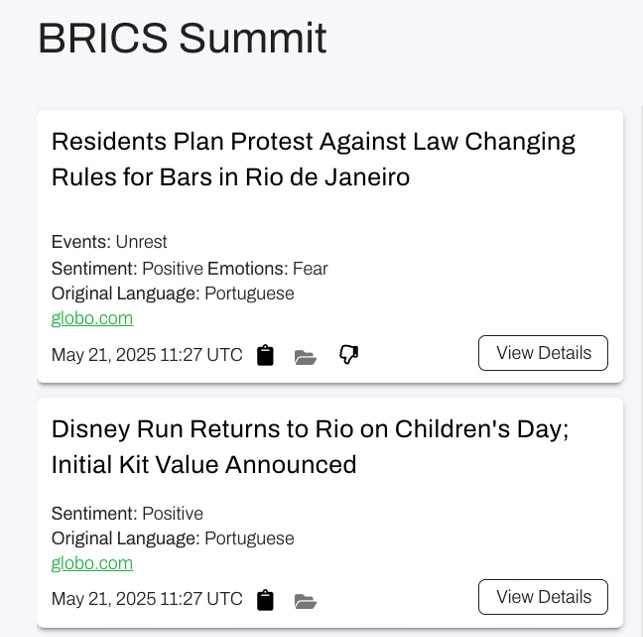
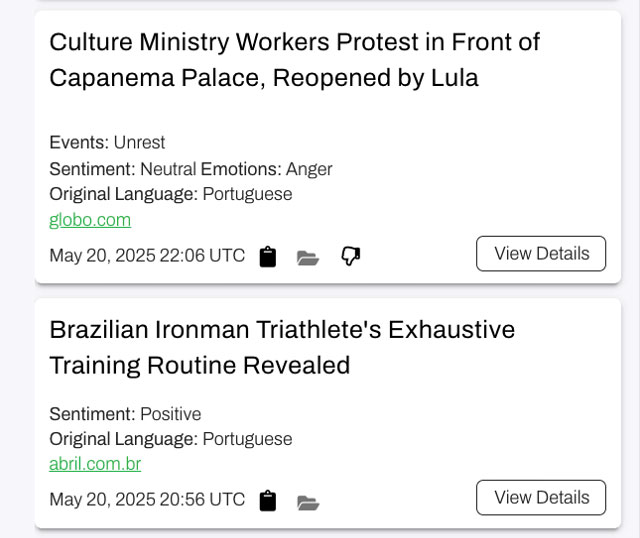
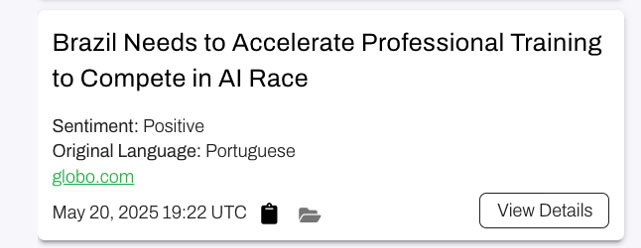
EventsAl searches can be tailored using custom keywords to find information specifically related unrest and crime. This allows users to monitor both traditional news coverage of security developments and planned unrest events.
Create custom searches to monitor local and international news coverage, as well as social media, to track security and related events ahead of the BRICS Summit.��
1 of 6
2 of 6
3 of 6
4 of 6

5 of 6
6 of 6
Search Result Examples


Source: Seerist

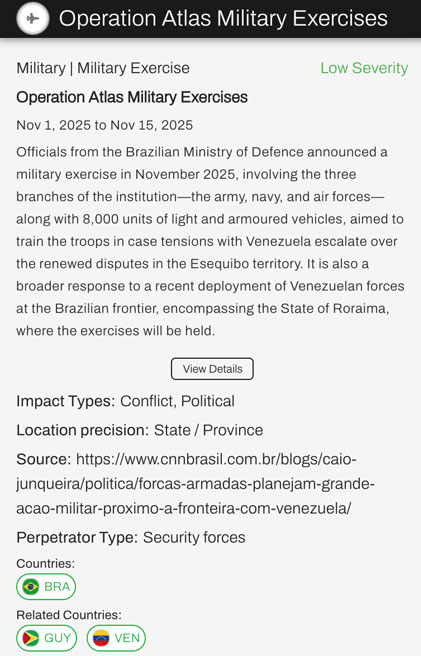
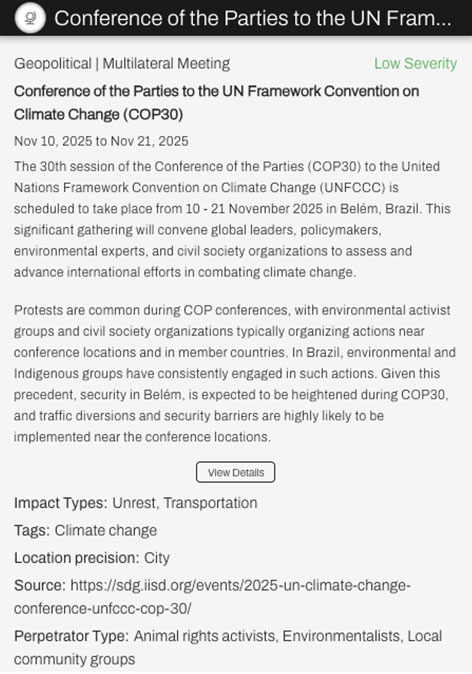
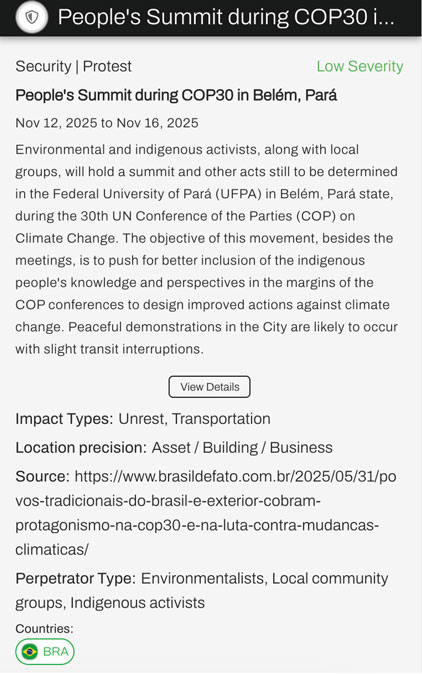
Future Events to Monitor in Brazil

1 of 4
2 of 4
3 of 4

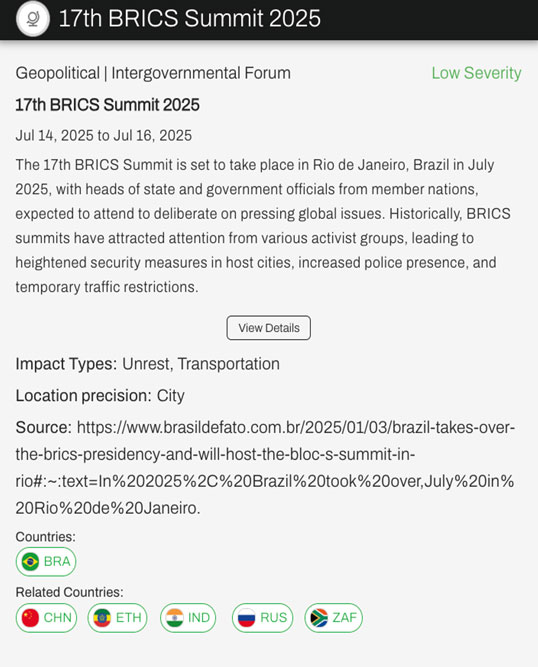
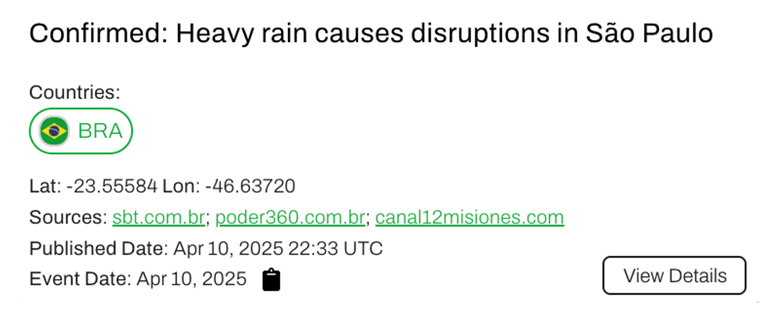
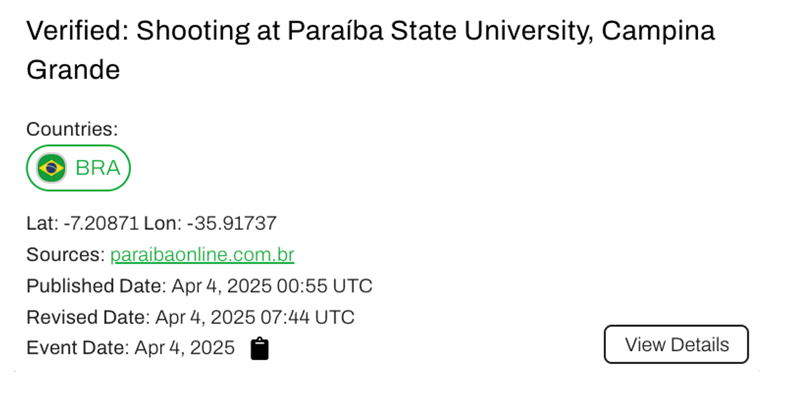
Seerist provides Breaking Events and Future Events to allow users to continuously monitor major security incidents in Brazil.
Seerist’s dedicated intelligence team reports Breaking Events as soon as they are detected – even if the information initially does not meet our standards for verification. As details around a Breaking Event emerge, we will issue new alerts and indicate when an event has been Verified (one or more Verified Events will be added) or Confirmed (for events that do not fall under our methodology).��

4 of 4
Future Events in Brazil�
Breaking Events
Breaking Events
Future Events cover one-off or recurring events that could cause operational disruption, heightened security threats or result in significant political decisions. Found on the dedicated country page, all calendar events are given a rating for their potential severity, in addition to assessing impact types such as ‘unrest’ and ‘transportation’.�
Control Risks Analysis
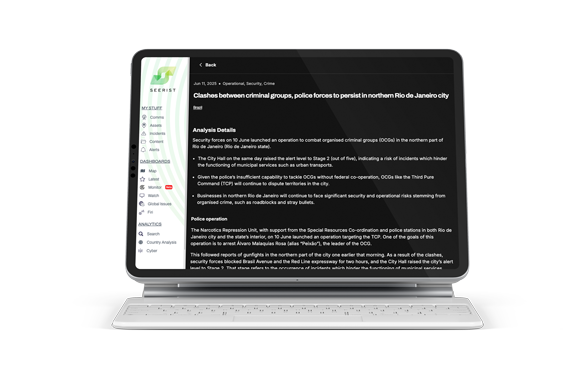
Clashes between criminal groups, police forces to persist in northern Rio de Janeiro city���
Security forces on 10 June launched an operation to combat organised criminal groups (OCGs) in the northern part of Rio de Janeiro (Rio de Janeiro state).
The City Hall on the same day raised the alert level to Stage 2 (out of five), indicating a risk of incidents which hinder the functioning of municipal services such as urban transports.
Given the police’s insufficient capability to tackle OCGs without federal co-operation, OCGs like the Third Pure Command (TCP) will continue to dispute territories in the city.
Businesses in northern Rio de Janeiro will continue to face significant security and operational risks stemming from organised crime, such as roadblocks and stray bullets.��
�
��
Source: Control Risks analysis published on 11 June 2025�
Read More Analysis
Police operation�The Narcotics Repression Unit, with support from the Special Resources Co-ordination and police stations in both Rio de Janeiro city and the state’s interior, on 10 June launched an operation targeting the TCP. One of the goals of this operation is to arrest Álvaro Malaquias Rosa (alias “Peixão”), the leader of the OCG.
�This followed reports of gunfights in the northern part of the city one earlier that morning. As a result of the clashes, security forces blocked Brasil Avenue and the Red Line expressway for two hours, and the City Hall raised the city’s alert level to Stage 2. That stage refers to the occurrence of incidents which hinder the functioning of municipal services, such as urban transport. Blocked roads and spikes in gun violence will continue to stem from clashes between OCGs and security forces in the city throughout 2025.
Crime and religion�The TCP exerts informal control over the Complexo de Israel, a cluster of favelas (slums) in northern Rio de Janeiro – including Cidade Alta, Cinco Bocas, Pica-Pau, Parada de Lucas and Vigário Geral. The group emerged in the mid-1980s as a splinter faction of the Red Command (CV) following internal disputes. It has since become the CV’s main rival, fuelling ongoing turf wars in the city’s northern zone.��
What distinguishes the TCP from other OCGs is its fusion of crime and religious rhetoric. The group espouses a form of Pentecostalism that equates faith with material success, promoting the idea that divine favour is demonstrated through financial prosperity. Malaquias uses this narrative to portray himself as a divinely appointed leader, linking spirituality and violence to consolidate authority and expand the group’s influence.
�In communities where the state is largely absent – typically on the urban periphery with limited police presence – criminal groups often fill the vacuum by asserting informal control. In such contexts, they also influence religious life. The TCP exemplifies this trend, using religion to bolster social legitimacy, internal cohesion and community control. As religion continues to serve as a powerful tool for the TCP, other OCGs in Brazil are likely to adopt similar strategies to bolster their influence in the coming years.
Outlook�Gun violence will persist in northern Rio de Janeiro over the remainder of 2025 due to recurring clashes between the CV and the TCP, as well as confrontations with police forces. Businesses operating in the region will continue to face significant security and operational risks stemming from organised crime. These include roadblocks on main highways, frequent shootouts and disruption to logistics and employee mobility.
Sources:�“Bus driver passenger shot in operation against gang in RJ”, Folha de S.Paulo�“Massive police operation against criminal faction closes roads, causes morning of chaos in Rio”, Estadão��
Source: Seerist and Control Risks�


Explore Now
Learn more about delivering the trustworthy insights you need, right when you need them.
Discover Seerist Today
The foresight to get ahead of what may come.

The insights with the most impact.

Accelerate speed to decision.
