Terrorism Trends in Western Europe
Western Europe – and Germany in particular – has seen an uptick in incidents of extremist violence in recent months, and security services are foiling an increased number of potential terrorist attacks compared with recent years. This note examines terrorism trends across the region.
Militant actors retain intent to conduct complex attacks, but the attacks that remain most likely to succeed will involve easy-to-acquire weapons and be staged by lone actors – often individuals who are radicalised online.
Increasingly, the complex motivations of many perpetrators have broadened the range of attack targets and are also frustrating efforts to detect and foil attacks.
An increase in attacks – so far mostly in Germany – of vehicles being used as weapons is likely to inspire similar attacks in Western Europe in the coming months.
Businesses are unlikely to be singled out as targets in attacks. The most likely potential attack locations remain shopping and transport hubs, diplomatic and religious establishments, and large events.
Western Europe over the last year has seen an uptick in extremist violence, particularly violence motivated by Islamist extremism, compared with recent years. This trend has accelerated in recent months, notably in Germany. It also remains a prevalent issue in France: in December 2024, France’s National Anti-Terrorism Prosecutor’s Office (PNAT) warned that in 2024 the number of cases opened on suspicion of Islamist extremism was the highest it had been in several years. The PNAT noted that online radicalisation was the key driver. However, the severity of attacks across Europe remains below the level seen in the mid-to-late 2010s.
�Meanwhile, the threat is not limited to Islamist extremists. Intelligence services are dealing with an elevated threat of violence by far-right extremists and sabotage by both militant anarchists and state actors. Further complicating the threat environment is the emergence of a new ideological category of threat actor: mixed, unclear and unstable (MUU).
French newspaper Le Parisien on 13 March reported the arrest of a teenager on 11 March in Haute-Saône, eastern France, on suspicion of planning an Islamist extremist terrorist attack. In keeping with recent trends, the teenager was reportedly radicalised online. In February, a man acting alone and motivated by Islamist extremism stabbed several people, killing one person, in Mulhouse in eastern France.
�Germany has seen several seemingly Islamist extremism-motivated stabbing and shooting attacks over the past year by lone actors. Two of the three vehicle-ramming attacks in the country since December 2024 appear to have been motivated by Islamist extremism. The other, which took place in December 2024, was carried out by a Saudi Arabian national whom the authorities and the media described as an activist and vocal critic of Islam.
Militant actors retain intent to conduct complex attacks, such as those involving multiple actors or high-yield explosives. However, the authorities will likely continue to foil these, as demonstrated in the uncovering in February of a plot involving the use of explosives against the Israeli embassy in the German capital Berlin. Such attacks are easier for highly capable Western European intelligence services to detect, and security services are foiling an increasing number of potential attacks compared with recent years.
�Those attacks that succeed will be staged by lone actors and involve easy-to-acquire weapons or other unsophisticated methods. The perpetrators will likely not have conducted significant reconnaissance prior to the attack, and the choice of target will likely be easily accessible and not well protected.
Increasingly, the motivations of the perpetrators of attacks by lone actors are unclear, a mixture of various or niche issues, or may relate to mental health difficulties. UK counter-terrorism services in recent years have started referring to a new ideological category of threat actor: MUU. These radicalised individuals adhere to multiple ideologies (mixed), lack a clear or coherent ideology (unclear) or possess a set of ideological beliefs prone to shift and change (unstable). This frustrates efforts to detect and foil attacks and widens the range of potential targets.
�Furthermore, in many attacks that bear the hallmarks of Islamist extremist violence, authorities are increasingly uncertain of the main motivation. Frustrated, isolated individuals may view an act of violent extremism as a means to express their frustrations, with actors who are of Muslim heritage sometimes uttering the Islamic phrase “Allahu Akbar” during the attack, despite often not having had strong previous links to Islamist extremism. Such attacks tend to focus on the typical targets of Islamist extremist attacks in Europe, such as transport infrastructure. Others are more randomly staged.
�In addition to this, a nebulous, nihilistic, anti-society sentiment appears to be the inspiration for a growing number of such attacks, and attackers reference the actions of other previous attackers, with emulating them appearing to be their aim. This appears to have driven several high-profile incidents across Europe over the past year.
Germany especially has seen an uptick in attacks involving vehicles being used as a weapon. The revival of the method, used several times in the late 2010s, could inspire further attacks of this type in other countries in Western Europe in the coming months. As shopping areas shift to implementing more measures to prevent such attacks, these attacks may be directed against other targets.�
Businesses are unlikely to be the main targets of attacks. However, attacks pose threats to personnel and retail businesses caught up in attacks. The most likely targets of attacks include shopping and transport hubs, diplomatic and religious establishments, and large events, but attacks may also occur spontaneously with no apparent target.�
Sources:�“Germany: Police operation in Mannheim amid reported ramming”, DW�“Carnival in times of Fear of Terror”, DW�“Major operation in Mannheim after possible attack – car races into crowd”, Mannheim 24�"A teenager from Haute-Saône charged and imprisoned for a planned attack during Ramadan”, Le Parisien�“In Vesoul, a 17-year-old arrested for a planned attack”, Le Point�“Pnat: terrorist threat still ‘very high’ in France”, LINFO�“Radicalised and ‘schizophrenic’ profile of the suspect, Portuguese victim, injured… what we know after the terrorist attack in Mulhouse”, Liberation�“Attack in Mulhouse: one dead and several injured, Macron speaks of an ‘Islamist terrorist act’”, France 24�“Mulhouse attack: this Islamist terrorist that Algiers did not want”, Le Figaro�“Munich: Suspected attack – the driver is a 24-year-old Afghan”, Bayerischer Rundfunk�“Car drives into Ver.di demonstration march in Munich – Söder calls it an attack”, Spiegel�“Car drives into crowd – at least 20 injured”, Tagesschau�Control Risks
Executive Summary
Trends�
Recent Islamist extremist attacks
Unsophisticated attacks
Mixed motivations
Vehicles as weapons
Businesses remain unlikely targets



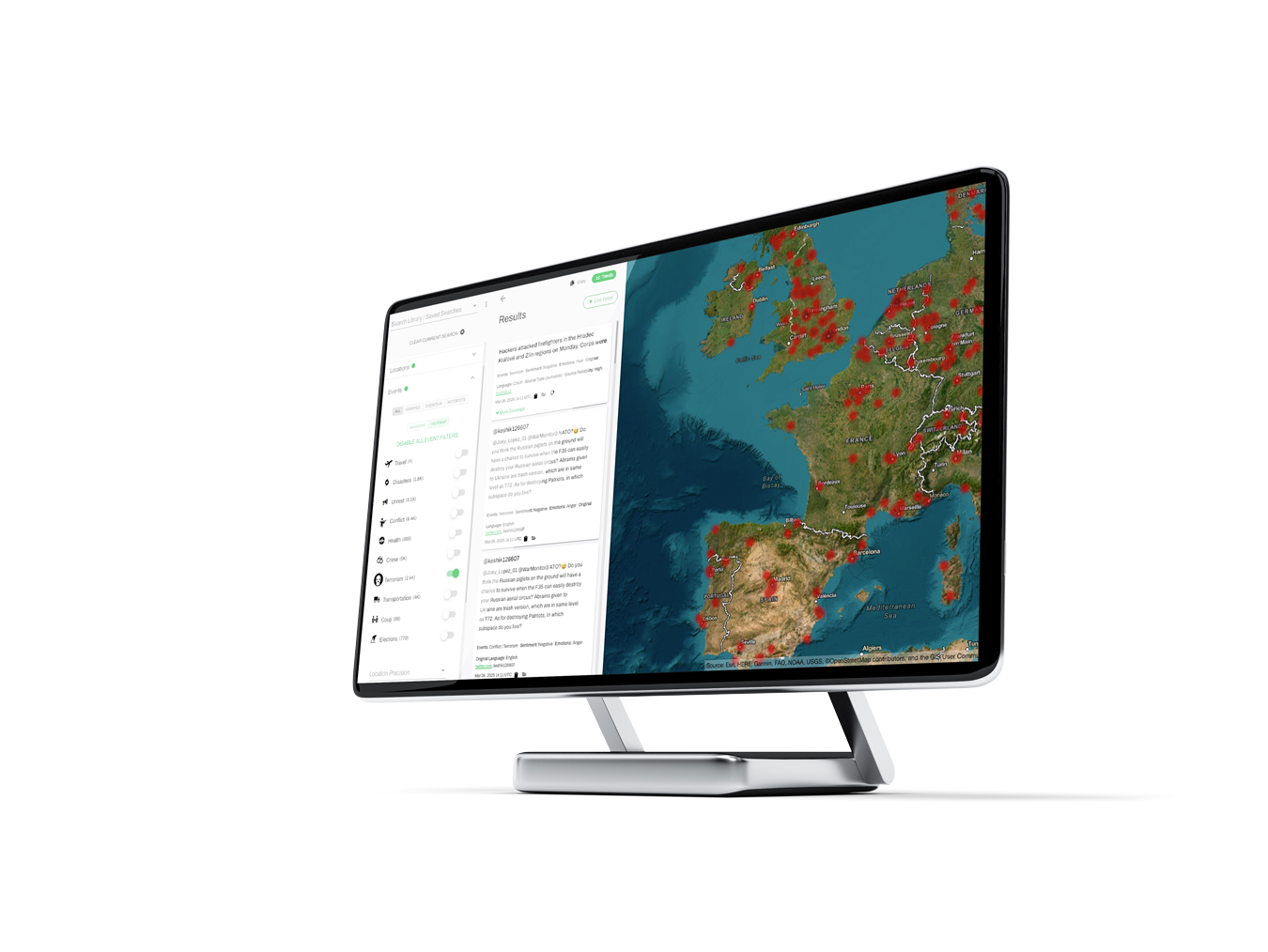
Explore the Seerist Solution.
See how Seerist combines AI and human verified analysis to proactively monitor these key issues in 2025.
Request a demo

2013
2014
2015
2016
2017
2018
2019
2020
2021
2022
2023
2024
2025


Request a demo
Request a demo to see how Seerist can support your security �and intelligence efforts.
Explore Seerist Today
The foresight to get ahead of what may come.

The insights with the most impact.

Accelerate speed to decision.


SHARE
THE
REPORT
0
10
20
30
40
50
60
70
80
90

Vehicle-as-weapon incidents in Western Europe
Deaths
Incidents
Chart: Control Risks • Source: Seerist