Pre-Holiday Season Terrorism Trends
Overview
Regional Overview
MENA
Africa
APAC
LATAM
In Focus
Germany and France
US Terrorism
Vehicle Ramming as Attack Type
Lone/Unstable Actors as Perpetrators
Control Risks' Analysis
Regional Deep-Dive REPORT
READ THE REPORT
Holiday Terrorism Risk Overview
Key Takeaways
Terrorist threat actors demonstrate heightened intent to carry out attacks during major end-of-year holidays, including Christmas, Hanukkah, New Year's, and Orthodox Christmas.
Attacks during holiday periods are most likely to be small-scale and improvised, utilizing unsophisticated tactics such as vehicle rammings, firearms, or bladed weapons.
Crowded public spaces such as holiday markets, shopping districts, and public events, as well as religious buildings, are primary targets.
While Islamist extremism remains a likely motive, attacks could also be motivated by right-wing extremism and other radicalized political beliefs.
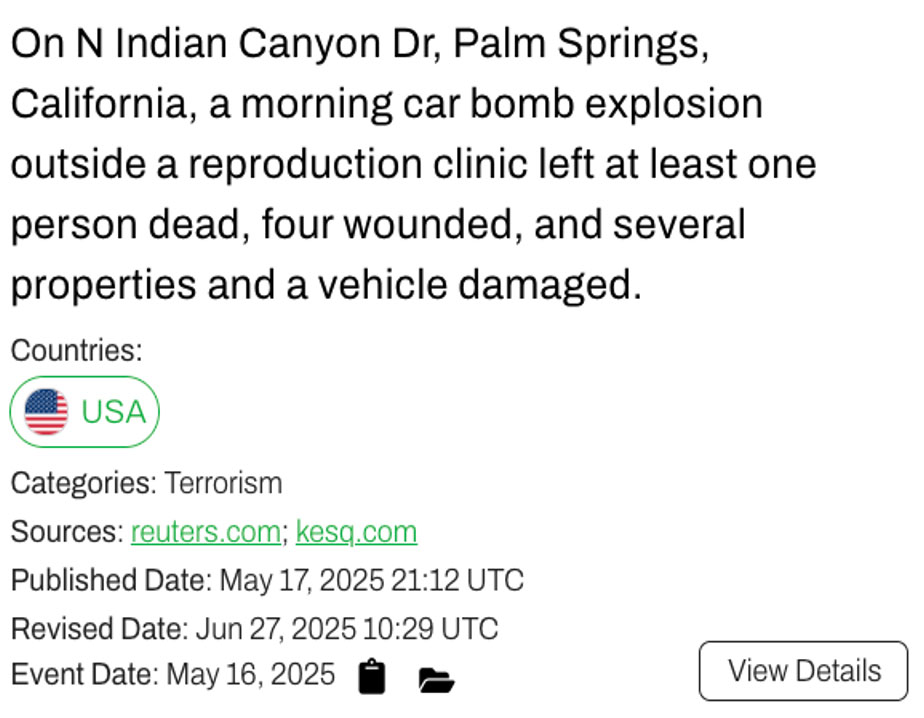
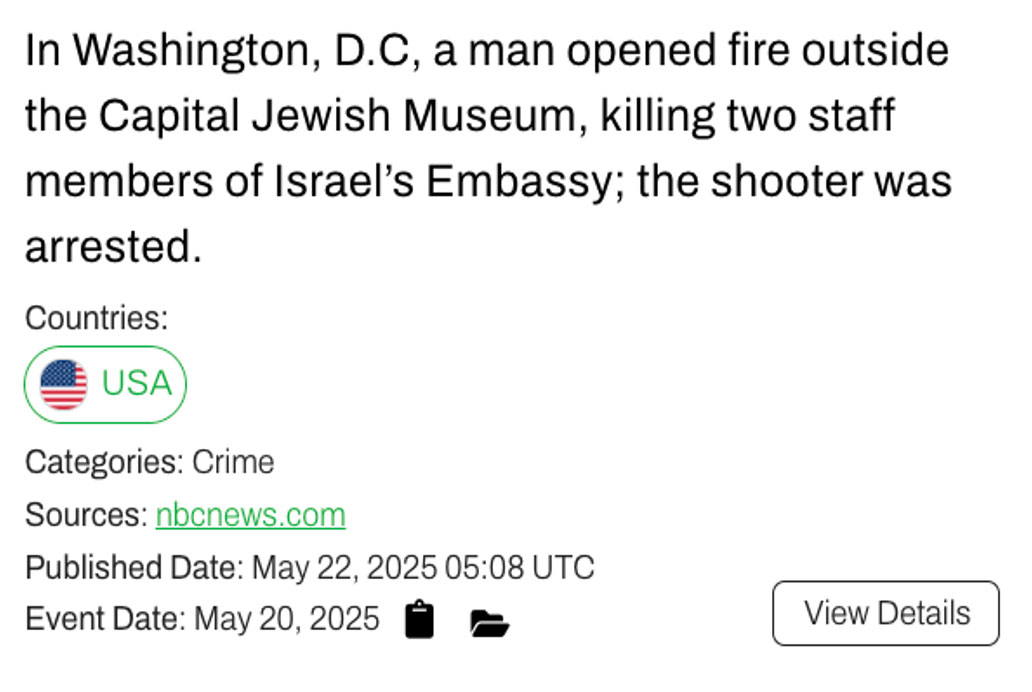
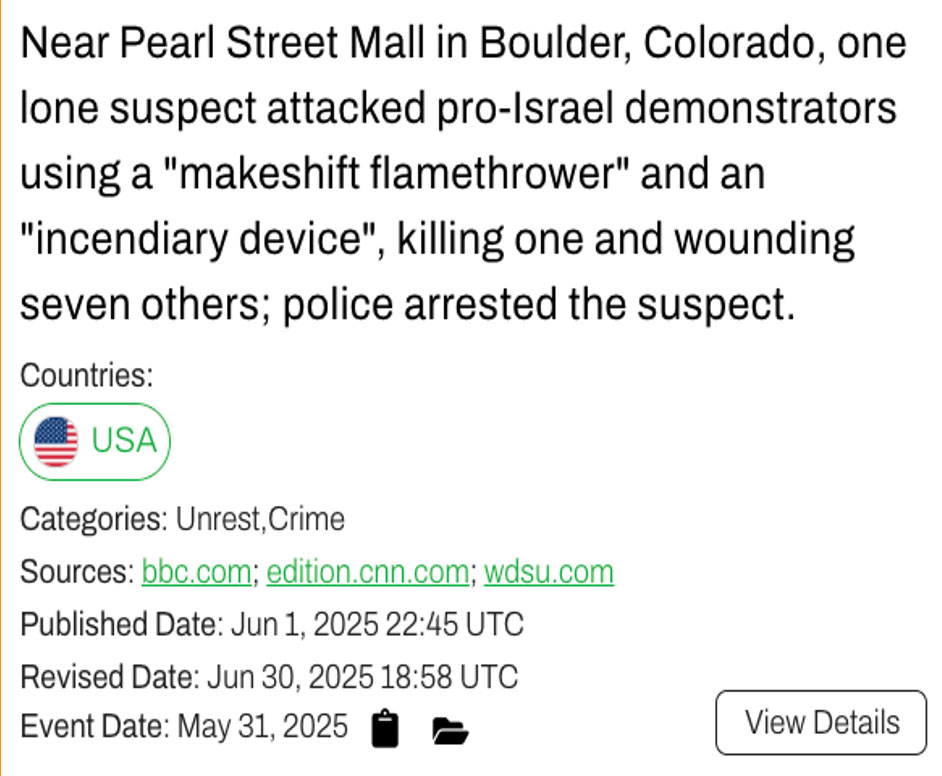
Looking Back to 2024: Notable verified terrorism events during last year’s holiday season
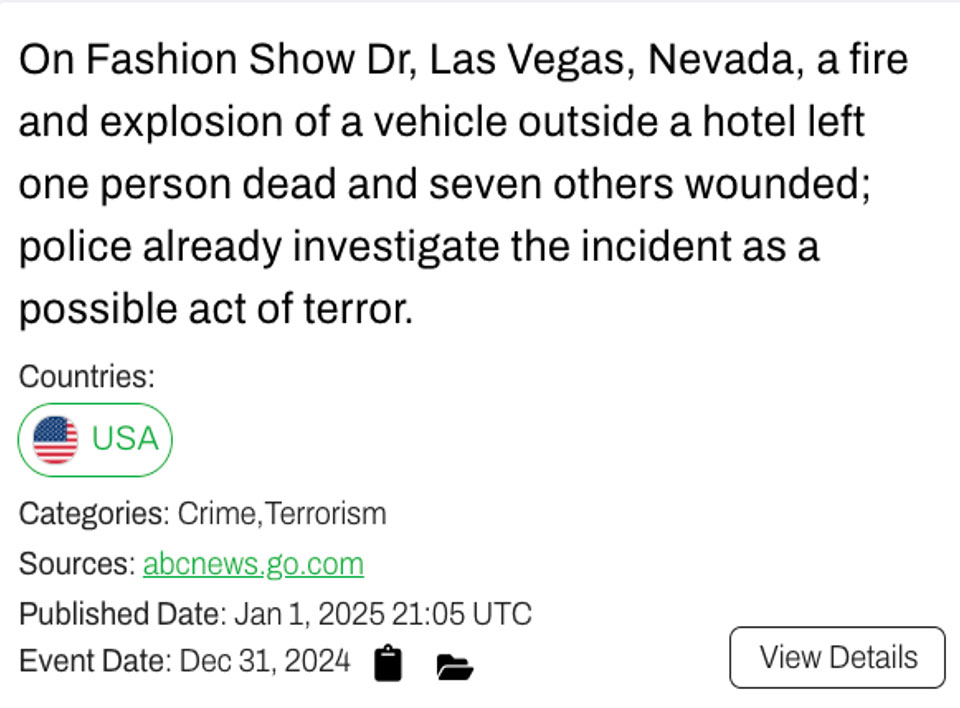
Dec 1
Jan 15
Dec 15
Jan 1
Hanukkah
Christmas
New Years
Orthodox Christmas
REGIONAL OVERVIEW: MENA
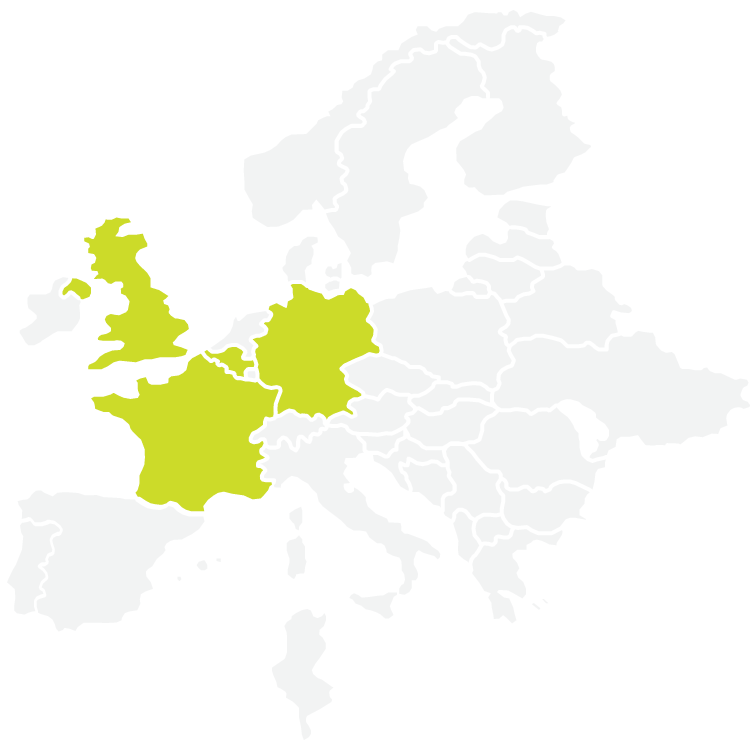
European Countries with Terrorism Risk Rating Medium
Regional Overview: MENA
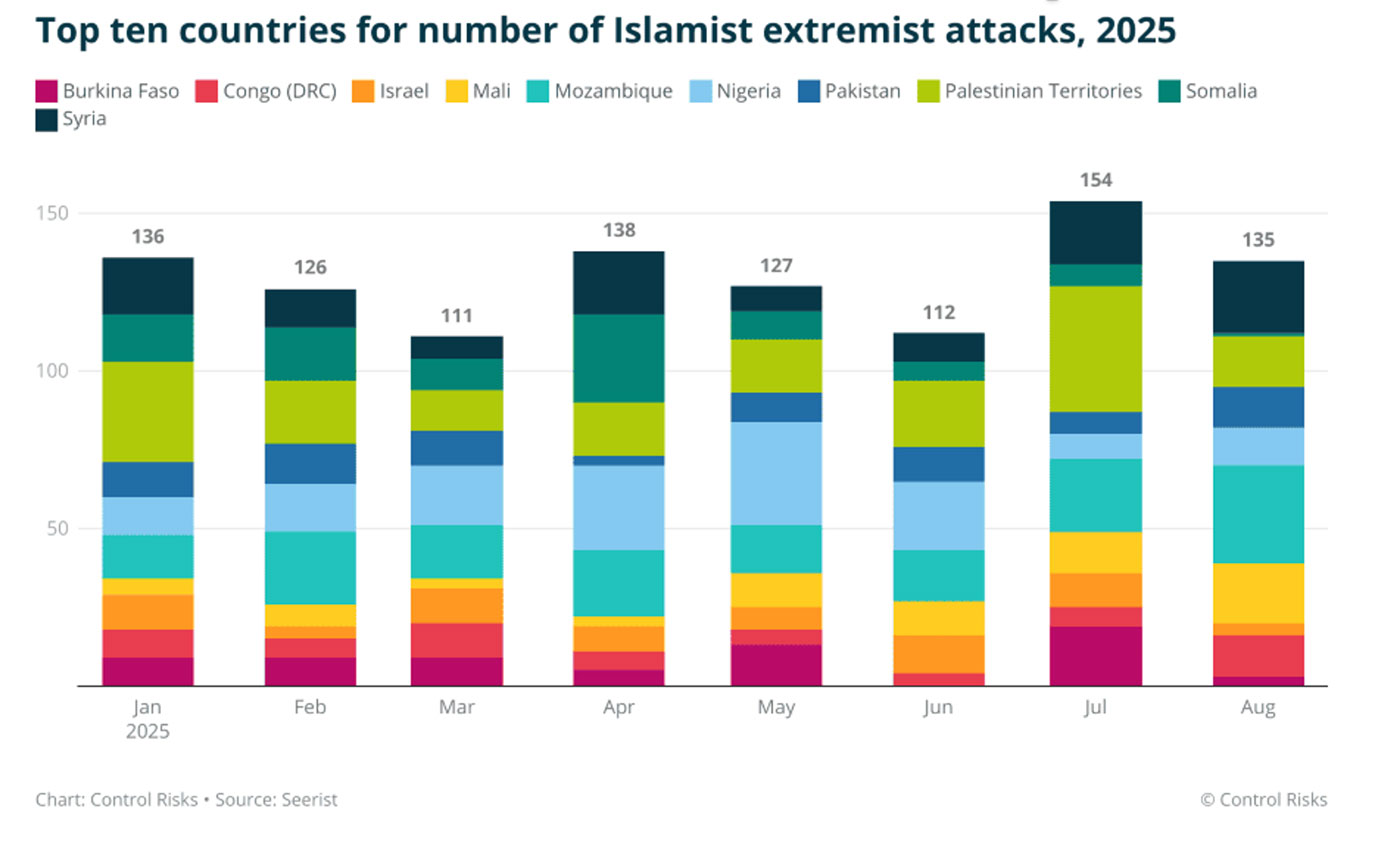
Analysis: Following the ceasefire and end of hostilities in the Israel-Hamas and Israel-Hizbullah War, verified terrorism events have decreased significantly in MENA in 2025 and are predominantly concentrated in Syria and Yemen.
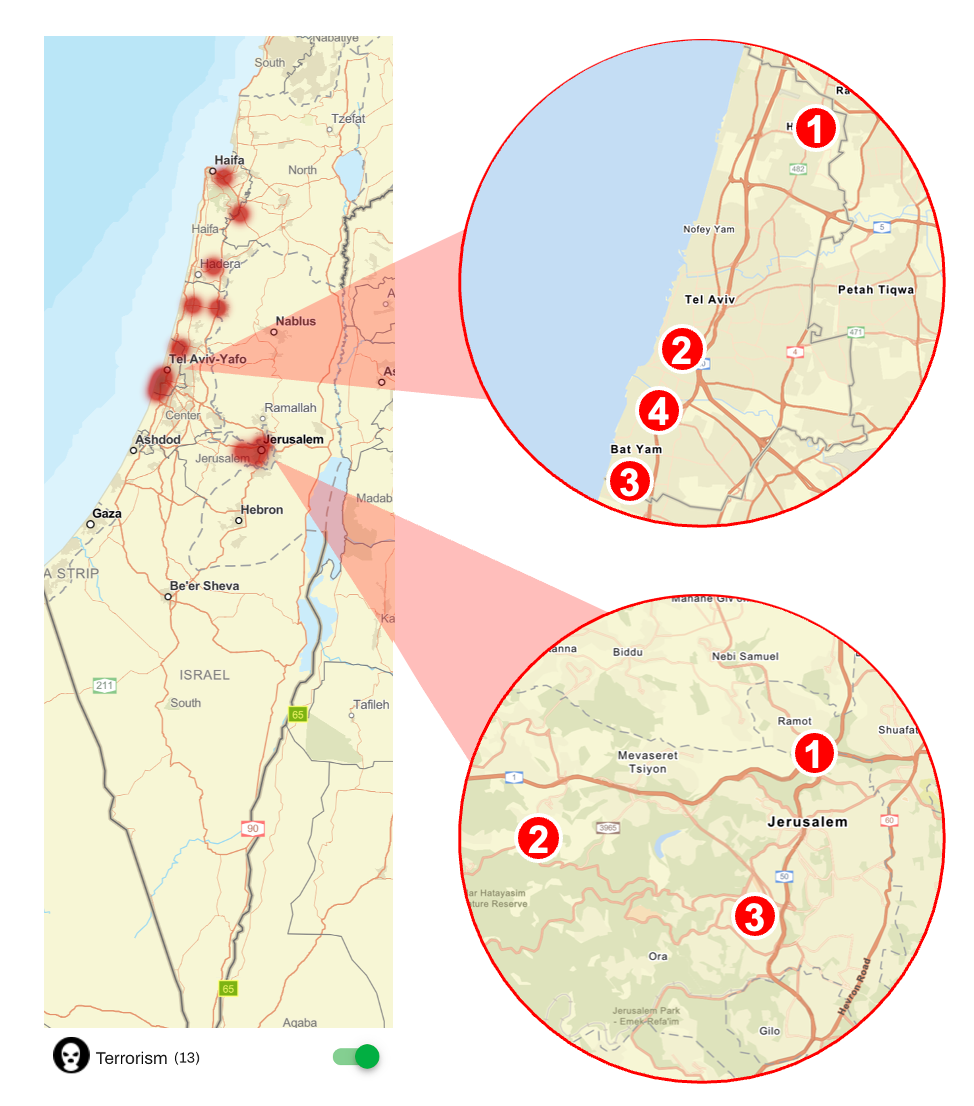
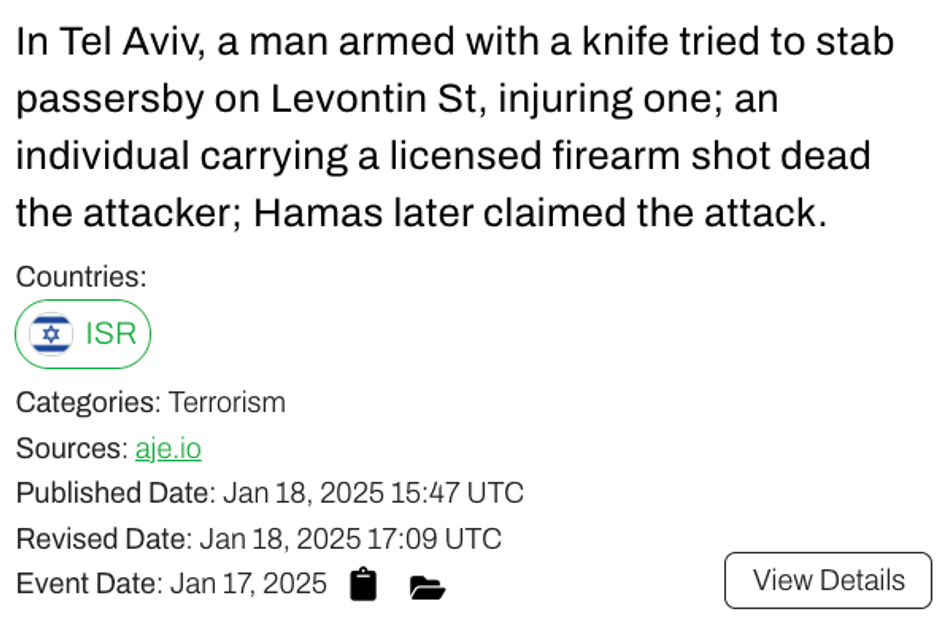
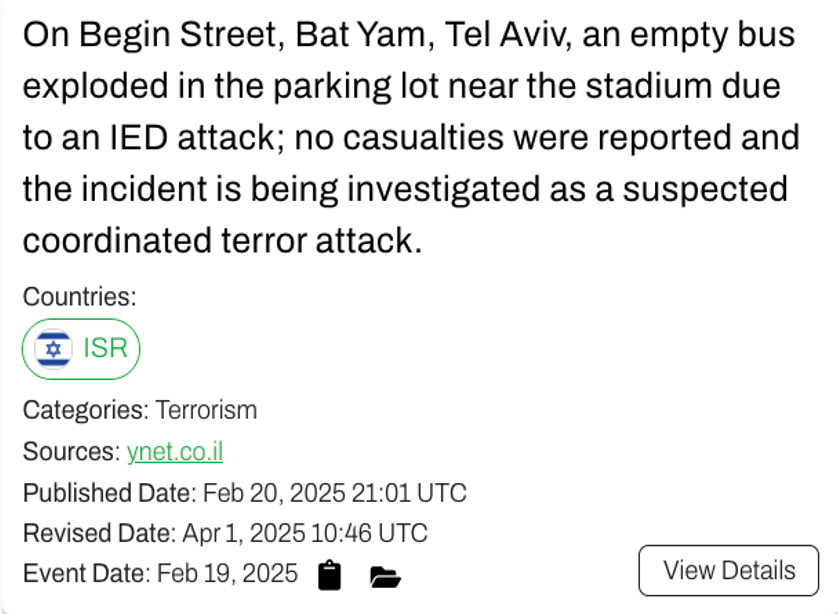
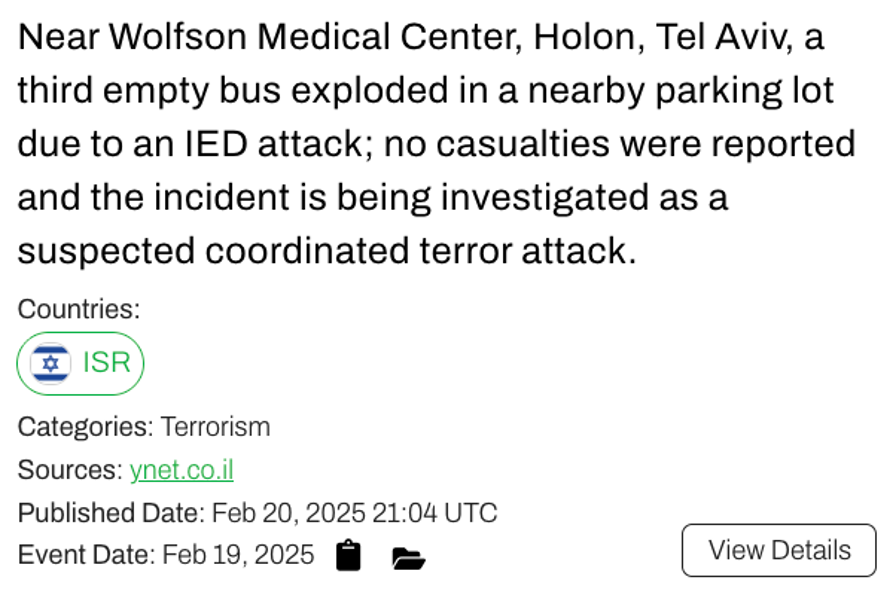
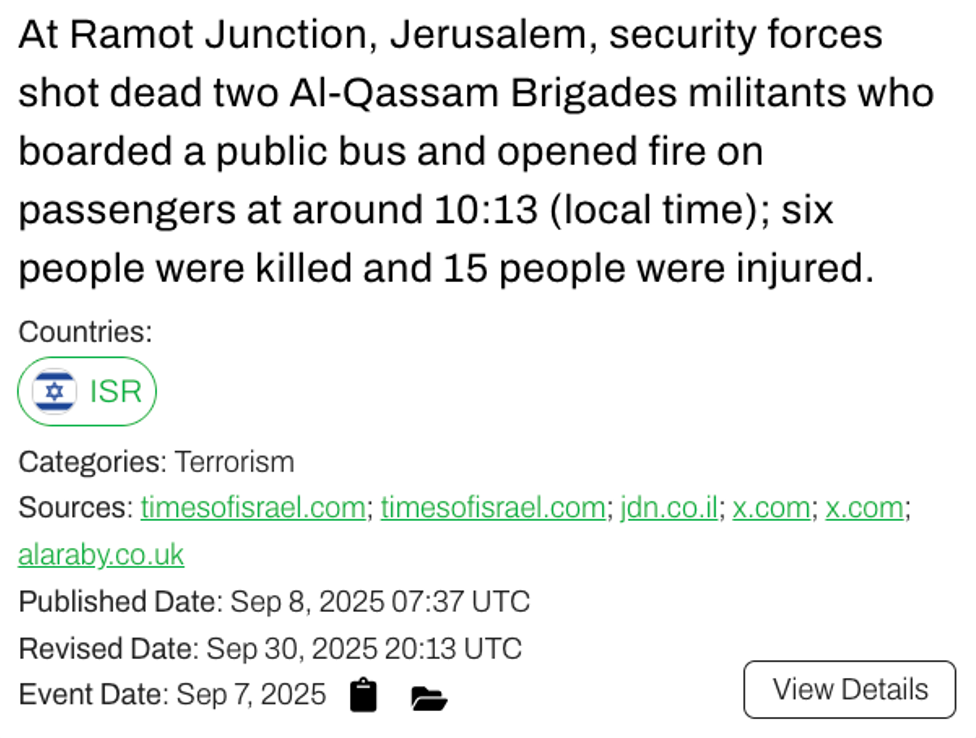
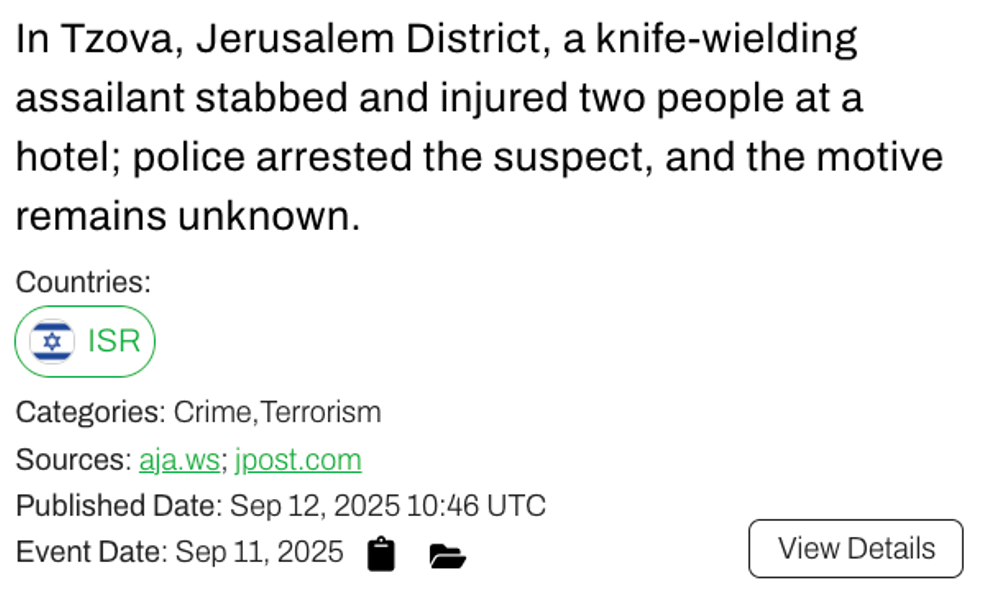
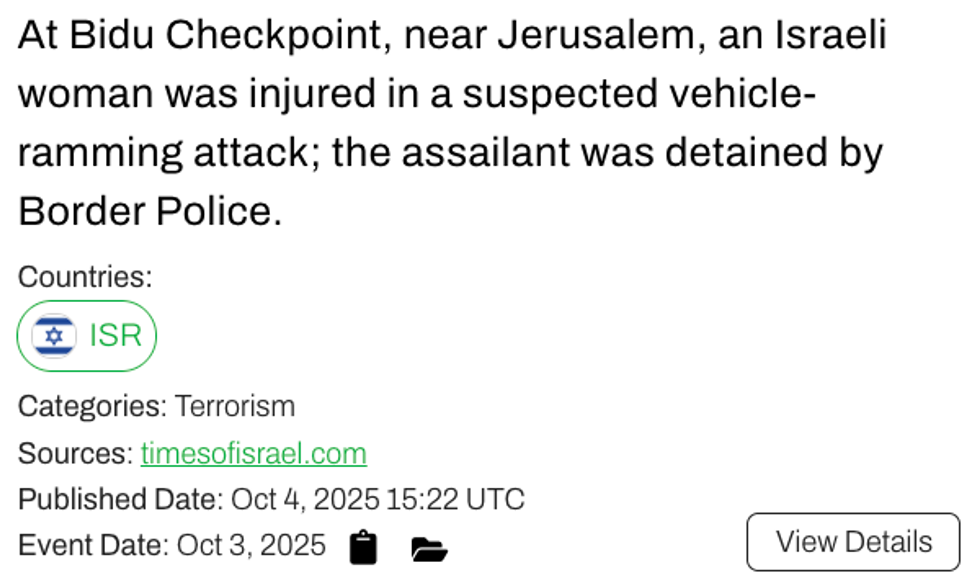
Palestinian militant groups and lone-wolf militants will retain the intent to perpetrate attacks in Israel targeting civilians, security forces and public spaces such as bus stops. Attacks will continue to occur in Israel on an irregular basis, but a step increase in the frequency and scale of attacks remains unlikely, sustaining our MEDIUM terrorism risk rating. Attacks are more likely to continue to take the form of opportunistic attacks rather than more extensively planned and relatively sophisticated attacks due to the authorities’ elevated intelligence and counterterrorism capabilities.
Heatmaps of verified terrorism events in Israel, conducted by Palestinian militants, excluding any rocket or drone attacks launched by Hamas from the Gaza Strip or by Houthi militants from Yemen
Click green buttons below to view Verified Event.
Click yellow buttons for details.
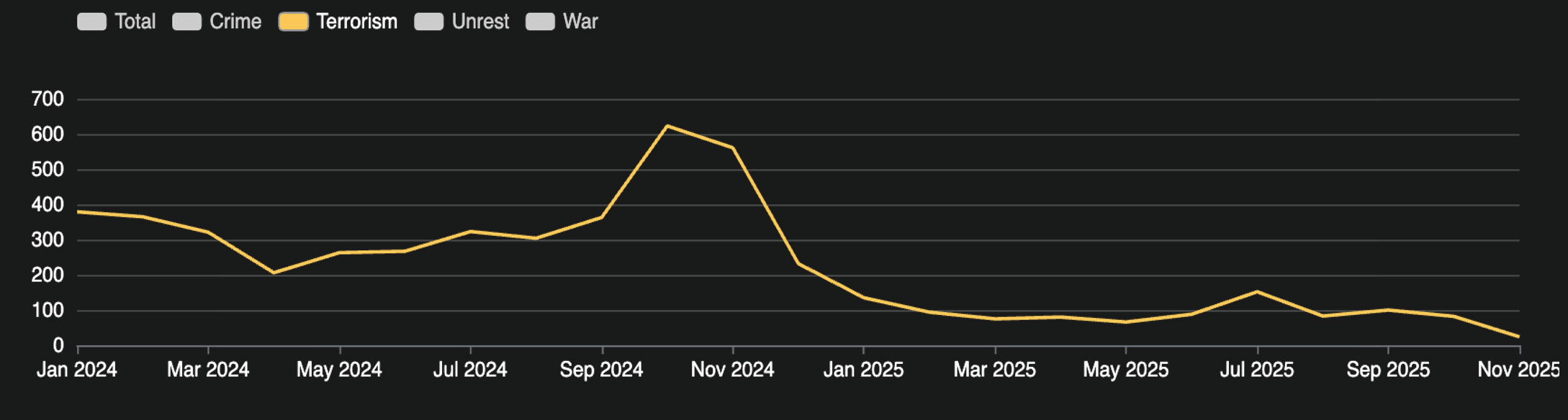
Consistently high levels of Terrorism events due to the Israel-Hamas and Israel-Hizbullah wars, as well as clashes between the former Syrian regime and Hay’at Tahrir Al-Sham (HTS)
Increase in Terrorism Events due to escalation between Israel and Hizbullah following the September pager attack, as well as the fall of the Assad regime and HTS victory
Consistently low levels of Terrorism events following the Israel-Hizbullah ceasefire in November 2024, fall of Assad regime in December 2024, and Israel-Hamas ceasefires in January 2025 and October 2025
Analyst’s Note: Palestinian militants have also targeted Israeli soldiers with vehicle rammings five times and stabbing attacks nine times in the Palestinian Territories in 2025.
Knife/bladed weapon 5
Vehicle ramming 4
Gun (firearm) 3
IED/ Homemade 3
Grenade 1
Roadside bomb 1
REGIONAL OVERVIEW: AFRICA
Regional Overview: Africa
Analysis: Despite a slight spike in recorded verified terrorism events across Africa in December 2023, Seerist and Control Risks' data since 2021 does not suggest that the region experiences a clear and regular uptick in terrorist attacks during the holiday season. Africa continues to be a global terrorism hotspot, with only two months since 2021 (September and October 2024) recording less than 90 verified terrorism events.
Looking at terrorism trends in the region over the past two years (November 2023 – November 2025), increased periods of militancy in the Sahelian countries of Mali, Burkina Faso, and Niger by Islamist extremist groups have driven the most prominent spikes in Verified Terrorism Events, as shown by the line chart above.
December 2023 saw a clear spike in terrorism events due to a surge in attacks in the Sahel by Al-Qaeda and Islamic State (IS) affiliated groups
Clear increase in terrorism events in January and February 2025 due to sustained strings of attacks by Al-Qaeda affiliate Nusrat al-Islam (JNIM) in Burkina Faso and Mali
Spike in terrorism events in October 2025 due to a coordinated campaign of attacks by JNIM on Malian fuel convoys and an uptick in attacks by Al-Sunnah militants in Mozambique
Outlook: Any large-scale and complex terrorist attacks over the holiday season are most likely in regions with highly active militant groups, which include North Africa and the Sahel region of West Africa. Most attacks are unlikely to be directly motivated by militant groups' attempts to disrupt communities celebrating the holiday season, but rather sporadic attacks linked to surges in month-to-month variations in militant activity.
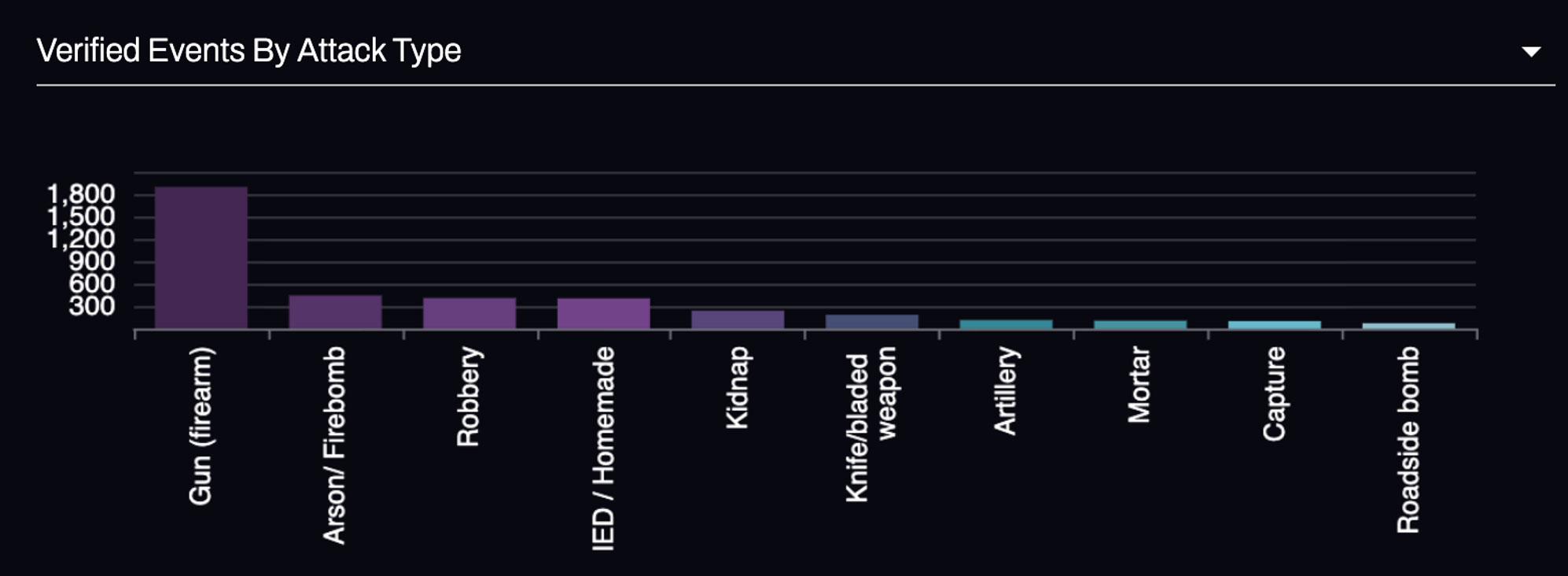
Analyst's Note: Unlike in other regions, vehicle rammings as an attack type by terrorist groups are extremely uncommon in Africa. Gunfire and arson (torching of property) are the two top attack types. Robberies also feature heavily, reflecting the reality that militant groups in Africa often launch attacks to gather resources and supplies to sustain their operations.
In-Focus Snippet: Are Christians in Nigeria facing increased threats from terrorist and armed groups?
READ MORE
The United States government and several international Christian advocacy groups have increasingly cited recent security incidents in Nigeria to declare that Christian communities across the country are being systematically and disproportionally targeted in attacks by terrorist and armed groups. Nigerian authorities however claim that terrorist attacks are largely indiscriminate in their impact, and that the US government's depiction of disproportionate suffering among Christians is an inaccurate reflection of the realities. While Control Risks' sources in Nigeria have noted an uptick in attacks on Christian communities by armed herdsmen since 2023, the US government's claim that militant groups more frequently attack Christians than Muslims – or if the motivations are purely religious – remains challenging to verify. A fatal attack on 18 November by an armed group at the Christ Apostolic Church (CAC) in Eruku, Kwara state, represents the most recent event fueling existing narratives around the targeting of Christians in the country. Outlook: Armed groups in Kwara state and the country more broadly are likely to interpret the church attack’s success as validation for additional mass-casualty assaults on soft targets, leading to more attacks. Security reinforcements around churches and other vulnerable targets are likely throughout November and December given public pressure, but such responses tend to be temporary.
Nigeria
Terrorism: Medium
REGIONAL OVERVIEW: APAC
Regional Overview: APAC
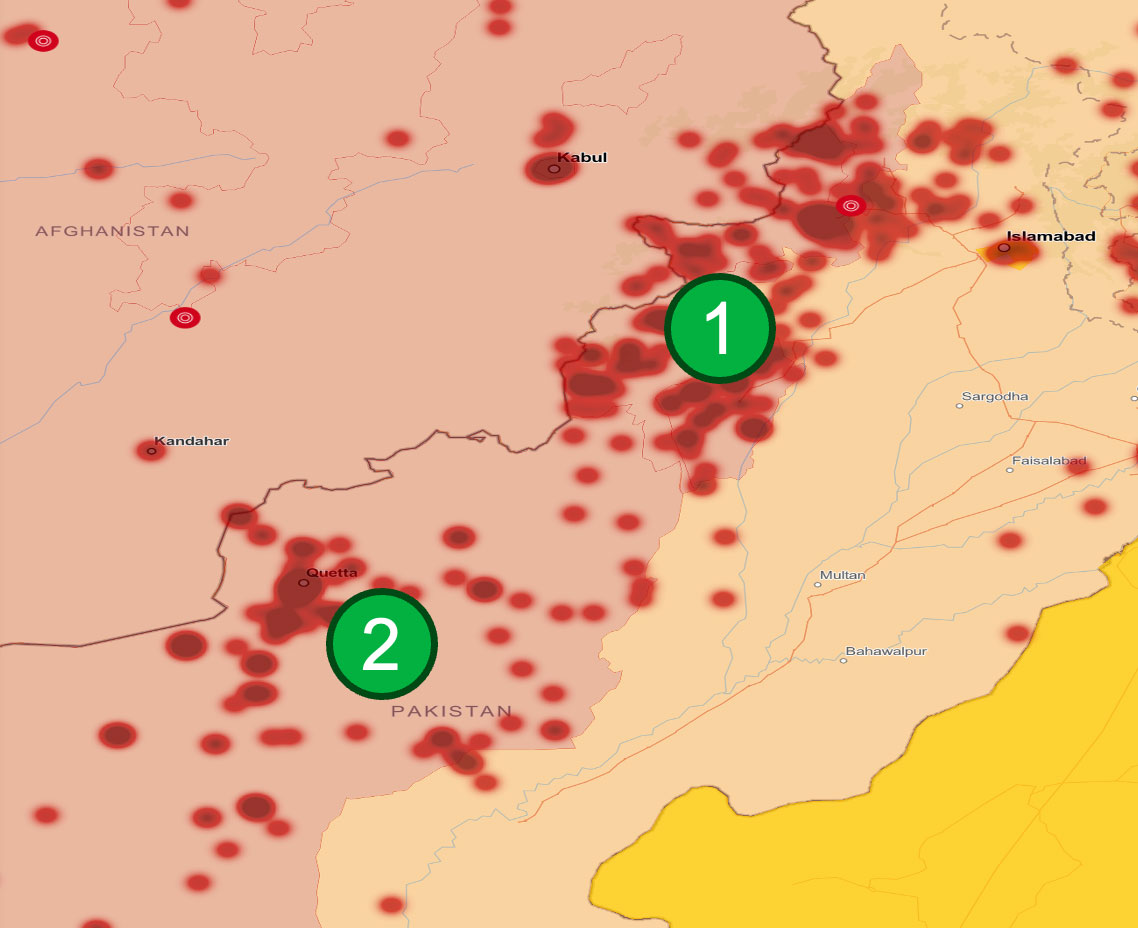
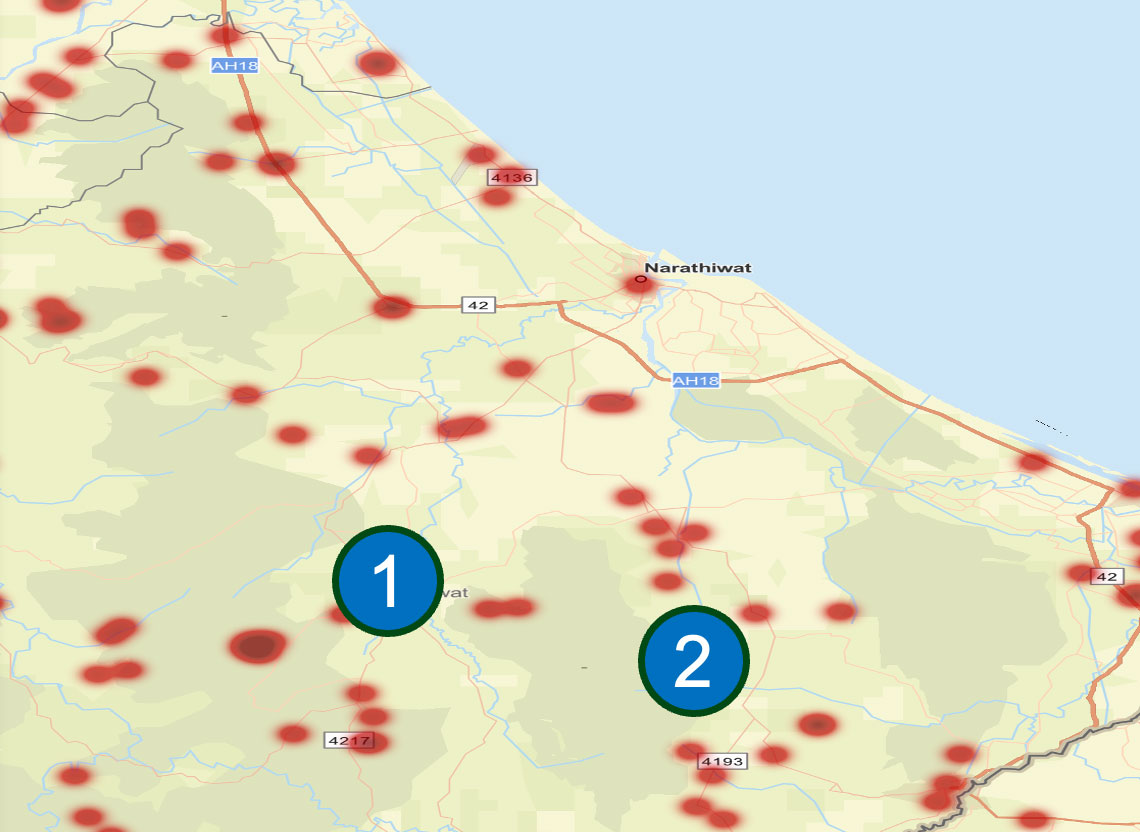
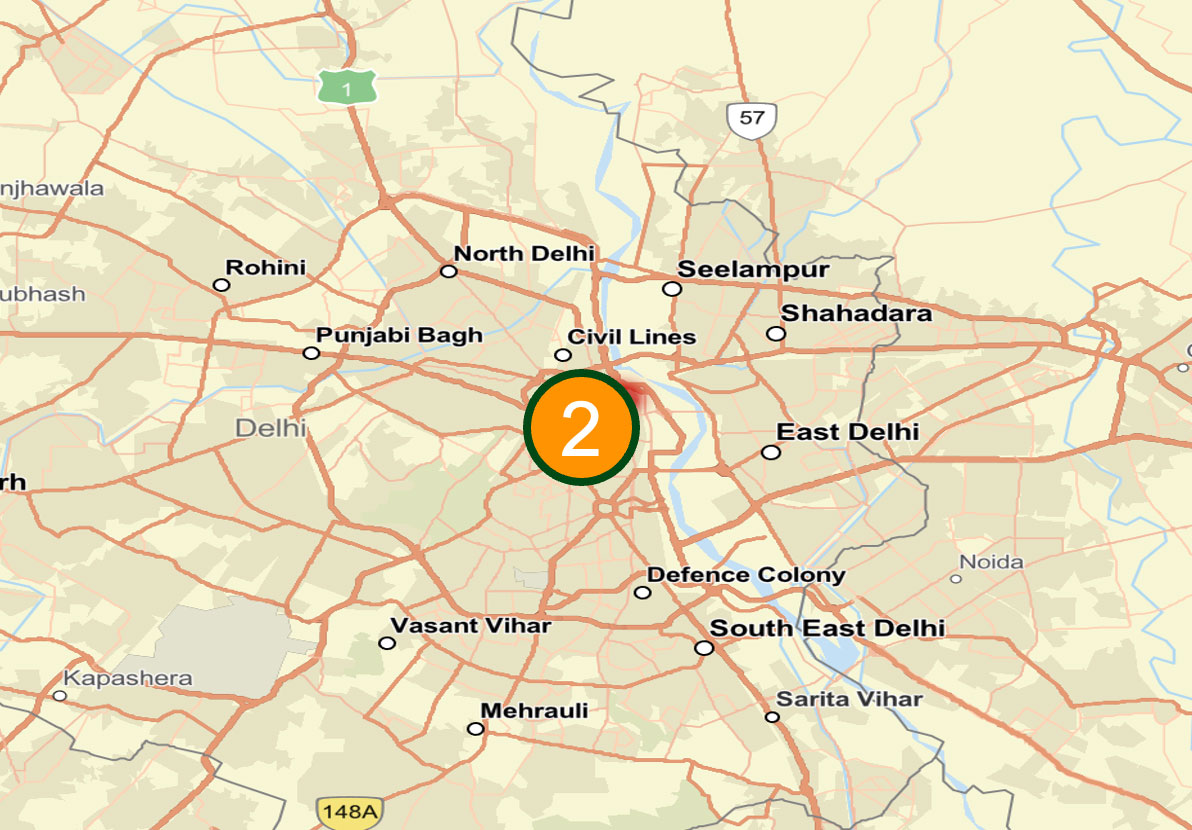
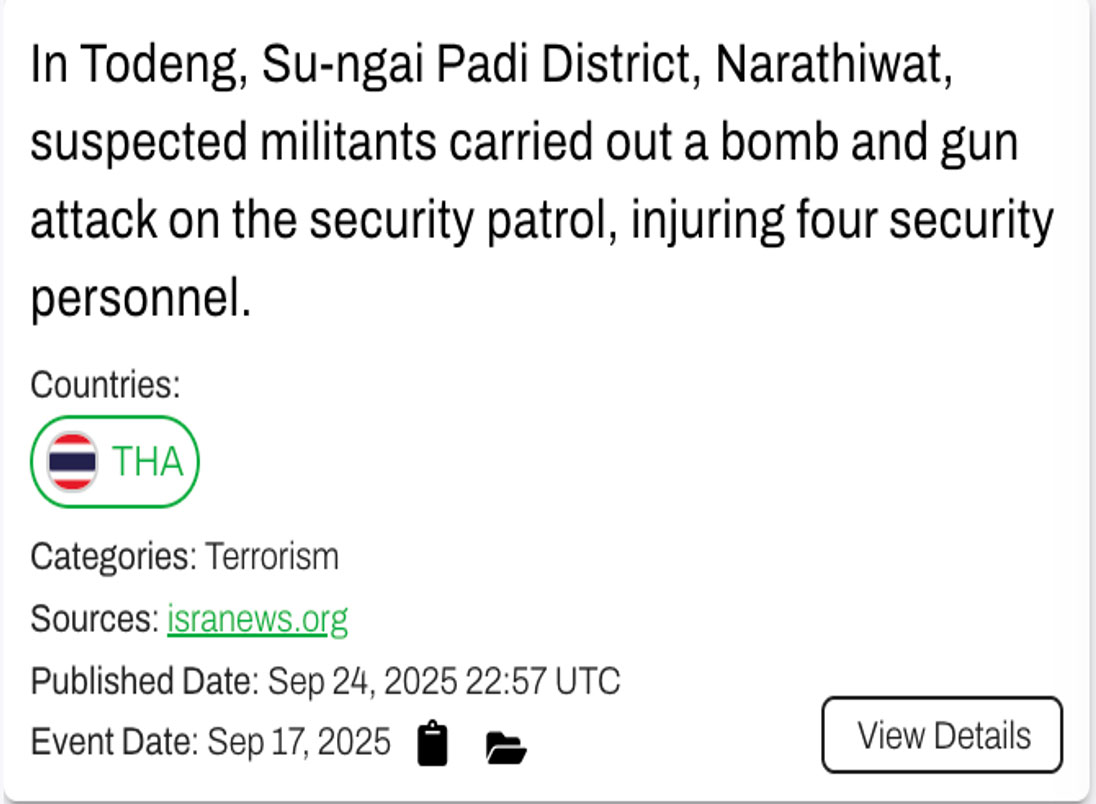
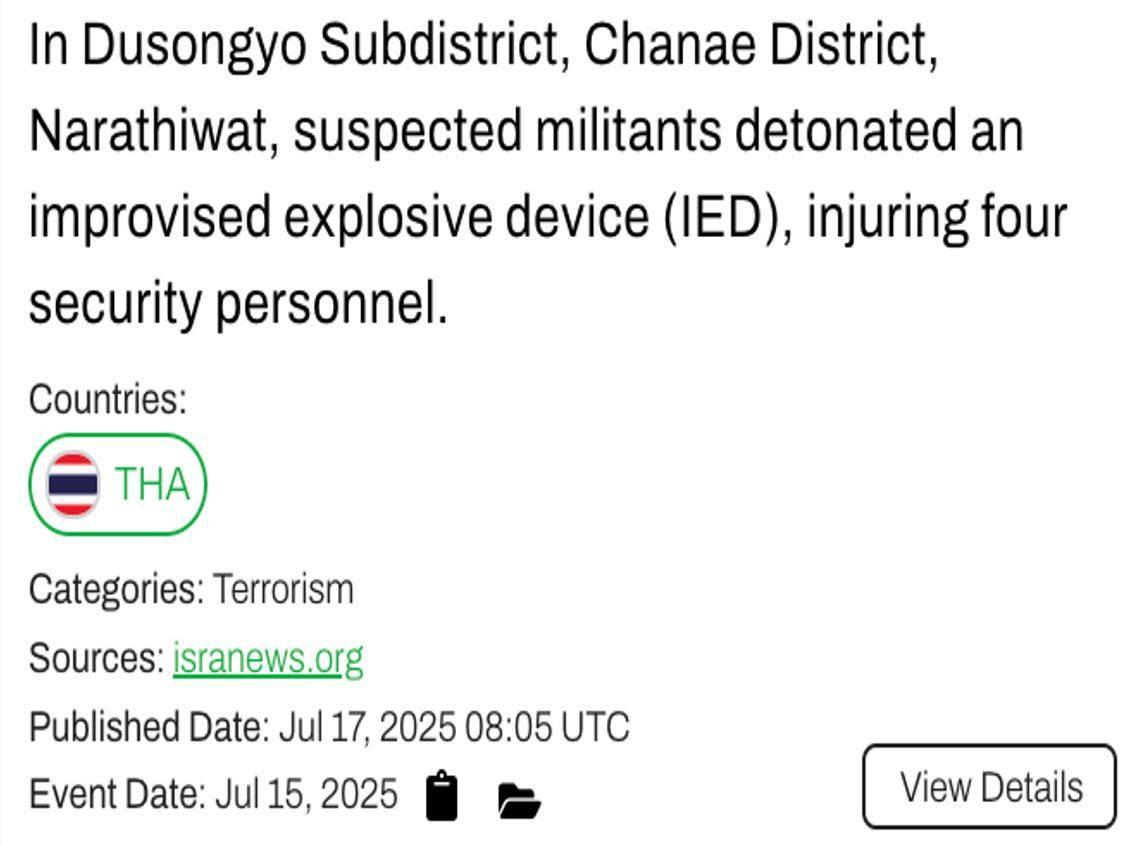
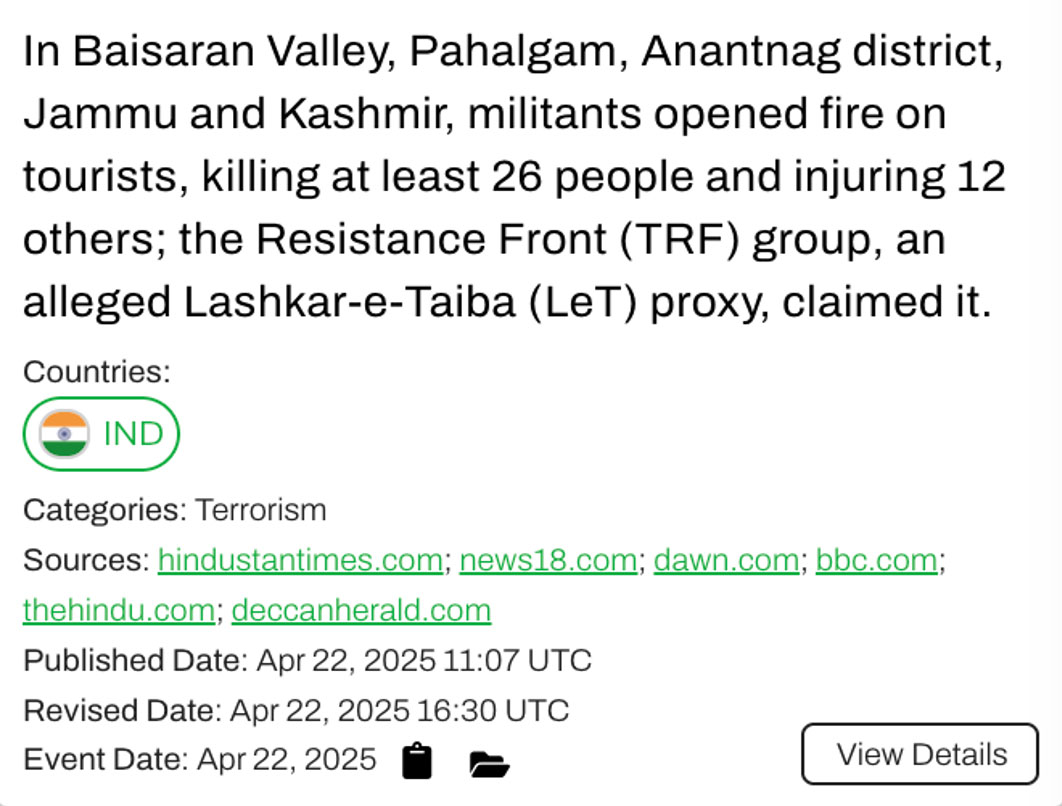
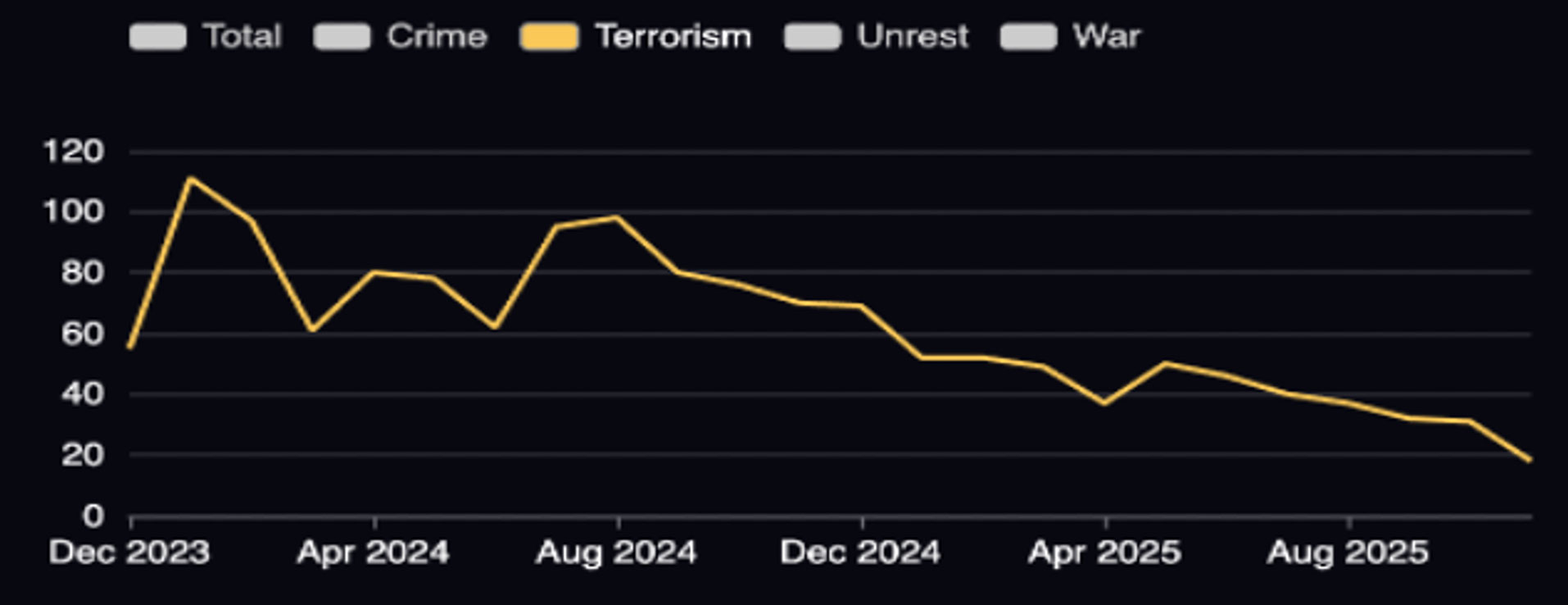
Analysis: Terrorism activity shows no signs of holiday related escalation based on Seerist and Control Risks’ data since December 2023. Instead, trends reflect persistent political and insurgent dynamics. In Pakistan, attack levels remain steady throughout the year with minimal seasonal variation, a pattern also observed in Afghanistan, Thailand and the Philippines. In contrast, India, and to a lesser extent Australia and New Zealand, where incidents are generally rare, may experience slight increases during the holiday period, though these fluctuations are neither strong nor consistently observable across verified events data.
REGIONAL OVERVIEW: LATAM
Heatmaps of Verified Terrorism Events in Pakistan, Thailand and India Click green buttons to view Verified Events.
Pakistan
Thailand
India
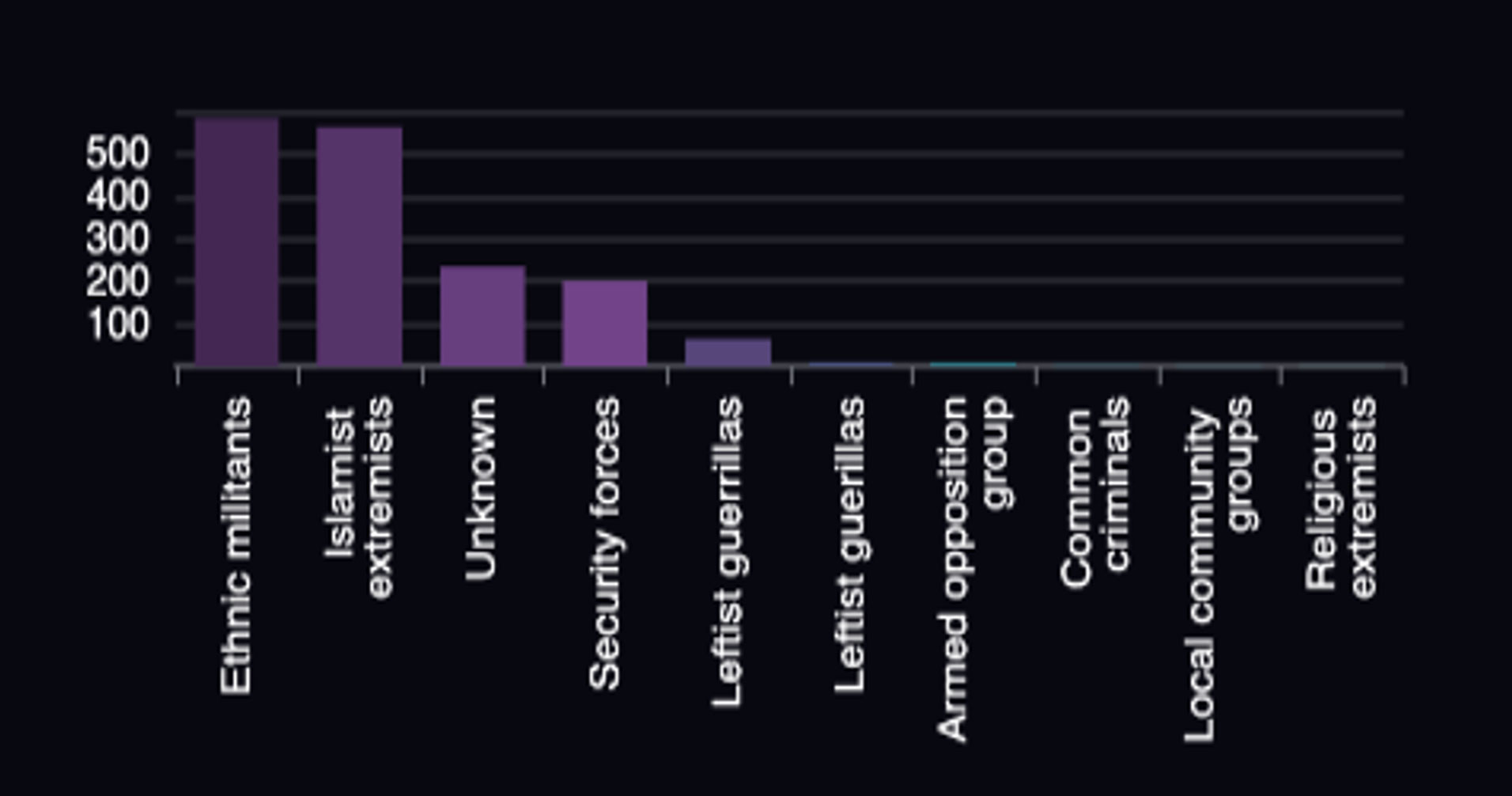
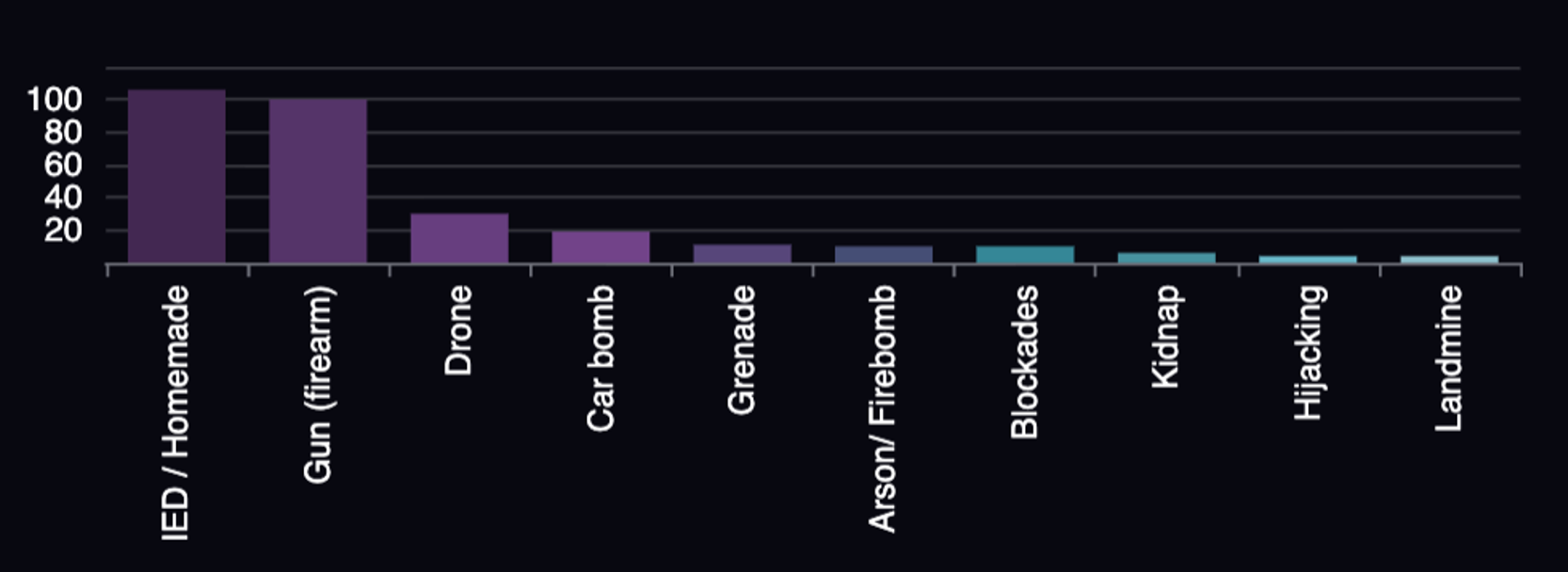
Analysist's Note: The terrorism attack profile is dominated by firearms, which make up over half of all incidents recorded during this period, followed by IEDs at around 20%. Overall, this reflects a strong reliance on low-cost, easily deployable weapons.
Ethnic militants and Islamist extremist groups together account for most recorded attacks, reinforcing that terrorism activity is concentrated within a few highly active militant ecosystems.
APAC Verified Terrorism Events (Dec 2023 – Dec 2025)
APAC Verified Terrorism Events by ‘Perpetrator’
APAC Verified Terrorism Events by ‘Attack Type’
Gun (firearm) 865
IED/ Homemade 346
Grenade 160
Arson/ Firebomb 94
Roadside bomb 52
Suicide bomber 39
Missile/ rocket 34
Car bomb 30
Knife 30
Landmine 21
Verified Terrorism Events
Verified Terrorism Events by Attack Type
Verified Terrorism Events by Perpetrator
Regional Overview: LATAM
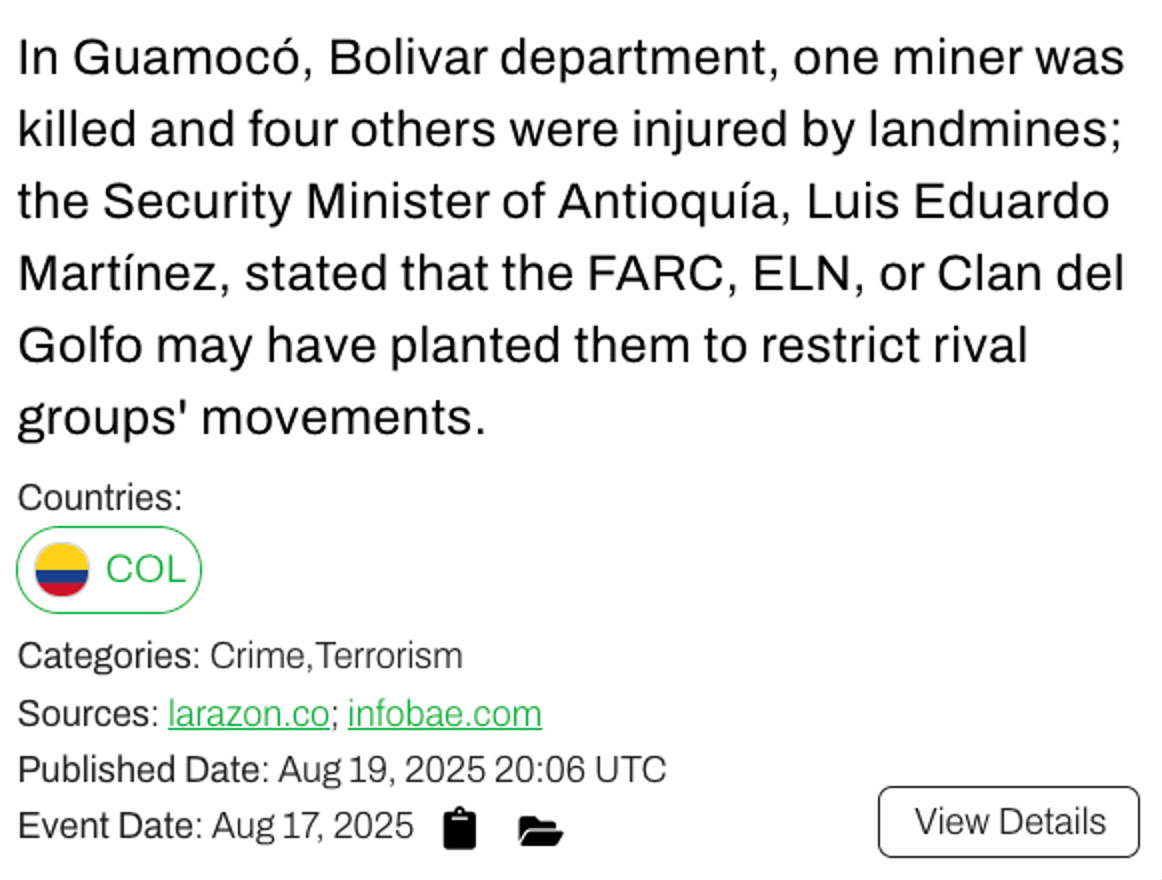
Analyst's note: After a temporary respite in 2023, terrorist acts since 2024 resumed an upward trend. In 2025 terrorism acts remain above the average recorded over the past decade. These attacks serve multiple purposes: to reinforce or defend territorial control in areas with active disputes; to deter or retaliate against military operations; to intimidate local populations to strengthen social control; and, to discourage cooperation with armed forces or rival groups.
IN FOCUS: GERMANY AND FRANCE
Heatmap of verified terrorism events in Colombia in 2025 Click green buttons to view Verified Events.
Elections: Government buildings, police stations and military headquarters are likely targets of increasingly violent guerrilla groups ahead of 2026 elections. Legislative elections will take place on 8 March 2026, and the first round of the presidential election will be on 31 May 2026. Outlook: Conflict hotspots in Cauca, Chocó, Valle del Cauca, Antioquia, Bolívar and Norte de Santander departments will remain exposed to the indirect effects of terrorist attacks targeting military assets, public buildings and critical infrastructure (such as roads and bridges).
The guerrilla is actively fighting rival organizations along the Venezuelan border and intends to become the dominant armed group.
Gulf Clan attacks in Antioquia target police and military personnel. In addition, clashes with the ELN are escalating as both seek to take over the other’s territory.
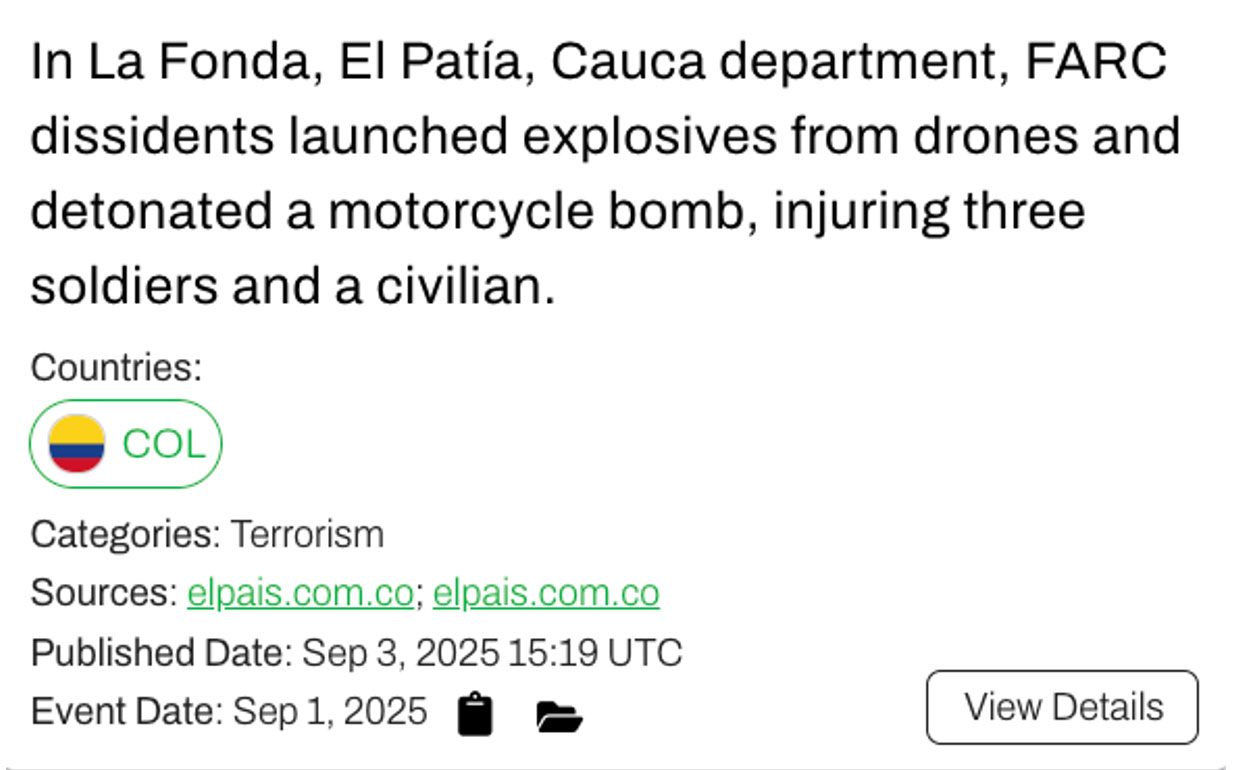
Two rival factions of the Central General Staff (EMC), a FARC dissident group, are engaged in a bloody turf war in southwestern Colombia.
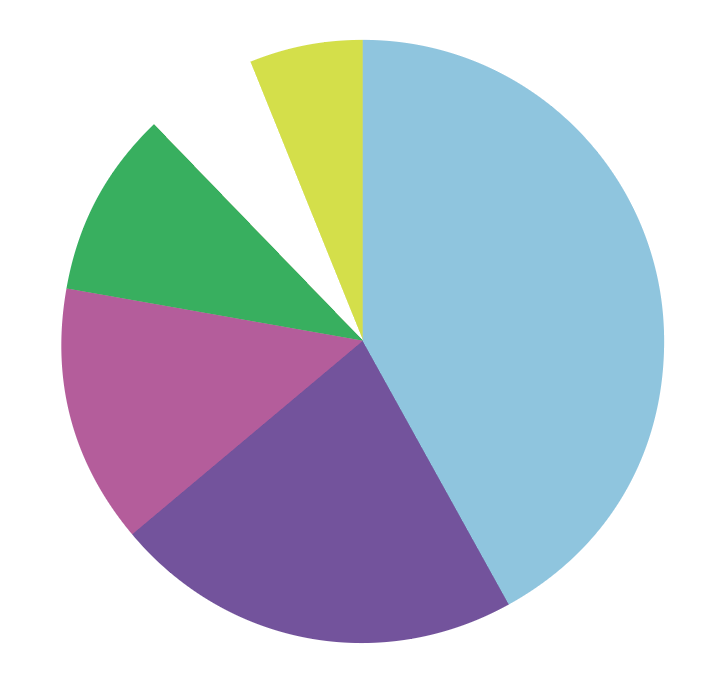
Government 6%
Road 9%
Private Property 18%
Military 28%
Law Enforcement 26%
Public spaces 5%
Sectors targeted by identified terrorist attacks in Colombia
Analyst's Note: Military, Law Enforcement and Private Property, remain the most affected sectors, with targeted shootings and IED/homemade explosives as the most repeated attack types. Armed groups are increasingly using airborne explosive devices (drones).
In Focus: Germany and France
Germany Terrorism Overview
IN FOCUS: US TERRORISM
The threat of terrorism affecting personnel or business in Germany is limited but has risen in recent years in line with the increased activity of far-right and Islamist extremists, in particular Islamic State (IS) and individuals inspired by its ideology. Attacks by Islamist extremists are most likely to target transport infrastructure or crowded public spaces, such as shopping streets and tourist sites. Unsophisticated attacks by lone attackers, involving knives or vehicles as weapons, are increasingly common. Attacks by far-right extremists will likely target ethnic minorities and be indiscriminate in nature. Attacks in recent years have seen individuals acting alone and using firearms, and this trend is likely to continue. While Germany’s security and intelligence services are highly effective and able to prevent most complex and coordinated attacks, Islamist extremists maintain some capability to carry out such attacks, including those involving explosives or active shooters. Most successful attacks in future will however likely be technology-poor or carried out by lone actors. Looking ahead at the 2025 holiday season in Germany, the terrorism threat for personnel will remain elevated, particularly around public events and touristic sites.
Germany
Nov 2016
Dec 2024
PLOT 26 November 2016 Ludwigshafen, Germany A young boy radicalized by an Islamic State (IS) supporter attempts to blow up a nail bomb at a Christmas Market, but it fails to detonate. Police later uncover the plot and arrest the boy on 16 December.
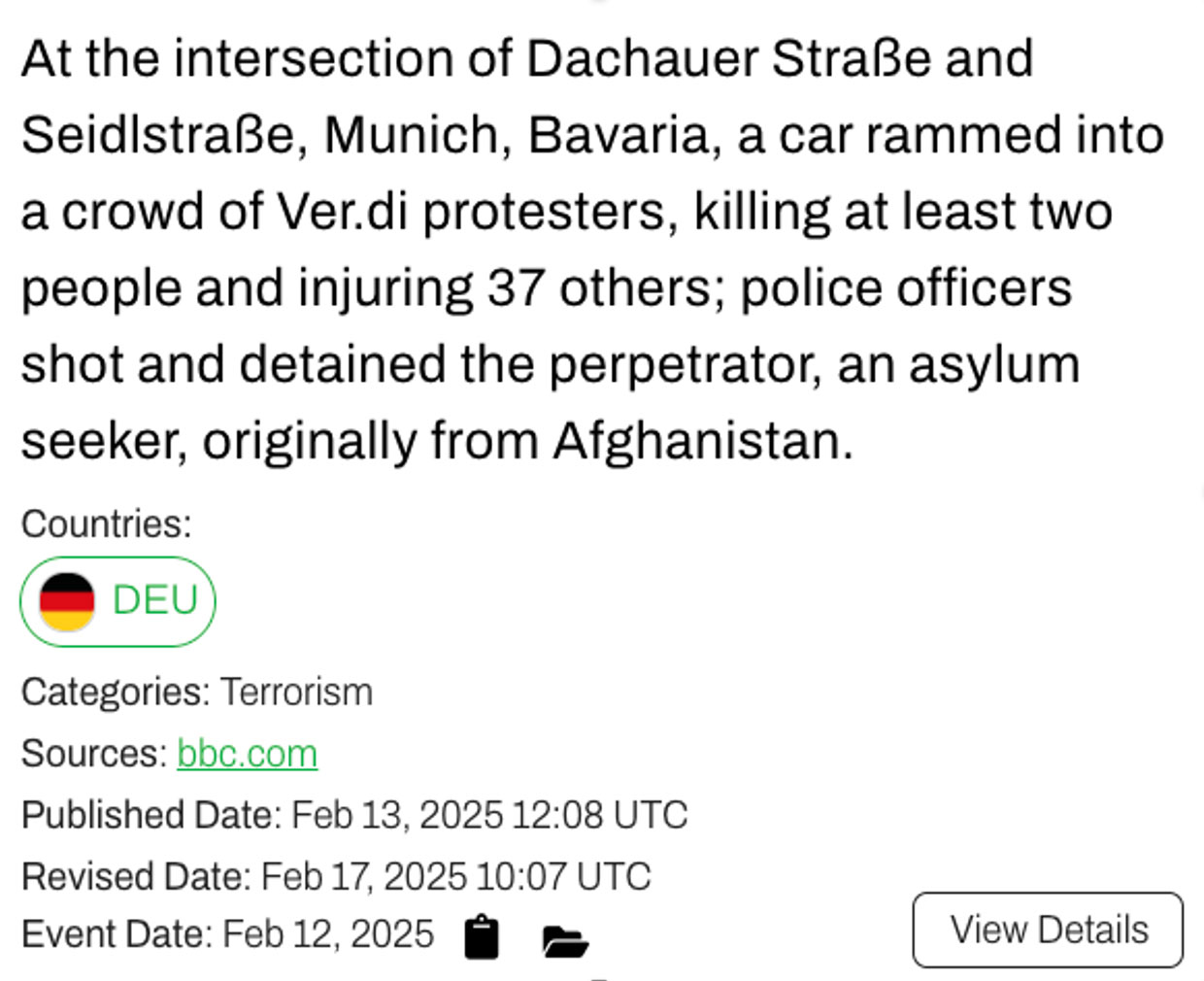
ATTACK 19 December 2016 Berlin, Germany A Tunisian Islamist extremist rams a truck into the Christmas market at Breitscheidplatz, killing 13 people and injuring 56.
ATTACK 11 December 2018 Strasbourg, France A French-Algerian national motivated by Islamist extremist ideology attacked crowds at the Christmas market in a shooting and stabbing attack, killing five people and wounding 11.
PLOT 29 November 2023 Leverkusen, Germany Police arrest a teenager radicalized by Islamist extremist ideology who planned to drive a truck into crowds attending the city's Christmas market in the Opladen district.
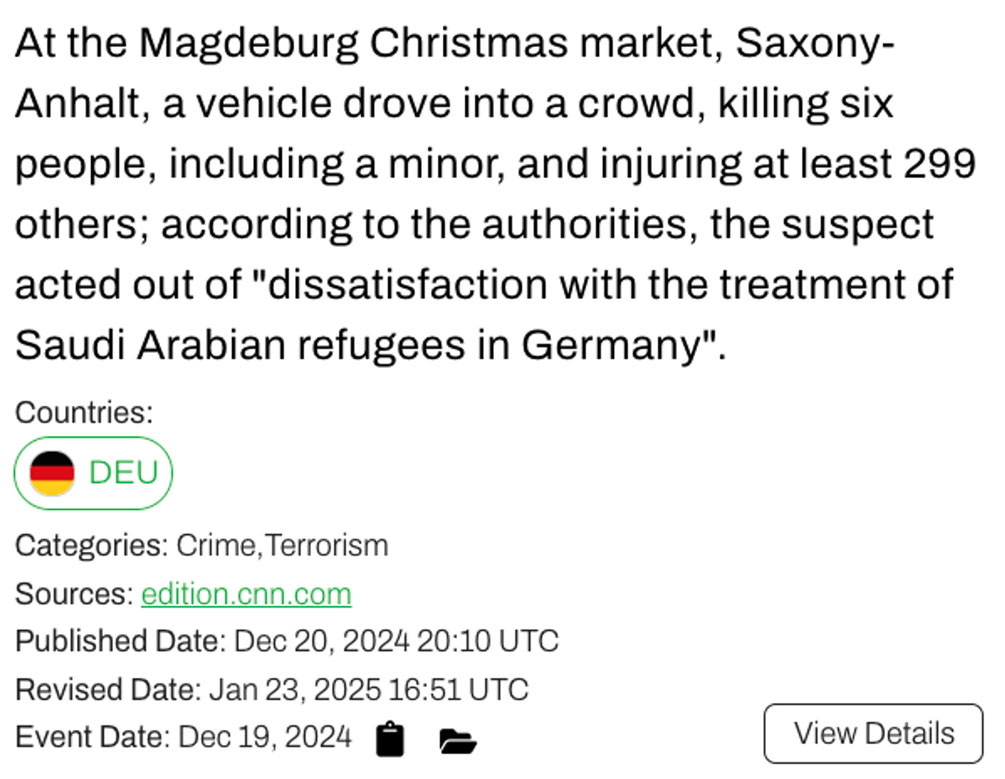
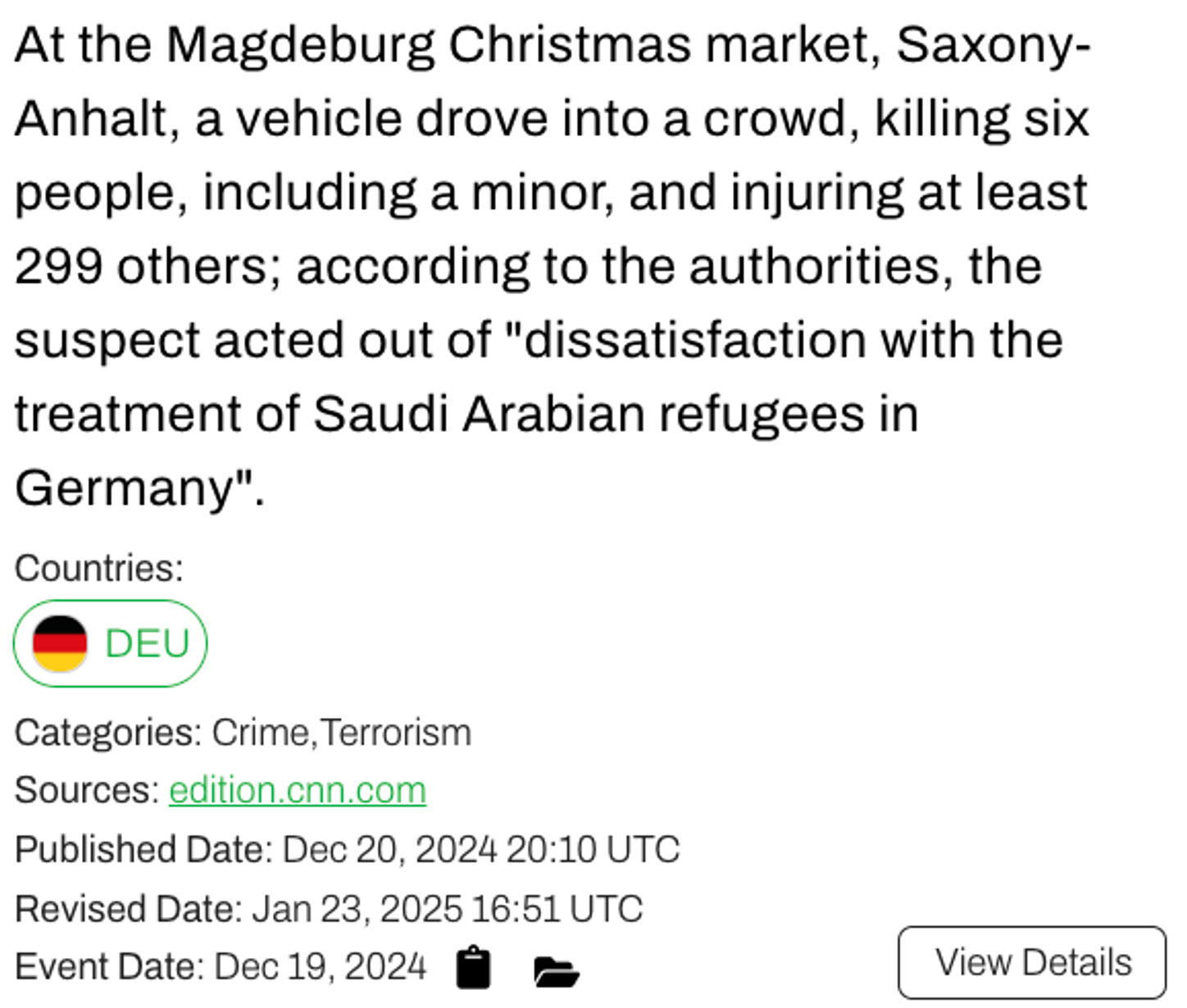
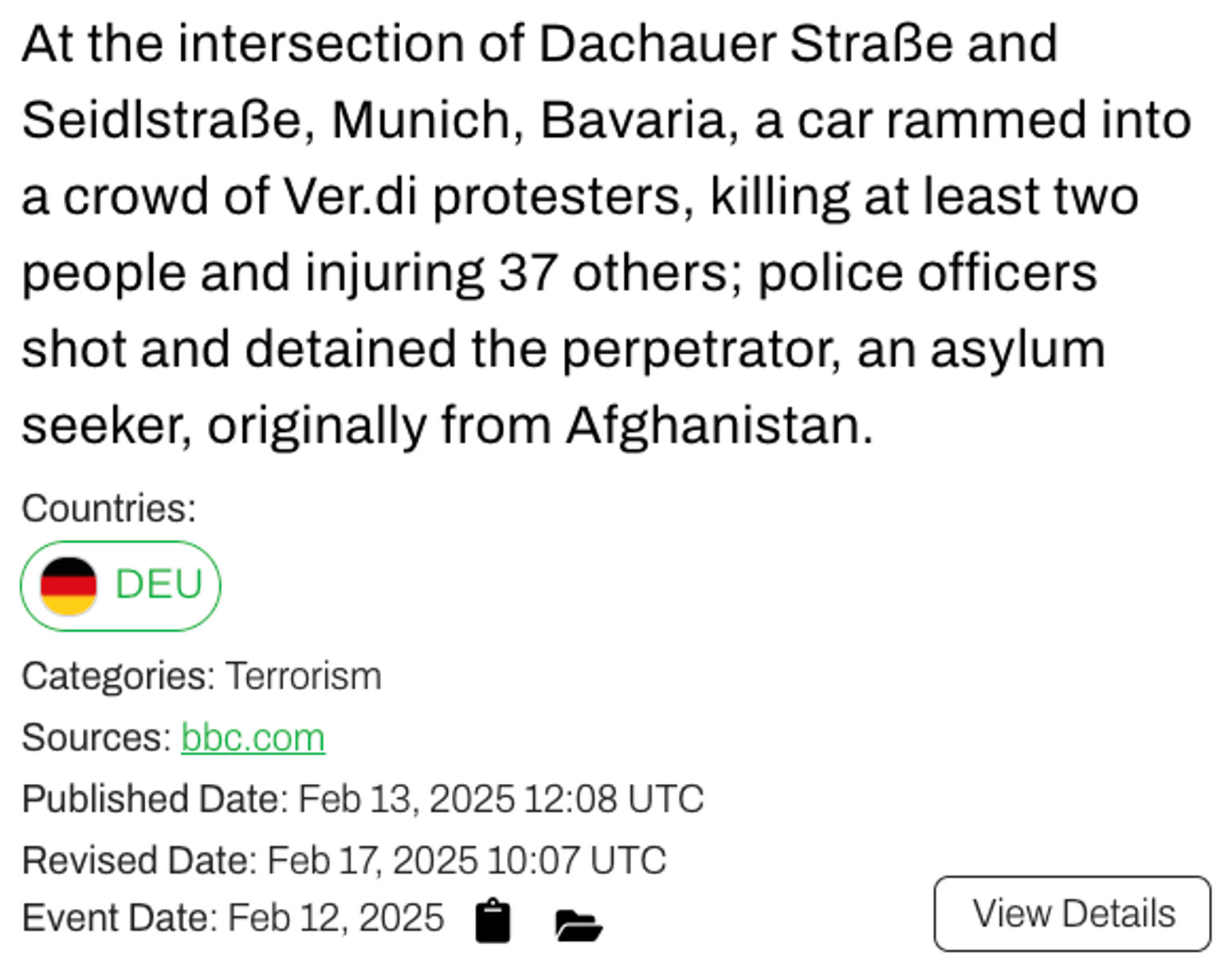
ATTACK 19 December 2024 Madeburg, Germany A Saudi national motivated by unclear ideology rammed his SUV into crowds at the local Christmas market, killing six people and injuring 323 others.
Timeline of terrorist attacks or publicly known plots targeting the Christmas / holiday season in Germany and France since 2015
France Terrorism Overview
Islamist extremist terrorist attacks have decreased since a peak in the mid-2010s, but further attacks remain likely. Since the high-profile 2015-2016 attacks in Paris and Nice, several smaller-scale attacks have taken place – including the killing of teacher Samuel Paty in October 2020 and most recently the February 2025 knife attack in Mulhouse. Although the state of emergency imposed following the 2015 attacks was lifted in 2017, heightened counter-terrorism measures remain in place and are usually implemented around high-profile events. Since the 2015 attacks, there has been a shift away from coordinated attacks involving improvised explosive devices (IEDs) and firearms towards low-technology methods, such as hostage-taking or the use of vehicles or knives. These types of attacks are likely to continue to represent the most significant trend in the coming years, but extremists retain the intent to use high-impact methods, such as IEDs. The increase in far-right extremist activity in recent years has led to a string of attacks motivated by far-right extremism sentiment, including several involving vehicles and firearms. The primary targets of such attacks are likely to remain ethnic, racial and religious minorities and related assets, as well as politicians.
France
In Focus: US Terrorism
Although the threat from Islamist extremism has declined in the US since the mid-2010s, due to internal fractures and sustained law enforcement efforts, recent high-profile attacks have been characterized by a surge in politically motivated violence carried out by lone actors who hold traditionally right-wing or left-wing beliefs combined with conspiracy theories and personal grievances. These attacks reflect an extremist landscape that has become increasingly fragmented and volatile in recent years, driven by domestic sociopolitical factors including growing institutional mistrust and intensifying political polarization. This increasingly fragmented landscape has eroded taboos around targeted violence, particularly in the political sphere. Outlook: The convergence of a fragmented extremist landscape, the personalization of violence, polarizing political issues, and rising anti-corporate hostility heighten the risk that individual grievances escalate into targeted attacks. These trends will drive increasing threats from extremist-driven violence over the coming years. Analyst’s Note: The US terminated more than 80% of US Agency for International Development (USAID) contracts. Progressively deteriorating humanitarian crises in fragile states will also increase cross-border terrorism risks in the coming years. Extremist groups, including Islamic State and al-Qaida affiliates, will exploit regional drivers, including food insecurity and limited public services, to bolster membership and support.
IN FOCUS: VEHICLE RAMMING AS AN ATTACK TYPE
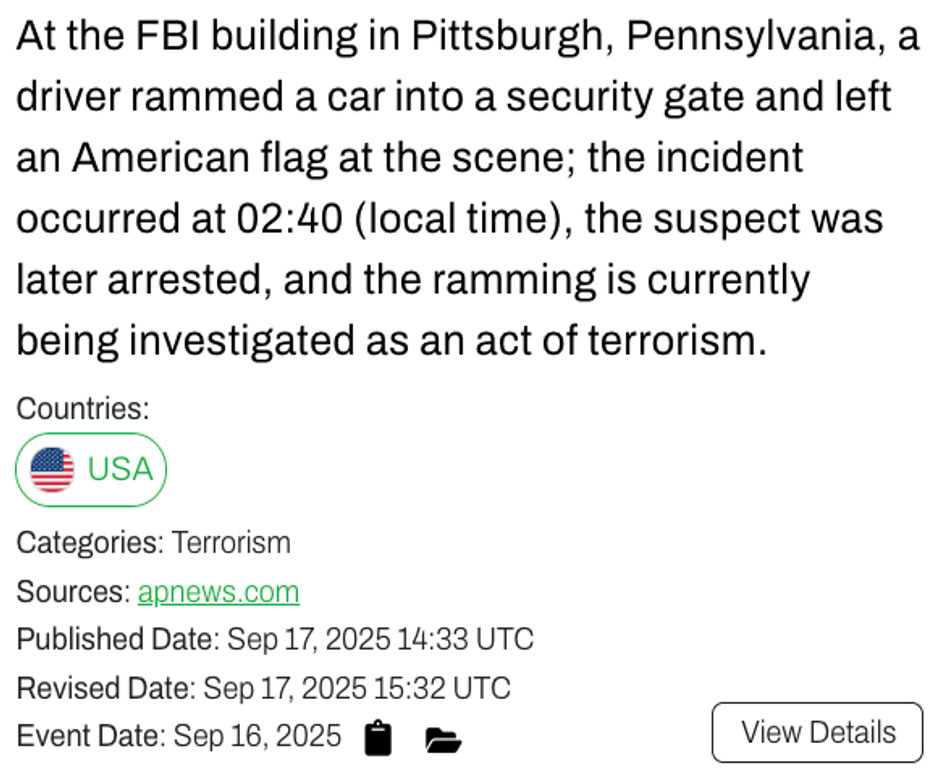
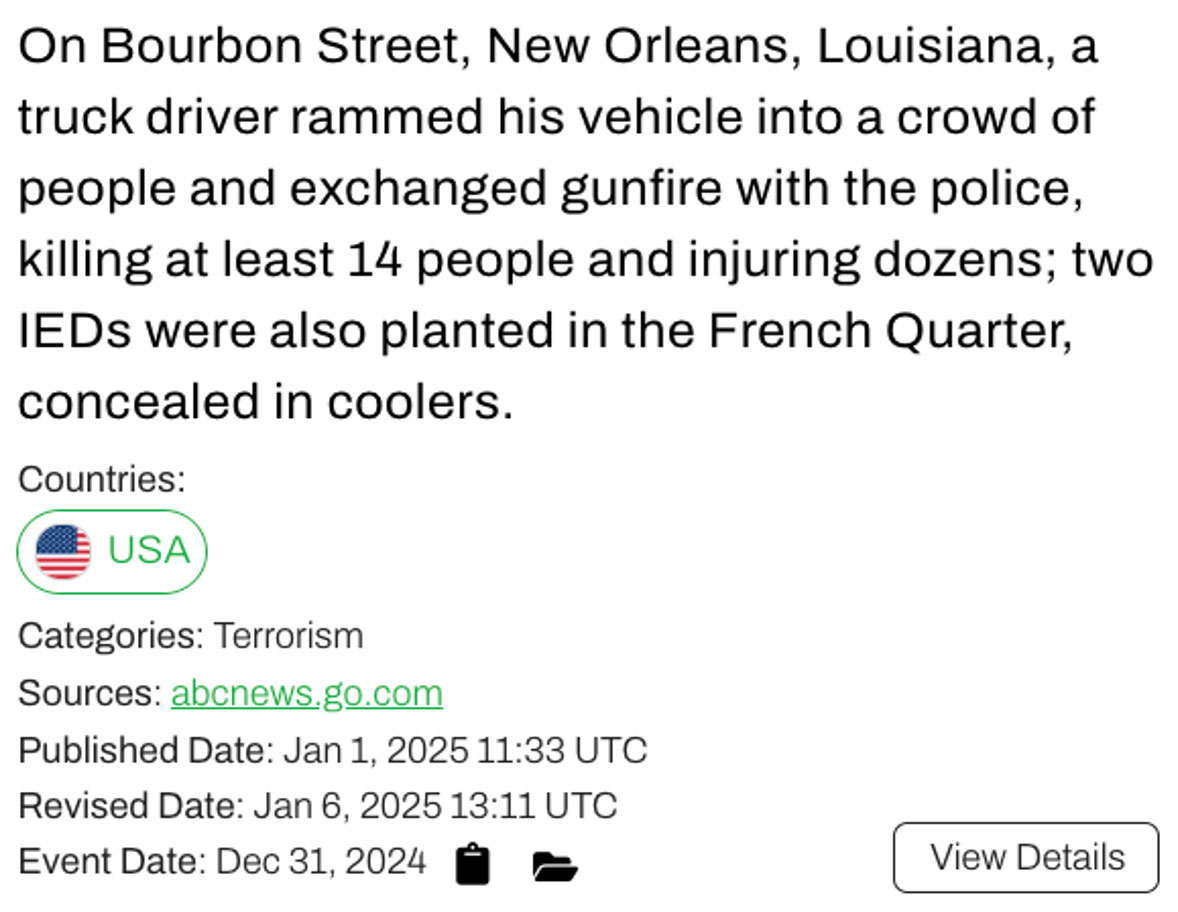
Police reportedly found an Islamic State (IS) flag in the vehicle, indicating allegiance to or affinity with the Islamist extremist group. Overlapping personal grievances and ideological radicalization have featured in past violent incidents.
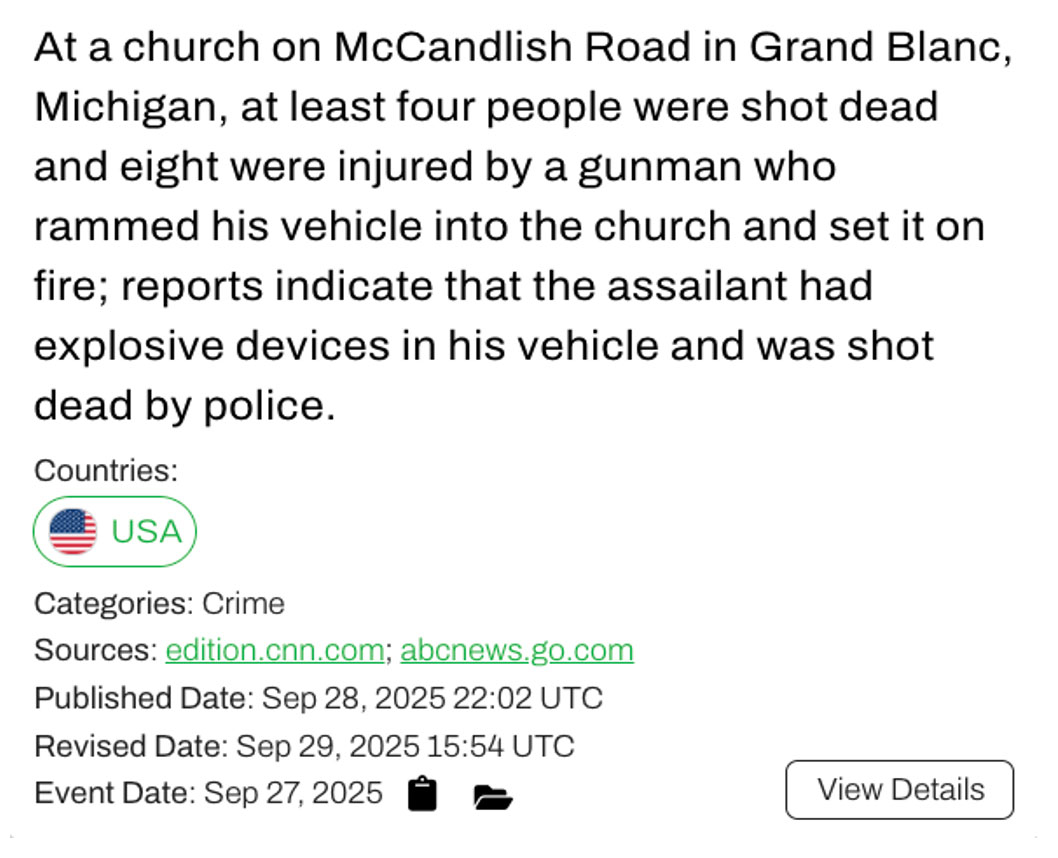
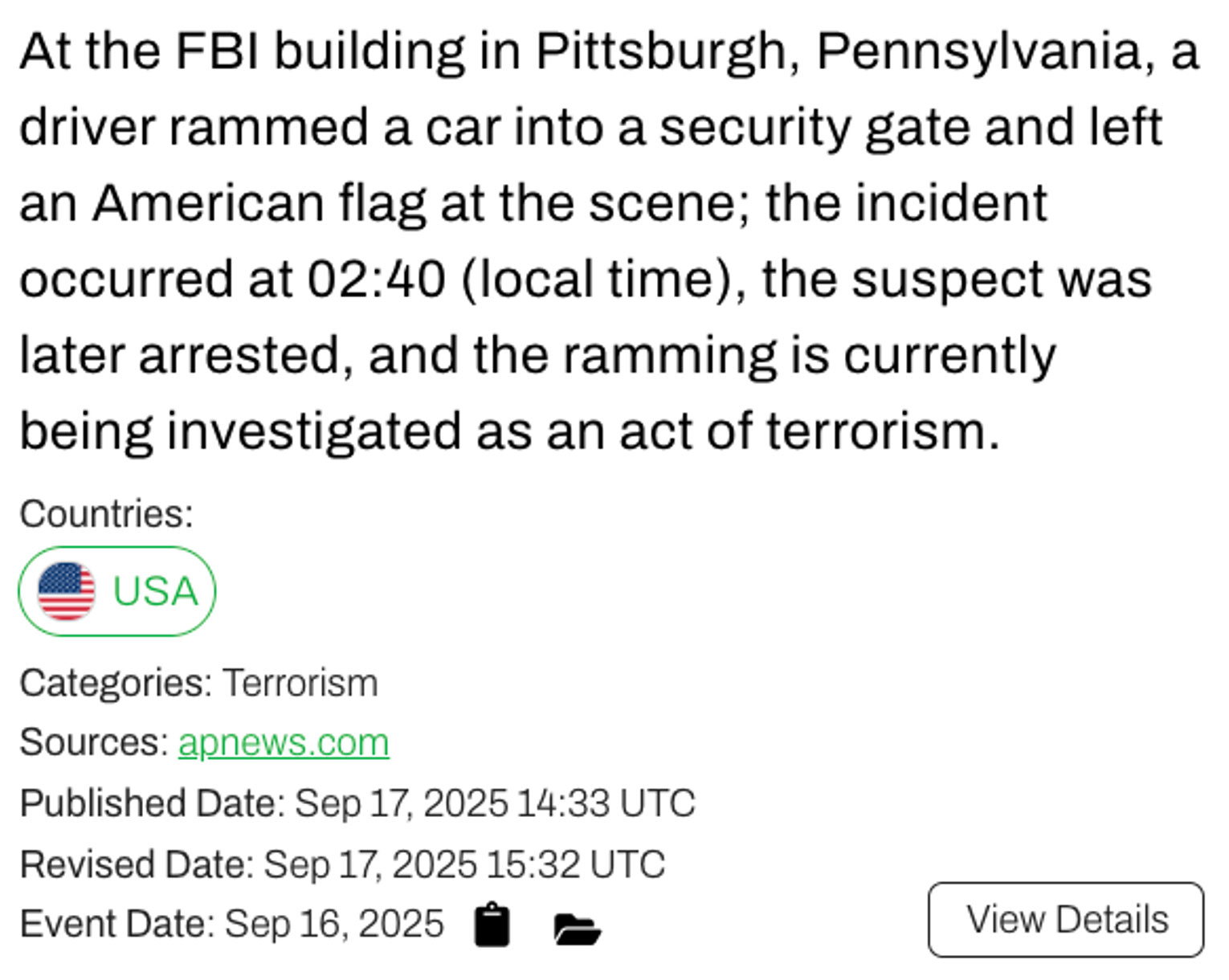
The perpetrator was reportedly fueled by political ideology, personal grievance and mental health. This attack follows a trend in the US where violence is driven by political polarization and radicalization channels. The perpetrator reportedly had identified about 70 potential political targets, including demonstrators at the “No Kings” protest.
This event follows a trend of increasing personalized and political violence attacks in the US that have escalated over the past two years. Despite swift condemnation of the shooting from both Republican and Democratic leaders, the immediate reaction on social media speaks to a highly polarized environment.
Nov 2025
Terrorism
Politically motivated violence
In Focus: Vehicle Ramming as an Attack Type
Vehicle Ramming attacks accounted for only 16% of verified terrorism events in Europe and the United States in the past year. However, Vehicle Ramming attacks accounted for 83.8% of all casualties (fatalities and injuries) resulting from verified terrorism events in the US and Europe in the past year.
IN FOCUS: LONE/UNSTABLE ACTORS AS PERPETRATORS
1 of 6
2 of 6
3 of 6
4 of 6
5 of 6
6 of 6
Holiday Event, Public Place, High Casualty
Sporting Event, Public Place, High Casualty
Political Event, Public Place, High Casualty
Political Asset
Religious Asset
Analyst’s Note: These attacks are generally unsophisticated and frequently carried out by lone actors, which makes prevention especially challenging. Businesses and employees are unlikely to be targeted directly in similar incidents. Crowded public spaces, cultural events and pedestrian zones remain primary targets for vehicle-ramming attacks.
In Focus: Lone/Unstable Actors as Perpetrators
While law enforcement in the US and European countries have improved their ability to disrupt complex terrorist plots, risks remain persistent as terrorist threats shift away from coordinated multi-perpetrator attacks and increasingly follow the trend of targeted violence by lone actors. France, Belgium, Germany and the UK hold a MEDIUM rating of terrorism risk for increased activity by far-right extremists, Islamist extremist group and unpredictable lone actor violence, often ideologically fluid or motivated by personal grievance.
CONTROL RISKS ANALYSIS
Analyst’s Note: Elevated security at event venues may redirect attackers towards unsecured targets near target venues, including public spaces, shopping areas and mass transit systems.
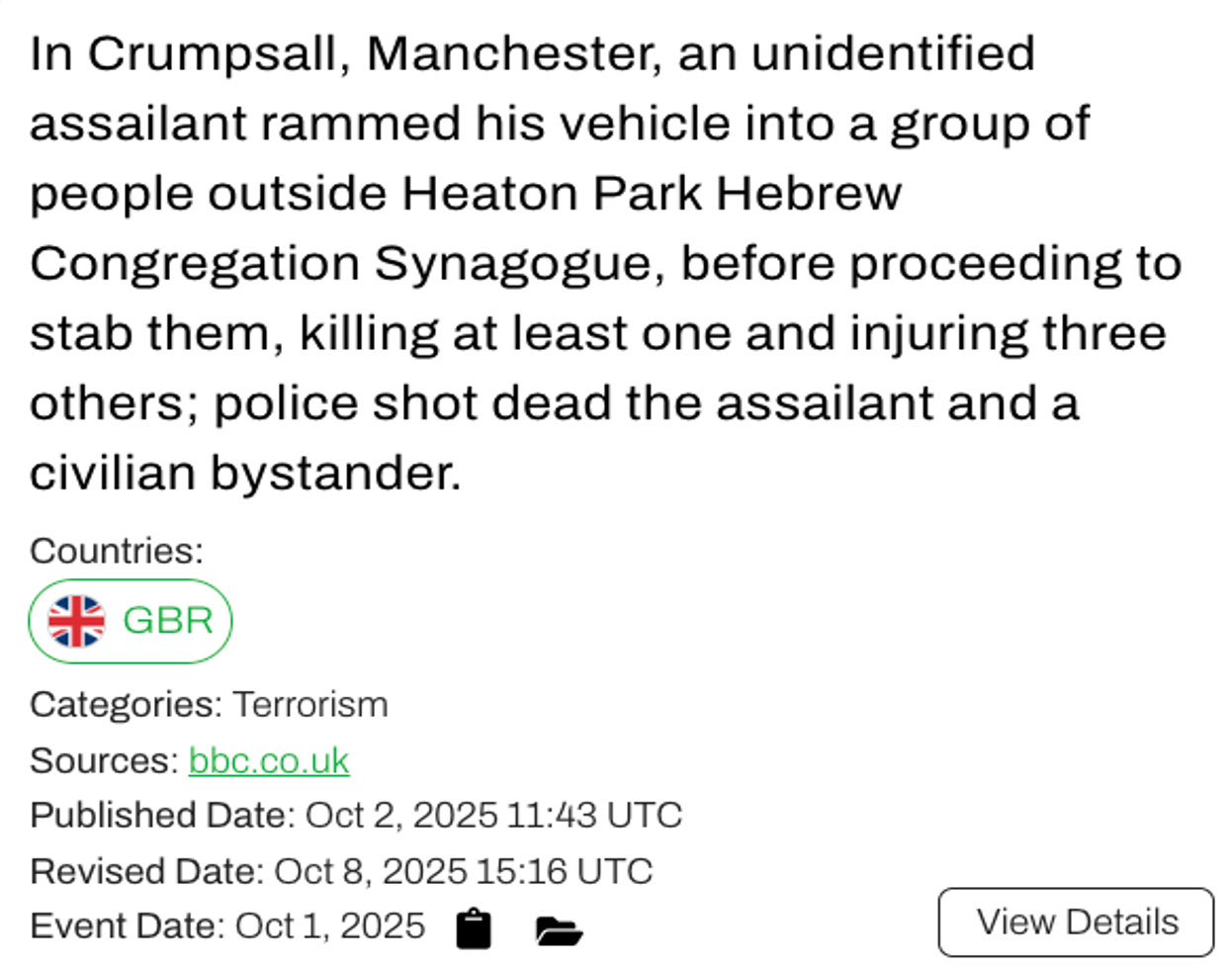
This attack reflects a wider trend of lone perpetrators engaging in low-sophistication attacks such as vehicle rammings or knife attacks. Although the motive remains unclear for this incident, similar attacks have been carried out by mentally unstable perpetrators and radicalized individuals with links to Islamic extremism.
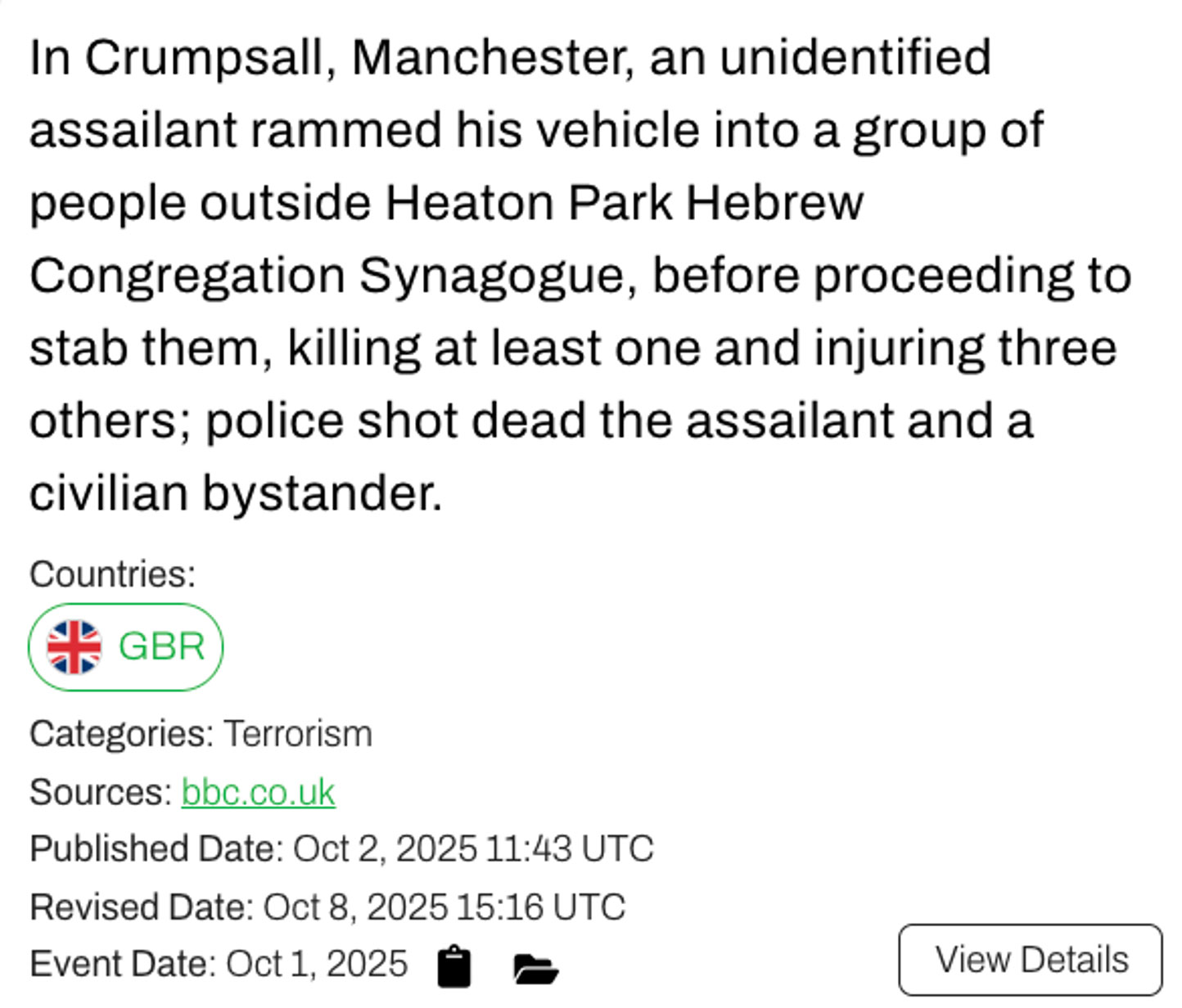
Complex attacks, especially those involving explosives and multiple perpetrators, are likely to remain very rare as UK security services have increasingly improved their capabilities in thwarting sophisticated terrorism plots. However, authorities will be unable to prevent all unsophisticated plots hatched by individuals, and the UK is likely to continue to see sporadic attacks in the coming years.
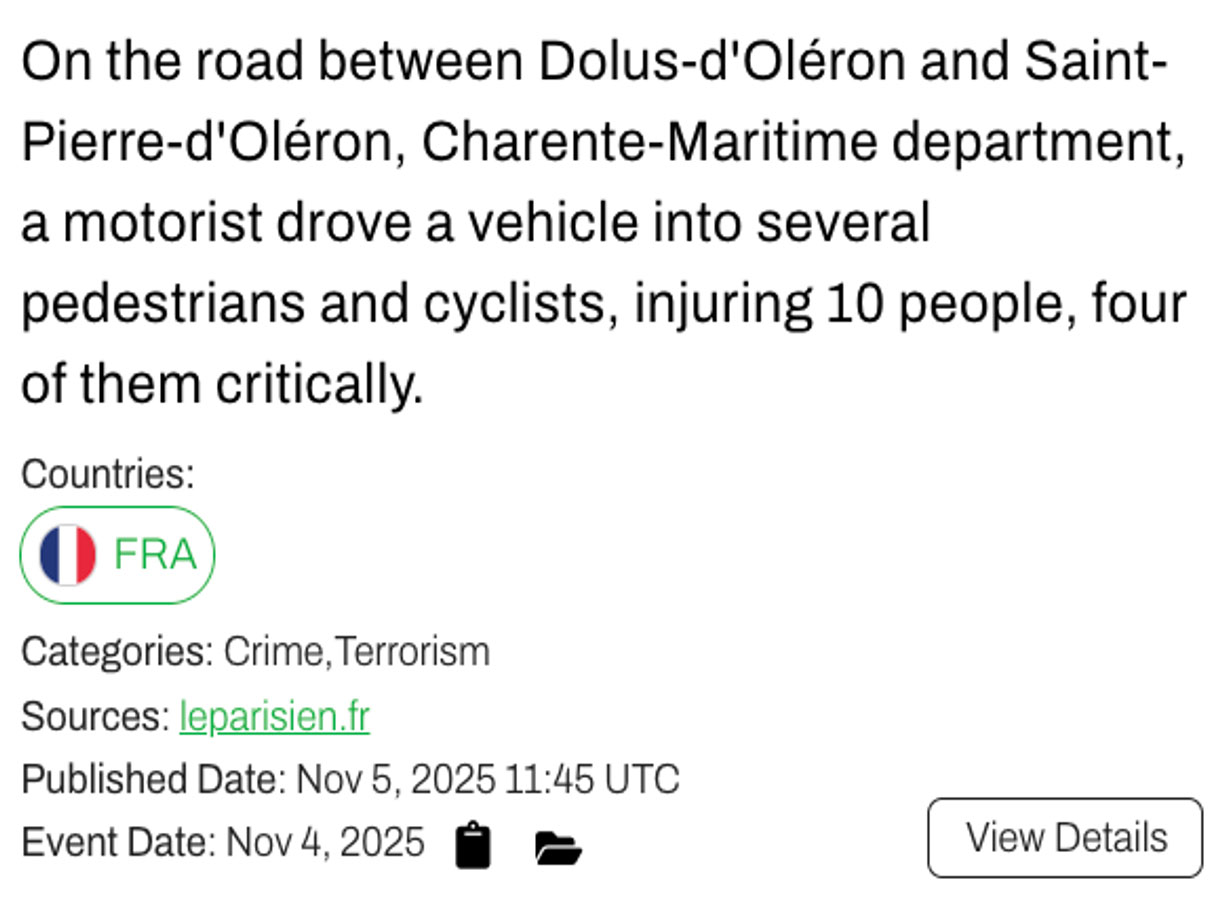
The attack reflects the broader trend in France of seemingly spontaneous attacks by lone actors, who often have poor mental health or unclear motivations. Attacks are taking place in increasingly varied locations, as evidenced by the rural location of this incident.
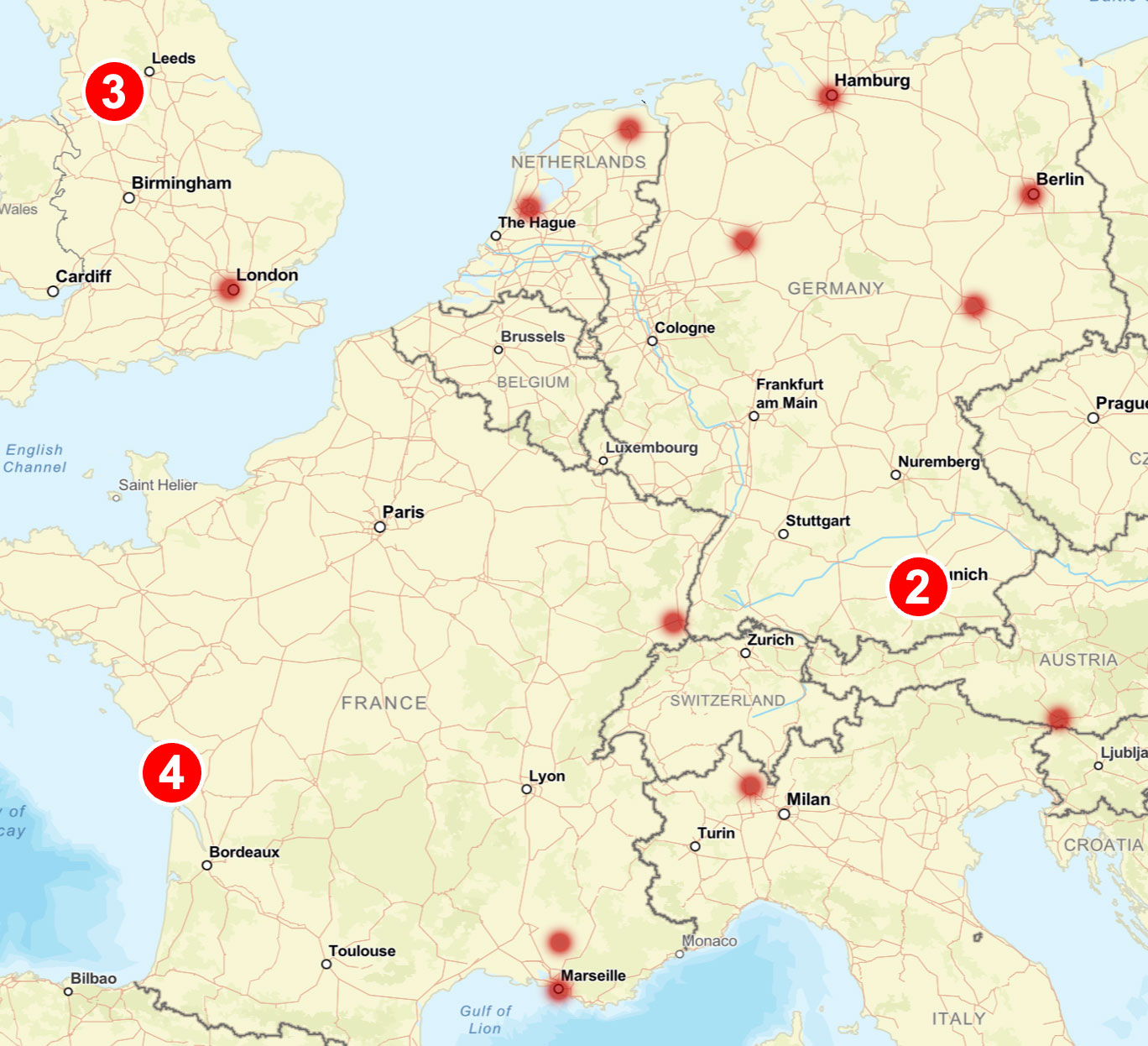
Heatmap of verified terrorism events in Europe and the US in 2025. Click green buttons below to view Verified Events.
Homegrown terrorists and other violent extremists are expected to continue to use firearms, improvised explosives, bladed weapons and vehicles in attacks against soft targets. The reported recovery of an IS flag is consistent with prior incidents of online radicalization and Islamist extremism.
Gun (firearm) 10%
IED/ Homemade 14%
Knife/bladed weapon 42%
Vehicle ramming 22%
Graph of ‘Attack Types’ in Europe and the US from lone actor attacks in 2025
FOLLOW US ON LINKED IN FOR MORE INSIGHTS
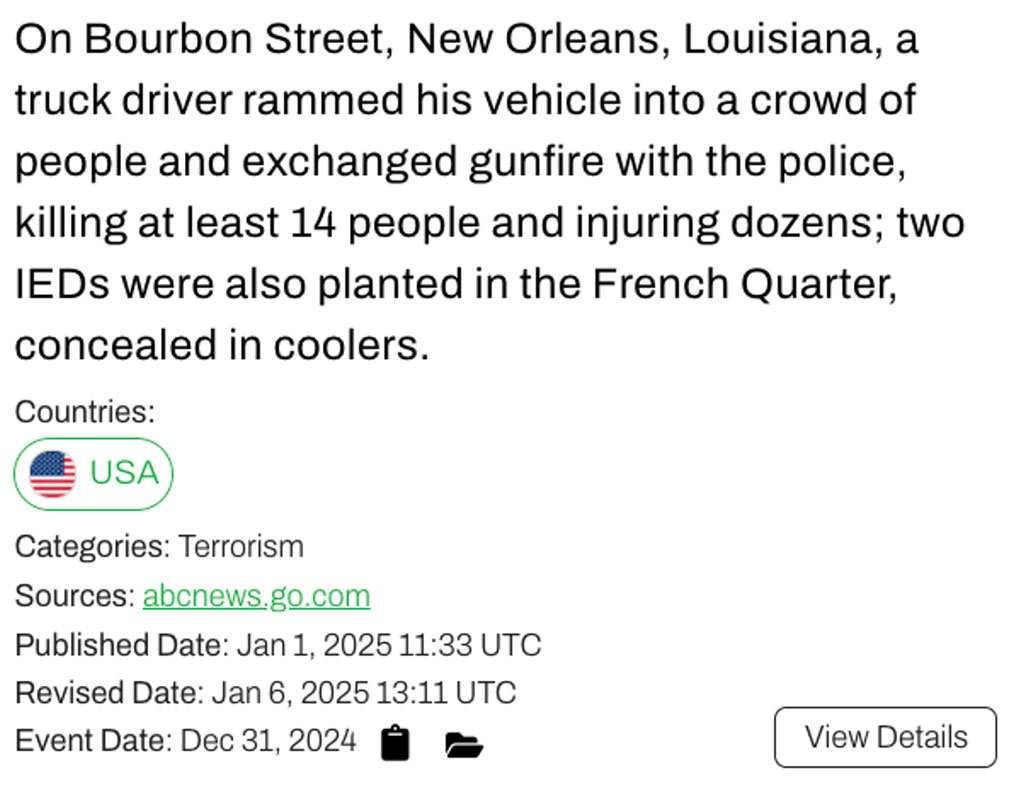
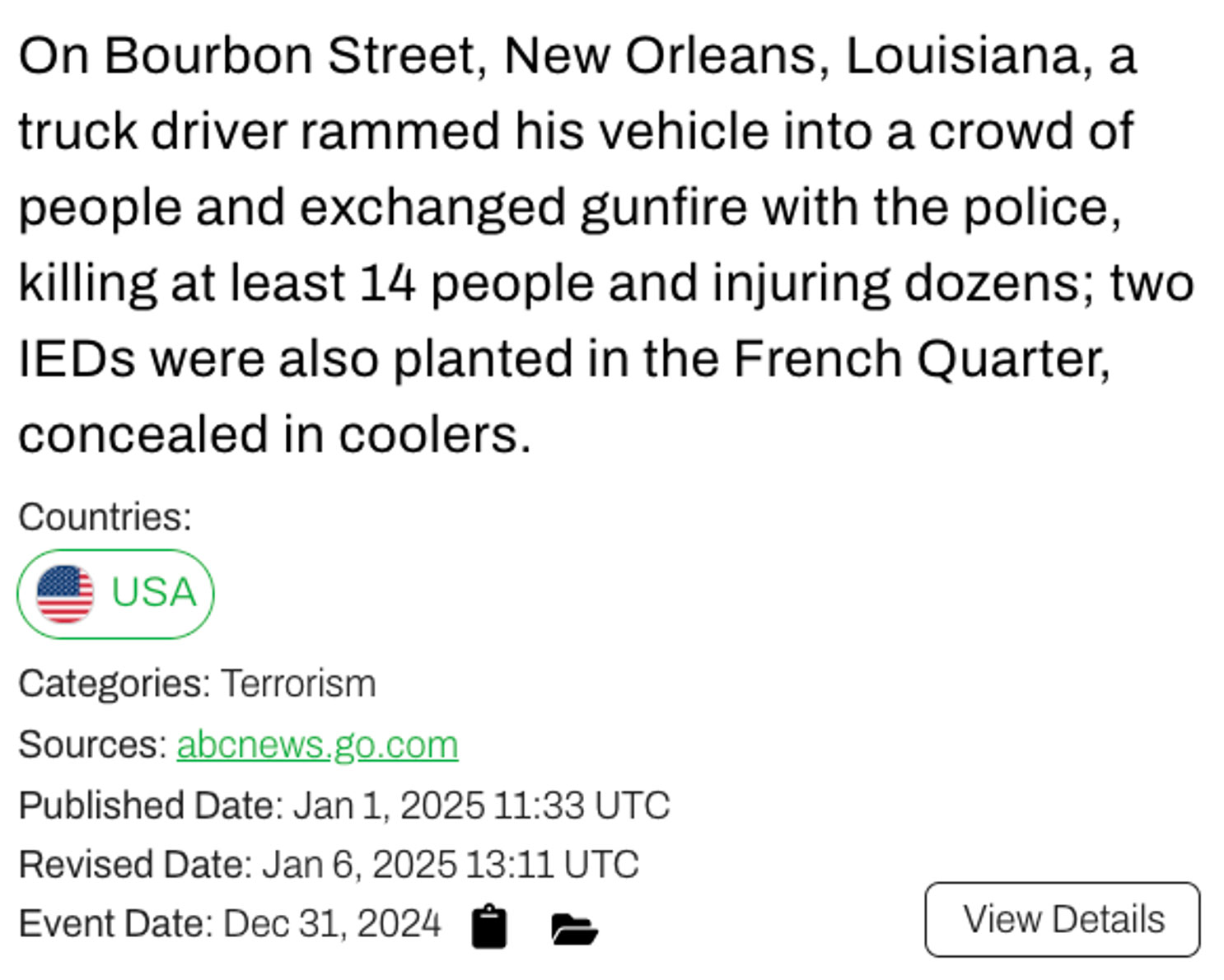
Holiday threats Global security threats will be elevated during the holiday season in Q4 2025 as threat actors will have heightened intent to call for and carry out attacks on or around Christmas (24-26 December), the Jewish festival of Hanukkah (14-22 December), New Year (31 December-1 January) and Orthodox Christmas (7 January). While Islamist extremist terrorist attacks have been decreasing in Western countries during the holiday season over the past few years, the conflicts in the Middle East mean that Islamist extremists have an elevated intent to mount attacks. Even if a peace deal, such as a US-proposed initiative on 29 September to end the Israel-Hamas conflict, tempers activity, extremists will likely retain elevated intent to mount attacks, especially if they view any agreement as unfair. The Palestinian militant group Islamic Jihad has denounced the US plan calling it a “recipe for aggression” against Palestinians. Threat actors will likely continue to use vehicle-borne tactics when mounting attacks, including against soft targets such as pedestrians and crowded venues during the holiday period. A man linked to Islamic State (IS) on 1 January was killed in a shootout with police after driving a truck into pedestrians in New Orleans (Louisiana state), killing 14 people and injuring more than 50. Authorities stated that suspected improvised explosive devices (IEDs) were recovered from the suspect's vehicle and the local area. In Germany, a man in December 2024 drove into crowds attending the Christmas market in the city of Magdeburg; however, he acted because of “dissatisfaction with the treatment of Saudi Arabian refugees in Germany”. While Islamist extremists, and to a lesser extent right-wing extremists and conspiracists, have increasingly used vehicles as weapons since the mid-2010s, personal grievances will likely continue to be the most dynamic motivation behind the threat of such attacks.
Islamist extremist terrorists will have increased intent to carry out attacks during the end-of-year holiday period, though the number of attacks will likely remain below previous holiday period highs.
The most likely scenario for an Islamist extremist attack in Western countries will be an attack by an individual or small group using unsophisticated tactics against soft targets, such as holiday markets, shopping districts and public events.
Personalized and political violence targeting high-profile individuals, politicians or corporate leaders, as well as locations linked to contentious events, will persist, particularly in the US.
Targeted political violence is likely to have limited physical and operational impacts on companies. However, corporate political positions or associations could expose executives and employees to direct security threats.
Threat actors will likely continue to use vehicle-borne tactics when mounting attacks, including against soft targets such as pedestrians and crowded venues during the holiday period.
Large-scale and complex attacks are most likely in regions with active militant or insurgent groups, including North Africa, the Sahel region of West Africa and the Middle East. In Europe, North America, Australia and New Zealand, attacks are most likely to be improvised or small-scale; involve firearms, bladed weapons or vehicles; and take place against soft targets. Already heightened security measures around the holiday period are likely to be increased across the country, particularly at Christmas markets, shopping areas, transportation hubs and other crowded areas, making such attacks more difficult to perpetrate.
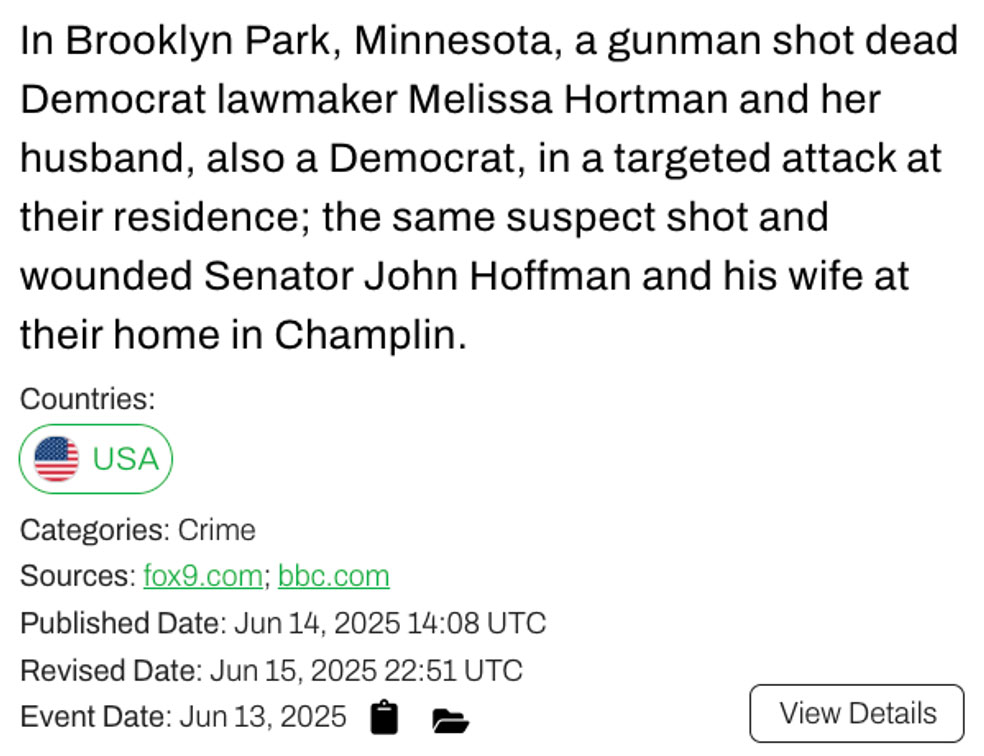
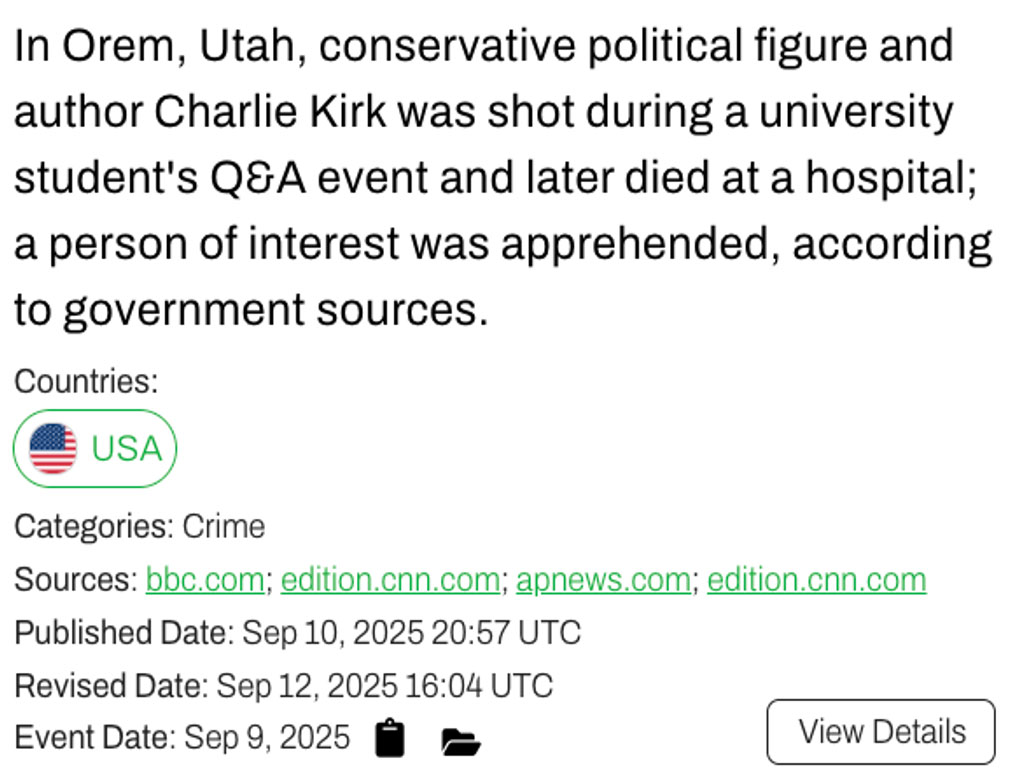
Pervasive political violence Personalized and political violence targeting high-profile individuals, politicians or corporate leaders, as well as facilities linked to contentious issues, will likely persist, particularly in the US. Several high-profile targeted killings have taken place in the US in recent months. Conservative influencer Charlie Kirk on 10 September was shot dead during a public event at Utah Valley University (Utah state). On 14 June a man killed a Democratic Party lawmaker and her spouse and injured another Democratic lawmaker and his spouse in Minnesota state. The normalization of political violence will continue to translate into indiscriminate attacks against organizations that the perpetrators perceive to be biased or controversial. A man on 8 August fired 500 rounds of ammunition on the headquarters of the US Centers for Disease Control and Prevention (CDC) in Atlanta (Georgia state), killing a police officer. The motivation was reported to have been opposition to COVID-19 vaccinations. A man on 19 September fired at the lobby of a Sacramento (California state) affiliate office of the television network ABC; the attack followed ABC’s suspension of a talk show over remarks about Kirk’s killing.
The normalization of political violence will continue to translate into indiscriminate attacks against organizations that the perpetrators perceive to be biased or controversial.
The mounting tensions over immigration in the US have manifested in violent incidents targeting immigration facilities. On 1 July, a man armed with an assault rifle fired at federal agents and a US Customs and Border Protection (CPB) facility in McAllen (Texas), injuring a police officer, before authorities shot dead the perpetrator. Eleven individuals in military-style clothing on 4 July shot a police officer outside an Immigration and Customs Enforcement (ICE) center in Alvarado (Texas). On 25 September, a gunman killed a detainee and injured two others at an ICE field office in Dallas (Texas). Outlook: The diversity of threats from ideological extremists, state actors, criminals and individuals with mixed motivations is increasing, posing new security challenges for governments and law enforcement. Targeted political violence is likely to have limited physical and operational impacts on companies. However, corporate political positions or associations could expose executives and employees to direct security threats.
Analysis Details
Explore Now
Learn more about delivering the trustworthy insights you need, right when you need them.
Discover Seerist Today
The foresight to get ahead of what may come.
The insights with the most impact.
Accelerate speed to decision.