By Chris Caesar
law of technology
Return to Table of Contents
winter 2026
rule of law
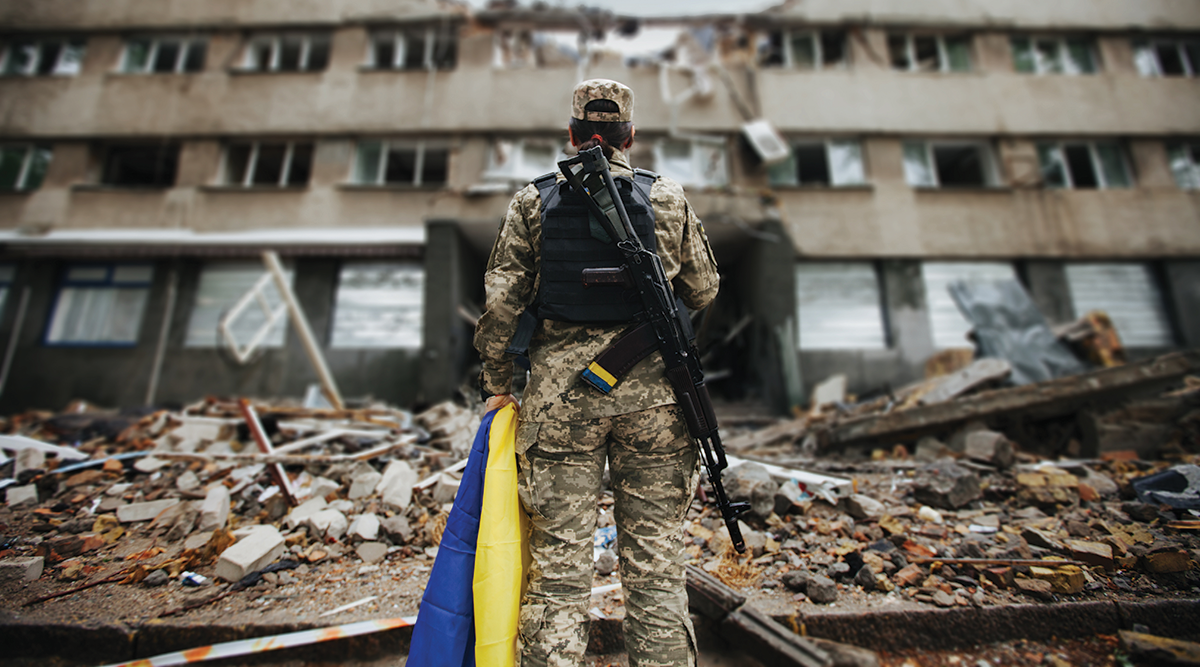
An end to Russia’s war on Ukraine remains elusive, as the number of casualties hits hundreds of thousands and continues to climb. But a dedicated group of Suffolk Law students, alumni, and others from around the country and globe are laying the groundwork for holding violators of international law accountable.
The latest fruit of that effort arrived in September when students in the Suffolk Law–based Ukraine Accountability Project published the fourth edition of their exhaustive report Russian War Crimes Against Ukraine. The 479-page account details the war’s atrocities, the international laws the Russians have breached, and who is most responsible.
The stakes may be as high as the international order established after World War II, according to Suffolk Law’s Sara Dillon, professor of international law and the project’s faculty advisor. “Russia’s attempt to destroy the Ukrainian state poses one of the greatest challenges to the postwar international order,” she says. “My hope would be that due in part to our efforts there’s a higher likelihood that the principal parties will be held to account.”
Affiliated with the Global Accountability Network—which has established similar efforts focused on countries such as Syria, Yemen, and Venezuela—the project is led by Professor David Crane of Syracuse University College of Law, the founding chief prosecutor of the UN Special Court for Sierra Leone. It includes law students and alumni from across the country, but the core of the 40-person team is based at Suffolk Law.
The students scour open-source materials, including social media platforms popular with the Russian government (like Telegram), to aggregate data and compile as thorough a picture as possible. Among the many atrocities documented, one of the most harrowing is Russia’s bombing of the Mariupol theatre in southeastern Ukraine.
Hundreds of civilians, including many women and children, had taken refuge in the building after their homes were destroyed. The Russian military blew up the theater using two 500-kilogram aerial bombs, according to munitions experts. The building was clearly marked with a warning visible from the air that it was a nonmilitary site, and yet the Russians killed roughly 600 civilians, according to the Associated Press.
Beyond direct attacks on civilians, the team has investigated Russia’s violations of environmental law. In a recent white paper, the team documented Russia’s widespread environmental destruction in Ukraine—from the contamination of air, water, and soil to the obliteration of vital ecosystems. Crane’s network helps ensure that the work gets in front of officials able to leverage it, including war crimes prosecutors, and UN and U.S. State Department officials.
“Our work streamlines the efforts of war crimes prosecutors and researchers by providing vetted, reliable sources they can act on,” explains Isaiah Hutchinson, a fourth-year evening student and the project’s current executive director.
“What happens in terms of criminal accountability here will influence how the rule of law is upheld in future international conflicts,” he adds. “If Russia is not held to account, the message is that war crimes will be accepted and tolerated.”
“There are days when I fear that those who are attacking the international rule of law could prevail,” says Professor Dillon. “Moments when I look at the assumptions I made about the international human rights system just ten years ago and wonder if it will hold up.” But she’s given hope by seeing so many in the international human rights law community defending the rule of law. “International law will rise and fall, rise and fall, but ultimately it's going to prevail,” she says. “Because it has to.”
By Robert Schlesinger
Photography: Adobe