By Chris Caesar
law of technology
Return to Table of Contents
winter 2026
rule of law
April 2025
Dear Suffolk Law students:
My primary responsibility as the dean is to advance our educational mission: preparing you to become outstanding lawyers who understand and defend the fundamental principles of our legal system. In that spirit, I’d like to share two recent communications that I (and Suffolk University President Marisa Kelly) fully support.
The first is a statement from the American Bar Association, objecting to recent attempts by government officials to intimidate and punish lawyers for ethically representing their clients. These efforts threaten the legal profession and fundamental principles that are at the core of what we do. Speaking out against such intimidation is neither partisan nor political. It is an expression of a necessary principle for the proper functioning of our law school and justice system.
The second communication is from the dean of Georgetown Law, William Treanor. In his letter, he responds to a threat from the Interim United States Attorney for the District of Columbia to stop hiring Georgetown graduates if the law school continues teaching issues related to diversity, equity, and inclusion. Dean Treanor objected to the government’s attempt to dictate his law school’s curriculum, and I applaud his response. The objections he raised are central to what we do as an academic institution.
This moment offers an opportunity to reflect on two important aspects of our educational mission. First, Suffolk Law must be a place that welcomes civil dialogue among those who have strongly divergent views on pressing political and legal controversies. Regardless of your political affiliation, I encourage you to discuss the issues raised here with people whose perspectives are different from your own. These issues are not partisan. They concern core features of our democracy and require engagement across the ideological spectrum.
A second and related principle is that we must be able to engage in this free exchange of ideas in our legal studies and the ethical representation of clients without fearing government reprisals. When the government seeks to punish lawyers for merely doing their jobs or threatens law schools for the material that they teach, our core educational mission and the system of justice we are sworn to uphold are at stake.
Under these circumstances, the legal profession has a special duty to speak out, both for the integrity of our professional roles and the sake of our constitutional democracy. I am doing so here because safeguarding your ability to learn freely and advocate ethically is not just central to our mission—it is the foundation upon which your future contributions to justice depend.
Andrew Perlman
Dean & Professor of Law
Suffolk University Law School

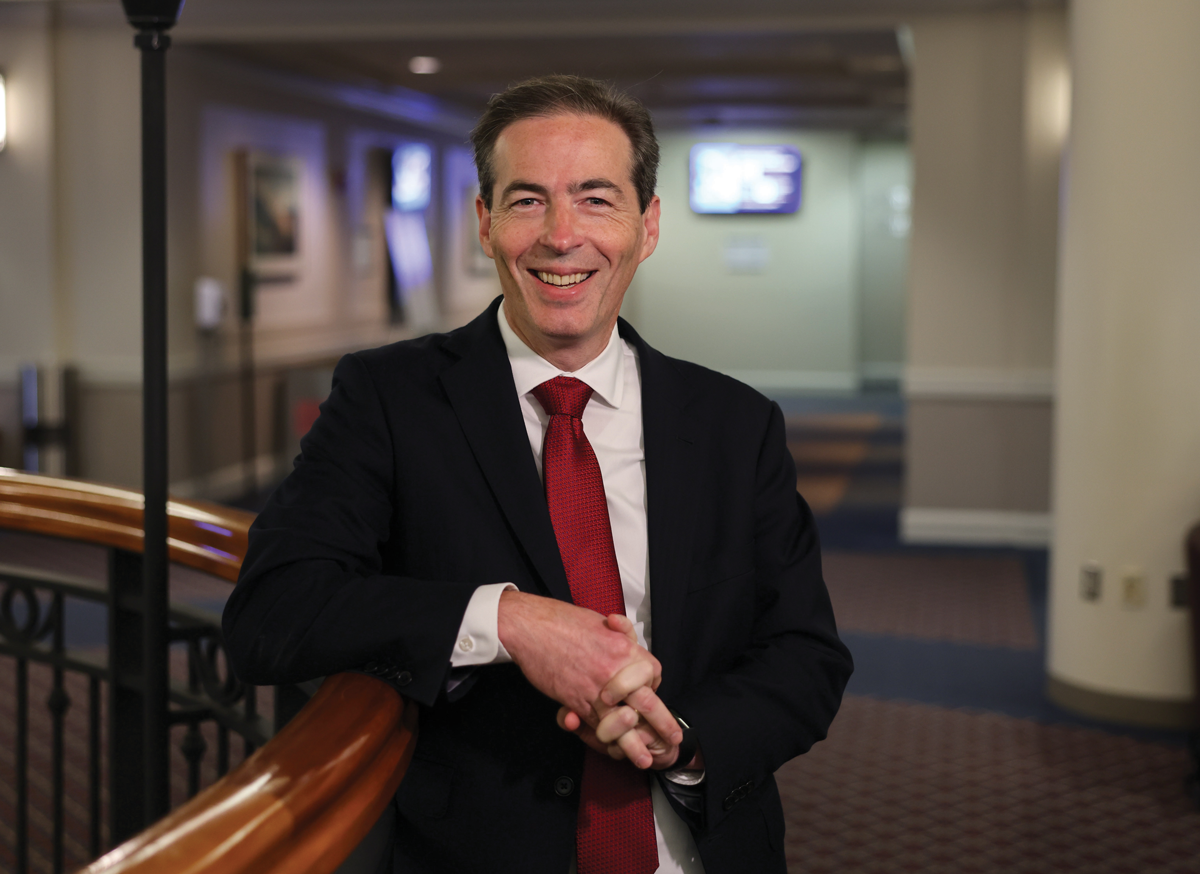
Dean Andrew Perlman
Photography: Michael J. Clarke