feature
From the moment a dozen ASB students arrived in Hilo on HAWAII'S BIG ISLAND, they realized they were on sacred ground, said co-leaders Kerry Matthews and Raffaella Shanahan, both Class of 2026. They had come prepared to work on a forest restoration project, serve at an animal shelter, and clear invasive species, but getting their hands in the earth—literally—was life-changing.
“The most incredible thing was the way people in Hawaii value the land and their duty to take care of it,” said Shanahan, a broadcast journalism major. “If more people thought that way, how we treat climate issues would be far less political.”
The Kona Cloud Forest was so awe-inspiring that the entire Suffolk group fell silent and spent time connecting mindfully with the natural beauty around them. “It really hit home how the land can live without us,” said Matthews, a sociology major, “but we can’t live without the land.”
Return to Table of Contents
spring 2025
Whether they’re planting vegetables in New Orleans (above) or working on a forest restoration project in Hawaii (below), says CCE Program Manager Mena Vollano, “students are immersing themselves in meaningful service, connecting with diverse communities, and developing a deeper understanding of social justice issues.” Photograph courtesy of Center for Community Engagement
By Erica Noonan
Photograph courtesy of Raffaella Shanahan


Visiting the venerable walled city of OLD SAN JUAN, PUERTO RICO was both a history lesson and a poignant modern-day window into the poverty that impacts many city neighborhoods, said students who traveled there.
The 12 students spent several mornings at La Fondita de Jesús—a nonprofit that serves community members who are unhoused or at-risk of becoming so—helping sort donations and assisting in the free health clinics and the soup kitchen. For Kayla Moses, a senior psychology major, immersing herself in a different culture and language was eye-opening.
“The kindness we experienced in Puerto Rico was really unmatched,” she said. “Community service is considered so important. I also learned a lot about the importance of cultural humility and remembering we were there to learn from them.” Several trip participants were native or fluent Spanish speakers, Moses said, and helped lead discussions about the issue of Puerto Rican statehood versus independence.

The Suffolk students who arrived in the rural SOUTH TEXAS BORDER COMMUNITY OF LAREDO to help build homes with Habitat for Humanity were thrilled to discover a happy coincidence: Their 2025 work site was directly across the street from the home the Suffolk ASB group helped build last spring.
Not only was this year’s ASB crew able to meet the woman whose house they were helping to build, but they also met the family with three small children who are now happily settled in the home their fellow students had worked on the previous year.
“It felt like we were able to make an impact and see a glimpse of the future for the woman whose home we were helping build,” said Carson Stiles, a senior film major. “She has been waiting and hoping for a house for her and her kids since 2021.”
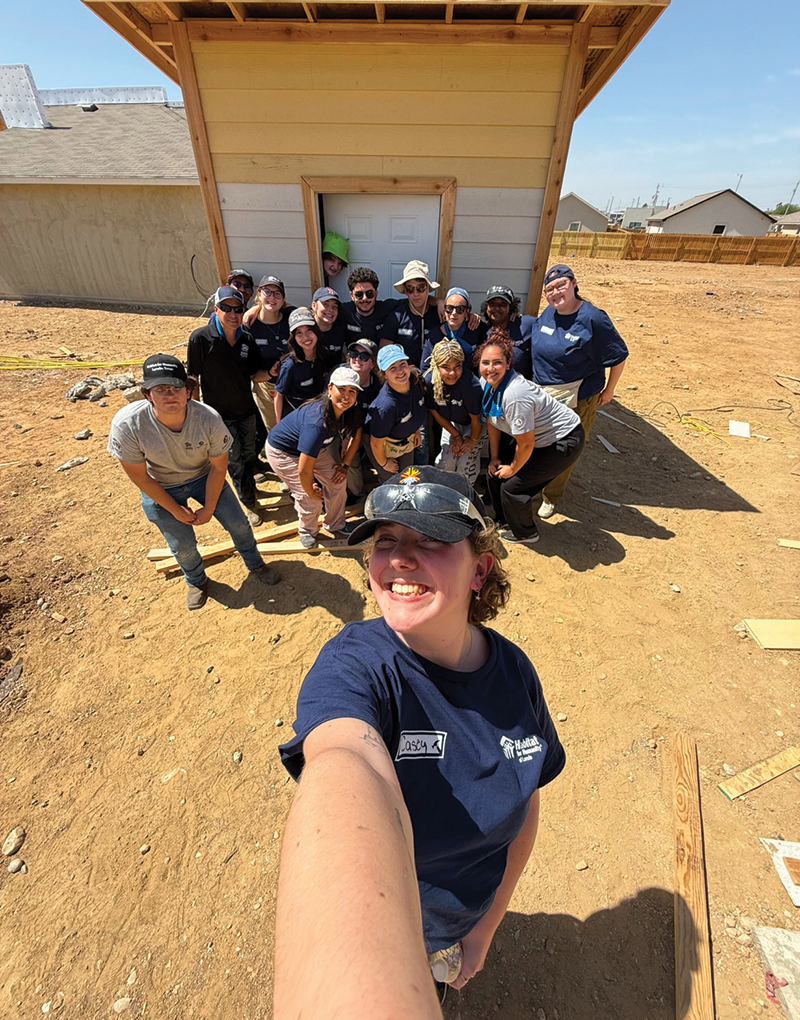
Photograph courtesy of Casey Wells
On a mild March day, 11 Suffolk students made their way around the Whitney Plantation, a Louisiana museum dedicated to exploring the history and legacies of slavery. The group fell silent as they walked past buildings where enslaved people had lived and labored. “We couldn’t even speak,” said junior Aidan Knaster, a law major and one of the trip’s co-leaders. “We were all so affected.”
Understanding slavery’s legacies was part of what brought the Suffolk group to NEW ORLEANS for a service-learning trip focused on racial justice issues. For junior Gabrielle Buissereth—also a law major and the trip’s other leader—those legacies are woven into the social fabric, from the way that communities of color continue to be disproportionately impacted by the aftereffects of Hurricane Katrina to the persistent lack of equity and opportunity that students of color encounter. Suffolk students saw this firsthand, she said, when they met with seniors at New Orleans’ Bonnabel High School. For many, she said, “college was only a dream, because they face so many systemic barriers”—under-resourced schools, financial and family obligations, and a lack of mentors to help them navigate the admissions process and career planning.
Yet no matter where they went, said Knaster, they were met with warmth, “and that really made me fall in love with the city.” He laughed as he described the day the group helped plant 700 eggplant and pepper plants. “We were tired, but it was great,” he said. “These fresh vegetables will be used at a nonprofit’s restaurant to feed members of the community”—advancing both racial justice and sustainability.

Photograph courtesy of Kaitlyn Creighton