mission driven
Return to Table of Contents
fall 2025
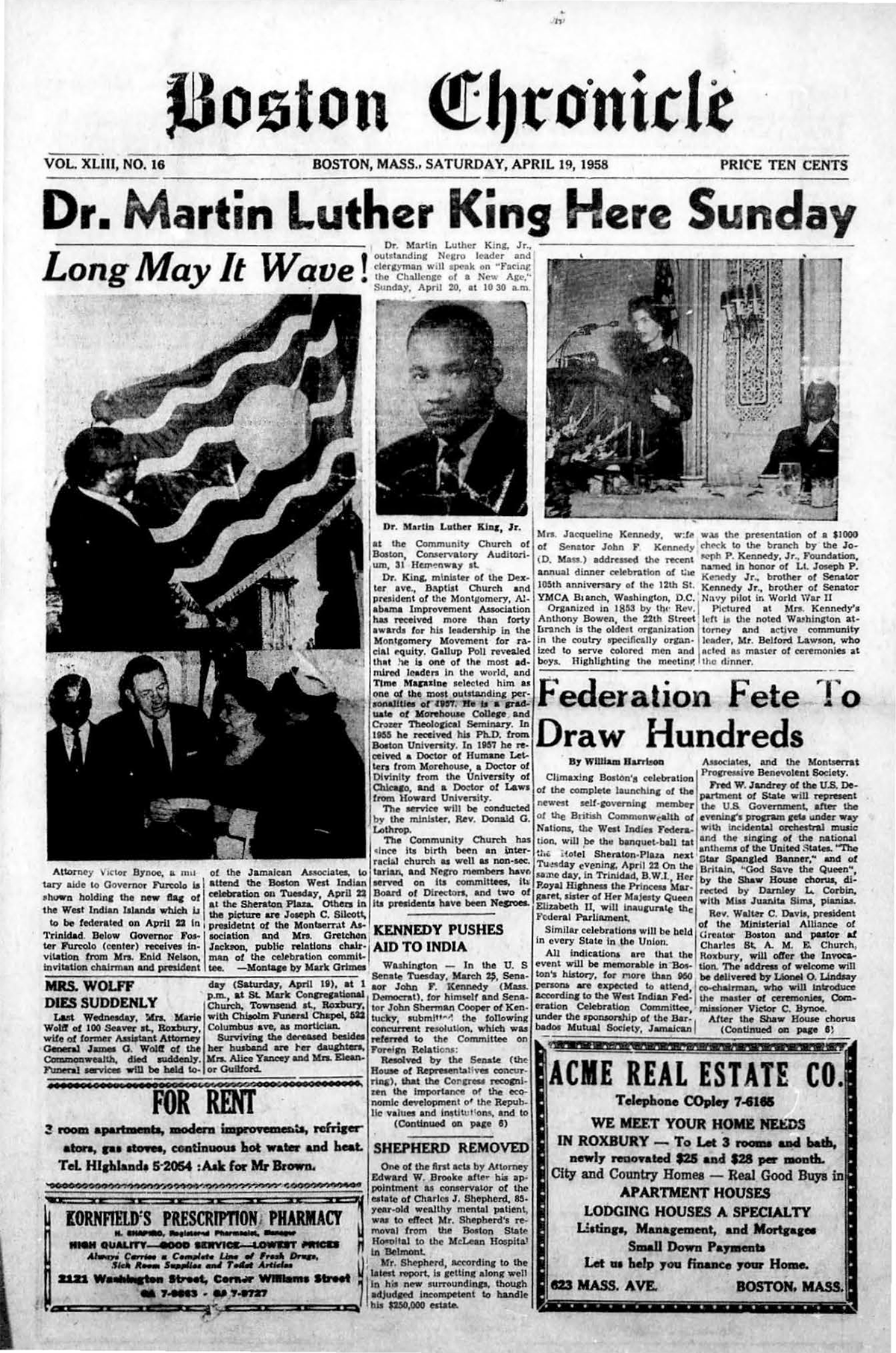
Suffolk University students and faculty are piecing together long-overlooked histories of African American and Caribbean communities in Boston through a unique archiving project centered on a daily newspaper co-founded by Suffolk University’s first Black graduate.
The aim of the University Archives’ Boston Chronicle digitization effort—now in its second year—is to create an indispensable and accessible resource for researchers around the world seeking a fuller picture of Black history in early 20th century Boston.
The Chronicle was founded in 1915 by a group of West Indian immigrants, including Thaddeus A. Kitchener, a native of Jamaica who graduated from Suffolk Law just two years earlier. It published into the early 1960s, catering to Boston’s Black residents at a time when mainstream newspapers virtually ignored communities of color.
Suffolk students have done much of the most intensive archiving work, painstakingly transcribing headlines and creating searchable keywords and larger themes, says University Records Manager Michael Dello Iacono.
“This paper represents an underserved community within an already underserved community,” he says.
While the city’s larger Black-owned newspaper, the Boston Guardian, focused on civil rights and politics, the Chronicle sought to elevate working-class voices and celebrate the accomplishments of ordinary citizens.
“The founders really saw it as a community resource, and even made a woman an editor, which, for that time, was amazing,” says Dello Iacono. The archives’ collection is particularly special because it includes Chronicle issues on microfilm between 1932 and 1940, years missing from all other Boston-area libraries.
Student-archivists help Reveal history
A unique aspect of the Chronicle digitization work has been the opportunity for undergraduate students to be front and center on historical discoveries with the potential to reshape the narrative of Black history in Boston, and nationwide.
The Chronicle regularly covered figures before they emerged on a national scale. Gospel singer Mahalia Jackson, sports legends Bill Russell and Hank Aaron, and the Reverend Dr. Martin Luther King, Jr. (then still a young preacher in Alabama) all found space in its pages, years before mainstream recognition.
Black women breaking down color barriers also made headlines. An October 1945 issue showed a photo of Boston’s Captain Mildred Davenport-Carter, one of the first Black women to enlist and serve in the Women’s Auxiliary Army Corps during World War II, being welcomed home by Boston Mayor John E. Kerrigan.
“These aren’t just footnotes,” Dello Iacono says. “They can change our understanding of who was making history and when.”
Christiana McKenzie, BA ’25, began working with the archives as an intern during her senior year, drawn by her interest in learning more about the lives of immigrants from the West Indies. She spent hundreds of hours digitizing fragile microfilm editions of the Chronicle—a labor of love, says the history major.
“These archives truly detail the diversity of the Black community,” she says. “The articles talk extensively about American descendants of slavery and how these different communities work together under one greater umbrella of a Black community to fight against racism and social injustices.”
A 1955 piece discussed the murder of Emmett Till and the community’s reaction. “That article in particular will never leave me,” McKenzie says.
During the spring semester, Political Science & Legal Studies Professor Maye Henning encouraged her Race and the Law undergraduate students to use primary source materials from the University Archives, including the Chronicle, to uncover nuanced perspectives on critical moments in American social history.
“These archives democratize research opportunities,” says Henning. “They are available online, they give undergraduate students more opportunities to do serious research, and they allow students to connect with historical subjects in a much more personal way, highlighting the daily experiences of people often overlooked in traditional historical accounts.”
John Owusu, Class of 2026, first encountered the Chronicle through Henning’s class. Fascinated by the paper’s stories on early Black entrepreneurs and cultural exchanges between Boston and Caribbean immigrants, he applied to the archives' summer internship program to help with Chronicle digitizing.
“What drew me in was how much of the community life was hidden from public view,” Owusu says. “The Chronicle covered the first Black accountant accredited in Massachusetts, and African American–owned funeral homes that served families when white-owned businesses would not. These details might not seem major, but together they paint a vivid picture of resilience in the face of barriers.”
His research has so far revealed surprising international ties. Originally from Ghana, Owusu was struck to find articles about West African students studying in Boston during the 1920s. “To see evidence of networking between Ghana and Boston at that time was shocking,” he says. “It shows there were transnational connections happening that most history books just skip over.”
The project has done more than sharpen Owusu’s research skills as he prepares for a career in the law—it has deepened his sense of belonging in a larger historical narrative. “Being from Ghana, finding my country mentioned in a Boston paper from a hundred years ago makes me realize our stories have always been here,” he says. “We just need to bring them back to light.”
“Our stories have always been here,” says student-archivist John Owusu. “We just need to bring them back to light.” Photograph by Michael J. Clarke, Artwork from University Archives
By Erica Noonan