Alumni News
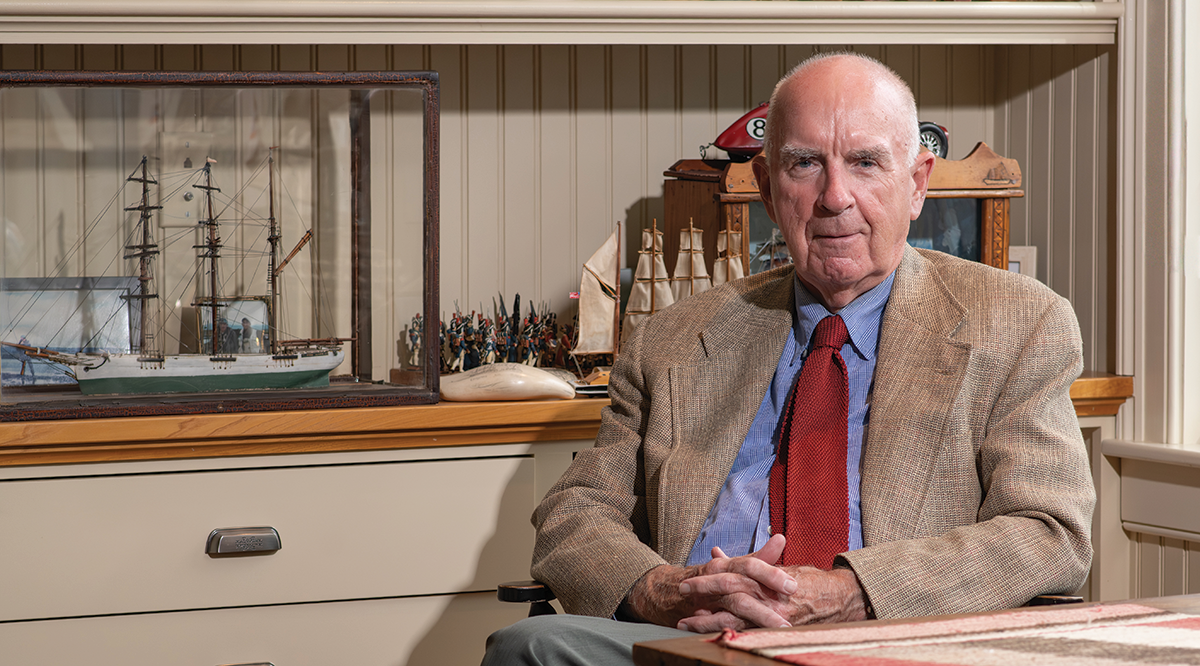
Jamie Stewart, JD ’80, was about to retire—with visions of golfing every day in Florida—when he got a call from Federal Reserve Chairman Alan Greenspan’s office recruiting him to be first vice president at the New York Federal Reserve. Two years later, he found himself in lower Manhattan during the terrorist attack on September 11, 2001. With both his boss and Greenspan out of the country, Stewart was charged with keeping the US banking system afloat in the immediate aftermath.
“The payment system had collapsed, and the banks were in trouble,” he says. “I was the one minding the store.” Stewart’s quick decisions to advance funds to banks to help them continue lending restored confidence, preventing financial freefall in the days after the attacks. “Because we were the bank regulator, we knew the banks were solid, so we could provide them with money,” he says. “It was a liquidity problem, not a solvency problem.”
That sense of duty has defined Stewart’s career, as time and again he has put off retirement to answer the call of service. After leaving the Fed, he was recruited to lead the Federal Farm Credit Banks Funding Corporation, which manages 40% of lending to the nation’s farmers and ranchers. Seeing risky patterns of Wall Street lending before the 2008 financial crisis, he tightened lending standards and built up liquidity. When other institutions faltered, Federal Farm Credit remained strong—one of the only lenders able to keep capital flowing to farmers and ranchers.
Stewart has established himself as a go-to fixer, trusted with balancing profit with the public good. “If you are that kind of person, your reputation precedes you,” he says. Those values were instilled in him early by his father, a Navy pilot. After graduating from Dartmouth College with a degree in French, Stewart earned his own Navy commission as an officer on a cruiser stationed in France. “I was responsible for 800 lives,” he says. “That wakes you up pretty quick.”
He earned a business degree at Harvard before joining Bank of Boston, where he specialized in dealing with troubled loans. “That’s when I realized the importance of working with legal issues,” says Stewart, who enrolled in Suffolk Law’s night program. “Lawyers think differently from businesspeople,” he says. “It gave me a much broader view of government, regulation, and risk, critical for making decisions as you move higher in business.”
After leaving Federal Farm Credit in 2012, he was again about to retire before being asked to join the board of Federal Guaranty Insurance Company, helping restructure the insurer of municipal bonds after it ran into severe financial problems following the 2008 crisis.
“I thought it would be a four- or five-year assignment, and well, 13 years later I’m still here,” he says. At the same time, this Summa Society President's Circle donor has kept busy serving as a member of Suffolk Law’s Dean’s Cabinet, providing guidance on financial law to an institution that helped shape his career. It’s clear that when duty calls, Stewart is quick to answer. That Florida golf date may have to wait a little longer. —Michael Blanding
Return to Table of Contents
fall 2025
Photograph by Peter Julian