

AlUla Old Town & AlJadidah
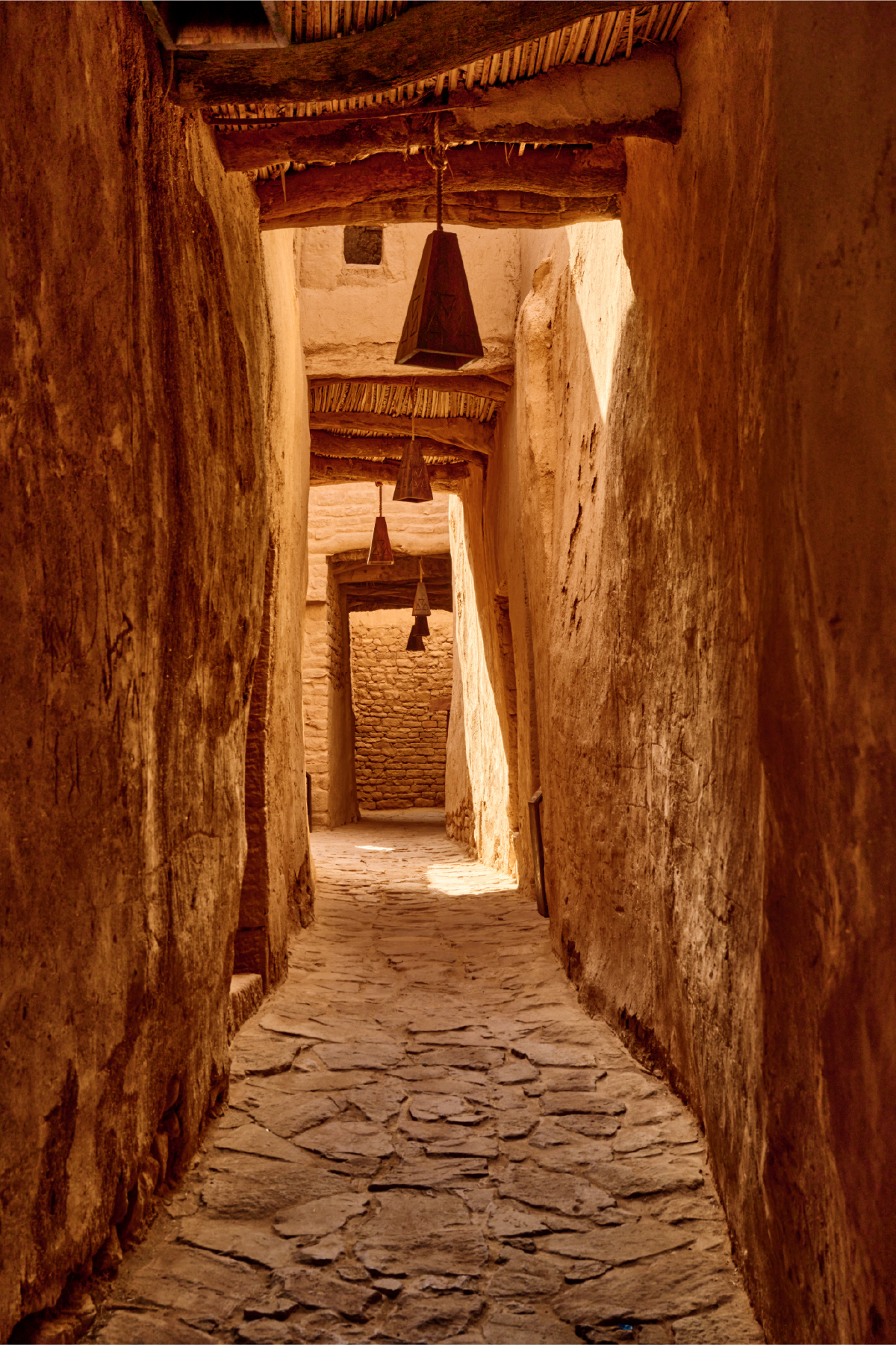
Down the winding alleys of AlUla Old Town you’ll find ancient heritage buildings, mosques and markets dating back about seven centuries. Nearby are the five distinct squares of AlJadidah, or ‘new’ town, a vibrant hub of restaurants and shops
Not all settlements in AlUla have been empty for centuries. Up until a few decades ago, the Old Town was a throng of activity until complex inheritance laws and sub-division of land made modern living untenable. But gradually, farmers and their families are returning to revive stories of the past.
Connecting a path once used by pilgrims travelling from Damascus to Mecca, the scenic Oasis Heritage Trail winds for three kilometres through farms and plantations of fanning date palms, running from Dadan South through the oasis to the Old Town.
Occupied since the 12th century (but abandoned in the 1980s) a honeycomb of stone and mudbrick buildings has been restored to create a living museum dotted with traditional cafés and restaurants showcasing Saudi hospitality. Dine on kbeibah hai’l (grape leaves stuffed with a heady mix of aromatic spices) and listen to AlUla’s residents speak nostalgically about their home.
At the centre of the complex is the Tantora sundial, traditionally used as a marker for changing seasons and to distribute water springs fairly between summer farms.
To fully appreciate the importance of this fertile valley, climb the ramparts of AlUla Castle, the oldest part of town. From up here it’s possible to admire a dense blanket of rich greenery wrapped by sandstone mountains and arid desert plateaus, illustrating why AlUla has always been a valuable source of life.
Inviting travellers to move forward in time and connecting AlUla Old Town to the pedestrian-friendly AlUla Arts District or AlJadidah precinct is the Incense Road. Discover a flavour of the historic Incense Route in a vibrant urban setting, curated with outdoor exhibitions such the world’s largest hand-painted carpet, which welcomes visitors to AlJadidah, its shops and eateries.
Designed to tell the next chapter in AlUla’s story, five squares each have distinct identities: admire art in the Art Square’s galleries; seek shady seating in the Gathering Square; find food trucks and vegan restaurant Moon Shell in Muayada Square; enjoy nightly live music in the Oasis Square; or simply sit in Qanat Square and enjoy the peace afforded by an open space.
The easiest way to fly is direct from London to Saudi Arabia with Saudia or British Airways, taking six and a half hours. Change planes in either capital Riyadh or Jeddah to take a short domestic flight of around 90 minutes to AlUla’s newly renovated international airport, a 35km or 30 minute drive from most accommodation.
Another option is to fly with Emirates Airlines to Dubai where flights connect with Emirates’ partner airline flydubai flying non-stop from Dubai into AlUla International Airport. Alternatively, you can fly with Qatar Airways or Royal Jordanian from the UK non-stop to Doha or Amman with flight connections directly into AlUla. Local Saudi airline flynas provides flights into AlUla from Dubai, Cairo, Riyadh, Jeddah and Dammam.
How to get to AlUla
Click an area on the map to explore AlUla, or scroll to keep reading


AlUla Old Town & AlJadidah
Down the winding alleys of AlUla Old Town you’ll find ancient heritage buildings, mosques and markets dating back about seven centuries. Nearby are the five distinct squares of AlJadidah, or ‘new’ town, a vibrant hub of restaurants and shops
Not all settlements in AlUla have been empty for centuries. Up until a few decades ago, the Old Town was a throng of activity until complex inheritance laws and sub-division of land made modern living untenable. But gradually, farmers and their families are returning to revive stories of the past.
Connecting a path once used by pilgrims travelling from Damascus to Mecca, the scenic Oasis Heritage Trail winds for three kilometres through farms and plantations of fanning date palms, running from Dadan South through the oasis to the Old Town.
Occupied since the 12th century (but abandoned in the 1980s) a honeycomb of stone and mudbrick buildings has been restored to create a living museum dotted with traditional cafés and restaurants showcasing Saudi hospitality. Dine on kbeibah hai’l (grape leaves stuffed with a heady mix of aromatic spices) and listen to AlUla’s residents speak nostalgically about their home.
At the centre of the complex is the Tantora sundial, traditionally used as a marker for changing seasons and to distribute water springs fairly between summer farms.
To fully appreciate the importance of this fertile valley, climb the ramparts of AlUla Castle, the oldest part of town. From up here it’s possible to admire a dense blanket of rich greenery wrapped by sandstone mountains and arid desert plateaus, illustrating why AlUla has always been a valuable source of life.
Inviting travellers to move forward in time and connecting AlUla Old Town to the pedestrian-friendly AlUla Arts District or AlJadidah precinct is the Incense Road. Discover a flavour of the historic Incense Route in a vibrant urban setting, curated with outdoor exhibitions such the world’s largest hand-painted carpet, which welcomes visitors to AlJadidah, its shops and eateries.
Designed to tell the next chapter in AlUla’s story, five squares each have distinct identities: admire art in the Art Square’s galleries; seek shady seating in the Gathering Square; find food trucks and vegan restaurant Moon Shell in Muayada Square; enjoy nightly live music in the Oasis Square; or simply sit in Qanat Square and enjoy the peace afforded by an open space.
The easiest way to fly is direct from London to Saudi Arabia with Saudia or British Airways, taking six and a half hours. Change planes in either capital Riyadh or Jeddah to take a short domestic flight of around 90 minutes to AlUla’s newly renovated international airport, a 35km or 30 minute drive from most accommodation.
Another option is to fly to travel via Dubai where flydubai, and flynas operate flights directly into AlUla International Airport. Or fly from Amman on Royal Jordanian or from Cairo on flynas.
How to get to AlUla
Click an area on the map to explore AlUla, or scroll to keep reading

Back to top

Advertiser content for
Illustration: Pei-Hsin Cho, Design: Matthew Brant,
Editor: Hannah Hopkins, Pictures: Alex Kelly,
Web Producer: Caroline Stacey,
Project Manager: Michelle Birbeck
Words: Sarah Marshall
Advertiser content for
Illustration: Pei-Hsin Cho, Design: Matthew Brant,
Editor: Hannah Hopkins, Pictures: Alex Kelly,
Web Producer: Caroline Stacey,
Project Manager: Michelle Birbeck
Words: Sarah Marshall
Select an option below to continue exploring
Select an option below to continue exploring
Introduction
Hegra
Jabal Ikmah
Dadan


One of Arabia’s oldest cities and home to the Nabataean city of Hegra, a UNESCO World Heritage Site, the ancient region of AlUla is being rediscovered.
For more inspiration, visit experiencealula.com
One of Arabia’s oldest cities and home to the Nabataean city of Hegra, a UNESCO World Heritage Site, the ancient region of AlUla is being rediscovered.
For more inspiration, visit experiencealula.com