Cairo | luxor & aswan | Bahariya Oasis & beyond | the red sea
Egypt
T he muezzin’s call drifts over Cairo as first light hits the Nile, turning the water a bruised gold. Below, the city stirs to life. Taxis honk, bakers pull warm flatbread from stone ovens, and the scent of diesel and cardamom mingles in the air. Egypt’s capital is a place that never truly rests, where the ancient and the immediate exist in the same breath. From the balcony of a downtown hotel, you can glimpse both the silhouettes of the Great Pyramids in the distance and the geometric sweep of the long-awaited Grand Egyptian Museum rising from Giza’s plateau, shimmering in the morning light.
Cairo is where the Nile moves broad and steady, gathering strength for its journey ahead. As the river quickens, Egypt’s flowing heart carries travelers south—past the temple-lined banks of Luxor and Aswan, through the quiet desert of Bahariya Oasis and onward to where land meets the Red Sea at Egypt’s edge. It is across this living corridor that the Nile becomes both passage and story. Each bend offers a distinct chapter, drawing travelers deeper into Egypt’s enduring tale.


Unmatched diversity
in collaboration with:


BACK TO
THE TOP

BACK TO
THE TOP

BACK TO
THE TOP

BACK TO
THE TOP


Nile Dahabiya Cruise


Cairo:
The restless heart of Egypt
Luxor & Aswan:
The river as a time machine
Bahariya Oasis & beyond:
The stillness of the desert
The Red Sea:
Egypt's edge of renewal


Plan your trip


Bazaar
Stanley Bridge, Alexandria
Tomb of Ramses V and VI
Felucca in Aswan
White Desert National Park
Siwa Oasis
Sunrise on Mount Sinai
Swimming pool at Castle Zaman in Taba
Sea turtle in Marsa Alam
Asalah
SEE OUR OFFERS

South toward Marsa Alam, newer resorts balance luxury with sustainability, attracting divers eager to explore vibrant coral reefs and swim alongside spinner dolphins. For those more drawn to history than the underwater world, the region offers quieter treasures. The Ruins of Abu are remnants of ancient ports once tied to the incense trade, quiet witnesses to a long-lost era.
Nearby, Bedouin fishing villages like Asalah, Mashraba and Medina still follow the rhythms of the sea, where camels wander along the shore and daily life moves at a gentler pace. These spots offer travelers a quieter, more contemplative side of Egypt’s Red Sea coast, far from the resorts and dive sites. Consider hiring a local guide for a walking tour along the villages and shoreline to experience daily life up close and learn about traditional fishing practices.
At journey’s end, the Nile gives way to the sea. The Red Sea, shimmering and impossibly clear, represents Egypt’s frontier—both literal and symbolic—where desert mountains plunge into turquoise waters alive with color and movement.
Sharm el-Sheikh and Dahab anchor the Sinai Peninsula, known as much for world-class scuba diving as for its relaxed coastal pace. In Dahab, coral gardens lie just offshore; you can spend the morning exploring the famous Blue Hole dive site and the afternoon sharing plates of grilled fish in a beachfront café. The reefs here are among the most vibrant in the world: technicolor coral, darting parrotfish and even the occasional turtle drifting through the blue.
For those seeking spiritual reflection, head east to the Monastery of St. Anthony, the world’s oldest active Christian monastery, tucked in the Eastern Desert near the Red Sea Mountains. Pilgrims and visitors alike climb Mount Sinai before dawn to watch sunrise illuminate the same slopes said to have borne the Ten Commandments.
After days tracing the Nile’s slow pulse, the desert’s stillness feels like another kind of revelation. West of the river, Bahariya Oasis serves as a jumping-off point for the White Desert National Park, where wind-sculpted chalk formations twist into shapes that look almost alive, catching the light in shades of pearl and pink.
Overnight safaris allow you to sleep under the stars, the silence broken only by crackling fires and Bedouin tea being poured in the dark. Bahariya Oasis itself offers pockets of date palms and cool springs, a refuge that feels like a dream after the glare of the open road.
By the time you reach Aswan, the Nile feels like it’s carrying you backward in time. Visit Elephantine Island, where Nubian villages rest in shades of blue and ochre, or take a felucca at sunset as the call to prayer drifts across the water.
Farther south, near the Sudanese border, the colossal Great Temple of Ramses II at Abu Simbel waits. Here, the seated pharaohs carved into its facade still defy time and the desert, their gaze fixed on eternity.
Leaving Cairo for Luxor feels like stepping into another era. As Egypt’s capital fades behind you, the sound of engines and horns gives way to rippling water and the steady rhythm of oars. Life along the banks unfolds like a moving mural: children waving from the shore, farmers steering donkeys through fields and fishermen casting nets into the same waters their ancestors once revered.
A river cruise like Sonesta St. George Nile Cruise or Nile Dahabiya Cruise is the most atmospheric way to travel this stretch, whether aboard a modern ship or a traditional dahabiya, a two-sailed wooden vessel once used by 19th-century explorers.
Farther west, Siwa Oasis sits near the Libyan border—remote, mystical and entirely its own. Float in the turquoise Salt Lake, where the water holds you effortlessly, or sip sweet mint tea as the sun melts behind the dunes. Rent a bike to explore palm groves, crumbling mud-brick villages and the Oracle Temple of Amun, where Alexander the Great was declared a god. Siwa’s rhythm is slow, its beauty understated. Experience clay fortresses, salt-brick houses and the quiet dignity of a people shaped by both isolation and endurance.
Luxor was once Thebes, the pharaohs’ capital, and its temples still reflect divine ambition. Begin at the Temple of Karnak, whose Amun Temple Enclosure forms one of the largest religious complexes ever built. Don’t miss Medinat Habu, a lesser-visited masterpiece covered in well-preserved reliefs.
Across the river, the Valley of the Kings holds the tombs of Egypt’s most powerful rulers. The Tomb of Ramses VI (KV 9) is particularly spectacular, its ceiling painted with celestial maps. Nearby, the smaller Tomb of Ramses I offers quieter contemplation. The Luxor Museum, smaller but beautifully curated, gives the temples human scale, featuring statues of kings and queens rendered with grace rather than grandeur.
Cairo
Ramses II at Abu Simbel
Bahariya Oasis
Tiran Island, The Red Sea
Camels by the Great Pyramid
Cairo doesn’t so much welcome you as sweep you into its current. Twenty-two million people, a chorus of horns and prayer calls, the scent of spice and exhaust. It’s a city that tests your patience—and rewards it with life at its most vivid.
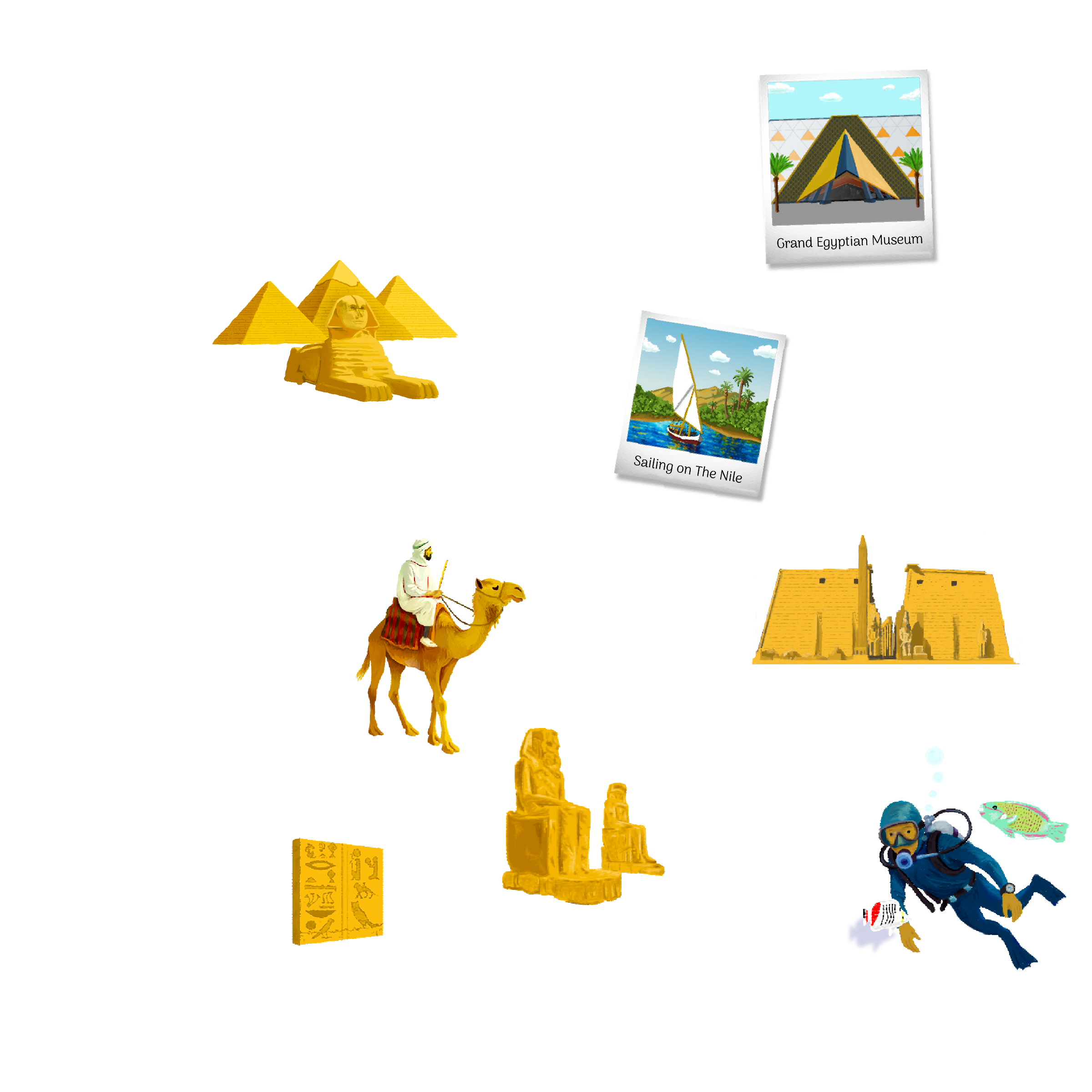
In Giza, the Pyramids and Sphinx still command the horizon, unmoved by time or traffic. Arrive as the desert cools in the early morning to beat the crowds, or linger until sunset when the sand glows amber and the monuments seem to hover between earth and sky. The newly opened Grand Egyptian Museum, gleaming and monumental in its own right, brings together more than 100,000 relics of Egypt’s past under one roof, from royal mummies to Tutankhamun’s golden mask. For those short on time, a 90-minute guided tour is the best way to navigate its vast halls.
Back downtown, Cairo reveals its modern edge. In Zamalek, an island in the Nile lined with embassies and leafy boulevards, stop at Zawal for Egyptian-made design goods or sip thick coffee at a café where locals debate the day’s news. El Horreya Café remains a timeless hangout—part beer hall, part living archive of Cairo’s creative spirit.
For a taste of the old city, head to Khan el-Khalili Bazaar, where El Fishawy, open since 1773, serves shisha and mint tea beneath carved wooden ceilings. A few blocks away, Beit Zeinab Khatoon and the Gayer-Anderson Museum offer glimpses into Cairo’s Mamluk and Ottoman past, complete with marble courtyards and Islamic woodwork.
If you have time to venture north, Alexandria is a three-hour train ride away. Founded by Alexander the Great, the port city blends Greek, Roman and Egyptian influences. The Bibliotheca Alexandrina—a sleek reinvention of the ancient library—captures the country’s enduring relationship with knowledge and light.

Cairo, Giza, and the Grand Egyptian Museum
Bibliotheca Alexandrina

Coral reefs


Temple of Karnak


unmatched diversity