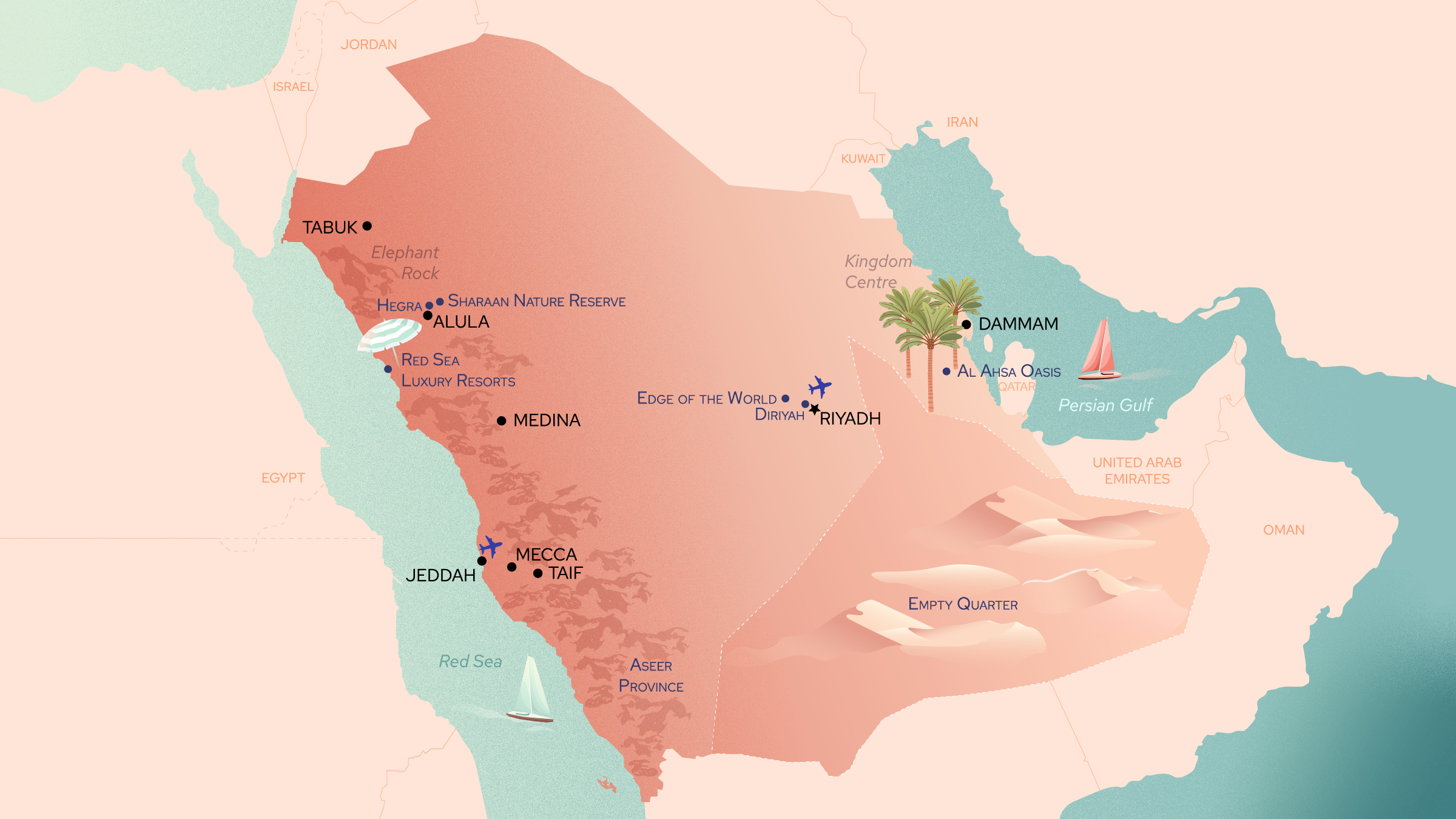
living history | natural beauty & bounty | energetic evolution | a warm welcome
Saudi Arabia
saudi Arabia is a country of contrasts. The nation is the historic heart of Islam, with a conservative culture and heritage that goes back thousands of years. Yet, it is also the home to some of the most futuristic projects on the planet—challenging the status quo of what's possible in sustainable development. The same country that just opened to international tourists in 2019 has set the ambitious goal of 150 million visitors by 2030 and will host the World Cup in 2034.
But well before then, Saudi Arabia is becoming increasingly easy to reach. Delta's newly announced nonstop service from Atlanta in October 2026 will be the fifth North American city with direct service. (Saudia flies out of New York, Los Angeles, Washington, D.C., and Toronto.) That’s in addition to connections from gateways such as Istanbul, Dubai and Doha. Simply put, the barriers to entry that existed a few years ago are quickly coming down.
Start your journey through time with a side trip to nearby Diriyah, the cradle of Saudi history. Stroll through the At-Turaif District, a UNESCO World Heritage Site whose mudbrick palaces and narrow streets date back to the 18th century. This was the birthplace of the Saudi kingdom. At the district's center stands the majestic Salwa Palace, once a royal residence and now home to the Diriyah Museum, which traces the rise of the House of Saud.
After exploring At-Turaif's museums and courtyards or relaxing under palm groves along Wadi Hanifah, visitors can cross to Bujairi Terrace, Diriyah's lively shopping and dining quarter. Here, you'll find boutiques, cafes and global fine-dining heavyweights Tatel and Long Chim, Michelin-starred restaurant groups making their Saudi debut. As the sun sets over the valley, the walls of At-Turaif take on a golden hue, offering a timeless reminder of where the Saudi story began.


Travel beyond expectations
in collaboration with:


BACK TO
THE TOP

BACK TO
THE TOP

BACK TO
THE TOP

BACK TO
THE TOP


Elephant Rock


Diver in the Red Sea


Living history
Natural beauty & bounty
Energetic evolution
A warm welcome

Diriyah

Plan your trip


Jeddah
Maraya | credit: Royal Commission of AlUla
Qasr al-Farid
Shebara Resort
Jeddah
Taif roses
Al Ahsa Oasis
Souq al-Zal
AROYA Cruise ship
Qahwa ritual
Traditional Saudi dishes
Cristiano Ronaldo


Reffen Street Food Market
Photo credits: Lukas Bukoven (left); Reffen - Copenhagen Street Food (right)


The BLOX Building (left); The Black Diamond (right)
Photo credit: Daniel Rasmussen
Jeddah, on Saudi's Red Sea coast, shows how the past and future coexist. The city is the principal gateway for religious pilgrimages to Mecca, an important trade port on the ancient spice route, and—according to local tradition—the final resting place of the Biblical Eve. In the UNESCO-listed district of Historic Jeddah (Al-Balad), buildings dating back to the 17th century line the narrow streets, their thick coral stone walls harvested from the nearby Red Sea reef. Intricate wooden rawasheen screens shade interior spaces while allowing the sea breeze. Architectural features blend Ottoman, Indian and Hijazi influences, showcasing the city's merchant heritage.
Best Bet 2026
Saudi Arabia was chosen as a Travelzoo Best Bet for 2026. Only ten worldwide destinations were selected for this honor, based on factors like increased interest among Travelzoo members, sustainability considerations or landmark events for the new year. See the full list here.
Best Bet 2026
Best Bet 2025
Best Bet 2026
Saudi Arabia was chosen as a Travelzoo Best Bet for 2026. Only ten worldwide destinations were selected for this honor, based on factors like increased interest among Travelzoo members, sustainability considerations or landmark events for the new year. See the full list here.
Kingdom Centre Tower
Edge of the World, near Riyadh
Diriyah
Not far from AlUla is the Sharaan Nature Reserve, a 580-square-mile protected area established in 2018 to conserve the desert ecosystem as the region opens to tourism. Currently accessible only on guided day tours, the reserve features dramatic sandstone cliffs and canyons, as well as flora like acacia, desert wildflowers and wild grasses. Visitors can hike and take 4x4 safaris in search of Arabian oryx, Idmi gazelles and Nubian ibex, species reintroduced thoughtfully to their native habitat. You'll also visit The Arch (aka Rainbow Rock), a natural sandstone formation whose bands of red, orange and gold shift in the sunlight.
Surrounded by tranquil, warm waters, it's no surprise that Saudi Arabia would be a diving hot spot. Jeddah is an excellent jumping-off point for Red Sea diving, where crystal-clear waters teem with marine life, around 15% of which is found nowhere else on Earth. More experienced scuba divers may venture to Yanbu, called "the Pearl of the Red Sea" due to the healthy coral reef system and excellent underwater visibility.
A few hours from Jeddah in the Hijaz Mountains is Taif, the City of Roses. The cool mountain climate makes the area a popular summer getaway, and the perfect growing environment for the famous Taif rose, a 30-petal wonder prized for its uncommonly intense fragrance. Visitors can tour traditional distilleries where huge antique copper pots and scales are still used to transform tens of thousands of hand-picked blossoms into the coveted attar of Taif rose—one of the world's most expensive natural perfumes, used by luxury brands like Chanel. (Ounce for ounce, the rose oil is often worth more than gold.) Factory floors are blanketed with carpets of petals during harvest season (April-May), filling the air with their scent. Before leaving town, pick up rose oil or rose water as high-quality souvenirs, then treat yourself to a rose tea in the gardens, surrounded by pink and red blooms.
Across the country in Saudi's Eastern Province, the verdant leaves of 2.5 million palm trees shade the Al Ahsa Oasis, the largest oasis in the world. Underground springs and fertile soil have long made this area between Riyadh and the Persian Gulf coast a crossroads for trade. Filled with ancient forts, mosques and historic sites, the oasis was recognized as a UNESCO World Heritage Site. But more importantly, the region produces over 120,000 tons of dates each year. The role of dates in Saudi culture can't be overstated: offered to guests as a symbol of generosity and welcome, and used to break the Ramadan fast, the date is a pillar of both the Saudi diet and identity. Be sure to bring some home as a delicious reminder of your visit.
At the crux of this innovation is the capital city of Riyadh, a dynamic place where simple souqs and towering skyscrapers share the ever-changing landscape. Dominating the skyline is the 99-story Kingdom Centre Tower with its parabolic arch and Sky Bridge forming a distinctive design that can be seen from all around the city. Completed in 2002, the tower houses a luxury mall, offices and residences, as well as the Four Seasons Hotel Riyadh, one of the many high-end hotel properties sprinkled throughout the city.
Humbler in stature but no less impressive are marketplaces such as the Souq al-Zal (for traditional Saudi goods), Souq al-Owais (for jewelry and men's clothing) and Souq Taibah (for abayas, the traditional women's outer cloak), scarves and perfume. Getting around the city is easier with the Riyadh Metro, a massive project opened in 2024, bringing six lines and 85 stations on line in little more than a decade. In the cooler months (October through March), Riyadh Season takes over the city calendar with concerts, festivals such as Soundstorm (the world's largest electronic music festival), immersive attractions and sporting events from WWE's Royal Rumble to the Six Kings Slam tennis tournament.
Modern touches take on a new meaning in the tourism initiative called The Red Sea, which is transforming an untouched archipelago of over 90 islands and inland sites along the Saudi Red Sea coast into a luxury destination of unparalleled scope.
Five resorts are already open to guests, with overwater villas at The St. Regis Red Sea Resort, the Nujuma, Ritz-Carlton Reserve, and Shebara Resort, and escapist desert retreats at the Six Senses, Southern Dunes and Desert Rock Resort. Shura Island is one centerpiece of The Red Sea development, pairing a gorgeous links golf course with 11 world-class resorts that includes a veritable who's-who of aspirational brands including Four Seasons, Miraval, Rosewood, Fairmont, Raffles, Grand Hyatt, SLS, EDITION, Jumeirah and InterContinental. Flights are already available from Riyadh, Jeddah and Dubai to Red Sea International Airport.
A luxury transfer from the airport via electric vehicle, helicopter or yacht will take you to Amaala, a luxury wellness sanctuary located in the Triple Bay Area, situated between the Hijaz mountains and the sparkling waters of the Red Sea. Taking its name from the Arabic word for “hope” and the Sanskrit word for “purity”, the destination will be home to coastal resorts from the likes of Four Seasons, Ritz-Carlton, Six Senses, Rosewood and the fitness brand Equinox.
Despite the audacity of building a world-class destination seemingly from scratch, the entire project is a case study in regenerative tourism. Only 1% of the total area is being developed for tourism, with 75% set aside for conservation. Sustainability efforts include a ban on single-use plastics, plans to grow 50 million mangrove trees to prevent erosion, a 1 million visitor cap to the area each year and a commitment to a carbon-neutral operation—helped by 760,000 solar panels providing energy to the resort areas and surrounding community for hospitality workers. The St. Regis, Ritz-Carlton, Six Senses and Shebara all already earned LEED Platinum status, the highest available classification.
The array of luxurious travel options goes well beyond Red Sea resorts and the AlUla region. In 2024, Saudi Arabia launched AROYA Cruises, its own luxury cruise. The 1,678-cabin ship departs from Jeddah, sailing to Red Sea destinations including Egypt, Jordan and Saudi coastal ports. The luxury resort at sea combines Arabian hospitality traditions with high-end dining experiences and 20+ entertainment venues.
Qahwa or Saudi coffee is not like what you'll get at Starbucks. Serving coffee is a ritual in Saudi culture, poured from a long-spouted pot called a dallah into small handleless cups called finjan. Your finjan will be refilled by the host unless you shake your cup to signal you've had enough, though it's polite to drink at least three small servings. The drink itself is made from lightly roasted Jazan Arabica beans and infused with cardamom (and sometimes saffron, cloves or cinnamon) for a fragrant, spiced taste. Saudi coffee is consumed without milk and often served with dates or date-filled mammoul shortbread cookies to balance the bitterness. Coffee served with dessert would match Western travelers' expectations for color and taste, and is often flavored with sugar, milk, chocolate or caramel.
Saudi Arabia's culinary profile is on the rise, with internationally recognized chefs from Jason Atherton to Alain Ducasse to Nobu Matsuhisa bringing their world-class dishes to Saudi outposts. That said, you will also want to try traditional Saudi dishes, which favor aromatic spices for flavor over heat. Considered Saudi Arabia's national dish, kabsa combines scented, fluffy rice, vegetables and slow-cooked meat (chicken, lamb, beef, goat or even camel) with regional twists. Yughmush, freshly cooked pocket bread stuffed with tender meat, is a street food staple. Grab one for an on-the-go snack and eat while the bread is still warm, soaking up the meat's juices.
The hospitality extends to a calendar packed with major international sporting events taking place across Saudi Arabia. As the nation prepares to host the World Cup in 2034, it's made a concerted investment in soccer—signing global superstar Cristiano Ronaldo and other big-name talents to teams in its domestic league, as well as bringing the Italian and Spanish Super Cups to Saudi stadiums.
Pair that with regular events across Formula 1, LIV Golf, ESports World Cup, UFC, WWE and pro boxing and the star power is unreal.
The country's roots are firmly planted in the past, as evidenced by 8 UNESCO World Heritage Sites and numerous preservation projects to restore ancient treasures. But there is also an eye toward the future, loosening long-standing restrictions on dress and gender norms to welcome guests, while fast-tracking the creation of tourist attractions seemingly from scratch.
This is a destination that stands on the precipice of possibility. Travelers who are culturally curious, looking for an intriguing blend of authenticity and modernity, would do well to explore here. Between the stunning landscapes, timeless history, rich culture and welcoming people, many will find that the country challenges preconceived notions and confounds expectations.

Rijal Almaa

Many visitors to Saudi Arabia will fly to the capital of Riyadh, a vibrant city at the forefront of the country's modern makeover. To fathom the future, however, it helps to understand the past.
A trip further back in time (and a short flight from Riyadh) will take you to AlUla, where natural wonders and man-made marvels span millennia. Plan to spend a few days here, choosing from accommodation options that range from the luxury tented villas at Banyan Tree AlUla, the eco-conscious Habitas AlUla nestled amid sandstone canyons, or the boutique Dar Tantora The House Hotel set within restored buildings in AlUla's Old Town. For something more affordable, the Hyatt Place AlUla is slated to open in 2026.
Wander the labyrinthine streets of the Old Town and nearby AlJadidah Arts District, or stroll along the two-mile Oasis Heritage Trail, shaded by palm groves and fragrant citrus orchards. Join a guided tour to see Jabal Ikmah, known as AlUla's "open-air library" for the ancient inscriptions etched into sandstone cliffs, and the archaeological ruins of Dadan, a 2,000-year-old stone city with tombs skillfully cut into the red rock walls, some as high as 50 feet above the valley floor.
A short drive from Old Town is Jabal AlFil, or Elephant Rock, a geological giant sculpted by desert sands to its iconic shape. Visiting around day's end yields some amazing golden-hour photo ops, as well as a hopping social scene with a food truck, fire pit and music. Equally as photogenic is Maraya, which seems a mirage—it's the largest mirrored building in the world with 9,740 glass panels reflecting the desert canyon. The likes of Andrea Bocelli, Alicia Keys and Seal have performed inside the concert venue, whose name means "mirror" in Arabic.
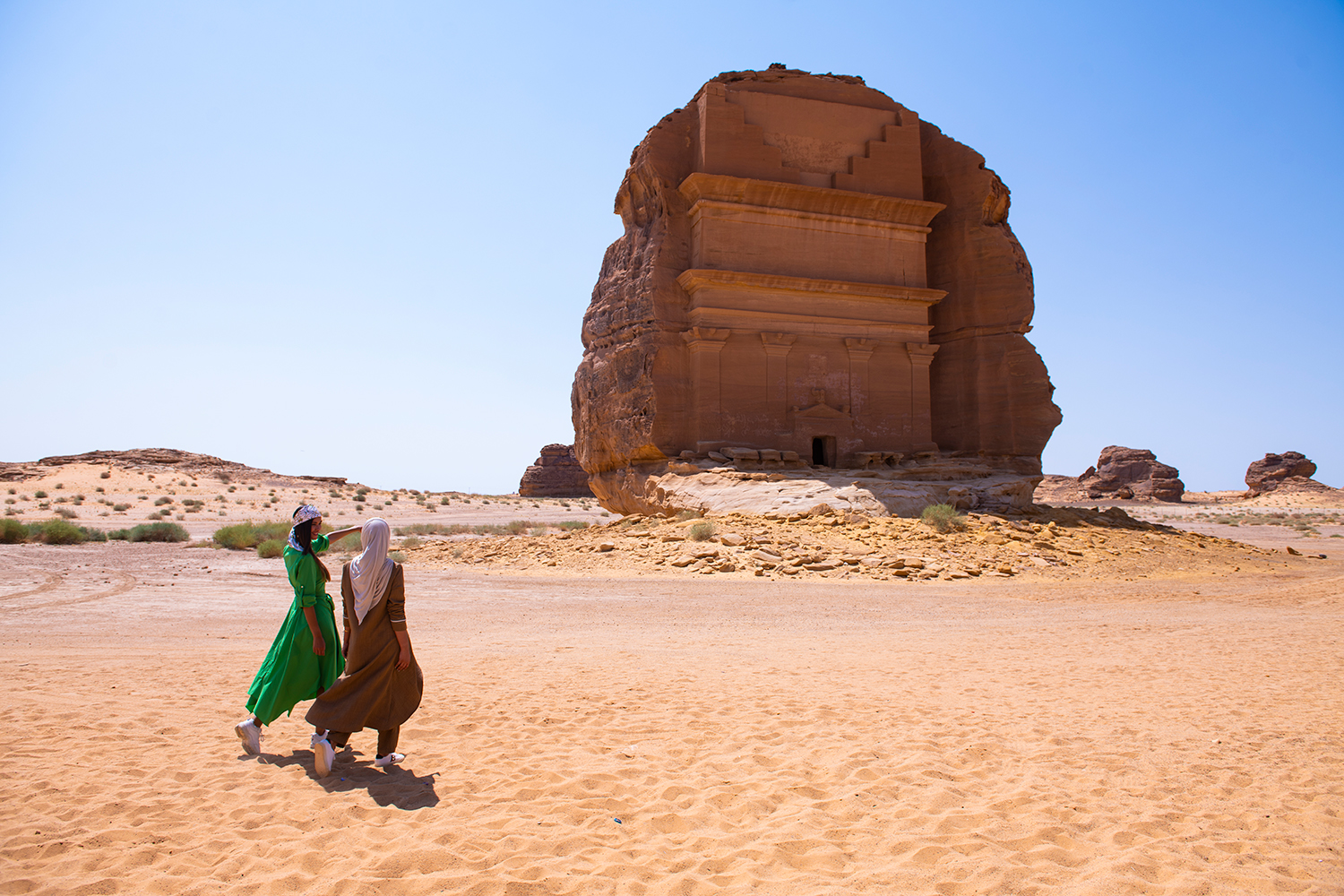
All of this is the precursor to the main reason for venturing to AlUla, the ancient Nabataean city of Hegra. Once a thriving trading post on the incense route linked to sister city Petra, the UNESCO World Heritage Site is best known for over 100 monumental rock-cut tombs, adorned with detailed inscriptions. The most famous, Qasr al-Farid (or "The Lonely Castle"), is an unfinished tomb carved into a 72-foot-tall sandstone monolith, its sculpted facade standing sentinel above the shifting sands. To preserve the timeless treasures, daily visitors to Hegra are limited, so book your timed guided tour early.

AlUla Oasis | credit: Royal Commission of AlUla
King Fahd Fountain

Saudi Arabia's second-largest city also brims with modern life: bustling souqs and chic quayside restaurants serving fresh seafood. The waterfront is ribboned by the scenic Jeddah Corniche, an 18-mile promenade alive with joggers, cyclists, families and those out for a leisurely stroll or beach day in the gentle Red Sea surf. Along the esplanade stand open-air sculptures by Joan Miró, Henry Moore and other modern masters, punctuated emphatically by the King Fahd Fountain, the world's tallest, sending jets of water soaring over 1,000 feet into the night sky. Another stunning seaside sight any time of day: the Al Rahma Mosque perched above the Red Sea. The so-called Floating Mosque is gorgeous inside and out, and can be visited by non-Muslims outside of prayer times.
The perception that Saudi Arabia is merely a land of deserts and dunes belies a country rich in natural wonders, from snow-dusted mountains to thriving coral reefs, from lush oases flush with date palms to mountain valleys where a distinctive rose blooms. Here, conservation and sustainability aren't buzzwords, but instead cultural norms practiced and perfected over centuries.

Snow in Saudi Arabia? Yes, it happens in high elevations north of Tabuk, leading to widely shared photos of camels walking in the snow and the occasional sledding or snowboarding excursion. There's not enough powder to ski, at least not yet. That will change with Trojena, part of the NEOM megaproject in the mountains near Tabuk. Slated to host the 2029 Asian Winter Games, there could be skiing in the desert in just a few years.
If hurtling down a hill is the adrenaline rush you're looking for, trade snow for sand in Saudi's Empty Quarter, a sea of dunes covering much of the southern Arabian Peninsula. Here, the dunes reach as high as 800 feet, giving thrill-seekers a chance to surf down golden slopes on a sandboard. The adventure menu doesn't stop there, with 4x4 dune bashing one of many ways to make a sandy splash. For the more refined traveler, camel treks with Bedouin guides or camping under the stars offer a chance to experience the stillness and solitude of the rugged landscape. With no light pollution for hundreds of miles, the stargazing here ranks among the best in the world. Even the Milky Way is visible to the naked eye.
Snow in Tabuk
Saudi Arabia's focus on attracting travelers to experience its natural wonders, historic treasures and pioneering projects has propelled the country forward in ways both evolutionary and revolutionary. Ambitious initiatives are reshaping infrastructure and moderating cultural norms, while still staying true to the country's core identity. As the sands of time shift, things that might've taken decades or centuries before are now unfolding in months and years.

Also in the works is a luxury train called Dream of the Desert, which will travel from Riyadh through northern Saudi Arabia. Targeted to launch in late 2026, it promises an experience that's less about the destination and more about the journey itself—a "rail cruise" emphasizing the luxury of immersive slow travel.
Through it all, Saudi Arabia continues to become easier to reach, thanks to the expansion of its flagship carrier Saudia, growing service from global carriers such as Delta and Virgin Atlantic, and the launch of Riyadh Air, which started flying in October 2025. One especially notable option for intrepid travelers is the Saudia Stopover, which lets you explore the country for up to 96 hours on your way to or from another destination when flying on Saudia. You can add a free transit visa instantly in the booking process and even score a free hotel night on some itineraries. Use the time to explore Riyadh, Jeddah or even AlUla, setting the stage for a more immersive return trip at a future date.
Maraya in AlUla | credit: Royal Commission of AlUla
Saudi Arabia's roots in Bedouin heritage mean that hospitality is one of the country's core cultural traditions. The Bedouin principle of karam (generosity)—welcoming guests with coffee, dates and a meal is central to Saudi etiquette today.

Subtle yet significant cultural shifts have occurred in recent years to make tourists—especially Western travelers—more comfortable with visiting. For example, a decades-old ban on women driving was lifted in 2018. Unmarried couples can now share a hotel room. And, while dressing modestly is recommended for both men and women out of respect for local traditions, women are no longer required to wear a head scarf in public. If you intend to visit religious sites such as mosques, though, pick one up at a local souq. They are gorgeous and will be a wonderful reminder of your Saudi travel experience.
Reffen Street Food Market
Photo credits: Lukas Bukoven (left); Reffen - Copenhagen Street Food (right)
Jeddah's Historic District
Maraya | credit: Royal Commission of AlUla


Diriyah
Desert Rock Resort

Six Senses, Southern Dunes

The St. Regis Red Sea Resort


Qasr al-Farid
Riyadh skyline

Food market


Taif roses
Al Rahma Mosque


Nujuma, Ritz-Carlton Reserve

Nubian ibex


Milky Way in the desert


The Arch (Rainbow Rock)


Shebara Resort

living history | natural beauty & bounty | energetic evolution | a warm welcome
living history | natural beauty & bounty | energetic evolution | a warm welcome
living history | natural beauty & bounty | energetic evolution | a warm welcome