

INTRO
Glow Up
Barbie Universe
Meta Barbie
Barbiecore

Whether you love her or hate her, Barbie is for you. And so is Greta Gerwig’s Barbie movie (landing in theaters July 21). From its beach-offs and bashed-in baby doll skulls to its rollerblades and dance breaks, Barbie is about a hero’s journey to sentience and self-acceptance (with a himbo sidekick investigating his own Ken-ergy along for the ride). It promises to be a fuchsia-saturated fever dream that thrills fans and fuels the summer box office. But before Margot Robbie and company leave Barbieland behind for some real-world adventuring, let’s take a look at the movie universe that was, Barbie’s enduring presence as a fashion icon, and how a tiny piece of plastic created an empire fantastic.

Beginnings
GLOW UP


back to top

back to top

back to top

back to top

back to top
There are two stories of how Barbie came to life – both are true. The first follows the garage genius template. Mattel co-founder Ruth Handler built a three-dimensional role model for her young daughter Barbara who was tired of playing with paper dolls. The second sees Handler on vacation, dipping into a toy store and emerging with an ample-chested, pouty-lipped gag gift that men passed around for their own amusement. Handler took that bit of sexualized synthetic polymer, changed her features, named her after her daughter, and debuted her at the New York Toy Fair in 1959.
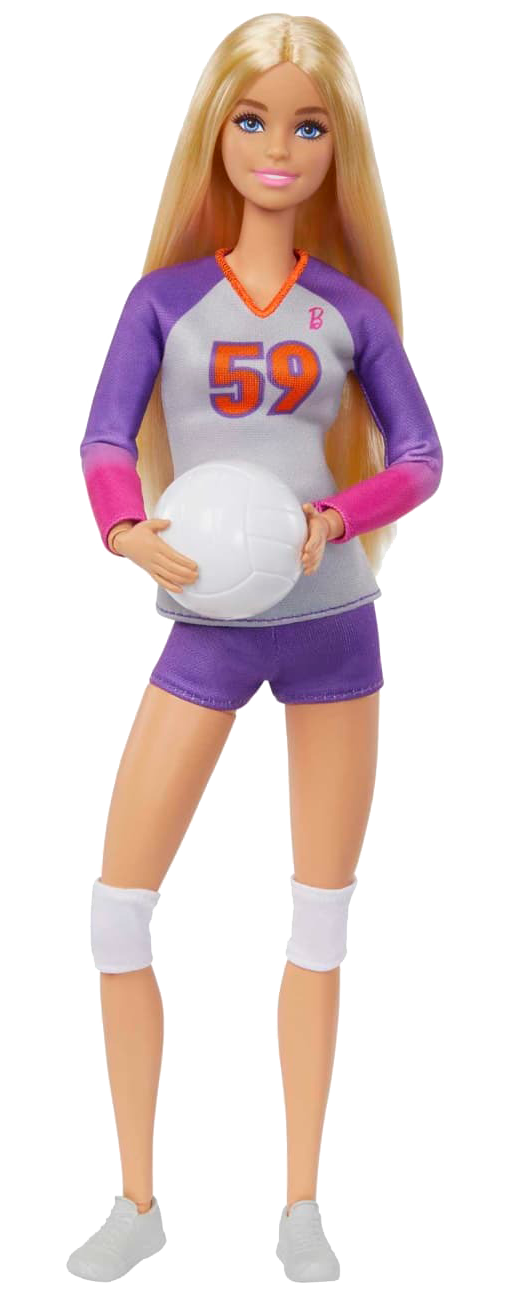
The duality of Barbie has always been present -- an aspirational action figure for young girls dreaming of the future (whether the patriarchy liked it or not) and a plaything capable of courting controversy with her too-tiny waist and perpetually arched feet. But in the beginning, she was, simply, revolutionary. Mattel would sell 300,000 Barbies that first year with outfits, accessories, and dream houses soon following. She’d go to the moon before Neil Armstrong stepped foot there. She’d become a surgeon when just 9% of all doctors were women. She’d break the plastic ceiling in 1963 in a chic day-to-night power suit and run for president in 1992. Still, even early on, Barbie
and the brand faced criticism when the doll strayed from Handler’s career-focused
goal for the toy. In the 1960s, a teen Barbie was sold with a diet book that told
young girls “Don’t eat.” Later, another teen doll would blurt out sexist
nonsense like “Math class is tough,” and “Will we ever have enough
clothes?” But she always bounced back, often to new heights, while being
marketed as the ultimate in femininity, ambition, and both the possibilities
and constraints of womanhood. With that kind of resume, how could
she not become a global icon?
Over the decades, Barbie slowly became more than a doll, she became a brand that was ripe for expansion. In 1961, she got a boyfriend named Ken and siblings too, first little sister Skipper, then later Stacie and Chelsea. Mattel began a push towards diversity in the 1980s, introducing a Black and Latina Barbie before Barbies with hearings aids, prosthetic limbs, wheelchairs, and Down’s Syndrome would follow in the 1990s and 2000s. On the screen, Barbie would have a series of her own animated TV shows, first in the 1980s with Barbie as a pop star in outer space before her Dreamhouse Adventures and plenty of G-rated movies would take hold in the 2010s.
Sure, Mattel was still churning out billions of dollars’ worth of dolls but the universe they were building on social
media, on streaming, with mobile games, and Youtube meant Barbie's domain was growing beyond store shelves.
In 2014, Mattel reached an even broader audience, introducing different body types
for Barbie – tall, petite, and curvy. They fashioned dolls after historical pioneers
like Ida B. Wells and Anna May Wong and paid tribute to current trailblazers
like Jane Goodall, Laverne Cox, and Naomi Osaka. Handler’s vision
that Barbie would be the canvas on which little girls could paint their
own possibilities was still the company’s compass and it was about to
steer them to Hollywood.
In 2014, superheroes ruled cinema. You might be thinking, “What do capes and spandex and the washboard abs of men named Chris have to do with Barbie?” Like every other brand at the time, Mattel thought that if the Barbie revolution was going to be televised, it needed to be franchised as well. That’s what sold the company, and later Sony (at the time under the direction of Amy Pascal) on a script pitched by Jenny Bicks (HBO’s Sex and the City). The idea seemed pulled from the Marvel playbook: Sony would launch a live-action Barbieverse that would make use of the over 150 careers then in Barbie’s repertoire. According to a Deadline report, the film would allow Barbie to “use her personal and professional skills to step into the lives of others and improve them, almost like a modern-day Mary Poppins,” allowing the studio to cast rising stars in the lead roles of Barbie and Ken while interchanging a supporting cast of more established talent in each subsequent film. The appeal of a universe-spanning blockbuster series steered by a chameleon-like heroine that could produce its own spinoffs down the line was easy to see, but nailing the script for such a behemoth undertaking took work. Multiple drafts of work. Spread out over years as Pascal and Sony first tapped Diablo Cody to rewrite the premise – a job she later admitted she “failed so hard at” -- before recruiting screenwriters Lindsey Beer (Sierra Burgess Is A Loser), Bert Royal (Easy A), and Hilary Winston (Community) to work three separate treatments at the same time to see which might best fit the studio’s vision.
In the end, Winston’s fish-out-of-water adventure that saw Barbie being kicked out of Barbie-ville and tossed into the real world before discovering the value of her own internal beauty, won out, but the movie was plagued by scheduling conflicts and tonal issues. Despite Mattel aiming for a PG rating, Amy Schumer was brought on to both star in the film and give its script a pithy re-write with help from her sister, Kim Caramele. Her R-rated Trainwreck had been a breakout at the box office a year earlier, and Schumer had gained a following that loved the boundary-pushing feminist-bent comedy of her Inside Amy Schumer series. But whatever plans Schumer had for Barbie fell apart a few months after her casting announcement. At the time, scheduling conflicts were to blame, but since then Schumer has revealed she felt wholly unsuited to Mattel’s vision for Barbie on the big screen.
“The studio definitely didn’t want to do it the way I wanted to do it. The only way I was interested in doing it,” Schumer told The Hollywood Reporter in 2022, listing gifted Manolo Blahniks
and the studio’s compromise that Barbie could be an inventor only if the
thing she invented was Jell-O high heels, as red flags. Shortly after,
Anne Hathaway’s name would be floated as a potential replacement
with Pascal hinting that an Oscar-winning actress was circling the
film in a New York Times profile. But when Sony’s option expired
and Barbie parked her pink convertible in the Warner Bros. lot,
Hathaway was gone, Pascal’s scripts were too, and the most
recognizable piece of plastic Americana was due
for a movie makeover.
“They are never going to let us make this movie.” That was Margot Robbie’s first thought when she peeked at a Barbie script penned by Greta Gerwig and her partner, fellow filmmaker Noah Baumbach. Robbie had been attached to star and then produce the new iteration of Mattel’s big-screen dream for a year before glimpsing the pair’s treatment. The gist, that Barbie might leave her dream world to explore her own humanity, was still central to the story, but significant changes had also been made. Barbie was about to be more camp, more meta, than ever before. And Gerwig was both excited and terrified to defy all of those set in plastic expectations. “That feeling that I had was knowing that it would be [a] really interesting terror. Usually that’s where the best stuff is,” Gerwig told Dua Lipa on the artist’s podcast. “Anything where you’re like, ‘This could be a career-ender,’ then you’re like, ‘OK, I probably should do it.'”
Filming got underway in summer 2022 and had the internet buzzing, as did a teaser that playfully dipped its perfectly-posed toes in Kubrickian homages that delighted film buffs. Its Vintage Barbie fashion won nostalgia points with diehard fans while giving absolutely nothing away in terms of its plot.
What was Barbie about? From what we can tell from glossy profiles like Robbie’s latest for Vogue, Barbie seems to be having an existential crisis, interrupting dance numbers to question if her plastic buddies contemplate death. She’s walking flat-footed. She’s malfunctioning. Gerwig references Reviving Ophelia, a book about the societal pressures stifling adolescent girls that her mother checked out of the library when she was young as a narrative guide of sorts. “They’re funny and brash and confident, and then they just—stop,”
Gerwig told Vogue. “How is this journey the same thing that a teenage girl feels?
All of a sudden, she thinks, ‘Oh, I’m not good enough.’” Both Robbie and
Gerwig want to defy expectations. Perhaps the best way to do that is to
confront it head-on, to poke fun at it, to give it a wink to camera before
surprising audiences with something subversive and surprising.
Something we didn’t know we wanted.
But what do we want from Barbie? Not just the film, the pop culture icon.
Filmmaker Andrea Nevins decided to investigate Barbie’s long, complex history in a Hulu documentary because, as she told the L.A. Times, “She carries a lot on her tiny shoulders.” She titled her film just that, Tiny Shoulders: Rethinking Barbie. “We have a very complicated relationship with our own femininity, and it’s not just us individually. Society still has a very complicated and unsolved idea of what women should be today. That’s captured in this doll.”
It’s also captured in Barbie-inspired aesthetics filtering through our timelines and taking up space in our closets at the moment. Fans are reclaiming pink, rejecting the outdated idea that women must eschew girliness in order to be taken seriously, to appear strong, to hold space in a patriarchal world. Nevins’ assertion that society’s definition of womanhood is simply a question mark is still true in many ways, but in the world of fashion – an arena stereotypically reserved for women – designers and trendsetters are embracing that ambiguity. They’re experimenting with ideas of gender norms. They’re challenging girlboss culture. And Barbie is helping them do that.
The trend is called Barbiecore and it’s all about vibrant pinks, exaggerated silhouettes, bold accessories, and an uber feminine aesthetic. Debuting on the scene in 2022 thanks to Gerwig’s movie and a Valentino runway collection busting at the seams with a “think pink” mentality, Barbiecore was the “it” look of the summer, and it could be found on red carpets, at awards shows, in Instagram influencer posts, and more. Suddenly, everyone
could be a Barbie girl – from Harry Styles to Saweetie, Lizzo, Sebastian Stan,
Zendaya, and, perhaps ironically, Anne Hathaway. “Barbiecore
represents the idea that fun, brightly colored and over-the-top looks do
not need to be reserved for just a doll,” celebrity stylist Britt
Theodora told CNN. “Barbie herself represents female
empowerment and the idea that a woman can do or be anything
she wants and the same goes for Barbiecore dressing.”

Beginnings
conclusion

Barbie universe
META Barbie
Barbiecore
conclusion
Barbie’s big screen debut and the hype surrounding it – from its costumes and set design to its soundtrack filled with bangers from Nicki Minaj, HAIM, and *checks notes* Ryan Gosling -- will undoubtedly add to her enduring legacy in ways both positive and negative. Gerwig and Robbie are playing in a sandbox filled with assumptions, resistant to change, and cemented in sentimental longing for a bygone time – one remembered differently depending on your gender, ethnicity, and inherited privilege. But perhaps the most promising element of the film is its eagerness to dismantle preconceived notions, to experiment with a historical icon, to give Barbie the space to grow once again. To become something new, something different, something uniquely her.



Writer: Jessica Toomer | Creative Direction: Jason Tabrys
Design/Build: Carlos Sotelo Olivas, Daisy James, Joseph Petrolis | Images/Video: Warner Bros. and Mattel