Home
The challenge
Respond with confidence
Where uncertainty hits hardest
What to watch in Washington
Your next move
The game-changing power of ERP
How to solve your industry’s biggest challenges
Don’t just ride out the storm. Use it.
Navigating uncertainty
Mid-market companies don’t have the agility of startups or the resources of giants. But in times of disruption, they can move with purpose. This guide reflects what we’re seeing across hundreds of mid-market organizations — informed by Wipfli’s industry teams and on-the-ground client conversations.
Mid-market leader trends
Let's talk
Previous page
Next page
Today’s business landscape isn’t just volatile — it’s layered. Leaders aren’t reacting to a single disruption but rather navigating a cascade: shifting policies, market fluctuations, labor shortages, new competitors and AI’s rapid advance. For mid-market leaders, this makes decision-making even harder. Without the deep war chests of large enterprises or the nimble models of startups, the pressure to get it right — now — is immense.
Uncertainty is the new normal
Pressure points we’re seeing in the mid-market include:
What mid-market executives say
of revenues are lost to uncertainty
4.4%
feel unprepared to navigate downturns
50%
know their top challenge is deciding when and where to act
73%
Distinguishing between passing trends and structural shifts.
Acting fast without overextending teams or resources.
Balancing near-term cost control with long-term investment.
1.
2.
3.
A framework to respond with confidence
Your response strategy
Reassess expansion bets based on new market signals Develop cost-efficient entry points into adjacent markets Act quickly on strategic M&A when valuations soften
Key strategies:
More mid-market companies are leaning into strategic growth moves — not pulling back. U.S. private equity deal volume rose 13.3% in Q4 2024, contributing to a 12.8% year-over-year increase in total deals. That momentum is being driven in part by mid-market firms capitalizing on favorable valuations and alignment opportunities.
Proof point:
Prepare for what’s next without overcommitting today. Some disruptions are opportunities in disguise — if you’re ready. This lens helps you stay positioned for growth by stress-testing current plans, exploring new markets and taking advantage of favorable pricing or timing.
Prepare for the upside
Align tech investments with operational readiness and business goals Automate key workflows to speed up decisions Improve scenario modeling, forecasting and planning processes
A midsized healthcare organization cut its month-end close time by 65%, increased Medicare reimbursement and transformed its supply change management with Wipfli’s enterprise technology strategy and solutions.
Design systems that let you shift when the market does. When the future is uncertain, flexibility becomes your biggest asset. This lens focuses on enabling agility — so you can act faster, respond smarter and empower your teams with better tools and data.
Build agility
Disruption doesn’t come with instructions — but your response can be structured.
We’ve identified three distinct lenses that help our mid-market clients act with more clarity and confidence. These aren’t mutually exclusive — many will use all three — but understanding which lens to emphasize first can help you prioritize limited resources and move with intention.
explore the 3 lenses:
Managing the downside
Positioning for the upside
Building agility
Build the guardrails that preserve capital and keep you compliant In uncertain environments, stability becomes a strategic advantage. This lens is about reducing risk, protecting cash flow and reinforcing your foundation so you can move forward with confidence. It’s a smart place to start when margins are tight or regulations are shifting.
Manage the downside
Project Name
Lorem ipsum dolor sit amet, consectetur adipiscing elit. Facilisi eget est, et ultrices.
John Pady
John Pady, chief program and expansion officer of the Community and Economic Development Association of Cook County, Inc. (CEDA), helped revolutionize weatherization and energy efficiency initiatives in the Chicago area. Under his visionary leadership, CEDA has been able to integrate cutting-edge technology and sustainable practices into the support they provide their community, helping to ensure tangible impact and long-term viability.
Prepare for what’s next without overcommitting today Some disruptions are opportunities in disguise — if you’re ready. This lens helps you stay positioned for growth by stress-testing current plans, exploring new markets and taking advantage of favorable pricing or timing. The goal isn’t to move fast — it’s to be ready.
Create the capacity to move when it matters most When the future is uncertain, flexibility becomes your biggest asset. This lens is focused on improving how your business responds — with better data, clearer decision-making and systems that scale. Agility isn’t a trait. It’s a capability you can build.
These aren’t theories. They’re the actions we’re hearing from Wipfli teams working across the mid-market — the real moves clients are making to navigate uncertainty.
What mid-market leaders are doing right now
Clients are consolidating legal entities to simplify operations and reduce risk exposure. Real estate developers are shifting from new builds to acquisitions or holding strategies. Organizations are outsourcing finance, HR and IT to avoid new FTE costs while improving quality. Manufacturers are trimming working capital by rightsizing inventory after COVID oversupply.
Many clients are stabilizing by restructuring, deferring nonessential spending and automating wherever possible.
— Matt Sabo, Wipfli Director, Modernization, Analytics and Commerce Practice
explore THE trends WE'RE SEEING through the 3 lenses:
WHAT OUR CLIENTS ARE DOING
— Ryan Rademann, Wipfli partner, strategic tech enablement
“Even in tight times, we’re seeing selective investments in tech, M&A and strategic expansion — the intent is growth readiness.”
Private businesses are exploring buy-side M&A to gain market share or tuck in capabilities Nonprofits are proactively reworking programs and funding models to meet emerging needs Tech upgrades are being made with an eye toward AI-readiness and growth, not just efficiency
What we’re seeing:
— Tom Cox, partner, organizational performance practice
“Clients want to move fast, but smart. That means better internal alignment and systems that don’t slow them down.”
Clients are aligning leadership teams and clarifying roles to make faster decisions Scenario planning and succession work are being prioritized to handle leadership transitions ERPs, CRMs, and data platforms are being modernized to improve visibility and planning
SELECT EACH LENS TO READ MORE
“Many clients are stabilizing by restructuring, deferring nonessential spending and automating wherever possible.”
Private businesses are exploring buy-side M&A to gain market share or tuck-in capabilities. Nonprofits are proactively reworking programs and funding models to meet emerging needs. Tech upgrades are being made with an eye toward AI-readiness and growth, not just efficiency.
— Ryan Rademann, Wipfli Partner, Strategic Tech Enablement
Clients are aligning leadership teams and clarifying roles to make faster decisions. Scenario planning and succession work are being prioritized to handle leadership transitions. ERPs, CRMs and data platforms are being modernized to improve visibility and planning.
— Tom Cox, Partner, Organizational Performance Practice
Even in tight times, we’re seeing selective investments in tech, M&A and strategic expansion — the intent is growth readiness.
Customer experience and data strategy: Personalize outreach, identify new revenue channels and scale impact . Improve customer engagement > Digital transformation and product strategy: Build new digital offerings or unlock new markets. Explore digital transformation > State and international tax structuring: Enable scalable growth with smart tax strategy. Visit international tax services > Leadership development and workforce planning: Build the right team to support your next move. Develop your leaders > Buy-side M&A strategy and diligence: Acquire strategically with the support of experienced advisors Explore buy-side services >
We recommend you act on opportunities with intention and flexibility — and scale where it matters most..
Make your next move count
Make your next move count Disruption creates openings. Smart companies are using this moment to reassess their growth bets, explore adjacent markets or take advantage of M&A opportunities while valuations are favorable. But upside strategy doesn’t mean overcommitting. It means finding scalable ways to act now — without compromising flexibility later.
AI automation and digital strategy: FP&A and scenario planning: Improve forecasting and build financial flexibility. Plan with confidence > Technology assessments and roadmaps: Build adaptive systems with IT strategy built for change. Explore IT strategy and risk services > Regulatory and compliance services: Stay prepared for evolving rules with proactive governance. Navigate compliance shifts > Learning and development strategy: Cross-train and upskill your team to improve flexibility. Explore team development > Investment banking and valuation- Keep your deal pipeline ready with insights on value and timing. Explore investment banking >
Be ready to shift In a time of fast-moving change, the ability to shift is a competitive advantage. That’s where agility comes in. Whether it’s through smarter tech investment, better scenario modeling or stronger alignment between teams and data, agility gives you the capacity to pivot without panic — and the clarity to move when others hesitate.
Most leaders tend to fall into two camps: those who freeze and those who act with intention. This isn’t about reacting faster — it’s about responding smarter. You’ve seen how other mid-market leaders are navigating uncertainty — from stabilizing margins to pursuing bold moves. But what is right for you? We’ve built a practical, flexible framework to help you act with confidence, not guesswork.
There’s no one right response to uncertainty — but there is a right response for you
explore YOUR next move to make through the 3 lenses:
AI automation and digital strategy: Reduce overhead and streamline core operations with practical AI use cases. STREAMLINE WITH AI solutions > ERP and CRM modernization: Replace legacy systems and improve visibility across teams. See ERP and CRM services > Tax credits and incentives: Improve liquidity through strategic use of federal and state programs. Maximize your tax credits > Workforce strategy and outsourcing: Restructure or supplement your workforce to align with today’s realities . Visit HR consulting > Sell-side advisory: Divest non-core business units or assets to free up capital. Learn about sell-side services >
Fortify your foundation Before you can grow, you have to stabilize. For many leaders, that means shoring up cash flow, revisiting tax strategy, minimizing compliance risk and finding operational efficiencies. The goal isn’t to play defense forever — it’s to create the financial and organizational headroom to make your next move with confidence.
Steps you can take We recommend stabilizing cash flow, reducing inefficiencies and strengthening your compliance position.
Customer experience and data strategy: Personalize outreach, identify new revenue channels and scale impact. Improve customer engagement > Digital transformation and product strategy: Build new digital offerings or unlock new markets.. Explore digital transformation > State and international tax structuring: Enable scalable growth with smart tax strategy. Visit international tax services > Leadership development and workforce planning: Build the right team to support your next move. Develop your leaders > Buy-side M&A strategy and diligence: Acquire strategically with the support of experienced advisors. Explore buy-side services >
Steps you can take We recommend you act on opportunities with intention and flexibility — and scale where it matters most.
FP&A and scenario planning: Improve forecasting and build financial flexibility. Plan with confidence > Technology assessments and roadmaps: Build adaptive systems with IT strategy built for change. Explore IT strategy and risk services > Regulatory and compliance services: Stay prepared for evolving rules with proactive governance. Navigate compliance shifts > Learning and development strategy: Cross-train and upskill your team to improve flexibility. Explore team development > Investment banking and valuation: Keep your deal pipeline ready with insights on value and timing. Explore investment banking >
Steps you can take We recommend creating systems, skills and insights that let you shift faster and respond smarter.
Customer experience and data strategy: Personalize outreach, identify new revenue channels and scale impact. Improve customer engagement > Digital transformation and product strategy: Build new digital offerings or unlock new markets. Explore digital transformation > State and international tax structuring: Enable scalable growth with smart tax strategy. Visit international tax services > Leadership development and workforce planning: Build the right team to support your next move. Develop your leaders > Buy-side M&A strategy and diligence: Acquire strategically with the support of experienced advisors. Explore buy-side services >
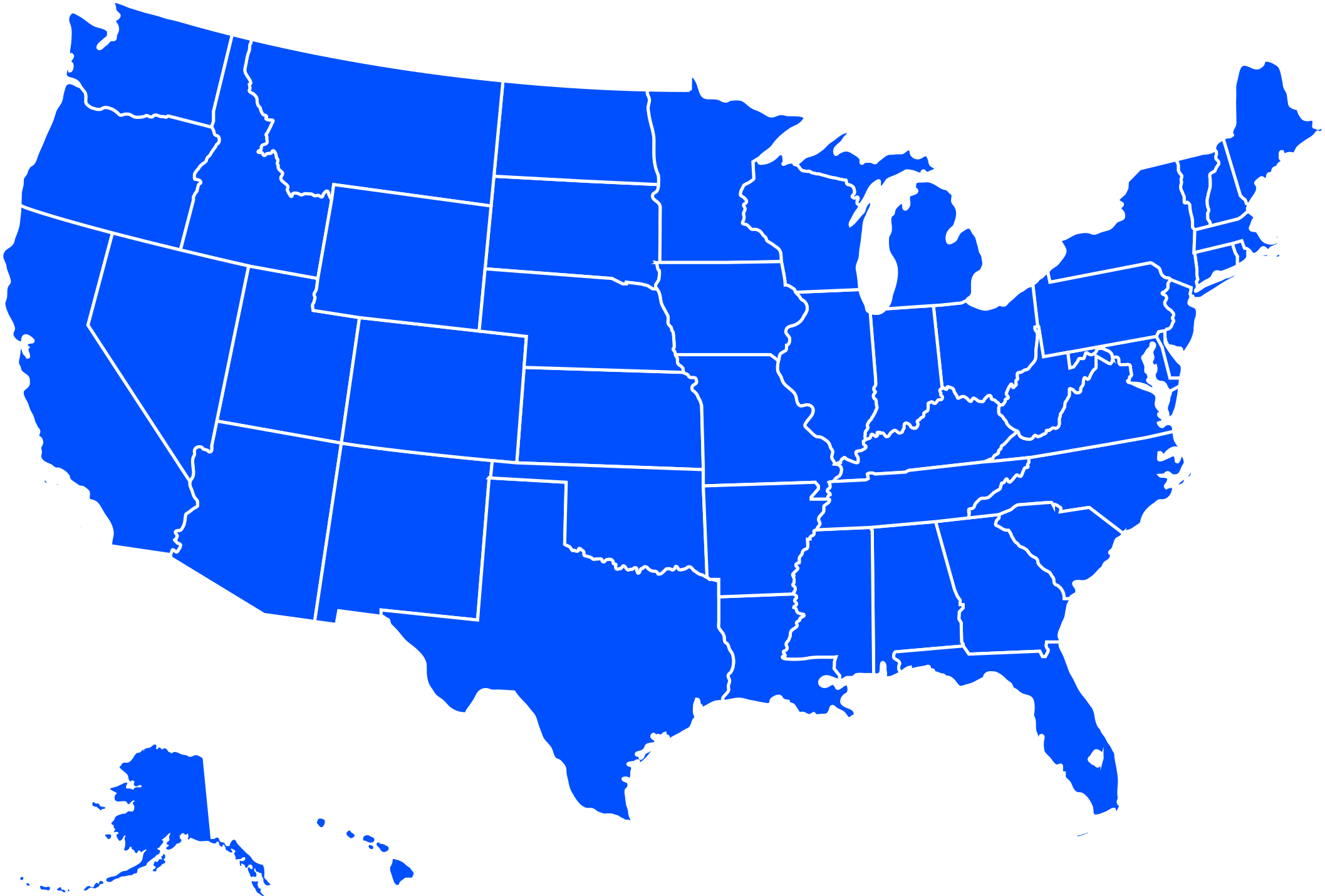
We’re not in a temporary blip — we’re in a new era of disruption. And the real story isn’t just playing out in headlines — it’s unfolding in boardrooms, budget meetings and hiring plans across the mid-market. Uncertainty isn’t abstract. It’s happening in real time, in specific places, with measurable impact. From regulatory overhauls to supply chain shifts to AI pressure, the complexity changes by region and industry. These are trends we’re tracking nationally — but what you’ll see here reflects where Wipfli teams on the ground are seeing the biggest impact for our clients.
How disruption shows up in each state
Select theme to explore map:
Regulatory shift
Where rules are changing fast — and making planning harder.
Supply chain and cost volatility
Tech adoption and AI pressure
Where inputs, pricing and timing are under pressure
Where disruption is moving fastest
What’s happening:
CPRA enforcement is creating complex new compliance obligations around consumer data. Recent budget adjustments are rolling back R&D tax credit flexibility for mid-sized innovators.
Tech, healthcare and manufacturing firms now face tighter margins and greater regulatory oversight.
Why it matters:
California
Federal funding delays and shifting grant eligibility rules are disrupting tribal program planning for tribal gaming and government. Compact renegotiations and state-level pressure on Class III gaming revenue-sharing are increasing legal and financial risk. New guidance on federal contracting and indirect cost recovery is changing budgeting practices for tribal governments.
Sovereign nations are navigating both economic opportunity and structural risk — often with limited visibility and shifting rules.
new mexico
State-level policy changes are putting pressure on tribal-state gaming compacts. Shifts in grant management protocols are complicating federal funding flows for tribal health, housing and education services.
Tribal governments here are navigating jurisdictional tension while trying to secure long-term funding reliability.
minnesota
New AI accountability law requires companies to explain algorithmic decisions in HR and consumer tools.
Firms using automation in hiring or customer targeting must review risk and transparency practices.
colorado
A cap is placed on state tax incentives affecting workforce and energy projects. There is a potential rollback of EDGE credits in 2025.
Incentive modeling is more important than ever for long-term planning.
Illinois
CMS value-based care pilots and reimbursement changes are impacting rural providers. Senior living communities face increasing compliance requirements without matching workforce support.
Providers are being asked to do more with less — and rethink how they deliver high-quality care in under-resourced areas.
IOWA
Aggressive remote work nexus enforcement is impacting payroll tax exposure. There are cybersecurity updates for regulated financial institutions.
Hybrid workforce models and fintech operations face greater compliance risk.
New york
Energy code updates are affecting the use of 179D/45L credits in new construction. There is increased state-level scrutiny on environmental reporting.
Construction and real estate firms may need to adjust planning for long-term credit eligibility.
Texas
florida
Updated CRA exam rules are increasing scrutiny for community banks. SEC rule proposals on ESG and cybersecurity are expanding disclosure obligations.
Smaller financial institutions face rising costs to comply with shifting federal priorities.
Ohio
Senior care and nonprofit organizations face reimbursement delays and funding gaps. Skilled labor shortages continue to challenge local manufacturers.
Wipfli clients here are balancing mission, margin and workforce strain — often all at once.
wisconsin
Healthcare providers are squeezed by stagnant Medicaid rates and staffing challenges. Midwest freight and distribution slowdowns are disrupting timelines for regional manufacturers.
Mid-market leaders are facing both systemic strain and day-to-day volatility.
missouri
Oklahoma
montana
The state’s 100% renewable mandate and recent energy credit programs are accelerating demand for solar, storage and infrastructure planning. New guidelines for energy project eligibility and incentive stacking are creating complexity for developers and local governments.
Energy advisors, contractors and public sector leaders need clarity on how to align incentives with fast-moving policy.
hawaii
State-by-state disruption impact
In 2026, CPRA enforcement is intensifying as regulators move from rule-setting to active scrutiny, penalizing companies that can’t operationally prove compliance across consumer rights, data minimization and vendor oversight. Senate Bill 711 revised the state’s research credit calculation for qualified research expenses and repealed the previous method.
Mid-sized tech, healthcare and manufacturing firms face tighter margins. They must reassess credit value, forecasting and documentation rather than relying on prior R&D calculations.
Federal funding delays and shifting grant eligibility are disrupting tribal program planning. Compact renegotiations and state pressure on Class III revenue-sharing are raising financial and legal risks. Updated federal contracting and indirect cost rules are altering tribal budgeting practices.
Colorado has enacted a pioneering state AI regulatory framework, set to take effect mid-2026, with compliance obligations for high-risk systems. It places documentation, bias mitigation and disclosure duties on developers and deployers of AI tools.
Operations
Technology
C-suite
Human resources
Finance and accounting
Iowa
Minnesota
Missouri
Montana
New Mexico
New York
What’s happening: CPRA enforcement is creating complex new compliance obligations around consumer data. Recent budget adjustments are rolling back R&D tax credit flexibility for mid-sized innovators. Why it matters: Tech, healthcare and manufacturing firms now face tighter margins and greater regulatory oversight.
>
<
Colorado What’s happening: New AI accountability law requires companies to explain algorithmic decisions in HR and consumer tools. Why it matters: Firms using automation in hiring or customer targeting must review risk and transparency practices.
Florida What’s happening: Energy code updates are affecting the use of 179D/45L credits in new construction. There is increased state-level scrutiny on environmental reporting. Why it matters: Construction and real estate firms may need to adjust planning for long-term credit eligibility.
Hawaii What’s happening: The state’s 100% renewable mandate and recent energy credit programs are accelerating demand for solar, storage and infrastructure planning. New guidelines for energy project eligibility and incentive stacking are creating complexity for developers and local governments. Why it matters: Energy advisors, contractors and public sector leaders need clarity on how to align incentives with fast-moving policy.
California What’s happening: CPRA enforcement is creating complex new compliance obligations around consumer data. Recent budget adjustments are rolling back R&D tax credit flexibility for mid-sized innovators. Why it matters: Tech, healthcare and manufacturing firms now face tighter margins and greater regulatory oversight.
Iowa What’s happening: CMS value-based care pilots and reimbursement changes are impacting rural providers. Senior living communities face increasing compliance requirements without matching workforce support. Why it matters: Providers are being asked to do more with less — and rethink how they deliver high-quality care in under-resourced areas.
Minnesota What’s happening: State-level policy changes are putting pressure on tribal-state gaming compacts. Shifts in grant management protocols are complicating federal funding flows for tribal health, housing and education services. Why it matters: Tribal governments here are navigating jurisdictional tension while trying to secure long-term funding reliability.
Missouri What’s happening: • Healthcare providers are squeezed by stagnant Medicaid rates and staffing challenges. Midwest freight and distribution slowdowns are disrupting timelines for regional manufacturers. Why it matters: Mid-market leaders are facing both systemic strain and day-to-day volatility.
Missouri What’s happening: Federal funding delays and shifting grant eligibility rules are disrupting tribal program planning for tribal gaming and government. Compact renegotiations and state-level pressure on Class III gaming revenue-sharing are increasing legal and financial risk. New guidance on federal contracting and indirect cost recovery is changing budgeting practices for tribal governments. Why it matters: Sovereign nations are navigating both economic opportunity and structural risk — often with limited visibility and shifting rules.
Labor shortages, shifting consumption patterns and infrastructure bottlenecks continue to impact lead times and inventory costs for companies in and around Washington.
Longer lead times and higher inventory costs directly strain cash flow, disrupt customer commitments and force difficult trade-offs between holding excess inventory and risking stockouts.
Washington
In late 2025, the Bureau of Land Management sharply increased timber sales in Oregon.
This boost could ease supply constraints but also introduces pricing uncertainty as markets adjust.
Oregon
Freight rail congestion and driver shortages are delaying critical deliveries. Warehousing costs are increasing in major logistics hubs.
Just-in-time models are no longer reliable — scenario planning is key.
In 2025, East Coast ports absorbed traffic from West Coast ports. However, in 2026, total U.S. import volumes are expected to decline due to tariffs and trade uncertainty.
Declining import volumes and tariff uncertainty increase per-unit logistics costs, reduce capacity flexibility and make transportation planning and inventory forecasting more volatile.
South Carolina
Concrete shortages and high demand from industrial expansion are pushing up prices. Steel volatility is linked to global market dynamics and infrastructure demand.
Project feasibility and profitability are shifting fast — especially in construction and heavy manufacturing.
georgia
Rising material and labor costs are straining commercial construction timelines, especially around hospitality and entertainment infrastructure. Gaming and tourism-driven enterprises are seeing cost spikes and unpredictable demand patterns tied to global travel and event cycles.
Businesses that rely on foot traffic or large-scale construction need tighter forecasting and scenario planning to stay profitable.
nevada
Tribal housing and broadband expansion projects are being slowed by contractor shortages and rural logistics barriers. Increased construction demand (from both public and enterprise initiatives) is driving material inflation in remote areas.
Budget planning and grant utilization are under pressure as costs outpace original project scopes.
Rapid growth in chip manufacturing is driving up demand for skilled labor and construction materials. Tight input markets are creating competition for resources.
Industrial firms may face unexpected price hikes and project delays as supply lags behind investment.
Arizona
Pennsylvania is seeing distribution center closures and layoffs at supply-chain firms as companies restructure operations in response to weak freight demand and cost pressures.
Fewer distribution centers and providers can lead to longer lead times, reduced service levels and less negotiating leverage with carriers and 3PLs at a time when cost control and reliability matter most.
pennsylvania
Colorado
Florida
Hawaii
Illinois What’s happening: A cap is placed on state tax incentives affecting workforce and energy projects. There is a potential rollback of EDGE credits in 2025. Why it matters: Incentive modeling is more important than ever for long-term planning.
Missouri What’s happening: Healthcare providers are squeezed by stagnant Medicaid rates and staffing challenges. Midwest freight and distribution slowdowns are disrupting timelines for regional manufacturers. Why it matters: Mid-market leaders are facing both systemic strain and day-to-day volatility.
Montana What’s happening: Federal funding delays and shifting grant eligibility rules are disrupting tribal program planning for tribal gaming and government. Compact renegotiations and state-level pressure on Class III gaming revenue-sharing are increasing legal and financial risk. New guidance on federal contracting and indirect cost recovery is changing budgeting practices for tribal governments. Why it matters: Sovereign nations are navigating both economic opportunity and structural risk — often with limited visibility and shifting rules.
New Mexico What’s happening: Federal funding delays and shifting grant eligibility rules are disrupting tribal program planning for tribal gaming and government. Compact renegotiations and state-level pressure on Class III gaming revenue-sharing are increasing legal and financial risk. New guidance on federal contracting and indirect cost recovery is changing budgeting practices for tribal governments. Why it matters: Sovereign nations are navigating both economic opportunity and structural risk — often with limited visibility and shifting rules.
Oregon What’s happening: Lumber exports remain volatile due to Canadian restrictions and wildfire fallout. Shipping backlogs from Asian trade routes are still recovering. Why it matters: Builders and manufacturers relying on timber and import timing are seeing budget and schedule disruption.
New AI transparency and accountability laws just took effect January 1, 2026, covering safety/risk assessments, chatbot disclosures and transparency requirements. Firms face growing compliance pressure under CPRA and potential federal regulation.
Innovation is speeding up, but so is scrutiny. Companies must modernize with eyes wide open.
Tribal enterprises are investing in automation and analytics for casino operations, but workforce training is a barrier. Tribal governments are also working to modernize cybersecurity — especially for systems managing health and education records.
Digital transformation needs to move forward without compromising sovereignty, security or accessibility.
State laws require companies to disclose and justify algorithmic decisions in consumer services and HR tech. Growing AI use is under new ethical and operational scrutiny.
Regulatory compliance is no longer optional — transparency is becoming a mandate.
Mid-market manufacturers are using AI for predictive maintenance and quality control. Many struggle to scale pilots due to integration challenges and budget limits. In 2025, Texas passed a broad AI governance law establishing statewide oversight and ethical guardrails for AI use.
Tech investment is accelerating — but success depends on more than the software, and regulatory scrutiny is increasing.
Large regional healthcare systems are rolling out AI in diagnostics and resource scheduling. State policy has yet to catch up, creating risk and confusion around patient data governance.
Senior living and hospital networks need a clear path from innovation to compliance.
Life sciences and medtech sectors are embedding generative AI in R&D and diagnostics. Demand for AI-skilled talent is outpacing local availability.
Automation can boost performance — but only if teams and systems are ready to support it.
Massachusetts
Federal contractors and defense-adjacent tech firms are updating AI governance frameworks. Risk teams are under pressure to prove accountability and reduce bias.
Strong controls and documentation are the new baseline for winning work and building trust.
virginia
Mid-market SaaS firms face growing pressure from investors to show profit over scale. Talent competition with remote-first coastal firms are squeezing internal growth.
Tech firms are rethinking hiring, roadmap velocity and where to deploy AI most strategically.
utah
Supply chain and cost volaitlity
Texas What’s happening: Energy code updates are affecting the use of 179D/45L credits in new construction. There is increased state-level scrutiny on environmental reporting. Why it matters: Construction and real estate firms may need to adjust planning for long-term credit eligibility.
Utah
Illinois amended its Human Rights Act to restrict employers’ use of AI in employment decisions. The state also prohibited the use of AI to independently provide therapy or make therapeutic decisions in mental health services.
The laws increase compliance obligations, requiring stronger governance, transparency and human oversight before deploying AI tools.
In 2025, Montana passed several laws restricting government AI use and mandating transparency and human oversight. It affirmed a “right to compute” limiting government regulation of computational resources, required risk practices for critical AI systems and barred undisclosed AI deepfake content in election communications.
The laws raise compliance expectations, increase transparency and human-oversight requirements and require stronger risk management if AI is tied to critical infrastructure or public communications.
Policy shifts reshaping the mid-market
Policy uncertainty isn’t slowing down. For mid-market leaders, it’s taking new forms — and it’s showing up in places that used to feel stable. From how you hire to how you file, change is happening across sectors. Here are the shifts we’re seeing shape business strategy the most.
2024
2025
Jan 2024
Mar 2024
July 2024
Aug 2024
Oct 2024
Jan 2025
Feb 2025
Mar 2025
Apr 2025
2026
May 2025
Q1 2025
Q2 2025
New ownership disclosure rules now in effect
Most privately held businesses must file beneficial ownership information (BOI) under the Corporate Transparency Act. Even small or family-owned firms are likely affected. Check filing deadlines and prepare documentation if you haven’t already.
Energy tax credits now require IRS pre-registration
Businesses using 179D, 45L or clean energy credits must register projects through a new IRS portal. Missing this step could delay incentives or trigger compliance issues. Talk to your tax advisor before starting a project.
Medicaid payment updates could reshape cash flow
Senior living and rural healthcare providers should expect changes to reimbursement models. This could create timing gaps or margin pressure — plan for possible budget adjustments.
Federal agencies were directed to selectively halt enforcement of certain labor, safety and environmental rules. While this may reduce short-term pressure, businesses should prepare for future reversals.
Temporary enforcement pause adds ambiguity
Agencies must retire one rule before proposing another. That means faster policy shifts — and more uncertainty in energy, utilities and construction-related sectors.
Zero-based budgeting begins for energy rules
The federal government revised cost allocation and procurement rules for grants. Nonprofits and tribal governments relying on federal funds should reassess their budgeting, especially around indirect costs.
Grant rule changes could impact nonprofit funding
DOJ and FTC issued guidance targeting the use of AI in employment and consumer-facing tools. If your company is using algorithms for hiring or dynamic pricing, review bias risks and documentation.
AI in hiring and pricing faces new scrutiny
A baseline tariff on all imports is in effect, potentially increasing costs across supply chains. Manufacturers, distributors and retailers should revisit sourcing strategies and adjust pricing models.
New 10% tariff adds cost to all imports
Agencies must now submit major rules to the White House for approval. Expect more delays and potential reversals — especially on environmental or labor policies.
Executive review slows down new regulations
Public companies and financial institutions must disclose material cybersecurity incidents within four days. Make sure your response and legal teams are aligned — delays now carry regulatory consequences.
New breach reporting deadline: 4 days
New policies are streamlining nuclear reactor licensing from 10 years to 18 months. Energy developers and contractors should assess readiness to act on faster timelines.
Faster approval coming for nuclear projects
Congress is considering reinstating full R&D expensing. Tech and manufacturing firms should watch this closely — delays could affect Q1 tax strategy and capital investment.
R&D (The federal research and development) tax treatment under review
Pandemic-era and IRA-funded programs like Head Start, broadband and energy grants are set to expire. Organizations dependent on these funds need to assess what happens if extensions don’t come through.
Major grant programs nearing expiration
Hover the date to learn more
JAN 2024 New ownership disclosure rules now in effect
MAR 2024 Grant rule changes could impact nonprofit funding
Jul 2024
JUL 2024 Energy tax credits now require IRS pre-registration
AUG 2024 AI in hiring and pricing faces new scrutiny
OCT 2024 Medicaid payment updates could reshape cash flow
MAY 2025 Faster approval coming for nuclear projects
Apr 2025 Zero-based budgeting begins for energy rules
FEB 2025 Temporary enforcement pause adds ambiguity
JAN 2025 New breach reporting deadline: 4 days
new 10% tariff adds cost to all imports
R&D tax treatment under review
MAR 2025 Executive review slows down new regulations
Jun 2025
JUN 2025 Major grant programs nearing expiration
Want to dig deeper into the impact of policy and regulation? Explore our full policy impact center >
JUL 2024 Energy tax credits now require IRS pre registration
APR 2025 Zero-based budgeting begins for energy rules
Want to dig deeper into the impact of policy and regulation?
Explore our full policy impact center
x
July 2025
One Big Beautiful Bill becomes law
JUly 2025 One Big Beautiful Bill becomes law
The sweeping tax-and-spending reconciliation act signed July 4 includes large-scale tax cuts, infrastructure funding, clean energy credit rollbacks, AI provisions and tariff extensions.
Timeline_
Sept 2025
The scope of reciprocal tariffs is modified
September 2025 The scope of reciprocal tariffs is modified
A new executive order adjusted U.S. tariffs again. Its impact includes increasing cost pressure and supply-chain uncertainty for import-reliant businesses and the need to reassess sourcing, pricing and margin strategies amid a more volatile trade environment.
Fair Credit Reporting Amendment Act becomes law
September 2025 Fair Credit Reporting Amendment Act becomes law
The act tightens consumer privacy controls around mortgage-related credit data. Financial institutions and consumer reporting agencies must refine how they access, share and use credit reports.
New order encourages AI use in cancer research
September 2025 New order encourages AI use in cancer research
The executive order focuses on accelerating pediatric cancer research with AI. It could enhance public-private research collaboration and spur demand for AI-driven healthcare technologies.
Dec 2025
Reauthorization of certain HHS programs
December 2025 Reauthorization of certain HHS programs
A new law reauthorized and extended federal programs on opioid use disorder prevention, treatment and recovery. The law helps stabilize and expand services offered by healthcare organizations.
A national policy framework for AI
December 2025 A national policy framework for AI
Trump’s executive order lowers compliance risk for mid-market companies adopting AI tools and accelerates automation, analytics and productivity gains. Tech companies have fewer pre-deployment hurdles, encouraging faster AI product launches and investment.
Let’s talk about what comes next
CONTACT US
Wherever you’re heading, Wipfli is here to help you get there — with local insight, practical guidance and a full view of your options. Whether you’re stabilizing, scaling or staying agile, you don’t have to do it alone.
For more tools, insights and guidance on leading through uncertainty, visit our resource hub.