How to use a data-driven approach to optimize clinical trials
Compare the design elements of a clinical trial against industry benchmarks by indication area and trial phase.
Get started
See trial comparison parameters
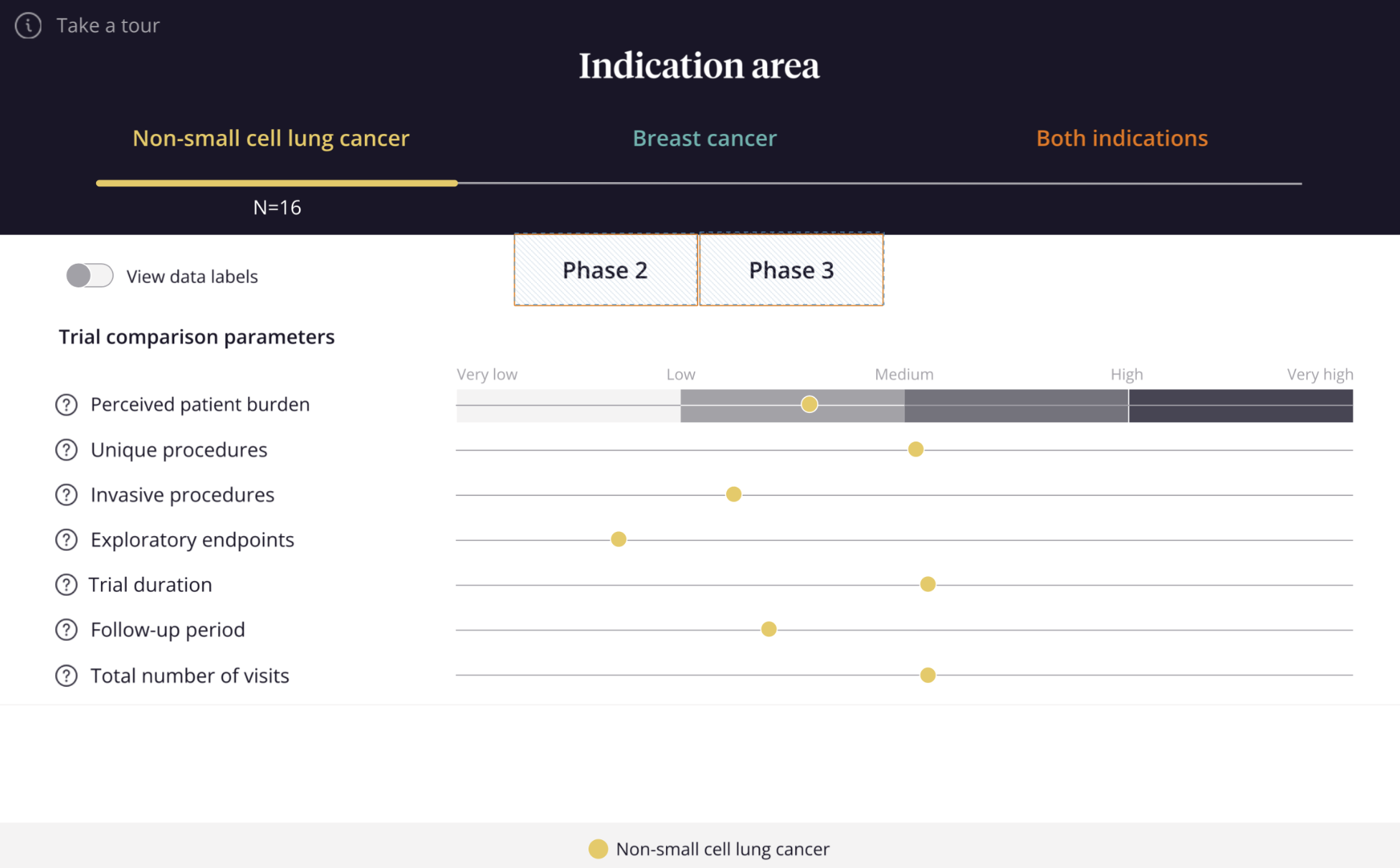
Unique procedures: Total number of procedures a patient and site will experience during the life of a trial in the most burdensome arm. Invasive procedures: Total number of invasive procedures a patient and site will take part in during a trial in the most burdensome arm. Exploratory endpoints: Total number of exploratory endpoints for each trial in the most burdensome arm. Trial duration: Per-patient cycle time, in months, from screening visit to final visit in the most burdensome arm. Follow-up period: The number of months between the final treatment to the last follow-up visit in the most burdensome arm. Total number of visits: The number of visits in the most burdensome arm. Perceived patient burden: This ZS and TCSDD-developed metric contextualizes the level of burden patients experience due to procedures during clinical trials, derived from aggregated and averaged feedback from thousands of patients, in the most burdensome arm.
Trial comparison parameters
Source: ZS protocol database
Unique procedures Total number of procedures a patient and site will experience during the life of a trial in the most burdensome arm. Invasive procedures Total number of invasive procedures a patient and site will take part in during a trial in the most burdensome arm. Exploratory endpoints Total number of exploratory endpoints for each trial in the most burdensome arm. Trial duration Per-patient cycle time, in months, from screening visit to final visit in the most burdensome arm. Follow-up period The number of months between the final treatment to the last follow-up visit in the most burdensome arm. Total number of visits The number of visits in the most burdensome arm. Perceived patient burden This ZS and TCSDD-developed metric contextualizes the level of burden patients experience due to procedures during clinical trials, derived from aggregated and averaged feedback from thousands of patients, in the most burdensome arm.
Share on linkedin
Share on Linkedin
Now, choose the trial phase for the indication.
Perceived patient burden
Start by choosing an indication area. Or choose both to see them together.
Look for the indication title to find its sample size.
Hover over each parameter to see its definition and data ranges.
Perceived patient burden – This ZS and TCSDD-developed metric contextualizes the level of burden patients experience due to procedures during clinical trials. It’s derived from aggregated and averaged feedback from thousands of patients, in the most burdensome arm. Range for perceived patient burden: 9,020-147,507
Phase 3
Phase 2
N=26
Both indications
Breast cancer
Non-small cell lung cancer
View data labels
Flip this switch to display the numerical data for each point on the chart.
Perceived patient burden – This ZS and TCSDD-developed metric contextualizes the level of burden patients experience due to procedures during clinical trials, derived from aggregated and averaged feedback from thousands of patients in the most burdensome arm. Range for perceived patient burden: 9,020-147,507 Very low to Low range: 9,020-22,196 Low to Medium range: 22,196-35,372 Medium to High range: 35,372-91,439 High to Very high range: 91,439-147,507
Start by choosing an indication area. Or choose both to compare them.
Indication area
Very high
High
Medium
Low
Very low
All indications
Breast Cancer
36
2
4
43
18
40
1
5
49
53
33
42
13
41
32
37
Total number of visits
Follow-up period
Trial duration
Exploratory endpoints
Invasive procedures
Unique procedures
Perceived patient burden
Back
How to use the interactive experience
See definitions and ranges
Now it's time to try for yourself
Next
Let's go
Use the next button to take a quick tour
Skip the tour
Learn more
Unique procedures: Total number of procedures a patient and site will experience during the life of a trial in the most burdensome arm. Range for unique procedures: 15-58
All therapy area average
N=11
Individual phase average
H
M
L
VL
VH
Individual indication area average
All phases
Take a tour
Invasive procedures: Total number of invasive procedures a patient and site will take part in during a trial in the most burdensome arm. Range for invasive procedures: 0-4
Exploratory endpoints: Total number of exploratory endpoints for each trial in the most burdensome arm. Range for exploratory endpoints: 0-14
Trial duration: Per-patient cycle time, in months, from screening visit to final visit in the most burdensome arm. Range for trial duration: 5-91
Follow-up period: The number of months between the final treatment to the last follow-up visit in the most burdensome arm. Range for follow-up period: 0-46
Total number of visits: The number of visits in the most burdensome arm. Range for total number of visits: 7-86
Perceived patient burden: This ZS and TCSDD-developed metric contextualizes the level of burden patients experience due to procedures during clinical trials, derived from aggregated and averaged feedback from thousands of patients in the most burdensome arm. Range for perceived patient burden: 9,020-147,507 Very low to Low range: 9,020-22,196 Low to Medium range: 22,196-35,372 Medium to High range: 35,372-91,439 High to Very high range: 91,439-147,507
N=16
N=15
N=10
Unique procedures Total number of procedures a patient and site will experience during the life of a trial in the most burdensome arm. Range for unique procedures: 15-58 Invasive procedures Total number of invasive procedures a patient and site will take part in during a trial in the most burdensome arm. Range for invasive procedures: 0-4 Exploratory endpoints Total number of exploratory endpoints for each trial in the most burdensome arm. Range for exploratory endpoints: 0-14 Trial duration Per-patient cycle time, in months, from screening visit to final visit in the most burdensome arm. Range for trial duration: 5-91 Follow-up period The number of months between the final treatment to the last follow-up visit in the most burdensome arm. Range for follow-up period: 0-46 Total number of visits The number of visits in the most burdensome arm. Range for total number of visits: 7-86 Perceived patient burden This ZS and TCSDD-developed metric contextualizes the level of burden patients experience due to procedures during clinical trials, derived from aggregated and averaged feedback from thousands of patients in the most burdensome arm. Range for perceived patient burden: 9,020-147,507 Very low to Low range: 9,020-22,196 Low to Medium range: 22,196-35,372 Medium to High range: 35,372-91,439 High to Very high range: 91,439-147,507
Total number of visits – The number of visits in the most burdensome arm. Range for total number of visits: 7-86
Follow-up period – The number of months between the final treatment to the last follow-up visit in the most burdensome arm. Range for follow-up period: 0-46
Trial duration – Per-patient cycle time, in months, from screening visit to final visit in the most burdensome arm. Range for trial duration: 5-91
Exploratory endpoints – Total number of exploratory endpoints for each trial in the most burdensome arm. Range for exploratory endpoints: 0-14
Invasive procedures – Total number of invasive procedures a patient and site will take part in during a trial in the most burdensome arm. Range for invasive procedures: 0-4
Unique procedures – Total number of procedures a patient and site will experience during the life of a trial in the most burdensome arm. Range for unique procedures: 15-58
Overall complexity score
Perceived patient burden – This ZS and TCSDD-developed metric contextualizes the level of burden patients experience due to procedures during clinical trials, derived from aggregated and averaged feedback from thousands of patients, in the most burdensome arm. Range for perceived patient burden: 9,020-147,507 VL-L lies in the range: 9,020-31,106; L-M: 31,106-53,192; M-H: 53,192-100,349; H-VH: 100,349-147,507